




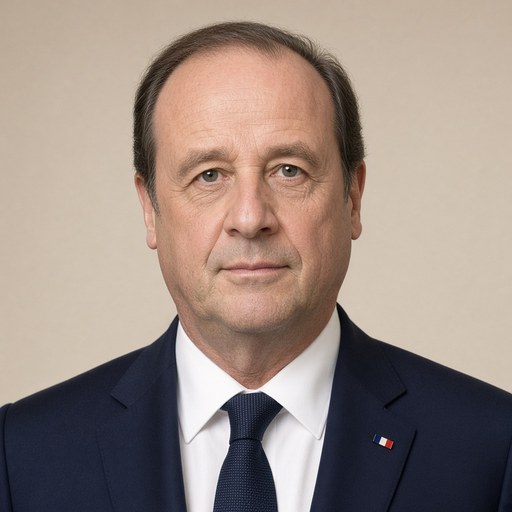
Statement by Mr. François Hollande, President of the Republic, on efforts in favor of palliative care, in Rueil Malmaison on July 17, 2012.
 François Hollande · President of France
- Context
- Hollande addressed staff and officials at the Maison du Lac in Rueil-Malmaison on July 17, 2012, to announce commitments to expanding palliative care in France.
- Main themes
- Palliative care development, dignity at end of life, relief of suffering, accompaniment of dying patients, support for caregivers and families, expansion of palliative care capacity, home-based end-of-life care, national solidarity, role of the state in healthcare
- Duration
- ~17 min
- Words
- 2,054
- Sentences
- 103
- Readability
- 52
- Grade
- 11.0
- Syntax
- 2.91
- Vocabulary
- 2.07
Translated from French
The broad sphere of national life a sentence belongs to. Every sentence has an Arena, so it is the denominator the other indices are read against.
Other103 sentences in 36 paragraphs
Mr. President of the Foundation,
Madam Director of the Maison du Lac,
Mr. Deputy Mayor,
Thank you for welcoming us here in this beautiful establishment that honors those who are received here and those who work here.
I come as President of the Republic, aware that we have a duty towards fragile individuals, those who are said to be at the end of life. I am accompanied by two ministers, the Minister of Social Affairs and Health and the Minister of Autonomy, which is the name we have chosen to give to the situations we must address.
I am accompanied by the director of the Regional Health Agency and by Mr. Prefect and also, and I am very pleased, by the president of the National Consultative Ethics Committee.
I greet the doctors, all the healthcare and administrative staff who are here. I also have a thought for the patients I could not meet, for their families, for the associations that come to give a little time through volunteers, to support families or accompany residents.
You have brought us great joy by welcoming us here, the joy of receiving testimonies, of having through these visits confirmation that you can provide, until the last moment of life, an exchange, care, a quality of relationship that allows each person received here to be regarded as a human being.
For the question you ask yourselves every day is how to offer a dignified life to each person? How to live until the end? By giving every moment a meaning, every day a value, every exchange a content, every gesture a warmth. And ultimately, to each person an identity. How to live with dignity until the end? How to ensure the end of one's existence? These are questions that occupy you and that are also posed to all public officials.
You bring a lot of serenity to your work, a lot of calm to your interventions, a lot of patience to the relationship you establish, and that is why today I wanted to mark as a commitment, that of palliative care. We have three convictions to affirm the necessity of developing palliative care.
The first conviction is our duty to spare, as much as possible, the suffering of all patients. For too long, so many dogmas, so many doctrines have sought to justify suffering, as if suffering allowed for better healing, as if there was a necessity for the patient to struggle, to suffer in order to access healing. That time is over.
You have been able to dominate suffering and allow that, by relieving, we are better. That is the new doctrine of palliative care.
The second conviction we all share is the need for every person who is living their last days to be accompanied until the very last moment, especially since these last days can be the last months or the last years. The feeling of being surrounded, understood, heard, respected, the word has come back several times, can allow one to go through these moments as a part of our life, a part full of an entire life.
The third conviction we share is the necessity for caregivers, that is, for families or for those who accompany another person, to be helped, to be supported in the ordeal of facing a loved one who is gradually losing their independence and sometimes their lucidity. It is a trial for the person who experiences this evolution, it is a suffering for families. And so, palliative care is also care for the entourage since it helps to preserve them from loneliness. It offers a framework, provides support and interlocutors to better understand, to better share.
These are the objectives we have set based on these three convictions that palliative care is a progress, an evolution not only necessary but desirable towards an improvement of care. The number of palliative care units has greatly increased over the past 10 years in France, and there are now nearly 5,000 identified beds for this type of care. But while this is twenty times more than in 2001, it is still very insufficient. Two-thirds of people who die from illness could benefit from palliative care, and we are very far from granting them this possibility. We must make up for this delay and do so in a way that takes into account the diversity of situations, services, and territories. But it is important not to reduce the issue simply to the number of beds because the end of life also takes place outside of hospital services. And indeed, many people who require palliative care want to live their last days at home. The end of life is therefore hospitalization when necessary, reception in an establishment as excellent as this one, but it is also day hospitals, and you will soon have a service that will open for this purpose, and finally, care provided at home or in structures for the elderly.
I therefore wish, and I commit to it, that we develop the diversity of palliative care offerings. This is the idea I have of the role of the State and national solidarity, to work in the service of the French people, particularly the most fragile and the weakest. To ensure autonomy, to allow for financial responses to be provided for dependency. This will be a reform that will be initiated in the coming months. It is a duty, a duty of solidarity between generations. It is also a duty towards the sick. It is at the moment when they may doubt their own future that we must ensure the presence of the community alongside them.
Of course, palliative care has a cost, and the question of financial coverage cannot be overlooked, but I also indicated to the professionals that palliative care is also an investment. It may seem paradoxical to invest in the last moments of life. And yet, if we allow people to live better, if we avoid a number of even more costly hospitalizations or unnecessary interventions, we have actually taken a preventive action, while also improving comfort and care, and that is why we must have a financial evaluation that highlights, alongside the additional costs, the savings that can be induced.
I therefore ask the Minister of Social Affairs and Health that reflections be conducted to move, whenever necessary, to a global pricing system so that these services remain affordable for all families.
But the development of palliative care also requires another prerequisite, which is training. Accompanying a person at the end of life cannot be improvised. And doctors can undergo long studies without always having the necessary training to address these situations. And medical staff, healthcare staff, administrative staff, ultimately have a very rich experience that they can pass on to these young doctors who are now alongside them. Therefore, we will ensure to multiply training and prepare all staff to provide the best possible care.
Progress has indeed been made on this point. An order dated July 20, 2011, now includes palliative care among the priority teaching themes in medical training. We will ensure that these provisions are fully applied.
But we must take two steps, that is to say, first, to make the training of healthcare personnel in palliative care systematic. And the second step, which is already largely engaged here, is to develop the multidisciplinary nature of this training. To mutually enrich all professionals through the action or experience of other professional sectors that are not always care sectors.
Palliative care is not the monopoly of doctors, and while medical science occupies an essential place, we must place alongside all techniques, all contributions from other sciences, psychology, sociology, and even culture to avoid reducing the end of life to a situation addressed solely on a clinical level.
In our universities, there will also be a need to develop research in palliative care because we can still learn a lot from what is being done, especially in places like this. And we will ensure that funding is dedicated to this research.
None of this will happen mechanically, naturally. It will require evolving minds, habits, and showing a firm commitment from the State.
We must also address the most painful subject, which is the right to die with dignity. I would say the right to live with dignity. Because it is the fundamental right to allow each person to fully live their life. I hear and respect the consciences and voices, particularly from spiritual authorities, who affirm this essential, respectable principle that every moment of a deserved life is worth living.
But anyone who has seen a loved one die in terrible physical and moral suffering will know what I am talking about. There comes a time when the breath of life seems to express only the wish to die. It is not for the community to decide this moment, to define or determine it. But it is for it to recognize that it exists. When there is no longer any way out, when the pain is too great, the only question that arises is how long after how much suffering, how much time of trials, death will occur.
The so-called "Léonetti" law of April 22, 2005, already authorizes, and this is a great progress, any sick person to refuse a treatment they deem unreasonable. It also gives the doctor the right to interrupt or not undertake treatments they deem unnecessary. There is therefore no longer, in France at the moment I speak, any legitimization of therapeutic obstinacy. And it is essential that all patients and all families know this: this right exists. And we will do everything possible to make the rights already provided for in our laws as clear as possible. Similarly, we must apply all elements of this so-called "Léonetti" legislation, particularly palliative care. Because the more palliative care beds there are, the more diverse the care offerings will be, the better life will be accompanied.
Should we, can we go further in exceptional cases where therapeutic abstention is not enough to relieve patients suffering from irreversible pain? And which calls for a medical act assumed at the end of a shared and thoughtful decision? To pose this question is to open a perspective that itself leads to a debate. And the questions are numerous:
At what point can the outcome be considered fatal?
How to assess the unbearable nature of a pain?
How to obtain the consent of a patient? And if it cannot be obtained, on what other basis can this decision be made? The debate deserves to be engaged. It must be conducted in calm, refusing caricatures, controversies, and battles. It is a noble and dignified debate.
A work of reflection, information, and consultation will therefore be conducted, and I have entrusted the mission of leading this work to Professor Didier SICARD, who is present here, Honorary President of the National Consultative Ethics Committee.
Based on the proposals he will present to me, the National Consultative Ethics Committee will be seized and will be able to deliberate within the framework of its attributions and missions.
This, ladies and gentlemen, is the message I came to convey. That is to say, first of all, the recognition of a work that is carried out in institutions like this one, in homes like yours. Work that is carried out by highly qualified professionals, dedicated, dignified staff who deserve the full consideration of the Nation.
I also wanted to tell the doctors who are here how much we support their approach, how much we call for interdisciplinary work, and how proud you can be of the action you are taking. You offer one of the most beautiful testimonies there is, that of allowing every human being to remain dignified at every moment of their existence. That is why you can count on the support and commitment of the State, and you have given us this morning the most beautiful gift. That of offering us a lesson in life, a lesson in happiness, the happiness of seeing happy patients. The happiness of seeing staff happy to make others happy, and if we could make this lesson in life a lesson for society, and give a little more happiness to everyone, we would have fulfilled our mission in our respective places.
Thank you for this lesson.
The original French. The tags above are read on the English translation's sentences.
Monsieur le Président de la Fondation,
Madame la Directrice de la Maison du Lac,
Monsieur le Député-maire,
Merci de nous accueillir ici dans ce bel établissement qui fait honneur à celles et ceux qui y sont accueillis et à celles et ceux qui y travaillent.
Je viens comme Président de la République, conscient que nous avons un devoir à l'égard des personnes fragiles, des personnes que l'on dit en fin de vie. Je suis accompagné par deux ministres, la ministre des affaires sociales et de la santé et la ministre aussi de l'autonomie, qui est le nom que nous avons voulu donner justement à ces situations que nous devons traiter.
Je suis accompagné par le directeur de l'Agence régionale de santé et par Monsieur le préfet et aussi, et j'en suis très heureux, par le président du conseil consultatif national d'Ethique.
Je salue les médecins, l'ensemble des personnels soignants et administratifs qui sont ici. J'ai également une pensée pour les patients que je n'ai pas pu tous rencontrer, pour leur famille, pour les associations qui viennent donner un peu de temps à travers des bénévoles, pour accompagner les familles ou accompagner les résidents.
Vous nous avez fait un grand bonheur en nous accueillant ici, le bonheur de recevoir des témoignages, d'avoir aussi à travers ces visites confirmation que vous pouviez donner jusqu'au dernier moment de la vie, un échange, un soin, une qualité de relation qui permettent à chaque personne reçue ici d'être considérée comme une personne humaine.
Car la question que vous vous posez chaque jour qui passe, c'est comment offrir encore une vie digne à chacun ? Comment vivre jusqu'au bout ? En donnant à chaque instant un sens, à chaque jour une valeur, à chaque échange un contenu, à chaque geste, une chaleur. Et en définitive à chaque personne une identité. Comment vivre dignement jusqu'au bout ? Comment assurer la fin de son existence ? Voilà des questions qui vous habitent et qui sont aussi posées à l'ensemble des responsables publics.
Vous donnez beaucoup de sérénité à votre travail, beaucoup de calme à vos interventions, beaucoup de patience à cette relation que vous établissez et c'est ce qui fait, qu'aujourd'hui je voulais marquer comme engagement, celui des soins palliatifs. Nous avons trois convictions pour affirmer la nécessité de développer les soins palliatifs.
La première conviction c'est notre devoir d'épargner dans toute la mesure du possible la souffrance à tous les malades. Pendant trop longtemps tant de dogmes, tant de doctrines ont voulu justifier la souffrance, comme si souffrir permettait de mieux soigner, comme si il y avait pour le malade nécessité à peiner, à éprouver pour pouvoir accéder à la guérison. Ce temps-là est terminé.
Vous avez été capables de dominer la souffrance et de permettre que, en soulageant, nous soyons mieux. C'est ça la doctrine nouvelle des soins palliatifs.
La seconde conviction que nous partageons tous c'est le besoin pour toute personne qui vit ses derniers jours, d'être accompagnée jusqu'au dernier moment surtout que ces derniers jours peuvent être des derniers mois ou des dernières années. Le fait de se sentir entouré, compris, entendu, respecté, le mot est revenu plusieurs fois, peut permettre de traverser ces moments comme une partie de notre vie, une partie pleine d'une vie entière.
La troisième conviction que nous partageons c'est la nécessité pour les aidants, c'est-à-dire pour les familles ou pour les personnes qui accompagnent une personne autre, d'être aidées, d'être soutenues dans l'épreuve qui consiste à faire face à un être cher qui perd peu à peu son indépendance et parfois sa lucidité. C'est une épreuve pour la personne qui connaît cette évolution, c'est une souffrance pour les familles. Et donc, ces soins palliatifs, ce sont aussi des soins pour l'entourage puisqu'ils permettent de se préserver de la solitude. Ils offrent un cadre, fournissent des appuis et des interlocuteurs pour mieux comprendre, pour mieux partager.
Tels sont les objectifs que nous nous sommes fixés à partir de ces trois convictions que les soins palliatifs sont un progrès, sont une évolution non seulement nécessaire mais souhaitable vers une amélioration du soin. Le nombre d'unités de soins palliatifs a beaucoup progressé depuis 10 ans en France, et il y a aujourd'hui près de 5 000 lits identifiés pour des prises en charge de ce type. Mais si c'est vingt fois plus qu'en 2001, c'est encore très insuffisant. Deux tiers des personnes qui meurent de maladie pourraient relever de soins palliatifs et nous sommes très loin de leur accorder cette possibilité. Nous devons combler ce retard et le faire d'une façon qui tienne compte de la diversité des situations, des services, des territoires. Mais il importe de ne pas réduire l'enjeu simplement au nombre de lits car la fin de vie se déroule aussi ailleurs que dans les services hospitaliers. Et d'ailleurs beaucoup de personnes qui relèvent de soins palliatifs veulent vivre leurs derniers jours à leur domicile. La fin de vie c'est donc l'hospitalisation lorsqu'elle est nécessaire, l'accueil dans une maison aussi excellente que celle-ci mais c'est aussi l'hôpital de jour et vous allez avoir un service qui va bientôt s'ouvrir à cette fin et ce sont enfin des soins qui sont apportés au domicile ou dans des structures pour personnes âgées.
Je souhaite donc, et j'en prends l'engagement, que nous développions la diversité de l'offre de soins palliatifs. Telle est l'idée que je me fais du rôle de l'Etat et de la solidarité nationale, travailler au service des Français, en particulier des plus fragiles et des plus faibles. Veiller à l'autonomie, permettre qu'il y ait sur le plan financier des réponses qui soient apportées à la dépendance. Ce sera une réforme qui sera engagée dans les prochains mois. C'est un devoir, un devoir de solidarité entre générations. C'est un devoir également à l'égard des malades. C'est au moment où ils peuvent douter de leur propre avenir que nous devons assurer une présence de la collectivité auprès d'eux.
Bien sûr, les soins palliatifs ont un coût et la question de la prise en charge financière ne peut pas être éludée mais j'indiquais aussi auprès des professionnels que les soins palliatifs c'est aussi un investissement. Cela peut paraître paradoxal, investir sur les derniers moments de la vie. Et pourtant si on permet à des personnes de vivre mieux, si on évite un certain nombre d'hospitalisations plus coûteuses encore ou des interventions inutiles, nous avons fait en réalité un acte de prévention, en améliorant en plus le confort et le soin et c'est la raison pour laquelle nous devons avoir une évaluation financière qui mettent en avant à côté des charges supplémentaires, les économies qui peuvent être induites.
Je demande donc à la ministre des affaires sociales et la santé que des réflexions puissent être conduites pour passer chaque fois que cela sera nécessaire, à un système global de tarification afin que ces prestations restent abordables pour toutes les familles.
Mais le développement des soins palliatifs suppose également un autre préalable, c'est la formation. Accompagner une personne en fin de vie ne s'improvise pas. Et des médecins peuvent faire des études longues, sans aujourd'hui avoir toujours les formations nécessaires pour aborder ces situations. Et les personnels médicaux, les personnels soignants, les personnels administratifs, finalement ont une expérience très riche, qu'ils peuvent transmettre d'ailleurs à ces jeunes médecins qui aujourd'hui sont auprès d'eux. Donc nous ferons en sorte de multiplier les formations et de préparer tous les personnels à assurer de la meilleure des façons les soins qui peuvent être prodigués.
Des progrès ont d'ailleurs été réalisés sur ce point. Un arrêté du 20 juillet 2011 inscrit désormais les soins palliatifs parmi les thèmes d'enseignement jugés prioritaires dans la formation des médecins. Nous veillerons à ce qu'il y ait une pleine application de ces dispositions.
Mais nous devons franchir deux étapes, c'est-à-dire d'abord rendre systématique la formation des personnels de santé aux soins palliatifs. Et la deuxième étape qui est d'ailleurs largement engagée ici, c'est de développer le caractère pluridisciplinaire de cette formation. Enrichir mutuellement tous les professionnels par l'action ou par l'expérience d'autres secteurs professionnels qui ne sont pas toujours des secteurs de soin.
Les soins palliatifs ne sont pas le monopole des médecins et si la science médicale y occupe une place essentielle, nous devons mettre côte à côte toutes les techniques, tous les apports d'autres sciences, de la psychologie, de la sociologie et même de la culture pour permettre d'éviter de réduire la fin de vie à une situation abordée sur le seul plan clinique.
Dans nos universités, il y aura également nécessité de développer la recherche en soins palliatifs car nous pouvons encore beaucoup apprendre de ce qui se fait et notamment dans des lieux comme cela. Et nous veillerons à ce que des financements soient dédiés à cette recherche.
Rien de tout cela ne se fera mécaniquement, naturellement. Il faudra faire évoluer les esprits, les habitudes et montrer un engagement ferme de la part de l'Etat.
Nous devons aussi aborder le sujet le plus douloureux qui soit qui est celui du droit à mourir dans la dignité. J'allais dire du droit à vivre dans la dignité. Car c'est le droit fondamental qui est celui de permettre à chacune et à chacun de vivre pleinement sa vie. J'entends et je respecte les consciences et les voix, venues notamment des autorités spirituelles qui affirment ce principe essentiel, respectable, selon lequel tout instant de vie méritée d'être vécu.
Mais quiconque a vu un proche mourir dans de terribles souffrances physiques, morales, saura de quoi je parle. Il arrive parfois un moment où le souffle de la vie ne semble plus exprimer que le souhait de mourir. Ce n'est pas à la collectivité de décider de ce moment, de le définir ou de le déterminer. Mais c'est à elle de reconnaître qu'il existe. Lorsqu'il n'y a plus aucune issue, lorsque la douleur est trop forte, la seule question qui se pose est de savoir après combien de souffrances, combien de temps d'épreuves, la mort surviendra.
La loi dite « Léonetti » du 22 avril 2005 autorise déjà et c'est un grand progrès, toute personne malade à refuser un traitement dont elle estime qu'il est devenu déraisonnable. Elle donne aussi au médecin le droit d'interrompre ou de ne pas entreprendre les traitements qu'il estime inutiles. Il n'y a donc plus en France au moment où je parle de légitimation de l'acharnement thérapeutique. Et il faut que tous les malades et toutes les familles le sachent : ce droit existe. Et nous ferons tout ce qu'il sera possible de faire pour rendre aussi clair que possible les droits qui sont déjà prévus dans nos lois. De la même manière, nous devons appliquer tous les éléments de cette législation dite « Léonetti » et notamment les soins palliatifs. Car plus nombreux seront les lits de soins palliatifs, plus diverse sera l'offre de soins, meilleure sera accompagnée la vie.
Faut-il, peut-on aller plus loin dans les cas exceptionnels où l'abstention thérapeutique ne suffit pas à soulager des patients aux prises avec une douleur irréversible ? Et qui appelle un acte médical assumé au terme d'une décision partagée et réfléchie ? Poser cette question, c'est ouvrir une perspective qui elle-même entraîne un débat. Et les questions sont multiples :
A quel moment l'issue peut-elle être considérée comme fatale ?
Comment évaluer le caractère insupportable d'une douleur ?
Comment recueillir le consentement d'un patient ? Et s'il ne peut être obtenu, sur quel autre fondement peut-on prendre cette décision ? Le débat mérite d'être engagé. Il doit se faire dans l'apaisement, en refusant les caricatures, les polémiques et les batailles. C'est un débat noble et digne.
Un travail de réflexion, d'information, de concertation sera donc conduit et j'ai confié la mission de mener ce travail au Professeur Didier SICARD, ici présent, Président d'honneur du Comité consultatif national d'éthique.
A partir des propositions qu'il me présentera, le Comité consultatif national d'éthique sera saisi et pourra délibérer dans le cadre de ses attributions et de ses missions.
Voilà Mesdames et Messieurs le message que j'étais venu porter. C'est-à-dire d'abord celui de la reconnaissance d'un travail qui est mené dans des institutions comme celle-ci, des maisons comme les vôtres. Travail qui est assumé par des professionnels de grande qualité, des personnels dévoués, dignes, qui méritent toute la considération de la Nation.
Je voulais aussi dire aux médecins qui sont là, combien nous soutenons leur démarche, combien nous appelons à un travail interdisciplinaire et combien vous pouvez être fiers de l'action que vous menez. Vous offrez l'un des plus beaux témoignages qui soit, celui de permettre à chaque être humain de rester digne, à tout moment de son existence. C'est pourquoi vous pouvez compter sur le soutien et l'engagement de l'Etat et vous nous avez fait ce matin le plus beau des cadeaux. Celui de nous offrir une leçon de vie, une leçon de bonheur, le bonheur de voir des malades heureux. Le bonheur de voir des personnels heureux de rendre heureux et si nous pouvions faire que cette leçon de vie soit une leçon de société, et donner un peu plus de bonheur à chacun, nous aurions à nos places respectives rempli notre mission.
Merci pour cette leçon.