




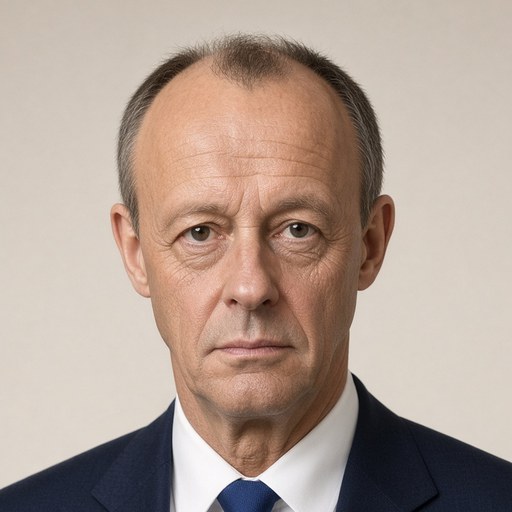
Speech by Chancellor Merz at the inauguration of the supercomputer JUPITER A supercomputer for the future
 Friedrich Merz · Chancellor of Germany
- Context
- Merz addressed the inauguration ceremony of the JUPITER supercomputer at the Jülich Research Center in Germany on 5 September 2025.
- Main themes
- Supercomputer JUPITER inauguration, European AI leadership, computing sovereignty, artificial intelligence decade, exascale computing, Germany as AI nation, AI gigafactories in Europe, quantum computing, research and innovation, transatlantic and Sino-American AI competition, scientific progress, industrial competitiveness
- Duration
- ~13 min
- Words
- 1,617
- Sentences
- 78
- Readability
- 39
- Grade
- 12.9
- Syntax
- 3.14
- Vocabulary
- 2.24
Translated from German
The broad sphere of national life a sentence belongs to. Every sentence has an Arena, so it is the denominator the other indices are read against.
Other78 sentences in 26 paragraphs
Dear Professor Lambrecht,
dear Professor Lippert, Professor Michielsen,
Mr. Minister-President,
dear colleagues from the state government and the federal government,
dear colleagues from the European Parliament, the German Bundestag, and the North Rhine-Westphalian State Parliament,
Excellencies,
ladies and gentlemen,
exactly 48 years ago today, the spacecraft Voyager 1 was launched from Cape Canaveral in the United States, under the watchful eyes of the world public, on its way to Jupiter. It is a technological and scientific breakthrough and the starting signal for new scientific progress. It is a historic pioneering project.
It is pure coincidence that we are inaugurating JUPITER in Jülich on this anniversary day – but a coincidence of great symbolic significance. JUPITER – as you mentioned, Professor Lambrecht – will soon exceed the Exascale benchmark. This means: It will be capable of performing more than one trillion calculations per second. To help us visualize this: That is as much as about ten million conventional laptops at the same second. If we were to stack these laptops, they would form a pile 300 kilometers high.
Ladies and gentlemen, this makes clear the dimension of what we are witnessing here today. JUPITER is the first European supercomputer and the first outside the United States to demonstrably reach this level. It is one of the four fastest computers in the world – as you said – and it is now operational in Germany. This means that today we are collectively witnessing a historic European pioneering project: JUPITER – "Joint Undertaking Pioneer for Innovative and Transformative Exascale Research." The name is indeed the program.
I would like to begin by saying, ladies and gentlemen: Thank you very much to all those who have made this pioneering achievement possible up to today and here, who have managed to build JUPITER in the record time of two years you mentioned and to put it into operation today; foremost the researchers, the staff at the Jülich Research Center, and especially at the Jülich Supercomputing Center; the employees of the participating companies ParTec and Eviden, as well as the project manager EuroHPC. They have laid the groundwork for the innovations that this supercomputer will now make possible, many of which we probably cannot even imagine today. This is indicated by the technological leaps that have been achieved in recent years, especially in the field of quantum computing and artificial intelligence. It is very likely that in retrospect, we will regard the 2020s as the AI decade of our time.
Playing a significant, shaping role in this technological revolution – that must be our aspiration in Germany, as a long-standing scientific nation, but also as an industrial nation, to participate in a leading role. We have written this in our coalition agreement and summed it up in a simple sentence: We want Germany to become an AI nation. Not alone, but especially with today’s date, many signs indicate that the competitiveness of our country, as well as our technological sovereignty, depends on whether and how we succeed in this.
At the moment, the United States of America and the People's Republic of China are in a neck-and-neck race for future market shares in an AI-driven global economy. But we in Germany and Europe have every chance to catch up and then keep pace:
We are strong in AI research. We have world-leading research institutions; we are currently in one of them. We have globally respected universities. We have dynamic and successful AI start-ups, such as DeepL in the field of machine translation, Black Forest Labs in the field of image generation, and Helsing in the field of security and defense.
Already now, we have an excellently positioned computing landscape for research, which has become even better with today’s date. I have learned that with JUPITER alone, we will see the computing power available for AI in Germany increase by a factor of 20 today. That we do not relent in this, ladies and gentlemen, is a key task for the coming years. We need sovereign computing capacities in Germany and Europe that are on par with international competitors. This is a matter of competitiveness as well as the security of our country. That is why this must now be a high priority.
The European Commission – we are pleased to have you with us, Commissioner – has announced the establishment of up to five AI gigafactories in Europe this spring. I want to say very clearly from this podium: Let’s bring at least one of them to Germany! A number of very powerful consortia from Germany have already expressed their interest in Brussels. The Jülich Research Center is prominently involved. If the consortium partners now pool their approaches, the prospects are very good that we can prevail against strong European competition; after all, we have a long and strong tradition when it comes to building world-class machines. A few weeks ago, Jensen Huang, the head of Nvidia, told me during a visit to the Chancellery in Berlin: "You can do machine building in Germany; because you can achieve perfection." You can also apply that to the construction of data centers, the construction of gigafactories.
That is exactly how we must approach it: linking our core competencies – mechanical engineering, robotics, automotive and chemical industries, cleantech, medicine, etc. – with AI research. Then we can and will, as an industrial nation, play a leading role again and for a long time. JUPITER is an impressive proof that it is possible. I am sure many more proofs will follow.
In this sense, we will also proceed ambitiously in the federal government to strengthen Germany as a technology location. On July 30, we adopted a high-tech agenda in the federal cabinet. We will implement it, starting this autumn, under the leadership of the newly established Ministry for Research, Technology, and Space, under the responsibility of the Federal Minister Dorothee Bär, step by step in close exchange with the states and our European partners.
This goes hand in hand with a whole bundle of measures to strengthen our research and innovation landscape. I will mention just a few: We will relieve the innovation actors in our country from unnecessary funding bureaucracy. We have not established an independent Ministry for Digitalization and State Modernization in our country without reason, which has all the necessary competencies. I am very pleased that the responsible Federal Minister, Karsten Wildberger, is not only with us today but is also taking the time to celebrate his birthday with us, dear Karsten Wildberger.
We are working on opening and experimentation clauses. We are working on real laboratories. We are working on new financing instruments for research and development. We are working on strengthening the German venture capital market. And we will improve the framework conditions for science and research overall, so that we can attract the best minds to Germany and, above all, keep them in Germany. You all know, ladies and gentlemen: As impressive as JUPITER is as a technical facility – without the people who operate it, who develop it, and who use it for their brilliant ideas, this facility would not be worth much.
Therefore, let me address you, the employees here at the Jülich Research Center, and all those who have contributed to making this celebration possible today: Your passion and your excellence move our country forward. You deserve not only appreciation on a day like today but also excellent career prospects and excellent research infrastructures in Germany. We are working on that, and we want that.
I want us to implement all of this with the greatest ambitions: the federal government in close cooperation with the states, but also with the European Union – I want to particularly emphasize, especially in this area, the close collaboration with our French neighbors, who are very interested in advancing these topics together with us – but also with partners from science and research, from business and administration. JUPITER is an example of how this partnership can work and what can emerge from it: genuine pioneering work, technological and scientific progress that ideally radiates out to our entire society.
Ladies and gentlemen, your work here at the Jülich Research Center is also proof of what we already know, namely proof of how much future potential lies in our country, how innovative and how adaptable our free and open society truly is.
It is therefore also my deepest personal conviction: The world around us may be changing profoundly at a rapid pace. We, in Germany and in Europe, can nevertheless face this epochal shift with all confidence and also help shape it. That is what Europe stands for, above all the European Union. Europe stands for free science, for open markets with market-based competition. Europe stands for a spirit of innovation that is always tied to the will to truly make things better, and ideally not just for us, but for humanity as a whole.
If you, ladies and gentlemen, continue to work at this level in this sense, if we in politics at the national and European level, also at the level of the federal and state governments, continue together to set the right priorities – on technological sovereignty, on freedom of innovation, on freedom of science, on companies and their competitiveness – then we have every chance and every opportunity for the future to be economically good and even better for us in Germany and in Europe.
In this sense, Professor Lambrecht, we accompany what is being demonstrated and technologically achieved here today with the greatest curiosity. We accompany what you personally do and how you are committed to this innovation with the greatest sympathy. Wishing you and your employees much success!
The original German. The tags above are read on the English translation's sentences.
Sehr geehrte Frau Prof. Lambrecht,
sehr geehrter Herr Prof. Lippert, Frau Prof. Michielsen,
Herr Ministerpräsident,
liebe Kolleginnen und Kollegen aus der Landesregierung und aus der Bundesregierung,
liebe Kolleginnen und Kollegen aus dem Europäischen Parlament, dem Deutschen Bundestag und dem nordrhein-westfälischen Landtag,
Exzellenzen,
meine sehr geehrten Damen und Herren,
auf den Tag heute vor genau 48 Jahren startet im
US
-amerikanischen
Cape Canaveral
unter den Augen der Weltöffentlichkeit die Raumsonde Voyager 1 Richtung Jupiter. Es ist ein technologischer und ein wissenschaftlicher Durchbruch und der Startschuss für neuen wissenschaftlichen Fortschritt. Es ist ein historisches Pionierprojekt.
Es ist ein reiner Zufall, dass wir gerade an diesem Jubiläumstag JUPITER in Jülich einweihen
–
aber ein Zufall von doch großer Symbolkraft. JUPITER
– Sie haben es gesagt, Frau Prof. Lambrecht –
wird in Kürze die
Exascale-Benchmar
k überschreiten. Das bedeutet: Er wird in der Lage sein, mehr als eine Trillion Rechenoperationen pro Sekunde zu erbringen. Damit wir es uns vorstellen können: Das ist so viel wie etwa zehn Millionen herkömmlicher Laptops zur selben Sekunde. Zusammengeklappt ergäben diese Laptops einen Stapel von 300 Kilometer Höhe.
Meine Damen und Herren, damit wird die Dimension dessen deutlich, was wir hier heute miterleben dürfen. JUPITER ist der erste europäische Supercomputer und der erste außerhalb der
USA
, der nachweislich dieses Level erreicht. Er ist einer der vier schnellsten Rechner der Welt
– Sie haben es gesagt –
, und er steht ab heute in Deutschland. Das heißt, wir sind heute gemeinsam Zeitzeugen eines historischen europäischen Pionierprojekts: JUPITER
–
„
Joint Undertaking Pioneer for Innovative and Transformative Exascale Research
“. Der Name ist genau das Programm.
Ich möchte gleich zu Beginn sagen, meine Damen und Herren: Herzlichen Dank all denen, die diese Pionierleistung bis heute und hierher möglich gemacht haben, die es fertiggebracht haben, JUPITER in der von Ihnen auch genannten Rekordzeit von zwei Jahren aufzubauen und heute in Betrieb zu nehmen; zuvorderst den Forscherinnen und Forschern, den Mitarbeiterinnen und Mitarbeitern am Forschungszentrum Jülich und hier vor allem am Jülich
Supercomputing Center
; den Mitarbeiterinnen und Mitarbeitern der beteiligten Unternehmen ParTec und Eviden sowie des Projektsteuerers EuroHPC. Sie haben die Weichen gestellt für die Innovationen, die durch diesen Supercomputer jetzt erst möglich werden und die wir uns heute zum großen Teil wahrscheinlich noch gar nicht vorstellen können. Darauf deuten jedenfalls die technologischen Sprünge hin, die in den vergangenen Jahren erreicht worden sind, vor allem im Bereich des Quantencomputing und im Bereich künstlicher Intelligenz. Es ist sehr gut möglich, dass wir im Rückblick eines Tages die 20er-Jahre des 21. Jahrhunderts als das
KI
-Jahrzehnt unserer Zeit gelten lassen werden.
Eine ganz wesentliche, gestaltende Rolle zu spielen in dieser technologischen Revolution – das muss unser Anspruch an uns selbst in Deutschland sein, als traditionsreiche Wissenschaftsnation, aber auch als Industrienation, und zwar teilzuhaben in führender Rolle
. Wir haben das in unserem Koalitionsvertrag auch so aufgeschrieben und es auf einen einfachen Satz gebracht: Wir wollen, dass Deutschland
KI
-Nation wird. Nicht allein, aber ganz besonders mit dem heutigen Tag deutet vieles darauf hin,
dass die Wettbewerbsfähigkeit unseres Landes, dass aber auch unsere technologische Souveränität davon abhängt, ob und dass uns das gelingt.
Im Augenblick liefern sich die Vereinigten Staaten von Amerika und die Volksrepublik China ein Kopf-an-Kopf-Rennen im Wettbewerb um künftige Marktanteile in einer
KI
-gestützten Weltwirtschaft. Aber wir in Deutschland und Europa haben alle Chancen aufzuholen und dann mitzuhalten:
Wir sind
stark in der
KI
-Forschung. Wir haben weltweit führende Forschungseinrichtungen; in einer davon sitzen wir gerade. Wir haben weltweit angesehene Universitäten. Wir haben dynamische und erfolgreiche
KI
-Start-ups, zum Beispiel DeepL im Bereich der maschinellen Übersetzung, zum Beispiel Black Forest Labs im Bereich der Bilderzeugung, zum Beispiel Helsing im Bereich der Sicherheit und Verteidigung.
Bereits jetzt haben wir eine für die Forschung exzellent aufgestellte Rechnerlandschaft, die mit dem heutigen Tag noch einmal besser geworden ist. Ich habe gelernt, dass wir allein mit JUPITER die in Deutschland für
KI
verfügbare Rechenleistung heute um das 20-Fache gesteigert sehen werden. Dass wir hier nicht nachlassen, meine Damen und Herren, ist eine Schlüsselaufgabe für die nächsten Jahre. Wir brauchen in Deutschland und in Europa insgesamt souveräne Rechenkapazitäten auf dem Niveau der internationalen Wettbewerber. Das ist eine Frage der Wettbewerbsfähigkeit genauso wie der Sicherheit unseres Landes. Genau deshalb muss das jetzt eine hohe Priorität haben.
Die Europäische Kommission
– wir freuen uns, dass Sie bei uns sind, Frau Kommissarin –
hat darum
–
viele von Ihnen hier werden das wissen
–
im Frühjahr den Aufbau von bis zu fünf
AI Gigafactories
in Europa angekündigt. Ich will es sehr deutlich und sehr klar von dieser Stelle aus sagen: Holen wir uns mindestens eine davon nach Deutschland! Eine Reihe von sehr leistungsstarken Konsortien aus Deutschland hat sich auf den Weg gemacht und ihr Interesse in Brüssel bereits bekundet. Das Forschungszentrum Jülich ist prominent beteiligt. Wenn die Konsortialpartner jetzt ihre Ansätze bündeln, dann sind die Aussichten sehr gut, dass wir uns durchsetzen können gegen die starke europäische Konkurrenz; denn wir haben ja eine lange und starke Tradition, wenn es darum geht, Maschinen von Weltrang zu bauen. So hat es mir vor einigen Wochen Jensen Huang, der Chef von Nvidia, in Berlin bei einem Besuch im Kanzleramt einmal gesagt: Maschinenbau
–
das könnt ihr in Deutschland; denn ihr könnt Perfektion. Ihr könnt damit auch den Bau von Rechenzentren, den Bau von Giga
factories
.
Genau so müssen wir es angehen: Verknüpfung unserer Kernkompetenzen
–
Maschinenbau, Robotik, Automobil- und Chemieindustrie,
Cleantech
, Medizin usw.
–
mit der
KI
-Forschung. Dann können und werden wir als Industrienation wieder und noch für lange Zeit ganz vorne mitspielen. JUPITER ist ein eindrucksvoller Beweis, dass es geht. Ich bin sicher, viele weitere Beweise werden dem noch folgen.
Wir werden in diesem Sinne auch in der Bundesregierung ehrgeizig vorangehen in der Stärkung des Technologiestandorts Deutschland. Wir haben am 30. Juli im Bundeskabinett eine
Hightech
-Agenda beschlossen. Wir werden sie, beginnend in diesem Herbst, unter Federführung des neugeschaffenen Ministeriums für Forschung, Technologie und Raumfahrt in der Verantwortung der dafür zuständigen Bundesministerin Dorothee Bär Schritt für Schritt im engen Austausch mit den Ländern und unseren europäischen Partnern auf den Weg bringen.
Damit Hand in Hand geht ein ganzes Bündel an Maßnahmen zur Stärkung unserer Forschungs- und Innovationslandschaft. Ich will Ihnen nur einige wenige nennen: Wir werden die Innovationsakteure in unserem Land von überflüssiger Förderbürokratie entlasten. Wir haben nicht ohne Grund auch deshalb ein eigenständiges Ministerium für Digitalisierung und Staatsmodernisierung in unserem Land eingerichtet, das über sämtliche dafür notwendige Kompetenzen verfügt. Ich freue mich sehr, dass der zuständige Bundesminister, Karsten Wildberger, heute nicht nur bei uns ist, sondern sich auch die Zeit nimmt, seinen heutigen Geburtstag mit uns zu feiern, lieber Karsten Wildberger.
Wir arbeiten an Öffnungs- und Experimentierklauseln. Wir arbeiten an Reallaboren. Wir arbeiten an neuen Finanzierungsinstrumenten für Forschung und Entwicklung. Wir arbeiten an der Stärkung des deutschen Wagniskapitalmarktes. Und wir werden die Rahmenbedingungen für Wissenschaft und Forschung insgesamt besser machen, damit wir die besten Köpfe für Deutschland gewinnen und vor allem auch in Deutschland halten können. Sie alle, meine Damen und Herren, wissen: So beeindruckend JUPITER als technische Anlage ist
–
ohne die Menschen, die sie bedienen, die sie entwickeln und die sie nutzen für ihre brillanten Ideen, wäre diese Anlage nicht viel wert.
Lassen Sie mich darum an Ihre Adresse sagen, an die Mitarbeiterinnen und Mitarbeiter hier im Forschungszentrum Jülich, an alle diejenigen, die daran mitgewirkt haben, dass wir uns heute zu diesem Festakt treffen können: Ihre Leidenschaft und Ihre Exzellenz bringen uns als Land voran. Sie verdienen dafür nicht nur Wertschätzung an einem Tag wie heute, sondern auch exzellente Karriereperspektiven und exzellente Forschungsinfrastrukturen in Deutschland. Daran arbeiten wir, und die wollen wir.
Ich will, dass wir das alles mit den größten Ambitionen umsetzen: die Bundesregierung im Schulterschluss mit den Ländern, aber auch mit der Europäischen Union
– ich will ganz besonders hervorheben, insbesondere in diesem Bereich, die enge Zusammenarbeit mit unseren französischen Nachbarn, die sehr daran interessiert sind, mit uns diese Themen gemeinsam voranzubringen –, aber
auch mit Partnern aus Wissenschaft und Forschung, aus der Wirtschaft und der Verwaltung. JUPITER ist ein Beispiel dafür, wie diese Partnerschaft laufen und was daraus entstehen kann: echte Pionierarbeit, technologischer und wissenschaftlicher Fortschritt, der im besten Fall ausstrahlt auf unsere ganze Gesellschaft.
Meine Damen und Herren, Ihre Arbeit hier im Forschungszentrum Jülich ist auch ein Beweis dafür, was wir eigentlich schon wissen, nämlich ein Beweis dafür, wie viel Zukunftskraft in unserem Land steckt, wie innovationsstark und wie lernfähig unsere freiheitliche und offene Gesellschaft in der Tat ist.
Es ist darum auch persönlich meine tiefste Überzeugung: Die Welt um uns herum mag sich in raschem Tempo tiefgreifend verändern. Wir, in Deutschland und in Europa, können diesen Epochenbruch, den wir erleben, gleichwohl mit allem Selbstbewusstsein begegnen und ihn auch mitgestalten. Dafür steht Europa, vor allen Dingen die Europäische Union. Europa steht für freie Wissenschaft, für offene Märkte mit marktwirtschaftlichem Wettbewerb. Europa steht für Innovationsgeist, der immer rückgebunden ist an den Willen, die Dinge wirklich besser zu machen, und zwar im besten Fall nicht nur für uns, sondern für die Menschheit insgesamt besser zu machen.
Wenn Sie, meine Damen und Herren, hier in diesem Sinne weiterarbeiten auf dem Niveau, auf dem Sie das tun, wenn wir in der Politik auf nationaler und europäischer Ebene, auch auf der Ebene von Bund und Ländern gemeinsam fortfahren, die Prioritäten richtig zu setzen
–
auf technologische Souveränität, auf Innovationsfreiheit, auf Wissenschaftsfreiheit, auf die Unternehmen und deren Wettbewerbsfähigkeit
–, d
ann haben wir alle Chancen und alle Möglichkeiten, dass die Zukunft für uns auch ökonomisch gut und sogar besser wird in Deutschland und in Europa.
In diesem Sinne, Frau Prof. Lambrecht, begleiten wir das, was hier heute gezeigt wird und technologisch geschieht, mit größter Neugier. Wir begleiten das, was Sie persönlich tun und wie Sie engagiert für diese Innovation sind, mit größter Sympathie. Viel Erfolg für Sie und Ihre Mitarbeiterinnen und Mitarbeiter!