




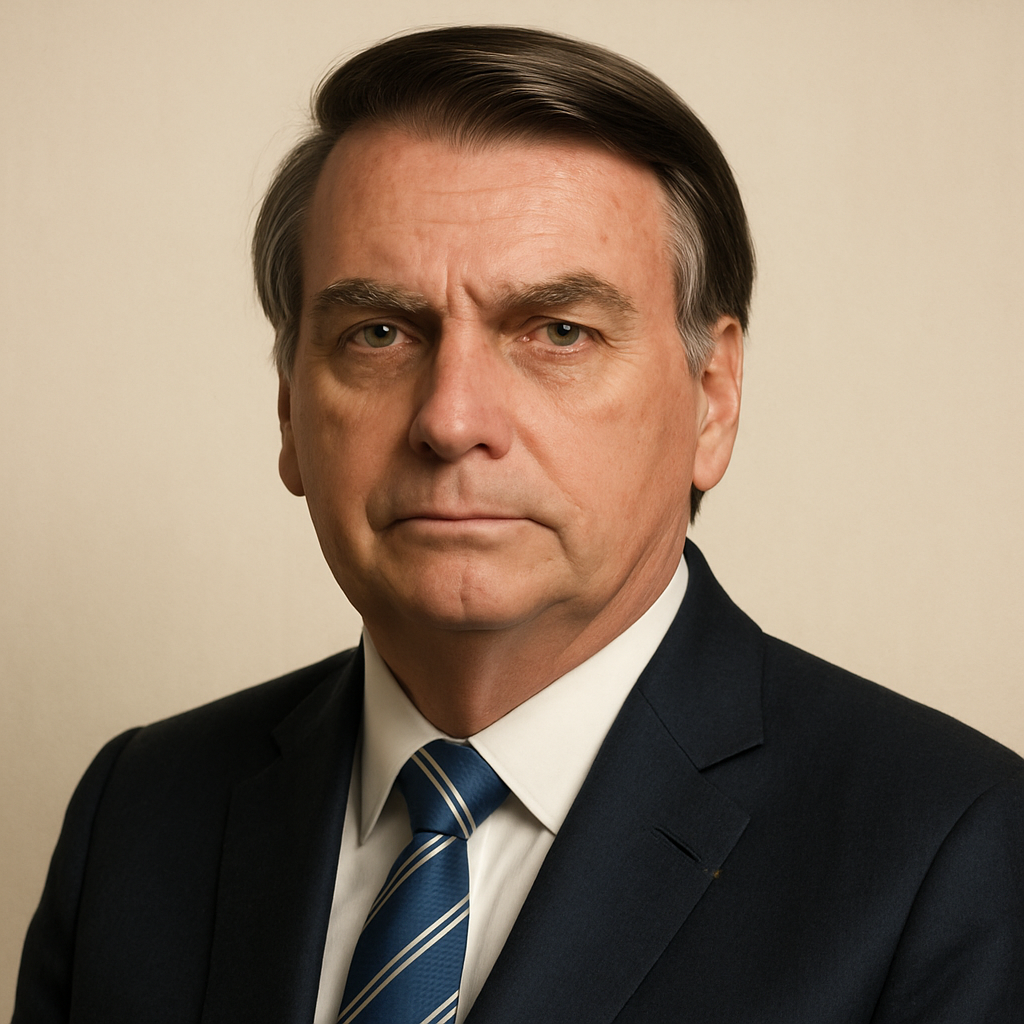
Speech by the President of the Republic, Jair Bolsonaro, during breakfast with ministers and parliamentarians - Palácio do Planalto
 Jair Bolsonaro · Former President of Brazil
- Context
- Bolsonaro addressed ministers and parliamentarians at a breakfast meeting at Palácio do Planalto on July 4, 2019, discussing agricultural policy and pension reform.
- Main themes
- Rural sector and agribusiness support, environmental sovereignty and Amazon deforestation, pension reform and military police benefits, Brazil's international relations, Embrapa revitalization, indigenous land demarcation, Paris Agreement compliance, government alignment with ruralist caucus
- Duration
- ~13 min
- Words
- 1,509
- Sentences
- 65
- Readability
- 53
- Grade
- 11.5
- Syntax
- 2.98
- Vocabulary
- 2.05
Translated from Portuguese
The broad sphere of national life a sentence belongs to. Every sentence has an Arena, so it is the denominator the other indices are read against.
Other65 sentences in 26 paragraphs
Good morning.
Dear Alceu,
Tereza Cristina,
My friends. I still feel like a federal deputy after twenty-eight years in the Chamber, and I want to say that this government here is yours.
First, I congratulate you for having nominated Ms. Tereza Cristina to be our minister, an exceptional person who has shown determination and competence in seeking solutions for the Power.
Over the course of twenty-eight years in the Chamber, I have followed and, more than that, I believe I voted 100% with the ruralist bench. And many times the issues arose there as if it were a rhinoceros birth: there was the press attacking you, there were NGOs, and there were also governments from other countries. And what I felt now in Osaka, Japan, especially from two heads of state, is something that confirmed what I thought in the past, what they think about us.
These two in particular thought they were dealing with previous governments that, after meetings like this, came here and demarcated dozens of indigenous areas, demarcated quilombola areas, expanded protected areas, in other words, making our progress here in Brazil increasingly difficult. And to conclude the issue there in Osaka, Mr. Macron wanted me, alongside Raoni, to announce decisions regarding our environmental issues. I gave him a resounding no! I do not recognize Raoni as an authority here in Brazil; he is a citizen like any other, whom we must respect and consider, but to be by my side to make a decision for our Brazil, he is not an authority. I even invited him and Angela Merkel to fly over the Amazon; if they found a square kilometer of deforestation between Boa Vista and Manaus, I would agree with them.
Now the same, as I have flown over Europe already, twice, I also told them that I did not find a square kilometer of forest in that region. So, they do not have the authority to come and discuss this issue with us. So, Brazil's posture towards the world has changed; yes, we have, over decades, with the connivance of heads of state, allowed Brazil to have a terrible reputation regarding the environment abroad.
The truth shows the opposite. Germany will not comply with the Paris Agreement regarding fossil energy; now Brazil has everything to comply with almost everything that is there, and whatever is possible, we will do.
The greatest demonstration I could give and give in being alongside you is during the campaign when we wanted and had the idea of merging the Ministry of Agriculture with the Environment, as we came to the conclusion that it was not the case, even talking to many of you. And we have, nowadays, a Minister of the Environment who is aligned with you. Imagine, without naming names here, but you can think of the last Ministers of the Environment; if we had a minister like that there, the hell it would be for the lives, not only of you but of all of us here in Brazil regarding this issue. So, we also had the opportunity and good sense to choose a Minister of the Environment who aligns environmental issues with development. We all win with that.
Now, let one thing be very clear: the problems we have today, with all due respect to you, of which I participated and was alongside you, were issues that we allowed to happen, so today we have to first undo what was done before we can do anything. And we are doing this alongside this valuable minister I have here by my side.
It was just mentioned about Embrapa, created in 1972/73 by the Médici government. It will indeed be revitalized. Tereza Cristina has been talking to me about it, about names, and this is progressing very well. Soon, I think in a few days, we will have a response so that our Embrapa can really do the wonderful work it did in the past, at the time it was created.
Well, to conclude here, one very important thing. We are here discussing the New Pension System, and we have a problem regarding military police, as well as federal and highway police.
First, let it be clear that military police have never had privileges in Brazil, so any discourse aimed at changes for military police speaks of restoring privileges; this is not true. And I appeal to you on this specific issue: let us attend, even if partially, because military police are more than our allies; they are those who give their lives for all of us, Brazilians. The same goes for the Federal Police and the Federal Highway Police. There is some misunderstanding that we, I, the Government, have made. And this issue can be resolved through the good sense of all of you.
I ask, please, the discourse of some as if we wanted to privilege the Federal Police and the Federal Highway Police does not hold. They are our allies and have also never had privileges here in Brazil. So, I appeal to this good sense that I make to all of you on this critical issue that is not easy to solve given the various interests that exist within the Chamber, which I know as well as you who are here.
Furthermore, there is a video circulating out there, from what we have gathered, it is from our dear state of Bahia, where an unarmed guard was inviting the invaders to leave; it is clear that they were not going to leave. More than that, they advanced with knives against these private guards, burned their vehicles, and expelled them, and they only did not kill them because they ran away. So, the issue of armament. It is not a matter of mine, a campaign promise; the weapon is on all our heads as a means of defense and more than that: an instrument that guarantees the freedom and democracy of a country. Because any government that disarms its people has bad intentions. So, I also ask you, regarding the issue of armament, with much affection, with much respect that you have for everything that is voted and discussed within the Chamber, to consider this issue and make the most accurate decision.
If my government, which is ours, which is yours, does not succeed, you know what can happen starting in 2023. And we do not want the return of that kind of people!
I apologize for going a little deeper. Here is Chico Rodrigues from Roraima. And he is a very concerned and active senator, who seeks solutions for that terrible issue happening in that state, given the plight of our brothers from Venezuela, fleeing violence and hunger; it is not easy what is happening there to have a solution so quickly. The Army has done its part; I thank the release of resources, around R$ 200 million, about a month and a little ago, for Operation Welcome and not for Venezuela.
Now, we have a problem in the south here, a possible problem here in the south here, in South America, our dear Argentina. It cannot suffer a setback either. So, more important than even seeking a solution for Venezuela is finding ways for our Argentina not to fall back into the hands of politicians who were very friendly with the petistas we had in the past governing our country as well.
So, dear Tereza Cristina, the agreement in Mercosur, obviously involving Argentina with the European Union, in my understanding, more than a good economic agreement for us, is an agreement that can help Argentina not to return to the hands of those who had a lot of affinity or, better, even integrated the Foro de São Paulo.
So all these issues we are taking here, discussing the agribusiness issue, discussing national politics, are part of the lives of everyone here. Including, when I spoke about the Military Police, Federal Police, and Federal Highway Police, where we appeal to the good sense of all - and I know you have - to seek solutions.
The future of Brazil is not in my hands; it is in our hands. And we have the means to make Brazil truly occupy the prominent place it deserves in the world.
Yesterday, for the first time in history, a President of the Republic was at the United States Embassy at night, celebrating, which is today, in fact, the independence of this brother country, the United States.
And it is by approaching all the countries of the world without ideological bias that we can indeed place Brazil in the prominent position it deserves.
Thus, I am neither a captain nor is Ramos, who will soon take over here at SEGOV at ten-thirty, a general; we are soldiers of Brazil and owe much more than gratitude to you, and, deep down, we owe loyalty to the people who placed all of us in this Central Plateau, the place of decisions on the great themes of our nation.
Thank you very much to all of you. We continue together.
The original Portuguese. The tags above are read on the English translation's sentences.
Bom dia.
Prezado Alceu,
Tereza Cristina,
Meus amigos. Eu me sinto ainda deputado federal depois de vinte e oito anos dentro da Câmara, e dizer que esse governo aqui é de vocês.
Primeiro os parabenizo por ter indicado a senhora Tereza Cristina para ser a nossa ministra, uma pessoa excepcional que tem demonstrado garra e competência para buscar soluções para o Poder.
Ao longo de vinte e oito anos dentro da Câmara eu acompanhei e, mais do que isso, eu acredito que 100% votei com a bancada ruralista. E muitas vezes as questões nasciam ali como se fosse um parto de rinoceronte: era imprensa batendo em vocês, eram ONGS e eram também governos de outros países. E o que eu senti agora em Osaka, no Japão, por parte em especial de dois chefes de Estado, é uma coisa que confirmou o que eu pensava no passado, o que eles pensam a nosso respeito.
Esses dois em especial achavam que estava tratando com governos anteriores que após reuniões como essa vinham para cá e demarcavam dezenas de áreas indígenas, demarcavam quilombolas, ampliavam áreas de proteção, ou seja, dificultavam cada vez mais o nosso progresso aqui no Brasil. E, para encerrar a questão lá de Osaka, o senhor Macron queria que eu, ele ao lado do Raoni, viesse anunciar decisões para nossa questão ambiental. Dei-lhe um rotundo não! Não reconheço o Raoni como autoridade aqui no Brasil, ele é um cidadão como outro qualquer, que nós devemos respeito e consideração, mas estar a meu lado para tomar uma decisão pelo nosso Brasil, ele não é autoridade. Convidei, inclusive, ele inclusive e Angela Merkel a sobrevoar a Amazônia, se encontrasse num espaço entre Boa Vista e Manaus um quilômetro quadrado de desmatamento eu concordaria com eles.
Agora o mesmo, como sobrevoei a Europa já, por duas vezes, eu também lhes disse que não encontrei um quilômetro quadrado de floresta naquela região. Então, eles não têm autoridade para vir se discutir essa questão para conosco. Então mudou a maneira do Brasil se portar perante o mundo, agora nós fomos, sim, ao longo de décadas, com a conivência de chefe de Estado, tendo sido feito com que o Brasil tivesse hoje em dia um péssimo conceito sobre meio ambiente lá fora.
A verdade mostra o contrário. A Alemanha não vai cumprir o Acordo de Paris no tocante a energia fóssil, agora o Brasil tem tudo para cumprir quase tudo o que está lá e o que for possível nós faremos.
A maior demonstração que eu pude dar e dou em estar ao lado de vocês é por ocasião durante a campanha quando nós queríamos e tínhamos a idéia de fundir o Ministério da Agricultura com o Meio Ambiente, pois chegamos a conclusão que não era o caso, até conversando com muitos de vocês. E temos, hoje em dia, um ministro do meio ambiente que está casado com vocês. Imaginem, sem citar nomes aqui, mas vocês podem pensar os últimos ministros do Meio Ambiente, se tivéssemos lá um ministro como esse, o inferno que seria a vida, não só de vocês, mas de todos nós aqui no Brasil nessa questão. Então tivemos aqui também a oportunidade e o bom senso de escolher um ministro do Meio Ambiente que casa a questão ambiental com o desenvolvimento. Todos nós ganhamos com isso.
Agora, fique bem claro uma coisa: os problemas que temos hoje, com todo respeito a vocês, que eu participei disso e estava ao lado de vocês, foram questões que nós fomos deixando acontecer, então hoje nós temos que não fazer, primeiramente é desfazer o que foi feito para depois fazer. E isso estamos fazendo ao lado dessa valorosa ministra que tenho aqui ao meu lado.
Falou-se agora pouco da Embrapa, criada em 1972/73 pelo governo Médici. Ela vai ser repotencializada sim. A Tereza Cristina tem conversado comigo sobre ela, sobre nomes e isso está caminhando muito bem. Brevemente, acho que em poucos dias, vamos ter uma resposta para que a nossa Embrapa realmente faça o trabalho maravilhoso que fez atrás, na época que foi criada.
Bem, encerrando aqui, uma coisa muito importante. Nós estamos aqui discutindo a Nova Previdência e estamos com um problema na questão de policiais militares, também policiais federais e rodoviários federais.
Primeiro deixar bem claro que policial militar nunca teve privilégio no Brasil, então qualquer discurso voltado para mudanças para policial militar se fala em restabelecer privilégio, isso não é verdade. E eu apelo aos senhores nessa questão específica: vamos atender, que seja em parte porque os policiais militares são mais do que os nossos aliados, são aqueles que dão as suas vidas por nós todos, brasileiros. O mesmo no tocante a Polícia Federal e a Polícia Rodoviária Federal. Tem algum equívoco que nós, eu, Governo, erramos. E dá para resolver essa questão através do bom senso de todos os senhores.
Eu peço, por favor, o discurso de alguns como se nós quiséssemos privilegiar também PF e PRF não procede. São pessoas aliados nosso e também nunca tiveram privilégio aqui no Brasil. Então, o apelo a esse bom senso que eu faço a todos os senhores nessa questão crítica que não é fácil solução tendo em vista os vários interesses que existem dentro da Câmara, que eu conheço tão bem quanto os senhores que estão aqui.
No mais, tem um vídeo rodando por aí, pelo que nós levantamos é lá do nosso querido estado da Bahia, onde uma guarda desarmada foi convidar os invasores a sair, tá na cara que não iam sair. Mais do que isso, avançaram com armas branca para cima desses guardas particulares, queimaram as suas viaturas e expulsaram, e só não mataram porque eles correram. Então, a questão de armamento. Não é uma questão minha, promessa de campanha, a arma está na cabeça de todos nós como um instrumento de defesa e mais do que isso: um instrumento que garante a liberdade e democracia de um país. Porque todo governo que desarma o seu povo está mal intencionado. Então meu peço aos senhores também, na questão do armamento, que com muito carinho, com muito respeito que vocês têm com tudo aquilo que é votado e discutido dentro da Câmara, vejam essa questão e tomem a decisão mais acertada.
Se o meu governo que é o nosso, que é de vocês, não der certo, os senhores sabem o que pode acontecer a partir de 2023. E nós não queremos a volta desse tipo de gente!
Me desculpem aprofundar um pouquinho mais. Tem aqui o Chico Rodrigues, de Roraima. E ele é um senador muito preocupado e atuante, que busca soluções para aquela questão terrível que acontece naquele estado, tendo em vista a figa de irmãos nossos da Venezuela, fugindo da violência e da fome, não é fácil o que está acontecendo lá ter uma solução tão rápido assim. O Exército tem feito a sua parte, agradeço a liberação de recursos, em torno de R$ 200 milhões, há questão de um mês e pouco atrás, para a Operação Acolhida e não para a Venezuela.
Agora, temos um problema no sul aqui no sul, um possível problema aqui no sul aqui, da América do Sul, a nossa querida Argentina. Ela não pode sofrer um retrocesso também. Então, mais importante do que até nós buscarmos solução para a Venezuela é buscarmos maneiras de que a nossa Argentina não volte nas mãos de políticos que eram muito amigos de petistas que tínhamos no passado governando o nosso País também.
Então, prezada Tereza Cristina, o acordo no Mercosul, obviamente, envolvendo a Argentina com a União Europeia, no meu entender, mais do que um acordo bom economicamente para nós, é um acordo que pode ajudar a Argentina não voltar para as mãos de quem tinha muita afinidade ou, melhor, integrava até mesmo o foro de São Paulo.
Então essas questões todas que estamos tomando aqui, discutindo a questão do agronegócio, discutindo política nacional, faz parte da vida de todos que estão aqui. Inclusive, quando eu falei em Polícia Militar, Polícia Federal e Polícia Rodoviária Federal, onde a gente apela ao bom senso de todos - e eu sei que vocês têm - para buscarmos soluções.
O futuro do Brasil não está nas minhas mãos não, está nas nossas mãos. E nós temos como fazer o Brasil realmente ocupar o lugar de destaque que ele merece no mundo.
Ontem, pela primeira vez na vida, um Presidente da República esteve na Embaixada dos Estados Unidos à noite, comemorando, que é na data de hoje, na verdade, a independência desse país irmão, os Estados Unidos.
E é se aproximando, então, de todos os países do mundo sem o viés ideológico, que nós podemos, sim, colocar o Brasil no local de destaque que ele merece.
Assim sendo, eu não sou capitão e nem o Ramos, que daqui a pouco vai assumir aqui a SEGOV, às dez e meia, é general, nós somos soldados do Brasil e devemos muito mais que gratidão a vocês e, no fundo, devemos, sim, é lealdade a esse povo que colocou a todos nós nesse Planalto Central, local de decisões dos grandes temas da nossa nação.
Meu muito obrigado a todos vocês. Continuamos juntos.