




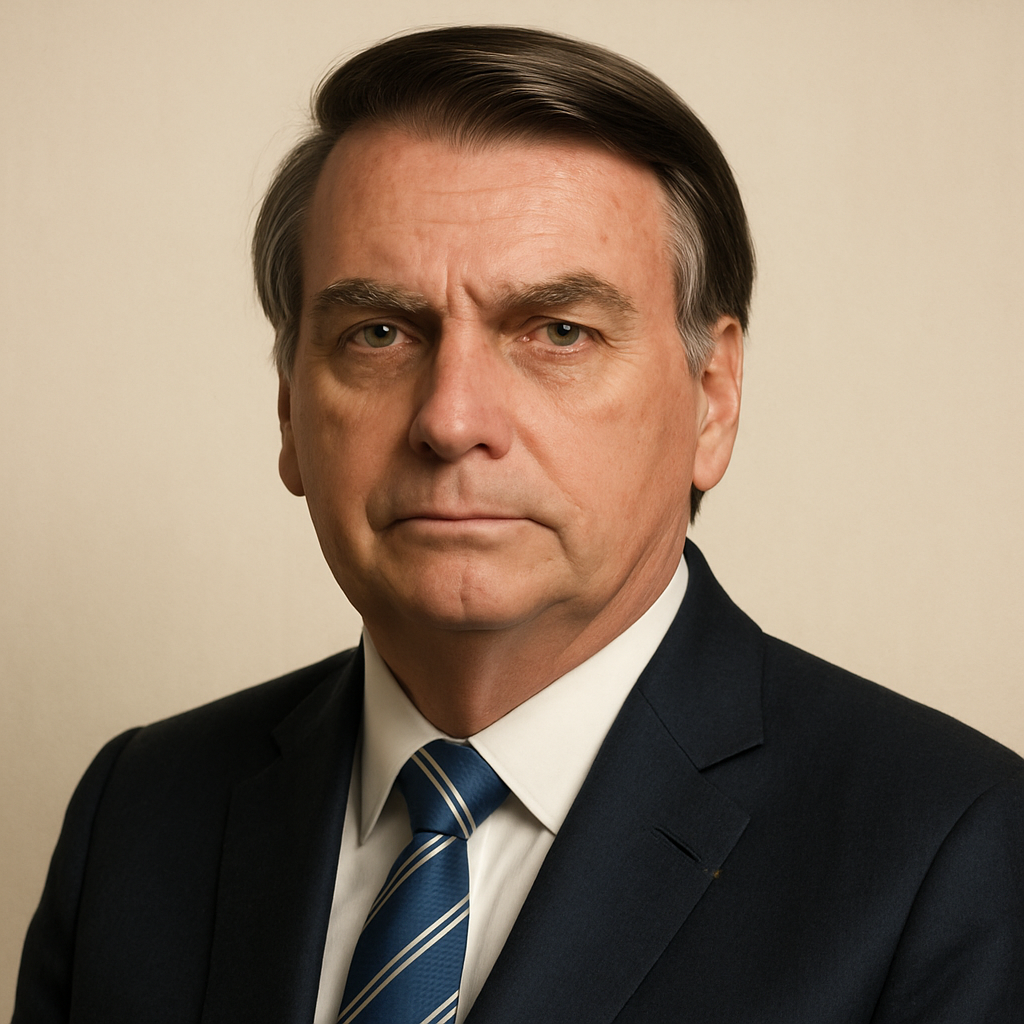
Speech by the President of the Republic, Jair Bolsonaro, during the ceremony for the launch of the Safra Plan 2020/2021 - Palácio do Planalto
 Jair Bolsonaro · Former President of Brazil
- Context
- Bolsonaro addressed the ceremony launching Brazil's Safra Plan 2020/2021 at the Palácio do Planalto on June 17, 2020, celebrating agricultural achievements and food security.
- Main themes
- Brazilian agribusiness and agricultural production, Safra Plan 2020/2021 launch, food security during COVID-19 pandemic, rural sector resilience, Embrapa and historical agricultural development, environmental preservation and Amazon, international trade agreements for agribusiness, tribute to farming community, government economic and agricultural policy
- Duration
- ~7 min
- Words
- 877
- Sentences
- 49
- Readability
- 61
- Grade
- 9.2
- Syntax
- 2.90
- Vocabulary
- 2.04
Translated from Portuguese
The broad sphere of national life a sentence belongs to. Every sentence has an Arena, so it is the denominator the other indices are read against.
Other49 sentences in 14 paragraphs
Dear Minister Tereza Cristina, on whose behalf I greet everyone here, in what is one of the most important events that takes place annually in this venue.
Brazil is truly a fantastic country. Its portrait comes from the countryside. All countries have the permanent goal of food security, even for reasons of social peace. The city may stop, but the countryside will make it rise again. But if one day the countryside stops, everyone will succumb.
During this pandemic, the countryside did not stop. Panic, some could not bring to this region. And this region, more than ensuring our food security, also ensured that food did not cease in the cities.
As our Minister Tereza Cristina said a little while ago, if we stopped today, we would have enough to feed our population for five years. So, in a quick mathematical calculation, what we produce in a year feeds the equivalent of 1 billion people. This is a number that corresponds to almost 15% of the world population.
Now, I want to pay tribute here to a government that, in the past, provided this for all of us. In 1972, President Emílio Garrastazu Médici and Minister of Agriculture Cirne Lima had the idea to create Embrapa and also to send young people, many of them children of farmers, abroad to study, to seek the best that the world had to offer, so that this could be brought back to our society. These young people fulfilled their role exceptionally. More than learning, they became teachers for the whole world. So, after all this, Brazil began to grow. After all, it was discovered at that time that we were still partly dependent on what the world produced in the countryside, and we had to take into account that we should invest in agricultural sciences. That is how it was done, and that is how Brazil grew. Today we reap what was planted abroad.
That is how agriculture works. You can only harvest what you plant. What we plant in politics today, we will harvest tomorrow.
Dear Ronaldo Caiado, you who are a governor of a great state, and your state has taken another step, right? It has gained another level regarding agricultural grain production in Brazil. Congratulations to you, who is a reference to all of us in this and other areas.
Therefore, I can only thank the people of the countryside now. Also for a moment of a pre-campaign, where I traveled many times alone throughout Brazil, but I was well received by all of you, with a proposal that I knew I could carry forward, but I could only advance this proposal because I managed to place patriotic people by my side who truly shared the same spirit of a better Brazil for all. Here, basically, in the persons of Tereza Cristina, Paulo Guedes, and also Ernesto Araújo, who, in our travels, in our wanderings around the world, always had people from this team, if not themselves, doing preparatory work for our arrival. When we arrived, we would just sign the international agreements, which allowed agribusiness to export even more.
And to say to those who criticize us, because I feel like a farmer at this moment because, after all, I have also planted 30 hectares of rice in the past, back in our dear Nioaque, Mato Grosso do Sul, the land of Tereza Cristina. I know the difficulties; I know it is not easy. How many times did I have to go to the field to plant rice with a hoe, on Saturdays and Sundays, weeding the rice because the Folidol could not handle destroying the broadleaf plants.
And to say more: that the man of the countryside, Paulo Guedes, is truly an example of a Brazilian worker. They work from Monday to Sunday, sometimes 24 hours a day, they do not complain about anything, except sometimes when the State wants to interfere in their work. With great resilience, they have overcome all of this.
And we also had, here, very good work alongside the Ministry of the Environment. After all, as our general, the vice president, said a little while ago: “we have all of this using approximately 8% of our territory.” So, it is proof that Brazil is a country that preserves the environment the most. Everyone uses much more to produce less. And we are an example in environmental matters. And our vice president, our General Mourão, had an idea a little while ago, which was put into practice, creating the Amazon Council, to prevent what they cruelly criticize us for abroad, often in an untrue manner, from happening and to also show how we treat our Amazon Region.
And to say more, to conclude, in the past there was interest in our Amazon Region. Today, a few other countries have interest in our entire country. And we should, yes, be increasingly concerned about this. And these agricultural frontiers, more and more, we are exploring, we are consolidating these 8.5 million square kilometers that belong to all of us.
Men and women of the countryside, thank you very much for your work. I feel proud to be the president of a country where there are workers from your roots.
Thank you very much.
The original Portuguese. The tags above are read on the English translation's sentences.
Prezada ministra Tereza Cristina, em nome da qual eu cumprimento a todos aqui, nesse que é um dos eventos mais importantes que ocorrem anualmente neste recinto.
O Brasil, realmente, é um país fantástico. O retrato dele é o que vem do campo. Todos os países têm como objetivo permanente a segurança alimentar, até por uma questão de paz social. A cidade pode parar, o campo a fará ressurgir. Mas se um dia o campo parar todos sucumbirão.
Nessa pandemia o campo não parou. O pânico, alguns não conseguiram levar para essa região. E essa região, mais do que garantir a nossa segurança alimentar também fez com que a alimentação não cessasse nas cidades.
Como disse a nossa ministra Tereza Cristina há pouco, se nós parássemos hoje, teríamos com o que alimentar por cinco anos a nossa população. Então, numa conta rápida, matemática, o que nós produzimos por ano alimenta o equivalente a 1 bilhão de pessoas. Isso é um número que equivale a quase 15% da população mundial.
Agora, eu quero render uma homenagem aqui a um governo que, no passado, propiciou isso a todos nós. Os anos 1972, presidente Emílio Garrastazu Médici, ministro da Agricultura Cirne Lima. Tiveram a ideia de criar a Embrapa e, também, mandar para fora do Brasil, jovens, muitos filhos de agricultores, estudarem, buscar lá fora o que havia de melhor no mundo, para que isso pudesse nos trazer para a nossa sociedade. Cumpriram o papel, esses jovens, de forma excepcional. Mais do que aprenderam, passaram a ser professores para o mundo todo. Então, após isso tudo o Brasil começou a crescer. Afinal de contas se descobriu, na época, que nós dependíamos em parte, ainda, do que o mundo produzia no campo e nós tínhamos que levar em conta que deveríamos investir em ciências agrárias. Assim foi feito, assim o Brasil cresceu. Hoje colhemos o que foi plantado lá fora.
Assim é a agricultura. Você só pode colher o que você planta. O que nós plantamos na política hoje, colheremos amanhã.
Prezado Ronaldo Caiado, você que é um governador de um grande estado, e seu estado deu mais um passo, não é? Ganhou mais um degrau no tocante à produção agrícola de grãos no Brasil. Parabéns a você, que é uma referência a todos nós nessa e em outra área.
Assim sendo, eu só tenho agora a agradecer ao pessoal do campo. Também por um momento de uma pré-campanha, onde eu rodei muitas vezes sozinho, pelo Brasil, mas fui bem recebido por todos vocês, com uma proposta que eu saberia que tinha como levar avante, mas só pude levar adiante essa proposta porque consegui colocar ao meu lado pessoas patriotas e que realmente tivessem o mesmo espírito de um Brasil melhor para todos. Aqui, basicamente, nas pessoas de Tereza Cristina, Paulo Guedes e, também, o Ernesto Araújo que, em nossas viagens, em nossas andanças pelo mundo, sempre pessoas dessa equipe quando não os próprios, faziam um trabalho de… uma preparação para a nossa chegada. Quando chegávamos apenas assinávamos, aí, os acordos internacionais, o que fez com que o agronegócio pudesse exportar mais ainda.
E dizer àqueles que nos criticam, porque eu me sinto um agricultor nesse momento porque, afinal de contas, eu também já plantei 30 hectares de arroz no passado, lá na nossa querida Nioaque, Mato Grosso do Sul, terra da Tereza Cristina. Sei das dificuldades, sei que não é fácil. Quantas vezes eu tive que ir ao campo plantar arroz com enxada, sábado e domingo, capinar o arroz porque o Folidol não dava conta de destruir as plantas de folha larga.
E dizer mais: que o homem do campo, Paulo Guedes, é um exemplo, realmente, de trabalhador brasileiro. Eles trabalham de segunda a domingo, por vezes 24 horas por dia, não reclamam de absolutamente nada, a não ser, às vezes, quando o Estado quer interferir em seu trabalho. Com muita resiliência eles venceram tudo isso.
E nós também tivemos, aqui, um trabalho muito bom junto ao Ministério do Meio Ambiente. Afinal de contas, como disse agora há pouco o nosso general aí, vice-presidente: “temos tudo isso usando aproximadamente 8% do nosso território”. Então, é uma prova que o Brasil é um país que mais preserva o meio ambiente. Todos usam muito mais para produzir menos. E nós somos um exemplo na questão ambiental. E o nosso vice-presidente, o nosso general Mourão, teve uma ideia há pouco tempo, foi colocada em prática, criando o Conselho da Amazônia, para evitar que aquilo que nos criticam lá fora, de forma cruel, muitas vezes, e de forma não verdadeira, ele se antecipe e faça também a amostragem de como nós tratamos a nossa Região Amazônica.
E dizer mais, para concluir, no passado tinham interesse em nossa Região Amazônica. Hoje, outros poucos países têm interesse em todo o nosso País. E devemos, sim, nos preocupar, cada vez mais com isso. E essas fronteiras agrícolas, cada vez mais, nós desbravamos, nós vamos consolidando esses 8 milhões e meio de quilômetros quadrados que pertencem a todos nós.
Homens e mulheres do campo, muito obrigado pelo trabalho de vocês. Me sinto orgulhoso de ser presidente de um país onde tem trabalhadores das raízes de vocês.
Meu muito obrigado.