




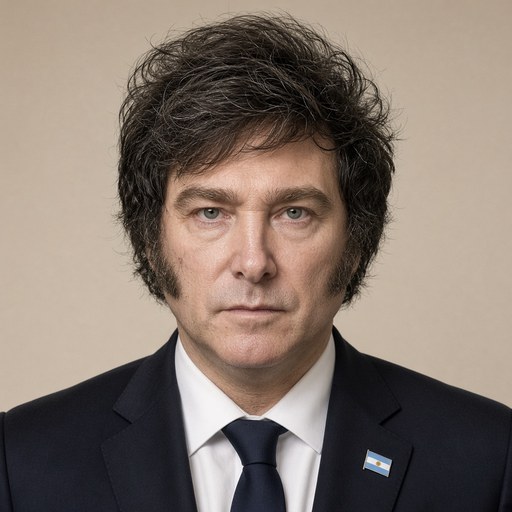
Words of the President of the Nation, Javier Milei, after receiving the Political Research Award, presented by the Ilan Foundation.
 Javier Milei · President of Argentina
- Context
- Milei addressed the ILAN Foundation in Argentina on July 21, 2024, after receiving the Political Research Award at the organization's official Argentine launch.
- Main themes
- Political innovation, firmness in convictions, adaptation to changing reality, criticism and resilience, Austrian economics and Mises, Kirchnerism critique, type one and type two error, entrepreneurship, Argentine political transformation, leadership challenges
- Duration
- ~19 min
- Words
- 2,294
- Sentences
- 99
- Readability
- 59
- Grade
- 10.8
- Syntax
- 3.21
- Vocabulary
- 1.96
Translated from Spanish
The broad sphere of national life a sentence belongs to. Every sentence has an Arena, so it is the denominator the other indices are read against.
Other99 sentences in 11 paragraphs
Good afternoon everyone. I want to thank the authorities of ILAN, particularly its president Isaac Assa, and congratulate them on the official launch of this house in Argentina, as well as thank all those present here today. We are happy to accompany you and be part of ILAN.
As I receive from you a recognition of political innovation today, I would like to take a minute to reflect briefly on what that concept means. There is an interesting phrase from Mises that says that the economy never stops; change, movement, and the emergence of unforeseen events are constant - I anticipate that I will not talk about economics, because I will get into creative destruction, with Schumpeter, so rest assured, it is just a reference to weave an argument. In some way, this phrase indicates that if reality is in a constant process of change, innovation is not so much a choice but an obligation, because failing to adapt to a reality in motion and clinging to dogmas that do not align with that reality is inevitably the path to defeat. One must be firm in convictions, but intelligent in translating those convictions into a changing reality, because if you do not innovate, reality will run you over. That is to say, I want to emphasize this: one must be firm in convictions. Being firm in convictions is… we all suffer this every day, because every day we are making decisions and one must have a north. One sets a north, one seeks that north, but reality is not a uniform straight-line movement, so one must advance towards that reality one is seeking; and obviously, it is not a flat, easy path, and so on. That is to say, there are obstacles; some can be jumped, some can be dodged; and I will tell you something: every time you are dodging an obstacle, someone will criticize you. Not only that, but not only will they criticize you, there will be others who will also shoot at you. But that is also part of the challenge one faces.
One of the things that is also important when one undertakes these types of situations, and that helps me a lot at least, is a reflection on Moses, already on the way to the promised land, having crossed the Red Sea. And there is something very interesting, because if Moses got up late, they said he was being lazy; if he got up early, they said he had fought with his wife, and if he got up on time, it meant he had nothing to do. That is to say, it did not matter what he did, he was going to be criticized. So, if they criticized Moses, they can say anything about me, there is no problem at all. So, also know that when you do things, they will criticize you. The only ones they do not criticize are the useless ones who do nothing.
So that is why I want to reiterate and underline this paragraph that says: one must be firm in convictions, but intelligent in translating those convictions into a changing reality, because if one does not innovate, reality will run you over, that is the reality. This is valid for the economy, as Mises says for those of us who make macroeconomic decisions, and also for entrepreneurs who decide what, how, and when to produce and market. But it is also valid for politics. Look, for example, at how the Argentine political reality changed and the traditional political leadership did not know how to adapt to that new reality. Since I decided to enter politics four years ago, I have insisted on an idea that I believe many people have identified with, which is that we cannot expect different results if we always do the same thing. This is a heuristic principle, that is, a methodological principle about how we approach a finding or how we discover the truth or a truth. In the face of any problem, before knowing what to do, one must understand that if we do what everyone else did and everyone else failed, then we will fail.
Economists often talk about type one error or type two error. Type one error is when one does everything right and it goes wrong; and type two error is when one does everything wrong and it goes right. That is quite interesting as a methodology, as a way of being self-critical, because even if it can go well, it can be a coincidence. If you want, the best tribute to type two error was Kirchnerism. And the truth is that every time they insist on the recipe, all they do is cause us more harm and sink us further. That is why it is also interesting when one is trying to fix the disaster they caused, that they come and criticize, because the truth is, we want to do the exact opposite because you sank everything and had a streak of four years of luck due to type two error. So one cannot be betting on type two error, that is, doing everything wrong and having it go well. That is why, I repeat, we cannot expect different results by doing the same old thing. This principle I believe is at the base of the political innovation that we have introduced in recent years. We discovered that it is true for political practice, because by doing the opposite or what everyone else did, we reached the presidency, by doing everything the opposite. We did everything the opposite, everything that the manual recommended in the conventional Argentine format, we did everything the opposite. And what did they say? That we would not make it. Well, they did not see it. They still do not see it, but well, some do. And we did it despite not having the resources that all the other candidates had and against what all the analysts, consultants, and dinosaurs who write columns in old newspapers recommended, who have never won anything in their lives, but believe that their word is worth gold. That is to say, on the side, you know that the oracle of Delphi gave advice, but did not make decisions, which is a slightly different step as well. In the stands, they are all great technicians.
But we not only adopted that innovative logic for the campaign, but we also trusted that it was the right approach for leading the country, to find solutions to the problems that have plagued us as a nation for too long. Because at all times, the political leadership changed cooks, but always continued to use the same recipe for failure to govern; and that is how it went for us. That is to say, it was a difference in manners. That is to say, many from the analog red circle, which fortunately the audience does not accompany, do not accompany the ratings. For which reason they are super angry and also because they are the great blunders and are constantly criticizing, because of course, they predicted that I had to lose against… even against Massa, supposedly, those from a certain side. And they did not realize that all they were doing was talking about the same recipe, but with different manners. In fact, they promote the same recipe, but believe that the problem is the manners. And that also shows how basic, rudimentary, and prehistoric they are, because they do not realize that what has truly changed is the concept. That is to say, Argentina is sinking because for 100 years it has continuously embraced increasing doses of socialism. And here, we have returned to embrace the ideas of freedom. Moreover, it is sometimes irritating or comical. I mean, people who criticize me “you are not doing liberalism.” And if they do not even understand the ideas, because if they understood them, they would be liberals. But they are not, because they do not understand them. So they criticize me, what I do or do not do; and they do not even understand what is being talked about. And there it is also interesting, during the campaign, Dipy said a phrase that for me is brilliant, and one of the things he said is that the problem was not the cook, the problem was the recipe. Because at the bottom, that is the flip side of what Hayek called the fatal arrogance. I mean, believing that the other, then, as he is less intelligent or less educated, or whatever, could not do it for those reasons, but now that the one who knows it all is coming, he will fix it. No. The problem is the idea, and that idea does not work.
That is why we know that it is not enough to change the leader, because to expect different results we must do different things, and that is why we have returned to embrace the ideas of freedom, which is what made the world great. It was what made Argentina great. It was the ideas we embraced starting in 1860, when we implemented Alberdi's Constitution of 1853 and in 35 years we became the world's leading power. If we did it in the 19th century with a much more adverse situation in terms of technology and speed of progress, why would we not do it now? That is why, also, a large part of the bet is to awaken lions, because I did not come to guide sheep, I came to awaken lions, precisely. That is to say, I came to awaken the creative force of each one; we are what will make a better future, but not the State, which is the machine of oppression.
And, finally, we have found that exercising doing things differently in Argentine politics necessarily implies the recovery of a central value for us: the value of truth. We say what we think and do what we say. That is to say, you will find a perfect consonance between the things we said in the campaign and the things we are doing. We campaigned and carried a chainsaw. And I said it would imply a chainsaw in public spending. We inherited a fiscal deficit of 15 points of GDP, 5 in the Treasury, 10 in the Central Bank. Despite all the forecasts, that it could not be adjusted more than one point per year in the Treasury and that the Central Bank's issue would fix itself - with which there were some geniuses who also proposed raising the interest rate, which would have made the problem today even much bigger -, we fixed it. Six months after taking office, we exterminated the consolidated fiscal deficit; we ended the one from the treasury and we ended the quasi-fiscal one generated by the Central Bank; we have made the largest adjustment in the history of humanity. And they said it was impossible. Nothing is impossible; one must have the conviction to do it.
Moreover, when the majority speculates, when the majority has become accustomed to lies, when the majority chooses speculation over truth, when the majority turns a blind eye to things that are wrong. I said it in the speech at the Latin American Jewish Congress, I repeat it now: when those on the side of good do not manifest in favor of good, they work for evil. Those who remain neutral work for evil; you are either on the side of truth or on the side of lies; you are on the side of peace or on the side of war; you are on the side of freedom or on the side of slavery; there are no shades of gray. There are no shades of gray. And maintaining neutral positions only favors the criminals. Therefore, with the criminals to the bone. Therefore, when one makes this statement, and when that occurs systematically, generalized across the entire political spectrum, the act of telling the truth, even if it is uncomfortable, becomes an innovative act. This is true for Argentine politics, but I believe it is also true for the attitude that a good part of the free world has taken towards the conflict in Israel. Our position is clear and we repeat it whenever we can. We have chosen the truth, even if it is uncomfortable; to do what is right, even if it is inconvenient. We want that to be one of our greatest legacies.
To close, I want to thank ILAN again for the recognition and the opportunity to share this moment with you and leave you with a message of hope. All men have a thread that connects us with the divine and the eternal. Innovation is one of the instances of that connection; it is a channel that connects us with the forces of heaven, because it allows us to transcend the limits of what seems humanly possible, that is, it allows us to make the impossible possible. That is why embarking on this innovative path will lead to possibilities still unforeseen for Argentina. After all, we are rich in resources and human capital; we have only been insisting on wrong formulas for a long time. I am sure that in that journey, the friendship and collaboration of our nation with the State of Israel will bring mutual benefits in different areas.
I hope that the launch of ILAN in Argentina helps to promote relations between our two nations and allows us to continue strengthening a bond that is not only important to me personally, but for all Argentines who have decided to support the ideas of freedom. Know that you will always find a staunch friend in Argentina. Thank you very much and long live freedom!
The original Spanish. The tags above are read on the English translation's sentences.
Buenas tardes a todos. Quiero agradecer a las autoridades integrantes de ILAN, en particular a su presidente Isaac Assa, y felicitarlos por el lanzamiento oficial de esta casa en la Argentina, como también quiero agradecer a todos los presentes que están aquí hoy. Estamos felices de acompañarlos y ser parte de ILAN.
Como hoy recibo de ustedes un reconocimiento de la innovación política, me gustaría tomarme un minuto para hacer una breve reflexión sobre qué significa ese concepto. Hay una frase interesante de Mises que dice que la economía jamás se detiene, es permanente el cambio, el movimiento y la aparición de imprevistos - igual anticipo no voy a hablar de economía, porque me pongo con la destrucción creadora, con Schumpeter, así es que quédense tranquilos, es solamente una referencia para hilar un argumento-. De alguna forma, esta frase indica que, si la realidad está en un proceso constante de cambio, la innovación no es tanto una elección sino una obligación, porque no poder adaptarse a una realidad de movimiento y aferrarse a dogmas que no se condicen con esa realidad es indefectiblemente el camino de la derrota. Hay que ser firmes en las convicciones, pero inteligente para traducir esas convicciones a una realidad cambiante, porque si no innovas la realidad te lleva a puesto. Es decir, quiero remarcar esto, hay que ser firme en las convicciones. Ser firme en las convicciones es… nosotros esto lo padecemos todos los días, porque todos los días estamos tomando decisiones y uno tiene que tener un norte. Uno fija un norte, uno busca ese norte, pero la realidad no es un movimiento rectilíneo uniforme, entonces uno tiene que avanzar hacia esa realidad a la cual está buscando; y obviamente no es un camino llano, fácil y demás. Es decir, hay obstáculos, algunos se los puede saltar, algunos se los esquiva; y les voy a decir algo: cada vez que ustedes están esquivando algún obstáculo, alguien los va a criticar. No solo eso, sino que no solo que los van a criticar, va a haber otros que además les van a disparar. Pero también es parte del desafío que uno enfrenta.
Una de las cosas que también es importante cuando uno emprende este tipo de situaciones, y que a mí al menos me ayuda mucho, es una reflexión acerca de Moshé, ya camino hacia la tierra prometida, habiendo cruzado el mar Rojo. Y hay algo que es muy interesante, porque si Moshé se levantaba tarde, decían que estaba haraganeando; si se levantaba temprano, que se había peleado con la mujer, y que si se levantaba a horario es que no tenía nada que hacer. Es decir, no importa lo que hiciera, lo iban a criticar. Así que, si lo criticaban a Moshé, a mí me pueden decir de todo, no hay ningún tipo de problema. Así es que, también sepan que cuando hacen los van a criticar. A los únicos que no critican es a los inútiles que no hacen nada.
Entonces por eso quiero volver a señalar y subrayar este párrafo que dice: hay que ser firme en las convicciones, pero inteligente para traducir esas convicciones a una realidad cambiante, porque si no se innova, la realidad lo va a llevar puesto, esa es la realidad. Esto es válido para la economía, como dice Mises para los que tomamos decisiones macroeconómicas y también para los empresarios, emprendedores que deciden acerca de qué, cómo y cuándo producir y comercializar. Pero también es válido para la política. Miren, por ejemplo, cómo la realidad política argentina cambió y la dirigencia política tradicional no supo adaptarse a esa nueva realidad. Desde que decidí hacer política hace ya 4 años he insistido con una idea con la que creo que mucha gente se ha identificado, que es que no podemos esperar resultados distintos, si hacemos siempre lo mismo. Esto es un principio heurístico, o sea un principio metodológico, sobre cómo nos acercamos a un hallazgo o sobre cómo descubrimos la verdad o una verdad. Ante cualquier problema, antes de saber qué hacer, hay que comprender que si hacemos lo que hicieron todos y todos los demás fracasaron, entonces fracasaremos.
Los economistas solemos hablar de error tipo uno o error tipo dos. El error tipo uno es cuando uno hace todo bien y le sale mal; y el error tipo dos es cuando uno hace todo mal y le sale bien. Eso es bastante Interesante como metodología, como forma de ser autocrítico, porque aun cuando puede salir bien puede ser una casualidad. Si quieren, el mejor canto al error tipo dos fue el kirchnerismo. Y la verdad es que cada vez que reinsisten en la receta, lo único que nos hacen es cada vez más daño y cada vez nos hunden más. Por eso también es interesante cuando uno está tratando de arreglar el desastre que causaron, que vengan y critiquen, porque la verdad, justamente queremos hacer todo lo contrario porque ustedes hundieron todo y tuvieron una racha de 4 años de suerte por el error tipo dos. Entonces uno no puede estar apostando al error tipo dos, es decir de hacer todo mal y que le salga bien. Por eso, repito, no podemos esperar resultados distintos haciendo lo mismo de siempre. Este principio creo que está en la base de la innovación política que nosotros hemos introducido en los últimos años. Descubrimos que es cierto para la práctica política, porque haciendo lo contrario o lo que hacían todos, llegamos a la presidencia, haciendo todo lo contrario. Hicimos todo lo contrario, todo lo que el manual recomendaba en el formato convencional argentino, hicimos todo lo contrario. Y qué decían, que no íbamos a llegar. Bueno, no la vieron. Todavía siguen sin verla, pero bueno, algunos. Y lo hicimos a pesar de no contar con los recursos con los que contaban todos los demás candidatos y en contra de los que recomendaban todos los analistas, consultores y dinosaurios que escriben columnas en periódicos vetustos, que nunca ganaron nada en su vida, pero creen que su palabra vale oro. Es decir, al margen, ustedes saben que el oráculo de Delfos daba consejos, pero no tomaba decisiones, que es un paso un poquitito distinto también. En la tribuna, son todos son todos grandes técnicos.
Pero no solo adoptamos esa lógica innovadora para la campaña, sino que también confiamos en que era el enfoque correcto para la conducción del país, para encontrar las soluciones a los problemas que nos castigan como Nación desde hace demasiado tiempo. Porque en todo tiempo la dirigencia política cambió de cocinero, pero siguió siempre utilizando la misma receta del fracaso para gobernar; y así nos fue. Es decir, fue una diferencia de modales. Es decir, muchos del círculo rojo analógico precámbrico, que afortunadamente no los acompaña la audiencia, no los acompaña el rating. Motivo por lo cual están súper enojados y además que son los grandes pifiadores y que están todo el tiempo criticando, porque claro, pronosticaron que yo tenía que perder frente… aún frente a Massa, supuestamente, los de un determinado lado. Y no se daban cuenta que de lo único que estaban haciendo era hablar de la misma receta, pero con distintos modales. De hecho, promueven la misma receta, pero creen que el problema son los modales. Y eso también muestran de lo básico, rudimentario y precámbricos que son, porque no se dan cuenta que lo que cambió verdaderamente es el concepto. Es decir, Argentina se hunde porque hace 100 años que abrazó continuamente dosis crecientes de socialismo. Y acá, volvimos a abrazar las ideas de la libertad. Es más, hasta es, a veces entre irritante o cómico. Digo, gente que me critica “no estás haciendo liberalismo”. Y si ni siquiera, entienden las ideas, porque si las entendieran serían liberales. Pero no lo son, porque justamente no las entienden. Entonces me critican, lo que hago o no hago; y ni siquiera entienden de lo que se está hablando. Y ahí también es interesante, durante la campaña el Dipy dijo una frase que para mí es brillante, y una de las cosas que decía es que el problema no era el cocinero, el problema era la receta. Porque en el fondo esa es la contracara de lo que Hayek llamaba la fatal arrogancia. Digo, creer que el otro, entonces, como es menos inteligente o menos educado, o lo que menos fuera, no lo podía hacer por esas cuestiones, pero ahora que viene el que se la sabe toda lo va a arreglar. No. Es que el problema es la idea y la idea esa no funciona.
Por eso nosotros sabemos que no alcanza con cambiar el conductor, porque para esperar resultados distintos tenemos que hacer cosas distintas, y por eso volvimos a abrazar las ideas de la libertad, que fue lo que hizo grande el mundo. Fue lo que hizo grande a la Argentina. Fue las ideas que abrazamos a partir de 1860, cuando pusimos en marcha la Constitución de Alberdi del 53 y en 35 años nos convertimos en la primera potencia mundial. Si lo hicimos en el siglo XIX con una situación mucho más adversa en términos tecnológicos y de velocidad del progreso, por qué no lo vamos a hacer ahora. Por eso también, digamos, gran parte de la apuesta es despertar leones, porque no vine a guiar corderos, vine a despertar leones, justamente. Es decir, vine a despertar la fuerza creativa de cada uno, nosotros es lo que vamos a hacer de un futuro un futuro mejor, pero no el Estado que es la máquina de oprimir.
Y, por último, hemos encontrado en el ejercicio de hacer las cosas distintas en política argentina implica necesariamente la recuperación de un valor central para nosotros: el valor de verdad. Nosotros decimos lo que pensamos y hacemos lo que decimos. Es decir, ustedes van a encontrar una perfecta consonancia entre las cosas que dijimos en la campaña y las cosas que estamos haciendo. Nosotros hacíamos campaña y llevábamos una motosierra. Y dije que iba a implicar una motosierra en el gasto público. Heredamos un déficit fiscal de 15 puntos del PBI, 5 en el Tesoro, 10 en el Banco Central. A pesar de todos los pronósticos, que no se podía ajustar más que un punto por año en el Tesoro y que lo del Banco Central se arreglaba solo -con lo cual había algunos genios que además proponían subir la tasa de interés, con lo cual el problema hoy hubiera sido todavía muchísimo más grande -, lo hemos arreglado. A seis meses de haber asumido hemos exterminado el déficit fiscal consolidado; terminamos con el del tesoro y terminamos con el cuasifiscal que genera el Banco Central; hemos hecho el ajuste más grande en la historia de la humanidad. Y decían que es imposible. Nada es imposible, hay que tener la convicción para hacerlo.
Es más, cuando la mayoría especula, cuando la mayoría se acostumbró a la mentira, cuando la mayoría elige la especulación sobre la verdad, cuando la mayoría hace la vista gorda ante cosas que están mal. Lo dije en el discurso en el Congreso Judío Latinoamericano, lo repito ahora: cuando los que están del lado del bien no se manifiestan en favor del bien, trabajan para el mal. Los que se mantienen neutrales trabajan para el mal; se está del lado de la verdad o el lado de la mentira; se está del lado de la paz o se está del lado de la guerra; se está del lado de la libertad o se está del lado de la esclavitud; no hay medias tintas. No hay medias tintas. Y mantener posiciones neutrales lo único que favorece es a los delincuentes. Por lo tanto, con los delincuentes hasta el hueso. Por lo tanto, cuando uno hace este planteo, y cuando eso ocurre de manera sistemática, generalizado a lo largo y a lo ancho de todo el espectro político, el acto de decir la verdad, aunque sea incómodo, se convierte en un acto innovador. Esto es cierto para la política argentina, pero creo que también es cierto para la actitud que buena parte del mundo libre ha tomado ante el conflicto en Israel. Nuestra posición es clara y la repetimos siempre que podemos. Nosotros hemos decidido la verdad, aunque sea incómoda; hacer lo correcto, aunque no convenga. Queremos que ese sea uno de nuestros máximos legados.
Para cerrar quiero volver a agradecerle a ILAN el reconocimiento y la posibilidad de compartir este momento con ustedes y dejarles un mensaje de esperanza. Todos los hombres tenemos un hilo que nos conecta con lo divino y con lo eterno. La innovación es una de las instancias de esa conexión, es un canal que nos conecta con las fuerzas del cielo, porque nos hace trascender los límites de lo que parece humanamente posible, o sea, nos permite hacer posible lo imposible. Por eso, emprender este camino innovador arribará a posibilidades aún insospechadas para la Argentina. Después de todo, somos ricos en recursos y en capital humano, solamente hemos estado insistiendo con fórmulas equivocadas por mucho tiempo. Estoy seguro de que en ese recorrido la amistad y colaboración de nuestra Nación con el estado de Israel traerá beneficios mutuos en distintos ámbitos.
Espero que el lanzamiento de ILAN en Argentina ayude a promover las relaciones entre nuestras dos naciones y nos permita continuar estrechando un vínculo que no solo es importante para mí en términos personales, sino para todos los argentinos que hemos decidido apoyar las ideas de la libertad. Sepan que siempre encontrarán un férreo amigo en la Argentina. Muchas gracias y ¡Viva la libertad, carajo!