




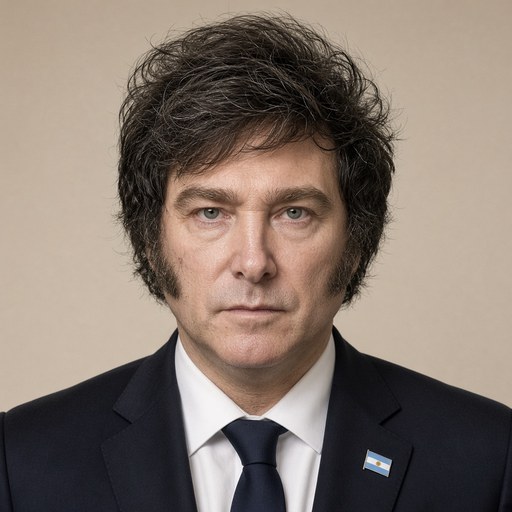
Words of the President of the Nation, Javier Milei, at the Tech Forum Argentina 2024, Hotel Libertador.
 Javier Milei · President of Argentina
- Context
- Milei addressed the Tech Forum Argentina 2024 at Hotel Libertador on October 19, 2024, speaking on technology, capitalism, and creative destruction.
- Main themes
- Creative destruction, technological progress, free market capitalism, labor market flexibility, increasing returns and monopoly regulation, Luddite fallacy, economic growth theory, libertarian liberalism, opposition to political control, Schumpeter's theories, Argentina's economic transformation
- Duration
- ~45 min
- Words
- 5,356
- Sentences
- 267
- Readability
- 59
- Grade
- 9.9
- Syntax
- 2.91
- Vocabulary
- 2.01
Translated from Spanish
The broad sphere of national life a sentence belongs to. Every sentence has an Arena, so it is the denominator the other indices are read against.
Other267 sentences in 44 paragraphs
Hello everyone. It is very interesting to return to this place and this room. Some of you here may not know it, probably the vast majority, but in this room we celebrated winning the first round. In this very room, we celebrated that we entered the second round and, as could not be otherwise, we celebrated that we were the first libertarian liberal government in the history of humanity.
Moreover, it is interesting because we had to choose a place to be. In the end, it became my home: the Hotel Libertador, it could not be otherwise than the Hotel Libertador, and to top it off, the colors of the hotel are violet; it is the color of La Libertad Avanza, it is the color of the political sign that will put Argentina back on its feet and will make it a power again.
Now, moving into the formal part, I will try not to deviate much from the speech, so we do not get into complicated loops. But, to begin, I want to greet and thank the authorities of Tech Forum for organizing such an important event. It is a pride for me, being a staunch defender of a free enterprise capitalism that has produced the greatest technological expansion in our history, to address an audience that bets daily on discovering new solutions to our everyday problems, knowing that, if they are successful in their endeavor, their efforts will be richly rewarded by the market.
As strange as it may sound to hear this from my mouth, I would also like to thank the Marxists, with their nefarious ideas, because if it were not for them, Schumpeter would never have developed the concept of creative destruction, which is what brings us all together here today. For me, Schumpeter's topic is very interesting. The concept of creative destruction is in a book called "Capitalism, Socialism and Democracy," and he basically develops this idea of creative destruction. These kinds of issues today in the world, I would almost say that, while they are not questioned within the models of economic growth literature — and by the way, that is my specialization — it is very difficult to deal with the issue of regulators. The concept of creative destruction is very interesting because, obviously, like everything that is new and like all innovation, it always generates fear. So, you find, for example, that many politicians are afraid of this; they are afraid of the new, of the unknown, so to speak.
One of the big discussions is what is going to happen with jobs.
The first thing I would like to tell you is that, if the Luddites were right — which is a reflection that is made and that has to do with Ludd, who was basically someone who lost his job because the loom appeared — then, basically, they went and broke the machine. The reality is that, if the Luddites were right, today the unemployment rate in the world would be 87.5%, which would make no sense, because, if new jobs had not been created, in the best of worlds the same jobs would have been created. But the population multiplied by eight times, therefore, we would be in quite an interesting problem, and that does not happen. So, there is no need to fear technological progress: jobs will be destroyed, but new ones will be created. Therefore, that is not a problem as long as there is flexibility in the labor market. There will be no problems and we will all have jobs. The problem is that politicians like control and do not like flexibility. But then, the problem is not technology; the problem is politicians. As it happens, the problem is politicians.
And then there is another issue that has to do with economic growth. This issue of the dystopian case is deactivated, which actually also has its answer in Smith, and which relates to the fact that the division of labor is limited by the size of the market. Therefore, all those dystopian scenarios that believe that machines directly eat humans… The question is: what are they doing all that development for? Someone is going to have to demand it, right? And they are humans. Moreover, those who invest and put in the resources are also humans. Therefore, that dystopian scenario also makes no sense.
Having dispelled the fears, there is another issue: technological progress generates increasing returns. And there is a problem there, because economic theory is not developed appropriately to contemplate these events. Consequently, when they see increasing returns, they associate them with monopoly and want to regulate them. Politicians always want to regulate, I don’t know if because they want to appropriate the rents or if they are really concerned about efficiency, so to speak, from a paritarian point of view. That is also a sinister concept. It must be clear: sinister is sinister, left, it makes no difference. I mean, those who called the left "sinister" were not wrong. And yes, I am Milei, and I cannot change.
I must have been speaking for seven minutes, and only one was of speech, and six were outside. These things happen. The issue of increasing returns is interesting because, in neoclassical theory, they are associated with monopolies. Therefore, what politicians do is regulate monopolies. The problem is that, when they want to assimilate a competitive company, they kill the present returns and, consequently, they kill economic growth. If you look, what is the most regulated area of the world? Europe. And what is the most miserable growth rate in the world? Europe. That is to say, that is why Argentina is a great opportunity. Beyond all the structural reforms we are making, there is nothing we hate more than regulations. In fact, we have a ministry dedicated to deregulation.
But returning to the speech, because at some point I had to return, I say that, to put it a bit in context, it is estimated that the human species has been around for about 300,000 years, of which we were hunter-gatherers for 290,000 years. That is, during all that time, we were nomads. There was no cooking, architecture, much less writing and even less engineering. However, at some point, about 10,000 years ago, we began to cultivate the land and congregated in cities. This led to an exponential flood of development, with which we colonized the entire planet, navigated all waters, built unimaginable monuments for our ancestors, and conquered mountain after mountain. Thanks to the exponentiality of this process, we managed that, in the last 200 years, the average citizen had the standard of living of a Roman emperor. This was what I was describing as increasing returns.
When you look at the evolution of GDP per capita in the Christian era, let’s say between the year zero and the year 2000, you will see something called "hockey stick." That is in all economic growth books and it is like a stick, literally, of hockey lying down. So, all of you have a long and constant part, and suddenly the tail lifts. Basically, the entire part that is constant goes from the year zero to 1800, and the strong growth, let’s say, occurs from the year 1800 to 2000. In fact, the growth of GDP per capita during the first 1800 years of the Christian era was 0.02%, that is, it took 3,500 years to double GDP. GDP per capita, in the years from 1800 to 2000, multiplied by 9.5 times, in a context where the population multiplied by seven. Therefore, see how the hypothesis of diminishing marginal returns was destroyed, and I would tell you that everything related to artificial intelligence will generate this increase in productivity that is truly like a minuscule act.
Again, returning to what we were pointing out earlier, put in mathematical terms: if we take Gutenberg's printing press from the year 1450 as the great civilizational year of our species, we estimate that 95% of technological and scientific advances occurred after this milestone. This means that 95% of human inventions occurred in the last 0.2% of the history of our species. To be clear about the moment we are living in: we have never lived as we are living now. Never has man been better than he is now.
There is an author who also fascinates me in terms of economic growth, named Oded Galor, who seems to have started following me on Twitter because I keep quoting him. Yes, in fact, they even offered to introduce me to him. This author did a phenomenal job, which is the unification of economic growth theory. Because if you take the period from year zero to 1800, that could be perfectly explained by Malthus. And if you take the 200 years that follow, actually, while the Solow model is aesthetically reasonable, empirically it is weak, and they move to endogenous growth models to explain this issue of acceleration and increasing returns.
And the genius of Oded Galor is that, in his model, he manages to reconcile the vision of the Malthusian model with the endogenous growth models. He has two points of trigger. The first trigger in the technological aspect has to do with the printing press, because it gives rise to human capital. As it is a human capital model, as a mechanism for generating growth, two facets of human capital intervene: not only the quantity of work but also the training. So, there is a trigger regarding the emergence of the printing press as a mechanism for transmitting knowledge. And there is another trigger that has to do with when the population reaches one billion human beings. That is, at the moment when Malthus predicted the great catastrophe. I say "catastrophe" later because of the Club of Rome and all the green killers that are around, neo-Marxists who pose the problem of man with nature and want to fix the world by killing innocents, such as abortionists.
So, there we have a good explanation of what we are living. And returning to the printing press, this evolutionary leap marked that in the last two centuries we went from not being able to guarantee ourselves two meals a day to having conquered the atom, the air, and space, even discussing how long it will take us to conquer Mars or how long it will be before we are replaced by robots or artificial intelligences for everyday things. A true marvel. I don’t know if you saw the new version of Optimus; it is wonderful. Aside from my deep admiration for Elon Musk, I don’t know if you saw the gesture that Optimus makes, which makes me like him a little more now.
So, I would tell you that, without going any further, raise your hand if you have used ChatGPT at least once in the last 30 days. It was a given, it was a penalty kick, with no goalkeeper. This penalty would not have been missed even by Pipita Higuaín in a final.
Therefore, technology is the greatest demonstration of the capabilities that human beings have, both individually and collectively. Each technological innovation is a step that humanity has taken in solving a problem, allowing itself to have leisure time to solve the next one. As you can see, I am optimistic, and it shows. You know there is a group that are techno-pessimists and see everything negatively, but well, let them go and meet with the Marxists and make a place for themselves with the cave men. Marxism is a self-fulfilling prophecy.
So, look, because this is the logic of human beings. Not because there was darkness, yes, we invented whale oil to light the streets and our homes. Whale oil ran out, we discovered coal and the chemistry that allowed that coal to become kerosene. Kerosene was not enough, and we developed electric energy. Coal is expensive and inefficient as fuel for the engine. We found and learned to process oil more cheaply and efficiently. There was not enough food to feed 6 billion people; we invented the genetic revolution in agriculture, which allowed us to multiply our production and of which Argentina was a special protagonist. That is, as an ancient proverb says: necessity is the mother of invention.
Here I also want to make a note about one of the greatest techno-activists in the history of humanity, Julian Simon. He is not so popular; I always say that pessimists have better press, I don’t know why, but…
I imagine there must be some psychological explanation for that, but I don’t know it. Julian Simon said that technological progress could be driven from two sides, either from the demand side or from the supply side. The growth we just described is growth from the demand side. That is, when a problem arises, if you let prices express themselves freely, you will find a reallocation of resources until a solution to the problem is found. In fact, I often use this example when I say that entrepreneurs are social benefactors.
I can do it with something recent that everyone will remember. At the moment COVID appeared and the problem of the pandemic, one of the things that was recommended was the use of masks and mass testing. That has to do with a model, which is used to analyze pandemics or epidemics, called SIR, susceptible, infected, and removed, where clearly the mask lowers the transmission rate and the tests remove the infected more quickly and therefore lower the speed of transmission.
I mention this because yesterday left this world that sinister being who was the unpresentable and repugnant Minister of Health that we had, accomplice of the largest caveman quarantine in history, and who was also responsible, along with former President Alberto Fernández, for the death of 100,000 Argentines. Because if Argentina had done things like a mediocre country, there would have been 30,000 deaths; however, we surpassed 130,000. Therefore, despite the fact that he died and people like to express themselves, it seems that the dead become good. This was a son of a thousand bitches and will be remembered as a son of a bitch. Since at some point there will be justice for what was done with the masks and especially for what was done with the testing.
And the reality is that economic policy had answers for this type of thing, because if there is a substantial, deep change in demand, and you stop demanding certain goods and start demanding others, that translates into a change in relative prices. And you take resources from the sector that needs to contract and send them to the other. And that is feasible because there is the price signal. The problem is that when politicians come in and want to control prices, the resources that need to fall do fall, but those that need to be transferred to the other sector do not happen. Thus, you have an enormous loss of welfare, and in this case, these mistakes made by politicians cost the lives of many human beings. Therefore, this is also a song in favor of the ideas of freedom. If we had applied the ideas of freedom, we would have had many fewer deaths. And not only that, but also, in an anarcho-capitalist model, we would not have had a piece of garbage president who used the quarantine and extended it for political reasons to improve his image and have a better electoral result. So, when anarcho-capitalists want to blow up the State, they are right.
Therefore, one of the ways that generates technological progress is precisely through this situation where the movement of demand generates quasi-rent and the intention of individuals to solve problems. What this generates is that technological progress appears and the problem is solved. But for that, you need to have freedom. The other way has to do with technological progress driven by the supply side. That is to say, very much against the grain of all those who want to murder children in the womb of their mothers. Because basically the question is: if I want to find a Mozart, what is the probability of finding him in a population of 100 people versus one of a million people? It seems to me that the result is obvious. Therefore, I also thought it was interesting for us to understand the logic of technological progress, how these processes are generated, how important the price system and freedom are, and that we do not go around killing people.
Does anyone want to do a calculation...? To see if we can banish these leftist stupidities that want to murder people. If I tell you...
Are you with the calculator? Good, okay. Because they say there is no room for everyone on the planet... Well, you are going to spoil the result for me, I won't do anything... Well, then I could tell you let’s see how many people live per square kilometer in Japan, but you are going to tell me they live like Japanese. I ask you a question: Do you like, for example, how people live in Monaco? Can anyone find out how many people live per square kilometer in Monaco? If I'm not mistaken, it’s 39,200 but... check it. Well, let’s say 36,000.
How many square kilometers does Argentina have? 3 million? Well, let’s multiply that number by 3 million. What does it give? No, what 1.08... it has to give you a number... Well, that’s it, take it and extend it... It’s 108 billion. Now take that 108, to eliminate zeros, divided by 8, which is 8 billion, which is what lives on planet Earth. That is to say that today in Argentina, the entire population of planet Earth would fit in 13 and a half times. And all the rest of the planet would be left to do whatever they want. Do you realize that all those who go around murdering people do so because they are ignorant or because they are sons of bitches?
Therefore, it is thus that the miracles of the past are the mundane facts of the present and what today seems to us only a dream will tomorrow be something of an ordinary reality. Moreover, since the discovery of the internet, which as an example of this miraculous life allows us to have the Library of Alexandria in our pocket, we indulge in having constant access to more information than all the great philosophers of our history combined. The expansion in productive development of recent centuries is a testament not only to the fact that greater innovation leads to greater prosperity, but above all that it is the advance of freedom that engenders innovation. That is why, to the extent that we have secured civil and economic liberties, which are a natural right of man, the pace of technological development has accelerated. I believe I have repeated to the point of exhaustion that those countries that are freer are 12 and a half times richer than the repressed. They have 25 times fewer poor people in the standard format and 50 times fewer in the extreme format. That is why I am deeply committed to making Argentina the freest country on the planet, so that we can be the most prosperous country on the planet.
Moreover, thanks to trade, it was possible to access new technologies developed by third parties, and thanks to competition, the processes of discovery became increasingly sophisticated and specialized, forming increasingly complex companies, in which all those involved benefit from each discovery. Something like a combination of Smith-Hayek dixit, it would be. All this, of course, the heroes of the golden age of Argentina knew and implemented. It is no coincidence that Roca said that trade knows better than the government what is good for him. True politics consists, then, in granting the highest freedom. And we are certainly doing that. Paradoxically, today to move towards the future we must reconnect with truths that are in the deep past of our nation and that the rest of the world seems to be forgetting.
There will always be a struggle between the private and the State, between those who innovate and those who regulate, between those who generate and those who confiscate, between those who explore the territory and those who then draw the maps and set the limits, between the supposed chaos of the daring and the order of the fearful. This struggle is today made explicit in how some States of the supposed free nations treat their technological sectors. Political leaderships infected with socialism impose regulation upon regulation, and the visionaries of the sector have no choice but to flee. As Ayn Rand said, when you notice that to produce you need to obtain authorization from those who produce nothing, then you can assert without fear of being wrong that your society is doomed.
Double-clicking on what I just mentioned about the individual wanting to free himself from state claws, today was largely characterized by representatives of blockchain technology and cryptocurrencies, who propose to kick the board in many aspects. The first and most important of them is that they propose to separate political power from economic control. As Hayek rightly anticipated, this is a clear proof that the individual said enough to the State and decided to put a brake where it hurts the most, which is the pocket. Citizens of the world are tired of monetary policy and economic shamanism, of inflation, of a parasite being able to triple the monetary base on a whim as if it were innocuous, when it is not only not innocuous, but also pushes hundreds of thousands into poverty with the push of a button, with no other end than to obtain political gain.
If they don’t come and explain it to me, that the previous government issued 13 points of GDP in a year and left me the bomb planted the next. Yes, they lost, but we have to work hard to lower inflation.
That is to say, it is no coincidence that the countries with the greatest fiscal irresponsibility, like Argentina until we arrived, are the ones with the most adoption and development of this type of technology.
And of course, to escape from the thieving politicians. As it should be. They are doing well.
Today, as an individual who, temporarily, let it be clear, presides over the great Nation of Argentina, I believe that we, the rulers, cannot turn a deaf ear to the people's demand that cries out for less State. Because we can choose to ignore reality, but the consequences will come knocking at our door. Can you imagine that running the State for me is music to my ears? So, the more they want of this, the better. And to know the consequences of ignoring this request, it is enough to look at the last 100 years of Argentina: destruction of capital, economic and financial crises, default, hyperinflations, civil unrest, productive stagnation, technological lag, and poverty levels above 50%. How could it be otherwise, if Argentina is designed to fit the political caste and not the citizens? If in Argentina even machines pay Gross Income, Check Tax, customs duties, and a myriad of taxes that reach the pockets of a few, harming the whole. A few days ago, a video went viral comparing a national olive pitter with a European one. And the European one pitted forty times faster. Why can they do it in Europe and not here? It has to do with all the obstacles and regulations that exist here.
As I told you before, to retrace this path we must reconnect with truths that are in the deep past of our history. That is what we have come to do. Embrace trade and competition and make them our highest standards, so that Argentines can access cutting-edge technology at competitive prices without enriching useless customs officials along the way. So that the productivity of all our workers can be enhanced, being able to access better tools from all over the world, which multiply the value generated by Argentines.
As we proposed in the Pact of May, we are working to propose a federal model marked by fiscal competition, with few national taxes to guarantee the functioning of the State and security, so that then each province and municipality can decide what tax burden they want to impose on their citizens, and it is they who have the possibility to choose the lifestyle they wish to live and know perfectly what they receive or stop receiving for the taxes they pay. In fact, we are making progress on this, we are forcing them to remove municipal fees from the bills, and those who resist and do not want to do it, we take away the branches of Banco Nación. And if not, we propose to Banco Nación to separate it so that they know how much has to do with the service and how much with the fiscal degenerates. This way, it also starts to be seen in prices how those who are charging them taxes are the ones ruining their lives. This is how we are also starting to generate competition between provinces and municipalities. Thus, provinces and municipalities with fiscal responsibility will be attractive and will prosper. And those that do not will have to explain to their voters why their provinces are becoming poorer. Do you know what it is for a mayor, who has them in his face all day, to explain to them that he charges them more taxes to have a worse life than others? You do not realize the moment we are living. It is wonderful. We are breaking all the foundations of this lie called the State.
That is to say, there is no other way. We want to be attractive again for capital and for citizens from all over the world, as we were a hundred years ago, when we were the greatest land of opportunities in the world. Although it may seem unbelievable, when people left Europe, they chose to go either to the United States, which was right in front of them, or to come to a very distant place, which was Argentina. It is incredible, because for those conditions, at that time, it was much riskier to come to Argentina, so imagine how attractive it was. And basically what we want is to be a promised land again. At the same time, it is interesting, because while Argentina opens up to competition, today many leading countries in the world are turning in the opposite direction. This is incredible, but we have already realized, after a hundred years, that we were wrong and that this was going nowhere. The incredible thing is that we have already realized, we started to turn back, and there are others who are copying the Argentine model, that is, it is shooting themselves in the foot. I do not understand it. That is why many times I go to international forums and tell them that I come from an apocalyptic future, what they are doing we have already done and it does not work. But the problem is that there is a matter of incompatibility of incentives. If you remember, during the campaign I used to say that while a traditional politician asks you for your vote to give him the power to transform your life... and in the meantime transforms his own... we asked for the vote to return power to the citizens, so that they are the architects of their own future.
Evidently, in the politician's box, the difference is substantial. That is to say, the more corrupt the politician, the more he will want the other model, the more he will like intervention and the good socialist... Because in the middle, they keep more money. Like that saying that the one who distributes keeps the best part. Well, that's what it's about. We do not like that model; we want to return freedom to the citizens, and we are certainly doing that.
With the Bases Law and the DNU, we made a structural reform that is eight times larger than the one Menem made, considering that Menem made the largest structural reform in Argentine history. In other words, you are truly facing a historic moment, where we made the largest structural reform in Argentine history. And we did that with 15% of the Chamber of Deputies and 10% of the Senate. What sounded impossible, we did. There is nothing that is impossible. None of your dreams are impossible. All your dreams can come true. The only thing you need is to have confidence. And you will have confidence when you stand in your own shoes and not when the State is doing it for you, because then you will do nothing. Moreover, those two reforms, which are actually 800, but in two packages, imply a leap in the levels of economic freedom of 90 positions. That is to say, today Argentina institutionally would start to resemble countries like Germany, France, or Italy. But that is not enough for me. We have 3,200 structural reforms pending. And our goal is to undoubtedly become the freest country on the planet, and do not doubt that we will achieve it.
So, while some Western powers underestimate the role of freedom in technological development and consequently in prosperity itself, Argentina embraces the ideas of freedom again after more than a century. And while developed countries become weighed down by unjustified regulations and scare away technological investment, we remove regulations and invite Argentine and world capital to develop here. We want to be a refuge for those who bet on technological development, both here and across the globe, because we trust in the natural relationship between freedom, innovation, and economic progress. Because as a country, we have learned that the alternative to freedom, innovation, and progress is the misery we have become accustomed to living in... well, but we resist and wanted to break free starting from what we did on November 19 of last year, when we turned our backs on the populists and decided to put a libertarian liberal for the first time in the history of humanity, which I celebrated here... And also, because we know that the unique condition that distinguishes human beings from animals, which is the condition to create, resides in a basic tenet of the human spirit: to always go beyond. Because when we reach a goal, we do not rest on our laurels; we ask ourselves what comes next and seek the next frontier. Always advance, never retreat. That is why technological optimism is almost a moral obligation, because our future depends on it. And that is why we cannot lose the Promethean spirit, that curiosity that is so human, nor the courage to pursue it.
We cannot allow ourselves to be intimidated by those who fear change, and in a flagrant act of intellectual dishonesty, see in it only a source of evils, when history indicates the opposite. Technological innovation is nothing more than doing more with less. There is no need to fear it. On the contrary, we should fear inertia, stillness, stagnation. In fact, the only thing to fear is fear itself. Well... you already know us... we are clearly not afraid, and when we encounter an obstacle, we do not stop; we accelerate. That is how we do things, and that is how we are going to take Argentina out of the 100 years of misery to which it has been condemned. Because if we embrace the ideas of freedom that once made us great again, I have no doubt that Argentina will be prosperous, and I have no doubt that the future will be better than the present.
Thank you very much, may God bless the Argentines, and may the forces of heaven accompany us. Long live freedom, damn it! Long live freedom, damn it!
Long live freedom, damn it!
The original Spanish. The tags above are read on the English translation's sentences.
Hola a todos. Es muy interesante volver a este lugar y a esta sala. Puede que algunos de los que estén acá no lo sepan, probablemente la gran mayoría, pero en esta sala hemos festejado ganar la primera vuelta. En esta misma sala, festejamos que entramos a la segunda vuelta y, como no podía ser de otra manera, festejamos que fuimos el primer gobierno liberal libertario de la historia de la humanidad.
Además, es interesante porque teníamos que elegir un lugar donde estar. Al final, se convirtió en mi casa: el Hotel Libertador, no podía ser de otra manera que el Hotel Libertador, y como si fuera poco, los colores del hotel son violeta; es el color de La Libertad Avanza, es el color del signo político que va a poner de pie a la Argentina y que la va a convertir en una potencia nuevamente.
Ahora, entrando en la parte formal, voy a tratar de no desviarme mucho del discurso, así no entramos en loops complicados. Pero, para comenzar, quiero saludar y agradecer a las autoridades de Tech Forum por la organización de un evento de esta importancia. Es un orgullo para mí, siendo un férreo defensor de un capitalismo de libre empresa que ha producido la mayor expansión tecnológica de nuestra historia, poder dirigirme a un público que apuesta diariamente a descubrir nuevas soluciones para nuestros problemas cotidianos, sabiendo que, en caso de ser exitosos en su cometido, sus esfuerzos serán recompensados con creces por el mercado.
Por muy raro que parezca escuchar esto de mi boca, me gustaría también agradecer a los marxistas, con sus ideas nefastas, porque de no ser por ellas, Schumpeter nunca hubiera desarrollado el concepto de destrucción creativa, que es lo que nos congrega a todos los aquí presentes. Para mí, el tema de Schumpeter es muy interesante. El concepto de destrucción creativa está en un libro que se llama “Capitalismo, socialismo y democracia”, y él básicamente desarrolla esta idea de la destrucción creativa. Este tipo de cuestiones hoy en el mundo, casi les diría que, si bien no se cuestionan dentro de lo que son los modelos de la literatura de crecimiento económico —y dicho sea de paso que es mi especialización—, es muy difícil lidiar con el tema de los reguladores. Es muy interesante el concepto de destrucción creativa porque, obviamente, como todo lo que es nuevo y como toda innovación, siempre genera temor. Entonces, ustedes, por ejemplo, una de las cosas que se encuentran es que muchos de los políticos tienen miedo a esto; le tienen miedo a lo nuevo, a lo desconocido, digamos.
Una de las grandes discusiones es lo que va a pasar con los puestos de trabajo.
Lo primero que quisiera contarles es que, si tuvieran razón los luditas — que es una reflexión que se hace y que tiene que ver con Ludd, quien básicamente fue alguien que se quedó sin empleo porque apareció el telar—, entonces, básicamente, fueron y rompieron la máquina. La realidad es que, si tuvieran razón los luditas, hoy la tasa de desempleo en el mundo sería del 87,5%, lo cual no tendría ningún sentido, porque, si no se hubieran creado nuevos empleos, en el mejor de los mundos se habrían creado los mismos. Pero la población se multiplicó por ocho veces, por lo tanto, estaríamos en un problema bastante interesante, y eso no ocurre. Entonces, no hay que tenerle miedo al progreso tecnológico: se van a destruir empleos, pero se van a crear nuevos. Por lo tanto, eso no es un problema en tanto y en cuanto haya flexibilidad en el mercado laboral. No va a haber problemas y todos vamos a tener trabajo. El problema es que a los políticos les gusta el control y no les gusta la flexibilidad. Pero entonces, el problema no es la tecnología; el problema son los políticos. Como ocurre, el problema son los políticos.
Y después hay otro tema más que tiene que ver con el crecimiento económico. Está desactivado este tema del caso distópico, que en realidad también tiene su respuesta en Smith, y que se relaciona con que la división del trabajo está limitada por el tamaño del mercado. Por lo tanto, todos esos escenarios distópicos que creen que directamente las máquinas se comen a los humanos… La pregunta es: ¿para qué están haciendo todo ese desarrollo? Alguien lo va a tener que demandar, ¿no? Y son humanos. Además, quienes invierten y ponen los recursos también son humanos. Por lo tanto, ese escenario distópico tampoco tiene sentido.
Habiendo ahuyentado los miedos, hay otra cuestión más: el progreso tecnológico genera rendimientos crecientes. Y ahí hay un problema, porque la teoría económica no está desarrollada de manera apropiada para contemplar estos eventos. Consecuentemente, cuando ven rendimientos crecientes, los asocian con monopolio y quieren regularlos. Los políticos siempre quieren regular, no sé si porque quieren apropiarse de las rentas o si realmente están preocupados por la eficiencia, digamos, desde el punto de vista paritiano. Eso también es un concepto siniestro. Tiene que quedar claro: siniestro es siniestro, izquierda, da lo mismo. O sea, no se equivocaron los que le pusieron “siniestro” a la izquierda. Y sí, soy Milei, y no puedo cambiar.
Debo llevar siete minutos de discurso, y solamente uno fue de discurso, y seis por afuera. Estas cosas pasan. La cuestión de los rendimientos crecientes es interesante porque, en la teoría neoclásica, están asociados con los monopolios. Por lo tanto, lo que hacen los políticos es regular los monopolios. El problema es que, cuando quieren asimilar a una empresa competitiva, matan los rendimientos presentes y, consecuentemente, matan el crecimiento económico. Si ustedes se fijan, ¿cuál es la zona del mundo más regulada? Europa. ¿Y cuál es la tasa de crecimiento más miserable del mundo? Europa. Es decir, por eso Argentina es una gran oportunidad. Más allá de todas las reformas estructurales que estamos haciendo, no hay nada que odiemos más que las regulaciones. De hecho, tenemos un ministerio que se dedica a desregular.
Pero volviendo al discurso, porque en algún momento tenía que volver, digo que, para poner un poco en contexto, se estima que la especie humana tiene alrededor de 300,000 años, de los cuales fuimos cazadores-recolectores durante 290.000 años. O sea, durante todo ese tiempo, fuimos nómades. No había cocina, arquitectura, mucho menos escritura y menos aún ingeniería. Sin embargo, en algún momento, hace cerca de 10.000 años, empezamos a cultivar la tierra y nos congregamos en ciudades. Esto dio lugar a un aluvión exponencial de desarrollo, con el que colonizamos todo el planeta entero, navegamos todas las aguas, construimos monumentos inimaginables para nuestros antepasados y conquistamos montañas tras montañas. Gracias a la exponencialidad de este proceso, logramos que, en los últimos 200 años, el ciudadano promedio tuviera el nivel de vida de un emperador romano. Esto era lo que estaba describiendo como rendimiento creciente.
Ustedes, cuando miran la evolución del PBI per cápita en la era cristiana, digamos entre el año cero y el año 2000, van a ver algo que se llama "palo de hockey". Eso está en todos los libros de crecimiento económico y es como si fuera un palo, literalmente, de hockey acostado. Entonces, todos ustedes tienen una parte larga y constante, y de repente la cola levanta. Básicamente, toda la parte que es constante va desde el año cero al 1800, y el fuerte crecimiento, digamos, lo tienen desde el año 1800 al 2000. De hecho, el crecimiento del PBI per cápita durante los primeros 1800 años en la era cristiana fue del 0,02%, o sea, se necesitaban 3500 años para duplicar el PBI. El PBI per cápita, en los años que van del 1800 al 2000, se multiplicó por 9,5 veces, en un contexto donde la población se multiplicó por siete. Por lo tanto, vean cómo se destruyó la hipótesis de los rendimientos marginales decrecientes, y les diría que todo lo que tiene que ver con inteligencia artificial va a generar este incremento de la productividad que verdaderamente es como un acto minúsculo.
De nuevo, volviendo a lo que estábamos señalando antes, puesto en términos matemáticos: si tomamos la imprenta de Gutenberg desde el año 1450 como el gran año civilizatorio de nuestra especie, estimamos que el 95% de los avances tecnológicos y científicos se dieron después de este hito. Esto significa que el 95% de los inventos humanos se dieron en el último 0,2% de la historia de nuestra especie. Para que tengamos claro el momento en el que estamos viviendo: nunca vivimos como estamos viviendo. Nunca el hombre estuvo mejor que como está ahora.
Hay un autor que a mí también me fascina en materia de crecimiento económico, que se llama Oded Galor, que parece que, a fuerza de citarlo, me empezó a seguir en Twitter. Sí, es más, hasta me ofrecieron presentármelo y todo. Este autor hizo un trabajo fenomenal, que es la unificación de la teoría del crecimiento económico. Porque si ustedes toman el período entre el año cero y el 1800, eso podría ser explicado a la perfección por Malthus. Y si ustedes toman lo que son los 200 años que le siguen, en realidad, si bien el modelo de Solow es una cosa estéticamente razonable, empíricamente es flojo, y se pasan a los modelos de crecimiento endógeno para poder explicar esta cuestión de la aceleración y los rendimientos crecientes.
Y la genialidad de Oded Galor es que, a su modelo, logra conciliar la visión del modelo maltusiano con los modelos de crecimiento endógeno. Tiene dos puntos de disparo. El primer punto de disparo en lo tecnológico tiene que ver con la imprenta, porque es lo que da lugar al capital humano. Como es un modelo de capital humano, como mecanismo de generación de crecimiento, intervienen dos facetas de capital humano: no solo la cantidad de trabajo, sino la formación. Entonces, hay un disparo por lo que tiene que ver con la aparición de la imprenta como mecanismo de transmisión del conocimiento. Y hay otro disparo que tiene que ver con cuando la población llega a mil millones de seres humanos. Es decir, en el momento en el cual, Malthus predecía la gran catástrofe. Digo "catástrofe" después por el Club de Roma y por todos los asesinos verdes que andan dando vuelta, neomarxistas que plantean el problema del hombre con la naturaleza y quieren arreglar el mundo matando inocentes, llámese a los aborteros.
Así que, ahí tenemos una buena explicación de lo que estamos viviendo. Y volviendo a la imprenta, este salto evolutivo marcó que en los últimos dos siglos pasáramos de no poder garantizarnos dos comidas diarias a haber conquistado el átomo, el aire y el espacio, incluso a estar discutiendo en cuánto tardaremos en conquistar Marte o cuánto falta para ser reemplazados por robots o inteligencias artificiales para cosas cotidianas. Una verdadera maravilla. No sé si vieron la nueva versión de Optimus; es maravilloso. Al margen de mi admiración profunda por Elon Musk, no sé si vieron el gesto que hace Optimus, con lo cual ahora, digamos, lo quiero un poquito más.
Así es que, yo les diría que, sin ir más lejos, levanten la mano los que hayan usado alguna vez ChatGPT en los últimos 30 días. Era cantado, era penal, sin arquero. Este penal no lo erraba ni el pipita Higuaín en una final.
Por ende, la tecnología es la mayor muestra de las capacidades que tiene el ser humano, tanto a nivel individual como colectivo. Cada innovación tecnológica es un paso que ha dado el hombre en solucionar un problema, permitiéndose tener tiempo ocioso para resolver el siguiente. Como verán, yo soy optimista, y se nota. Saben que hay un grupo que son los tecnopecimistas y ven todo mal, pero bueno, que vayan y se vean con los marxistas y que se hagan un lugar con los hombres en las cavernas. El marxismo es una profecía autocumplida.
Entonces, fíjense, porque esta es la lógica del ser humano. No porque había oscuridad, sí inventamos el aceite de ballena para iluminar las calles y nuestros hogares. Se le acabó el aceite de ballena, descubrimos el carbón y la química que logró permitir que ese carbón en queroseno. No alcanzaba el queroseno y desarrollamos la energía eléctrica. El carbón es caro e ineficiente como combustible para el motor. Encontramos y aprendimos a procesar el petróleo de forma más barata y eficiente. No alcanzaba la comida para alimentar a 6000 millones de personas; inventamos la revolución genética en la agricultura, que nos permitió multiplicar nuestra producción y de la que Argentina fue especial protagonista. O sea, tal como reza un proverbio antiguo: la necesidad es la madre de la inventiva.
Acá también quiero hacer una nota de color sobre uno de los más grandes tecnoactivistas de la historia de la humanidad, que es Julian Simon. No es tan popular; siempre digo que los pesimistas tienen mejor prensa, si no sé por qué, pero…
Me imagino que debe haber alguna explicación psicológica para eso, pero yo no la sé. Julian Simon decía que el progreso tecnológico se podía impulsar por dos lados, ya sea por el lado de la demanda o por el lado de la oferta. El crecimiento que acabamos de describir es el crecimiento por el lado de la demanda. Es decir, cuando aparece algún problema, si ustedes dejan que los precios se expresen libremente, se van a encontrar con una reasignación de recursos hasta que se encuentre la solución al problema. De hecho suelo utilizar mucho este ejemplo, cuando digo que los empresarios son benefactores sociales.
Lo puedo hacer con algo reciente, que todos van a recordar. En el momento en que apareció el COVID y el problema de la pandemia una de las cosas que se recomendaba era el uso del barbijo y el testeo masivo. Eso tiene que ver con un modelo, que es el que se utiliza para analizar las pandemias o las epidemias, que se llama SIR, susceptibles, infectados y removidos, donde claramente el barbijo baja la tasa de transmisión y los testeos remueven más rápidamente a los infectados y por ende bajan la velocidad de transmisión.
Lo menciono porque en el día de ayer dejó este mundo ese ser siniestro que fue el impresentable y repugnante ministro de Salud que tuvimos, cómplice de la cuarentena cavernícola más grande de la historia, y que además fue el responsable, junto al ex presidente Alberto Fernández, de la muerte de 100 mil argentinos. Porque si Argentina hubiera hecho las cosas como un país mediocre hubiera habido 30 mil muertos, sin embargo nosotros pasamos los 130 mil. Por lo tanto, a pesar de que murió y a la gente le gusta manifestar, parece que los muertos se vuelven buenos. Este era un hijo de re mil puta y será recordado como un hijo de puta. Ya que en algún momento va a haber justicia por lo que se hizo con los barbijos y muy especialmente por lo que se hizo con los testeos.
Y la realidad es que la política económica tenía respuestas para este tipo de cosas, porque si se da un cambio sustancial, profundo de la demanda, y ustedes dejan de demandar determinados bienes y pasan a demandar otros, eso se traduce en un cambio de precios relativos. Y ustedes sacan recursos del sector donde se tiene que contraer y los mandan al otro. Y eso es factible porque está la señal de precios. El problema es que cuando aparecen los políticos y quieren controlar precios, los recursos que tienen que caer caen, pero los que se tienen que trasladar al otro sector no ocurre. Con lo cual tienen una pérdida de bienestar enorme, y en este caso, estos errores de que los políticos metieron la mano le costaron la vida a muchos seres humanos. Por lo tanto esto también es un canto a favor de las ideas de la libertad. Si hubiéramos aplicado las ideas de la libertad hubiésemos tenido muchos menos muertos. Y no sólo eso, sino que además, en un modelo anarcocapitalista no hubiéramos tenido a una basura de presidente que utilizó la cuarentena y la extendió por motivos políticos para mejorar su imagen y tener un mejor resultado electoral. Así que, cuando los anarcocapitalistas quieren reventar el Estado, tienen razón.
Por lo tanto, una de las formas que genera progreso tecnológico es, justamente, por esta situación donde el movimiento de la demanda genera la cuasi renta y la intención de los individuos de arreglar los problemas. Eso lo que genera es que aparezca el progreso tecnológico y se resuelva el problema. Pero para eso ustedes necesitan que haya libertad. La otra forma tiene que ver con el progreso tecnológico impulsado por el lado de la oferta. Es decir, muy a contramano de todos estos que quieren asesinar niños en el vientre de la madre. Porque básicamente la pregunta es: si yo quiero encontrar un Mozart, ¿cuál es la probabilidad de encontrarlo en una población de 100 personas, versus una de un millón de personas? Me parece que el resultado es obvio. Por lo tanto, me pareció también que era interesante que entendamos la lógica del progreso tecnológico, de cómo se generan estos procesos, de lo importante que es el sistema de precios y la libertad, y que no andemos matando gente.
¿Alguien quiere hacer una cuenta…? Para ver si desterramos estas estupideces de zurdos que quieren asesinar gente. Si yo les digo…
¿Estás con la calculadora? Bien, ok. Porque dicen que no hay lugar para todos en el planeta… Bueno, me vas a spoilear el resultado, no hago nada… Bueno, entonces yo les podría decir veamos cuántas personas viven por kilómetro cuadrado en Japón, pero me van a decir que viven como japoneses. Les hago una pregunta: ¿Les gusta, por ejemplo, cómo vive la gente en Mónaco? ¿Alguien puede averiguar cuántas personas viven por kilómetro cuadrado en Mónaco? Si no me equivoco son 39.200 pero… chequeenló. Bueno, ponele 36 mil.
¿Cuántos kilómetros cuadrados tiene la Argentina? ¿3 millones? Bueno, multipliquemos ese número por 3 millones. ¿Cuánto da? No, qué 1,08… te tiene que dar un número… Bueno, por eso, agarrá y extendelo… 108 mil millones son. Ahora tomen ese 108, para ir eliminando ceros, dividido 8, que es 8 mil millones, que es lo que vive en el planeta Tierra. Es decir que hoy en la Argentina entraría 13 veces y medio toda la población del planeta Tierra. Y quedaría todo el resto del planeta para hacer todo lo que quieran. Se dan cuenta que todos esos que andan asesinando gente es porque son ignorantes o porque son unos hijos de puta.
Por lo tanto, es así que los milagros del pasado son los hechos mundanos del presente y aquello que hoy nos parece sólo un sueño, mañana será algo de una realidad ordinaria. Más aún, desde el descubrimiento de internet, que como ejemplo de esta vida milagrosa nos permite tener la Biblioteca de Alejandría en el bolsillo, nos damos el lujo de tener acceso constante a más información de la que tuvieron todos los grandes filósofos de nuestra historia combinados. La expansión en desarrollo productivo de los últimos siglos es testamento no solo de que a mayor innovación, mayor prosperidad, sino sobre todo de que es el avance de la libertad lo que engendra la innovación. Por eso, en la medida en que hemos asegurado las libertades civiles y económicas, que son un derecho natural del hombre, el ritmo del desarrollo tecnológico se ha acelerado. Creo que he repetido hasta el cansancio que aquellos países que son más libres son 12 veces y medio más ricos que los reprimidos. Tienen 25 veces menos de pobres en el formato estándar y 50 veces menos en el formato extremo. Por eso estoy profundamente comprometido en que Argentina sea el país más libre del planeta, para que seamos el país más próspero del planeta.
Es más, gracias al comercio se pudo acceder a nuevas tecnologías desarrolladas por terceros, y gracias a la competencia, los procesos de descubrimiento se volvieron cada vez más sofisticados y especializados, formando empresas cada vez más complejas, en la cual todos los involucrados se ven beneficiados por cada descubrimiento. Algo así como una combinación de Smith-Hayek dixit, vendría a ser. Todo esto, por supuesto, los héroes de la era dorada argentina lo sabían y lo implementaron. No por nada Roca dijo que el comercio sabía mejor que el gobierno lo que a él le conviene. La verdadera política consiste, pues, en dejarle la más alta libertad. Y vaya que nosotros lo estamos haciendo. Paradójicamente, hoy para ir hacia el futuro tenemos que reencontrarnos con verdades que están en el pasado profundo de nuestra nación y que el resto del mundo parece estar olvidando.
Siempre habrá una puja entre el privado y el Estado, entre quienes innovan y quienes regulan, entre quienes generan y quienes confiscan, entre quienes exploran el territorio y quienes luego dibujan los mapas y trazan los límites, entre el supuesto caos de los temerarios y el orden de los temerosos. Esta puja hoy se hace explícita en cómo algunos Estados de las supuestas naciones libres tratan a sus sectores tecnológicos. Dirigencias políticas infectadas de socialismo les imponen regulación sobre regulación y a los visionarios del sector no les queda otra que huir. Como dijo Ayn Rand, cuando usted advierta que para producir necesita obtener autorización de quienes no producen nada, entonces podrá afirmar sin temor a equivocarse que su sociedad está condenada.
Haciendo doble click sobre lo que mencioné recién del individuo queriendo librarse de las garras estatales, el día de la fecha estuvo protagonizado en gran medida por referentes de la tecnología blockchain y las criptomonedas, que se proponen patear el tablero en muchos aspectos. El primero y más importante de ellos es que se proponen separar al poder político del control económico. Como bien lo anticipó Hayek, esto es una prueba cabal de que el individuo le dijo basta al Estado y decidió ponerle un freno donde más le duele, que es el bolsillo. Los ciudadanos del mundo están cansados de la política monetaria y el chamanismo económico, de la inflación, de que un zángano pueda triplicar la base monetaria por capricho como si fuera inocuo, siendo que no solo no es inocuo, sino que aparte empuja a la pobreza a cientos de miles con el accionar de un botón, sin ningún otro fin que el de obtener rédito político.
Sino vienen y me lo explican a mí, que el gobierno anterior emitió 13 puntos del PBI en un año y me dejó la bomba plantada al otro. Sí, perdieron, pero bien que tenemos que laburar para bajar la inflación.
Es decir, no es casualidad que los países con mayor irresponsabilidad fiscal, como Argentina hasta que llegamos nosotros, sean los que más adopción y desarrollo tengan de este tipo de tecnologías.
Y claro, para escaparse de los políticos ladrones. Como tenía que ser. Lo bien que hacen.
Hoy como individuo que, transitoriamente, que les quede bien claro, preside la gran Nación Argentina, considero que los gobernantes no podemos hacer oídos sordos al pedido de la gente que exige a gritos menos Estado. Porque podemos elegir ignorar la realidad, pero las consecuencias van a venir a tocarnos la puerta. Se imaginan que correr al Estado para mí es música para mis oídos. Así que, cuanto más quieran de esto, mejor. Y para conocer las consecuencias de ignorar este pedido, alcanza con ver los últimos 100 años de Argentina: destrucción de capital, crisis económicas y financieras, default, hiperinflaciones, estallidos civiles, estancamiento productivo, rezago tecnológico y niveles de pobreza superiores al 50%. Cómo iba a ser de otra manera, si la Argentina está pensada a medida de la casta política y no de los ciudadanos. Si en Argentina hasta las máquinas pagan Ingresos Brutos, Impuesto al cheque, aranceles aduaneros y un sinfín de impuestos que les llegan al bolsillo a un par, perjudicando al conjunto. Hace unos días se viralizó un video que comparaba una descarozadora de aceitunas nacional con una europea. Y la europea descarozaba cuarenta veces más rápido. ¿Por qué en Europa pueden y acá no? Tiene que ver con todas las trabas y las regulaciones que hay acá.
Como les decía antes, para desandar este camino tenemos que reencontrarnos con verdades que están en el pasado profundo de nuestra historia. Eso es lo que venimos a hacer. Abrazar el comercio y la competencia y convertirlos en nuestros más altos estándares, para que los argentinos puedan acceder a tecnología de punta a precios competitivos sin enriquecer a aduaneros inútiles en el camino. Para que la productividad de todos nuestros trabajadores se potencie, pudiendo acceder a mejores herramientas de todo el mundo, que multipliquen el valor generado por los argentinos.
Tal como propusimos en el Pacto de Mayo, nosotros estamos trabajando para proponer un modelo federal marcado por la competencia fiscal, con pocos impuestos nacionales para garantizar el funcionamiento del Estado y la seguridad, para que luego cada provincia y municipio pueda decidir qué carga impositiva quiere imponer sobre sus ciudadanos, y sean estos quienes tengan la posibilidad de elegir el estilo de vida que deseen vivir y sepan perfectamente qué reciben o dejan de recibir por los impuestos que pagan. De hecho estamos avanzando en esto, estamos obligando a que quiten de las facturas las tasas municipales, y aquellos que se resistan y no lo quieran hacer, les sacamos las sucursales del Banco Nación. Y si no, le proponemos al Banco Nación que lo separe para que sepan cuánto tiene que ver con el servicio y cuánto con los degenerados fiscales. Así se empieza a ver también en los precios cómo aquellos que están cobrándoles impuestos son los que les están arruinando la vida. Así estamos empezando a generar también la competencia entre provincias y municipios. Así las provincias y municipios con responsabilidad fiscal serán atractivos y prosperarán. Y los que no, tendrán que explicarles a sus votantes por qué sus provincias se empobrecen. ¿Saben lo que es para un intendente, que los tiene todo el día en la cara, explicarles que les cobra más impuestos para tener una vida peor que los demás? Ustedes no se dan cuenta del momento que estamos viviendo. Es maravilloso. Les estamos rompiendo todas las bases de esta mentira llamada Estado.
Es decir, no hay otro camino. Queremos volver a ser atractivos para el capital y para los ciudadanos de todo el mundo, como lo fuimos hace cien años, cuando fuimos la mayor tierra de oportunidades del mundo. Aunque parezca mentira, la gente cuando salía de Europa elegía ir o a Estados Unidos, que lo tenía enfrente por decirlo de alguna manera, o venir a un lugar muy lejano, que era Argentina. Es increíble, porque para esas condiciones, en aquel tiempo, era mucho más arriesgado venir a la Argentina, así que imagínense todo lo atractivo que era. Y básicamente lo que nosotros queremos es volver a ser una tierra prometida. Al mismo tiempo, es interesante, porque mientras la Argentina se abre a la competencia, hoy muchos países líderes del mundo giran en la dirección contraria. Esto es increíble, pero nosotros ya nos dimos cuenta, después de cien años que le erramos y que esto no iba para ningún lado. Lo increíble es que nosotros ya nos dimos cuenta, empezamos a pegar la vuelta, y hay otros que están copiando el modelo argentino, o sea, es pegarse un tiro en los pies. Yo no lo entiendo. Por eso muchas veces voy a los foros internacionales y les digo que vengo de un futuro apocalíptico, lo que están haciendo ya lo hicimos y no funciona. Pero el problema es que hay una cuestión de incompatibilidad de incentivos. Si ustedes recuerdan, durante la campaña yo solía decir que mientras que un político tradicional te pide el voto para que le des el poder para transformar tu vida… y en el medio transforma la propia… nosotros pedíamos el voto para devolverles el poder a los ciudadanos, para que sean los propios arquitectos de su propio futuro.
Evidentemente, en la caja del político la diferencia es sustancial. Es decir, cuanto más corrupto es el político, más va a querer el otro modelo, más le va a gustar la intervención y el buenísimo socialista… Porque en el medio se quedan con más plata. Como el dicho ese de que el que reparte se queda con la mejor parte. Bueno, de eso se trata. A nosotros no nos gusta ese modelo, queremos devolverles la libertad a los ciudadanos, y vaya que lo estamos haciendo.
Nosotros con la Ley Bases y el DNU hicimos una reforma estructural que es ocho veces más grande que la que hizo Menem, siendo que Menem hizo la reforma estructural más grande de la historia argentina. Es decir, ustedes están verdaderamente frente a un momento histórico, donde hicimos la reforma estructural más grande de la historia argentina. Y eso lo hicimos con el 15% de la Cámara de Diputados y el 10% de la Cámara de Senadores. Eso que sonaba imposible, lo hicimos nosotros. No hay nada que no sea imposible. Ninguno de sus sueños es imposible. Todos sus sueños los pueden hacer realidad. Lo único que necesitan es tener confianza. Y la confianza la van a tener cuando ustedes se paren en sus propios zapatos y no cuando lo esté haciendo el Estado por ustedes, porque entonces no van a hacer nada. Es más, esas dos reformas, que en realidad son 800, pero en dos paquetes, implica un salto en los niveles de libertad económica de 90 puestos. Es decir, hoy Argentina institucionalmente empezaría a parecerse a países como Alemania, Francia o Italia. Pero a mí eso no me resulta suficiente. Nosotros tenemos 3.200 reformas estructurales pendientes. Y nuestro objetivo es convertirnos sin lugar a dudas en el país más libre del planeta, y no tengan dudas que lo vamos a lograr.
Entonces, mientras que algunas potencias de Occidente menosprecian el papel de la libertad en el desarrollo tecnológico y en consecuencia en la prosperidad misma, la Argentina vuelve a abrazar las ideas de la libertad después de más de un siglo. Y mientras los países desarrollados se vuelven pesados en regulaciones injustificadas y ahuyentan la inversión tecnológica, nosotros quitamos las regulaciones e invitamos a los capitales argentinos y del mundo a desarrollarse aquí. Nosotros queremos ser un refugio para quienes apuestan al desarrollo tecnológico, tanto aquí como a lo largo y ancho del planeta, porque confiamos en la relación natural entre libertad, innovación y progreso económico. Porque como país hemos aprendido que la alternativa a la libertad, la innovación y el progreso es la miseria en la que nos hemos acostumbrado a vivir… bueno, pero nos resistimos y quisimos salir a partir de lo que hicimos el 19 de noviembre del año pasado, cuando le dimos la espalda a los populistas y decidimos poner a un liberal libertario por primera vez en la historia de la humanidad, que lo festejé acá… Y además, porque sabemos que la condición única que tiene el ser humano que lo distingue de los animales, que es la condición de crear, reside una consigna básica del espíritu humano: ir siempre más allá. Porque cuando alcanzamos un objetivo no nos sentamos en nuestros laureles, nos preguntamos qué sigue y buscamos la próxima frontera. Siempre avanzar, nunca retroceder. Por eso el optimismo tecnológico es casi una obligación moral, porque nuestro futuro depende de ello. Y por eso no podemos perder el espíritu prometeico, esa curiosidad que es tan humana, ni tampoco la valentía para perseguirla.
No podemos permitir que nos amedrenten quienes tienen miedo al cambio, y en un acto flagrante de deshonestidad intelectual ven en él solo una fuente de males, cuando la historia indica todo lo contrario. La innovación tecnológica no es otra cosa que hacer más con menos. No hay que tenerle miedo. Al contrario, hay que tenerle miedo a la inercia, a la quietud, al estancamiento. Es más, a lo único a lo que hay que tenerle miedo es al miedo mismo. Bueno… a nosotros ya nos conocen… no tenemos miedo, claramente, y cuando encontramos un obstáculo no frenamos, aceleramos. Así hacemos las cosas y así es como vamos a sacar a la Argentina de los 100 años de miseria a la que la condenaron. Porque si volvemos a abrazar las ideas de la libertad que alguna vez nos hicieron grandes, no tengo dudas que la Argentina será próspera, y no tengo dudas que el futuro será mejor que el presente.
Muchas gracias, que Dios bendiga a los argentinos y que las fuerzas del cielo nos acompañen. ¡Viva la libertad, carajo! ¡Viva la libertad, carajo!
¡Viva la libertad, carajo!