




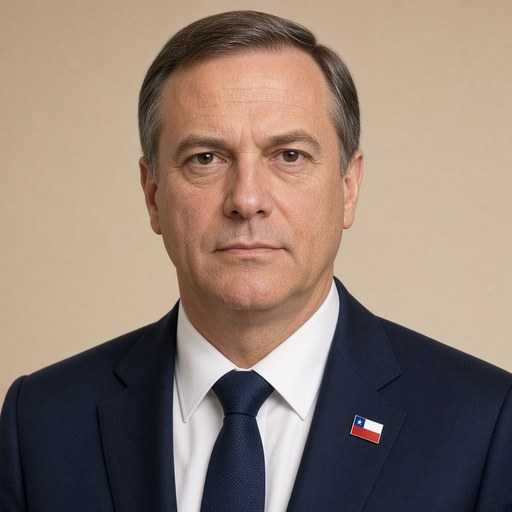
His Excellency the President of the Republic, José Antonio Kast, accompanied by the Minister of Education, María Paz Arzola, and the Minister of Security, Trinidad Steinert, signs bills to improve security in educational institutions.
 José Antonio Kast · Leader of the Republican Party (Chile)
- Context
- Kast signed two school safety bills in April 2026, responding to the murder of a student in Calama, aimed at protecting educational institutions across Chile.
- Main themes
- School safety legislation, violence in educational institutions, murder of Victoria Reyes, protected schools bill, disciplinary authority for teachers, student identification requirements, aggravating factors for crimes in schools, drug and weapons in schools, school coexistence, educational security reform
- Duration
- ~14 min
- Words
- 1,695
- Sentences
- 81
- Readability
- 53
- Grade
- 11.0
- Syntax
- 2.94
- Vocabulary
- 2.05
Translated from Spanish
The broad sphere of national life a sentence belongs to. Every sentence has an Arena, so it is the denominator the other indices are read against.
Other81 sentences in 31 paragraphs
Good morning.
I thank all the media for joining us today. I thank our ministers and undersecretaries for the work they have done in this regard.
There is a before and after the murder of Victoria Reyes in Calama. It moved us all, it affected us all; no one could believe what was happening that day. It was not only the school community of Calama that was affected, but all of Chile. It was a tearing, it was a deep pain in all school communities, and we also saw how that same day and the following day, reports and concerns increased in all school communities across Chile.
This was not a murder, a homicide, an attack in a dark street, in an abandoned place. No, it was inside a place that we all assume is safe, where our children, our grandchildren go, where a school community coexists and interacts. It was inside an educational establishment. It is something that moves us, it is something we had not seen with such a degree of violence in our homeland, and we must do everything possible to prevent this from happening again.
Here we are not only talking about a dramatic event such as a murder; we are also talking about injuries, assaults, mistreatment, the use of incendiary devices, the use of drugs, the carrying of weapons, a series of situations that have been taking root and that unfortunately some are normalizing. Our children, our teachers, our inspectors, education assistants are being exposed to situations that we cannot tolerate, much less normalize.
That is why today, living the urgency and importance, and as a government, we must act clearly when these serious issues or situations arise, we are sending to Congress today, we are going to send two bills aimed at having safe schools, protected schools, and also establishing an aggravating factor when these crimes are committed in an educational establishment or its vicinity.
The first project is the one that talks about protected schools, and this project is based on the simple conviction that in school, authority must prevail, never violence. And what does it propose, among other things? That the holders, those who have dedicated their lives, whether a religious establishment, a group of parents or teachers, a municipality, now the SLEPs, who dedicate their time to establishing the formula for educating through curricula and everything, should have the option to check the backpacks and belongings of people entering the establishments to precisely prevent the entry of dangerous items.
It also establishes that teachers have the real pedagogical and disciplinary tools that are mandatory for students and that allow them to maintain something as basic as order in the classroom.
That interrupting or halting classes be considered a violation, a serious violation of school coexistence. There is no possibility of learning, of incorporating the knowledge that a teacher transmits with effort if in class the students do not respect the authority of the teacher.
It also establishes that those convicted of serious crimes against persons or property cannot access free higher education.
This is very important because sometimes children and adolescents are led by even adults to commit violent actions against their peers, teachers, members of the school community, or against public property, when some of them leave the establishment and nothing happens. We want that to change, that everyone takes responsibility for their actions that affect other people or the well-being of others.
It also establishes something that is common sense, that students be uncovered. Why would a student intend to cover their face in the establishment or upon leaving the establishment? Why wear hoods? Why wear, when not in an academic action, these famous white overalls? Why hide? What are they afraid of? When one does something right, they have no fear of facing a sanction.
Therefore, we do not find it reasonable or pertinent that hoods, balaclavas, or anything that prevents identification be used. This safeguards everything related to health issues, to matters of faith, because there may be someone who has a health situation that requires wearing a certain hat or covering their face with a mask or something that goes in line with health, not with interrupting classes and not with the use of violence against peers or any member of the school community.
Schools, colleges are places to study, to learn, not to hide one’s face and commit violent acts against others.
These are measures that have been requested by the students themselves, those students who do not belong to these more violent groups and feel terrified, are prevented from continuing to study because a small group is generally the one that interrupts classes, exercises violence, and threatens their classmates, threatens teachers, administrators, and all the people who collaborate within the educational establishment so that young people can study.
These are measures that the Government is willing to implement, and that is why we ask Congress to legislate promptly. Chile cannot continue to wait for another violent event like the one that Chile, Calama, and the family of this murdered inspector in Calama suffered.
A second bill modifies the Penal Code to establish a new aggravating factor of criminal responsibility because committing a crime inside an educational establishment, in its premises or in the vicinity of the educational establishment cannot continue to be sanctioned with the same law that we know today. This has to change.
How many times have we lamented the attack on a young person in the vicinity of the school? Because this violence that is often exercised inside the school ends up outside the school, with a young person stabbed. Well, that will also be considered an aggravating factor when applying a sanction to the person who commits that crime.
This is not a declaration of principles. It is not that we say: look, this is what we would like to do. This is a conviction that the Government has and that the vast majority of Chileans have. We must act, not only be present, not only talk, but this must be concretized in very precise measures like those we are sending in these bills, and for which, again, I insist, we need the collaboration of all political sectors.
Because violence in schools has no political color. The life of any of our children or members of an educational establishment, of the educational community has no political color. This Government was elected precisely by the majority of Chileans to restore, to recover order, common sense, and authority.
Nothing is more serious for a society than teachers not having the authority to carry out a class. I mentioned it in a previous intervention. On that occasion when a young woman threw a jar of water at the Minister of Education, we saw when violence began, and we still do not know where it could end. Because this could, if we do not take measures, end up even worse than what we all had to live through and lament in this school in Calama.
We will never hide the figures. In this, you can be assured that we will show the real figures in all areas. Because our intention is to show the real situation in this area that can involve school violence, in the issue of security. You will see records. So that together, with a primary obligation of the Government, we can take measures so that those figures improve and improve the quality of life of our compatriots.
Teachers, inspectors, education assistants should be clear that we will be with you. We will do everything possible to protect you. We will implement all measures and change all the norms that are necessary for school coexistence to return to what it always was, a meeting place, a place where we all have the opportunity to learn.
To the parents, to the mothers, to the guardians, we also ask for your collaboration. This is not against your children. It is in favor of your children.
We need a greater commitment from parents and guardians. We need you to be present in schools. These actions must be recorded later in the school coexistence regulations.
We need each parent and guardian to know the school coexistence regulations. That is the starting point for there to be good quality education and life in our educational establishments.
Those who believe that a school, a high school, a school is a place where one can assault, threaten, or commit crimes with impunity must be clear that things are going to change. We will apply the law, we will apply the regulations, and everyone will have to take responsibility for their actions.
Ministers, thank you very much for the work. Thank you for having also promptly gone to Calama, where you will also return to continue working and supporting the families of that educational establishment. I also thank you for all the dialogues you have opened, the dialogues with the directors that you have carried out. In two regions, you have already met in each place with more than 100 directors of educational establishments. The dialogues you have begun to have with different neighborhood units, with people who only cry out for the law to be applied, for us to live in peace again.
And to the Ministers of Justice, the spokesperson minister, to the minister who has the role of going to Congress and defending, or rather proposing, and coordinating efforts, José García Ruminot, thank you very much, and to the Minister of Social Development. Because here we also have to ensure and see to the reception, because between Social Development and Justice we also work for reintegration.
A young person can commit an offense, can commit a crime, and that does not have to condemn them for life. As long as they also have the permanent intention to recover what is their inner peace, what is to recover their coexistence in society. And that is something that the Minister of Justice is also concerned about, and he will have the full collaboration of the Minister of Social Development.
So, thank you very much, and we will now proceed to sign the bills.
The original Spanish. The tags above are read on the English translation's sentences.
Muy buenos días.
Les agradezco a todos los medios de comunicación por acompañarnos en este día. Les agradezco a nuestros ministros y subsecretarios por el trabajo que han realizado en esta línea.
Hay un antes y un después del asesinato de Victoria Reyes en Calama. A todos nos conmovió, a todos nos afectó, nadie podía creer lo que estaba ocurriendo ese día. No solamente la comunidad escolar de Calama se vio afectada, sino todo Chile. Fue un desgarro, fue un dolor profundo en todas las comunidades escolares y vimos también como ese mismo día y al día siguiente aumentaron las denuncias y la preocupación en todas las comunidades escolares a lo largo de Chile.
Esto no fue un asesinato, un homicidio, un ataque en una calle oscura, en un lugar abandonado. No, fue al interior de un lugar que todos suponemos seguro, donde van nuestros hijos, nuestros nietos, donde una comunidad escolar convive, se vincula. Fue al interior de un establecimiento educacional. Es algo que nos conmueve, es algo que no habíamos visto con tal grado de violencia en nuestra Patria y tenemos que hacer todo lo posible para evitar que esto vuelva a ocurrir.
Aquí no solamente estamos hablando en este caso de un hecho dramático como es un asesinato, también hablamos de lesiones, de agresiones, de malos tratos, de uso de elementos incendiarios, de uso de drogas, de porte de armas, una serie de situaciones que se han ido instalando y que lamentablemente algunos van normalizando. Nuestros niños, nuestros profesores, nuestros inspectores, asistentes de la educación, están siendo expuestos a situaciones que no podemos tolerar ni menos normalizar.
Por eso, el día de hoy, viviendo la urgencia y la importancia, y como un gobierno tiene que actuar claramente cuando se dan estos temas o estas situaciones graves, enviamos al Congreso, el día de hoy, vamos a enviar dos proyectos de ley que van en la línea de tener escuelas seguras, escuelas protegidas y, también, instalar un agravante cuando estos delitos sean cometidos en un establecimiento educacional o en sus inmediaciones.
El primer proyecto es el proyecto que habla de las escuelas protegidas y este proyecto parte de esta convicción simple que en la escuela tiene que mandar la autoridad, nunca la violencia. ¿Y qué propone, entre otras cosas? Que los sostenedores, aquellos que han dedicado su vida, sea un establecimiento religioso, sea un grupo de apoderados o profesores, un municipio, ahora los SLEP, que les dedican el tiempo a establecer la fórmula de poder educar a través de los currículums y todo, que puedan tener la opción de revisar las mochilas y las pertenencias de las personas que ingresen a los establecimientos para precisamente evitar el ingreso de elementos peligrosos.
También, establece que los docentes tengan las herramientas pedagógicas y disciplinarias reales, que sean obligatorias para los alumnos y que les permita mantener algo tan básico como el orden en la sala de clases.
Que interrumpir o paralizar clases sea considerado como una falta, una falta grave a la convivencia escolar. No hay posibilidad de aprender, de incorporar los conocimientos que transmite con esfuerzo un profesor si en la clase los alumnos no respetan la autoridad del mismo docente.
También, establece que quienes sean condenados por delitos graves contra las personas o la propiedad no puedan acceder a la gratuidad en la educación superior.
Esto es muy importante, porque hay veces que niños y adolescentes, son llevados por incluso adultos a realizar acciones violentas en contra de sus compañeros, docentes, miembros de la comunidad escolar o contra bienes públicos, cuando algunos de ellos salen del establecimiento y no pasa nada. Nosotros queremos que eso vaya cambiando, que cada uno se haga responsable de los actos donde afecte a otras personas o el bienestar de otras personas.
También, se establece algo que es de sentido común, que los estudiantes estén a cara descubierta. ¿Por qué un estudiante tendría intención de cubrir su rostro en el establecimiento o a la salida del establecimiento? ¿Por qué usar pasamontañas? ¿Por qué usar, cuando no se está en una acción académica, estos famosos overoles blancos? ¿Por qué ocultarse? ¿A qué le temen? Cuando uno hace algo correcto no tiene temor de tener una sanción.
Por lo tanto, no encontramos razonable ni pertinente que se ocupen capuchas, se ocupen pasamontañas ni nada que impida la identificación. Se resguarda así todo lo que diga relación con temas de salud, con temas de fe, porque puede haber alguien que tenga una situación de salud que requiera usar un determinado gorro o cubrirse la cara con una mascarilla o algo que vaya en la línea de la salud, no de la interrupción de clases y no en el uso de la violencia en contra de compañeros o de algún miembro de la comunidad escolar.
Las escuelas, los colegios son lugares para estudiar, para aprender, no para ocultar el rostro y con eso cometer actos violentos en contra de otras personas.
Estas son medidas que nos han pedido los propios alumnos, aquellos alumnos que no integran estos grupos más violentos y se ven atemorizados, se ven impedidos de poder seguir estudiando, porque un grupo pequeño generalmente son los que interrumpen las clases, los que ejercen la violencia y los que amenazan a sus compañeros de curso, amenazan a docentes, a directivos, a todas las personas que colaboran dentro del establecimiento educacional para que los jóvenes puedan estudiar.
Estas son medidas que el Gobierno tiene la voluntad de concretar y por eso le solicitamos al Congreso legislar con prontitud. Chile no puede seguir esperando que ocurra otro hecho violento como el que sufrió Chile, Calama y la familia de esta inspectora asesinada en Calama.
Un segundo proyecto de ley modifica el Código Penal para establecer una nueva agravante de responsabilidad penal, porque cometer un delito al interior de un establecimiento educacional, en sus dependencias o en las inmediaciones del establecimiento educacional no puede seguir siendo sancionado con la misma ley que hoy día conocemos. Esto tiene que cambiar.
¿Cuántas veces hemos lamentado el ataque a un joven en las inmediaciones del colegio? Porque esta violencia que se ejerce muchas veces dentro del colegio termina en las afueras del colegio, con un joven acuchillado. Bueno, eso también se va a considerar una agravante en el momento de aplicar una sanción a la persona que cometa ese delito.
Esta no es una declaración de principios. No es que digamos: mire, esto es lo que nos gustaría hacer. Esto es una convicción que tiene el Gobierno y que tiene la inmensa mayoría de los chilenos. Tenemos que actuar, no solamente estar, no solamente hablar, sino que esto se tiene que concretar en medidas muy precisas como las que estamos enviando en estos proyectos de ley y para lo cual, nuevamente, insisto, necesitamos la colaboración de todos los sectores políticos.
Porque la violencia en las escuelas no tiene color político. La vida de cualquiera de nuestros niños o miembros de un establecimiento educacional, de la comunidad educativa no tiene color político. Este Gobierno fue elegido precisamente por la mayoría de los chilenos para devolver, para recuperar el orden, el sentido común y la autoridad.
Nada es más grave para una sociedad que los profesores no tengan la autoridad para poder llevar adelante una clase. Lo mencioné en una intervención anterior. Aquella ocasión donde una joven arrojó un jarro de agua a la ministra de Educación, vimos cuando partió la violencia y todavía no sabemos dónde podría terminar. Porque esto podría, si no tomamos medidas, terminar aún más grave que lo que nos tocó vivir a todos y lamentar en este colegio en Calama.
Nunca vamos a esconder las cifras. En eso tengan la certeza de que vamos a ir mostrando en todas las áreas las cifras reales. Porque nuestra intención es mostrar la situación real en esta área que puede involucrar la violencia escolar, en el tema de la seguridad. Ustedes van a ir viendo registros. Para que juntos y con una obligación primordial del Gobierno vayamos tomando las medidas, para que esas cifras vayan mejorando y vayan mejorando la calidad de vida de nuestros compatriotas.
Los profesores, los inspectores, los asistentes de educación tengan claro que vamos a estar con ustedes. Vamos a hacer todo lo posible por protegerlos. Instalar todas las medidas y cambiar todas las normas que sean necesarias para que la convivencia escolar vuelva a ser lo que siempre fue, un lugar de encuentro, un lugar donde todos tenemos posibilidad de aprender.
A los padres, a las madres, a los apoderados les pedimos también su colaboración. Esto no es en contra de sus hijos. Es a favor de sus hijos.
Necesitamos un compromiso mayor de los padres y apoderados. Necesitamos que ustedes se hagan presentes en las escuelas. De estas acciones tienen que quedar registros luego en los reglamentos de convivencia escolar.
Necesitamos que cada padre y apoderado conozca los reglamentos de convivencia escolar. Ese es el punto inicial para que pueda haber una buena calidad de educación y de vida en nuestros establecimientos educacionales.
Quienes crean que un colegio, un liceo, una escuela es un lugar donde se pueda agredir, amenazar o delinquir impunemente, tienen que tener claro que las cosas van a cambiar. Vamos a aplicar la ley, vamos a aplicar los reglamentos y cada uno tendrá que hacerse responsable de sus acciones.
Ministras, muchas gracias por el trabajo. Gracias por haber acudido también prontamente a Calama, donde ustedes también van a volver para seguir trabajando y acompañando a las familias de ese establecimiento educacional. Les agradezco también todos los diálogos que han abierto, los diálogos con los directores que usted ha llevado adelante. Ya en dos regiones se ha reunido en cada lugar con más de 100 directores de establecimientos educacionales. Los diálogos que han comenzado a tener con distintas unidades vecinales, con personas que lo único que claman es que se aplique la ley, que volvamos a vivir en paz.
Y a los ministros de Justicia, la ministra vocera, al ministro que le toca el rol de ir al Congreso y defender, o plantear más bien, y coordinar los esfuerzos, José García Ruminot, también muchas gracias, y a la ministra de Desarrollo Social. Porque aquí también tenemos que velar y ver por el acogimiento, porque entre Desarrollo Social y Justicia trabajemos también por la reinserción.
Un joven puede cometer una falta, puede cometer un delito, y eso no tiene por qué condenarlo de por vida. En la medida que él también tenga la intención permanente de recuperar lo que es su paz interior, lo que es recuperar su convivencia en la sociedad. Y eso es algo que tiene también ocupado al ministro de Justicia, y va a contar con toda la colaboración también de la ministra de Desarrollo Social.
Así que, muchas gracias, y procedemos ahora a firmar los proyectos de ley.