




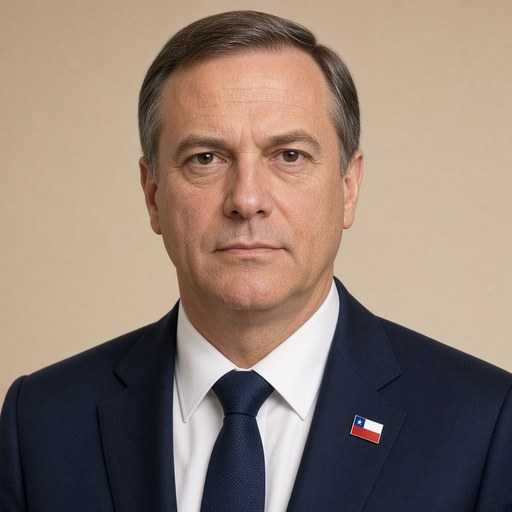
His Excellency the President of the Republic, José Antonio Kast, together with the Ministers of Justice, Fernando Rabat, and Public Security, Trinidad Steinert, promulgates the constitutional reform that transfers the Gendarmerie into the Forces of Order and Security.
 José Antonio Kast · Leader of the Republican Party (Chile)
- Context
- Kast addressed a ceremony at the Gendarmerie School in Chile on April 9, 2026, to promulgate a constitutional reform integrating Gendarmería into the Forces of Order and Security.
- Main themes
- Constitutional reform of Gendarmería, integration into Forces of Order and Security, organized crime in prisons, public security crisis, unified security leadership, Carabineros and Investigative Police coordination, human capital in penitentiary institutions, institutional capture by criminal networks
- Duration
- ~12 min
- Words
- 1,416
- Sentences
- 82
- Readability
- 52
- Grade
- 10.3
- Syntax
- 2.82
- Vocabulary
- 2.19
Translated from Spanish
The broad sphere of national life a sentence belongs to. Every sentence has an Arena, so it is the denominator the other indices are read against.
Other82 sentences in 32 paragraphs
Good afternoon, very, very good afternoon.
You cannot imagine the pride I feel to be here, at the Gendarmerie School. It is a tremendous institution. I have been pointing this out for many years, when I was a parliamentarian, just like the parliamentarians who are with us here: one always spoke of Carabineros de Chile, of the Police of Investigations, but it was always necessary to add Gendarmería de Chile.
This is a historic change. All changes generate doubts, generate concern, but let me tell you that our Government, the Government of Chile, is focused, concerned about highlighting this noble institution, which protects us, which collaborates with all Chileans, in a role that is sometimes unknown.
I make this introduction and now I want to greet the director of the school, Carol Araneda. Thank you very much for your selfless work, for defending the infrastructure for your students. We toured each of the facilities of Gendarmería.
Thank you also to you, aspirants and students. We apologize for the delay, because the delay causes havoc. Within the infrastructure that we lack, the director told us that shade is missing.
We will start from there. So, to the two ministers, and to the Minister of Public Works, and to all of you, we will commit to ensuring that the first thing we do is have a space within the school itself to hold an event like this. And where you can also receive families, where there is a meeting place.
Thank you, Mr. Director. I should have mentioned you first, but Mr. Rubén Pérez Riquelme, thank you for taking on the challenge in difficult times for the institution. Thank you for the words you mentioned, speaking of human capital, of the tradition of Gendarmería, of recognizing the work of each of your officials.
I want to tell you that this ceremony is also very important for us because of the presence of the national prosecutor. Thank you, prosecutor, for taking the time to be at this institution today.
Thank you, General Director of Carabineros, General Director of Investigations, who modified your agenda to be present today and to say, now we will be three noble, important institutions that will depend on the Ministry of Security. Just as the Armed Forces depend on the Ministry of Defense, you mentioned that to me on the way, well, now we will be three sister institutions that will work together.
Thank you, senator, because we find ourselves in an important social urgency, such as Health. Senator Castro, who is from the neighboring region of O'Higgins, is a member of the Health Commission, in his capacity as a doctor, but he also tells me now that he is in the Security Commission.
Thank you to the deputies, who within their obligations made time to be here and to say that they are also with the institution of Gendarmería.
Thank you, ministers, for accompanying us. We will ask the doctor to exercise his role. I will speak faster so as not to bore you further. Thank you, undersecretary, also, for being here.
Today we, as a Government, assume the commitment to act urgently in response to the security crisis that our Homeland is experiencing. Today, in this school, where the men and women who guard our prisons are trained, we promulgate a constitutional reform, which is a central part of this response. Gendarmería de Chile becomes part of the Forces of Order and Public Security. Together with Carabineros and the Police of Investigations, they will form a security system with unified strategic leadership.
Our prisons have gone through difficult times, and as the General Director of Gendarmería rightly said, before they become centers of operation for organized crime, we must act. In this, we also thank Prosecutor Pastén for his ongoing work in the fight against organized crime with information gathered from this great institution.
Because if not, from within the prisons, gangs will begin to coordinate and plan organized crime. This is not an exaggeration. In several countries, we have seen how this is a reality, where organized crime ends up capturing institutions that must safeguard society as a whole.
We also have to worry, as you mentioned, about human capital. That starts with the conditions in which our aspirants, our students, are trained to then remain and care for that vocation. What happens inside penitentiary facilities is not a separate problem, it is not something isolated. No, it is part of a phenomenon that affects our entire institutional framework, that puts politics at risk, that puts the Armed Forces at risk, that puts our Police at risk, that puts our society at risk. Gendarmería is not isolated from that danger. Organized crime operates in networks that do not distinguish between the prison and the cells.
That is why combating organized crime requires institutions to confront it, not to operate separately. That is a great advance of this reform. That Gendarmería, with its intelligence, which is extensive and very detailed, has information that is managed within the institution of Gendarmería that indicates how the most dangerous organized crime organizations in our country operate.
This intelligence must also be a resource so that together with Carabineros and the PDI they can make significant decisions on security issues. That is where we are working.
Today, with this reform, we give that coordination and an organic constitutional framework that was so necessary to confront this new phenomenon of organized crime.
This reform, among other things, makes some very concrete proposals. First, it incorporates Gendarmería into the Forces of Order and Security, endowing them with institutional links and we also hope for the necessary resources to properly develop their function and the constitutional recognition appropriate for a force of this rank.
Second, it unifies the strategic leadership of the institutions that combat crime. With Gendarmería under the tutelage of the Ministry of Public Security, we will have a chain of command and operational coordination that we simply did not know and did not have before.
Third, it clearly separates two functions that, although complementary, are distinct. As the Minister of Justice mentioned, the custody and penitentiary security pass to the Ministry of Public Security and the social reintegration of adults remains in the Ministry of Justice and Human Rights. Thus, each institution can better focus on what it has to do.
It is not about taking away powers from anyone. It is about organizing the State so that it functions coherently in the face of a threat that precisely demands that, coherence and decision.
Finally, I want to speak to you, who wear this uniform. Wear it with honor, wear it with pride. The work is hard, and we know that. You face situations daily that most Chileans cannot even imagine. You work in difficult conditions, with infrastructure that in many cases is not up to the level of the people who have to carry out this difficult mission. And with a growing and increasingly dangerous prison population.
Our Government recognizes this situation. And not only recognizes it, but wants to act accordingly. This reform, which has been worked on for some time, because this is a continuum, is not a reform that we can attribute solely to ourselves as a Government, but we acknowledge the Parliament and the previous government of Gabriel Boric for having advanced in this difficult task, because changes are difficult.
This reform is a clear signal that the State is on your side. That Chilean society needs and values you. That the President of the Republic supports you along with all his Government.
Today, by promulgating this reform of Gendarmería de Chile, Gendarmería is formally placed in the position it deserves, alongside the other institutions that ensure the safety of Chileans.
Chile is in a difficult moment. Citizens are fearful. They want to see the State act, they want to know that there is someone in charge and that the institutions function and that order is not an empty promise.
We came to Government to provide exactly that response. Urgently, with conviction, with the support of the institutions that make the security of Chileans possible.
Today, Gendarmería, as those who preceded me in speaking have rightly said, takes a historic step. And I, as President, have the honor of being part of that history. Thank you very much.
I reiterate my gratitude to all of you and that you take care, take care, always of your vocation.
Thank you very, very much.
The original Spanish. The tags above are read on the English translation's sentences.
Muy, muy buenas tardes.
No saben el orgullo que siento de estar aquí, en la Escuela de Gendarmería. Es una tremenda institución. Vengo señalando esto hace muchos años, cuando era parlamentario, igual que los parlamentarios que nos acompañan acá: que uno siempre hablaba de Carabineros de Chile, de la Policía de Investigaciones, pero siempre faltaba agregar Gendarmería de Chile.
Este es un cambio histórico. Todos los cambios generan dudas, generan preocupación, pero déjenme decirles que nuestro Gobierno, el Gobierno de Chile, está ocupado, preocupado de resaltar a esta noble institución, que nos cuida, que colabora con todos los chilenos, en una función que a veces es desconocida.
Hago esta introducción y ahora quiero saludar a la directora de la escuela, Carol Araneda. Muchas gracias por su labor abnegada, por defender la infraestructura para sus alumnos. Fuimos recorriendo cada una de las dependencias de Gendarmería.
Gracias también a ustedes, aspirantes y alumnos. Pedimos las disculpas por el retardo, porque el retardo causa estragos. Dentro de la infraestructura que nos falta, la directora nos decía que faltaba sombra.
Vamos a partir por ahí. Así que, a los dos ministros, y al ministro de Obras Públicas, y a todos los vamos a comprometer para que lo primero que hagamos sea tener un espacio dentro de la misma escuela para poder hacer un acto como este. Y donde ustedes puedan recibir también a las familias, donde haya un lugar de encuentro.
Gracias, señor director. Lo debería haber mencionado primero, pero don Rubén Pérez Riquelme, gracias por asumir el desafío en momentos difíciles para la institución. Gracias por las palabras que usted señala, hablando del capital humano, de la tradición de Gendarmería, de reconocer el trabajo de cada uno de sus funcionarios.
Quiero decirles que esta ceremonia para nosotros también es muy importante por la asistencia del fiscal nacional. Gracias, fiscal, por darse el tiempo para estar en esta institución hoy día acá.
Gracias, general director de Carabineros, director general de Investigaciones, que modificaron su agenda para poder estar hoy día presentes y decir, ahora vamos a ser tres instituciones nobles, importantes, que vamos a depender del Ministerio de Seguridad. Así como las Fuerzas Armadas dependen del Ministerio de Defensa, eso me lo comentaron ustedes en el camino, bueno, ahora vamos a ser tres instituciones hermanas que vamos a trabajar unidos.
Gracias, senador, porque nos encontramos en una urgencia social importante, como era Salud. El senador Castro, que es de la región vecina de O'Higgins, es miembro de la Comisión de Salud, en su condición de médico, pero también me dice ahora que está en la Comisión de Seguridad.
Gracias a los diputados, que dentro de las obligaciones que tienen se hicieron un espacio para estar acá y decir que también están con la institución de Gendarmería.
Gracias, ministros, por acompañarnos. Vamos a pedirle al doctor que ejerza su rol. Voy a hablar más rápido para que no siga aburriendo. Gracias, subsecretario, también, por estar aquí presente.
Hoy día asumimos como Gobierno el compromiso de actuar con urgencia frente a la crisis de seguridad que vive nuestra Patria. Hoy, en esta escuela, donde se forman los hombres y mujeres que custodian nuestras cárceles, promulgamos una reforma constitucional, que es parte central de esta respuesta. Gendarmería de Chile pasa a integrar las Fuerzas de Orden y Seguridad Pública. Junto a Carabineros, a la Policía de Investigaciones, formarán un sistema de seguridad con conducción estratégica unificada.
Nuestras cárceles han pasado por momentos difíciles, y como bien lo decía el director general de Gendarmería, antes de que pasen a convertirse en centros de operación del crimen organizado, tenemos que actuar. En eso también le damos las gracias al fiscal Pastén por su labor permanente en la persecución del crimen organizado con información que se recoge de esta gran institución.
Porque si no, desde dentro de las cárceles comenzarán a coordinarse las bandas y planificarán el crimen organizado. Esto no es exageración. En varios países hemos visto cómo esto es una realidad, donde el crimen organizado termina capturando instituciones que deben resguardar a la sociedad entera.
También tenemos que preocuparnos, como decía usted, del capital humano. Eso parte por las condiciones en las que nuestros aspirantes, nuestros alumnos, se forman para después permanecer y cuidar esa vocación. Lo que ocurre al interior de los recintos penitenciarios no es un problema separado, no es algo aislado. No, es parte de un fenómeno que afecta toda nuestra institucionalidad, que pone en riesgo la política, que pone en riesgo las Fuerzas Armadas, que pone en riesgo a nuestras Policías, que pone en riesgo a nuestra sociedad. Gendarmería no está aislada de ese peligro. El crimen organizado opera en redes que no distinguen entre la cárcel y las celdas.
Por eso, combatir el crimen organizado exige a las instituciones que lo enfrenten, no operen por separado. Ese es un gran adelanto de esta reforma. Que Gendarmería, con su inteligencia, que es mucha y muy detallada, hay información que se maneja dentro de la institución de Gendarmería que da a entender cómo operan las organizaciones de crimen organizado más peligrosas de nuestro país.
Esta inteligencia tiene que ser también un insumo para que junto con Carabineros y la PDI puedan tomar decisiones trascendentes en temas de seguridad. Hacia allá estamos trabajando.
Hoy con esta reforma le damos esa coordinación y un marco constitucional orgánico que era tan necesario para enfrentar este nuevo fenómeno del crimen organizado.
Esta reforma, entre otras, hace algunos planteamientos muy concretos. Primero, incorpora a Gendarmería a las Fuerzas de Orden y Seguridad, dotándolas de los vínculos institucionales y esperamos también de los recursos necesarios para desarrollar bien su función y el reconocimiento constitucional propio de una fuerza de este rango.
Segundo, unifica la conducción estratégica de las instituciones que combaten el delito. Con Gendarmería bajo la tuición del Ministerio de Seguridad Pública tendremos una cadena de mando y una coordinación operativa que hoy simplemente no conocíamos y no teníamos.
Tercero, separa con claridad dos funciones que, aunque complementarias son distintas. Lo mencionaba el Ministro de Justicia. La custodia y la seguridad penitenciaria pasan al Ministerio de Seguridad Pública y la reinserción social de adultos permanece en el Ministerio de Justicia y Derechos Humanos. Así, cada institución se enfoca mejor en lo que tiene que hacer.
No se trata de restar atribuciones a nadie. Se trata de ordenar el Estado para que funcione con coherencia frente a una amenaza que exige precisamente eso, coherencia y decisión.
Finalmente, quiero hablarles a ustedes, que visten este uniforme. Que lo lleven con honor, que lo lleven con orgullo. El trabajo es duro y lo sabemos. Ustedes enfrentan situaciones a diario que la mayoría de los chilenos ni siquiera se imagina. Trabajan en condiciones difíciles, con infraestructura que en muchos casos no está a la altura de las personas que tienen que ejercer esta difícil misión. Y con una población penitenciaria creciente y cada vez más peligrosa.
Nuestro Gobierno reconoce esta situación. Y no solo lo reconoce, sino que quiere actuar en consecuencia. Esta reforma que viene trabajándose desde antes, porque este es un continuo, no es una reforma que nos podamos atribuir nosotros como Gobierno, sino que hacemos un reconocimiento al Parlamento y al gobierno anterior de Gabriel Boric de haber avanzado en esta difícil tarea, porque los cambios son difíciles.
Esta reforma es una señal clara de que el Estado está de parte de ustedes. Que la sociedad chilena los necesita y los valora. Que el Presidente de la República los respalda junto con todo su Gobierno.
Hoy, al promulgar esta reforma de Gendarmería de Chile, Gendarmería queda formalmente en el lugar que le corresponde, junto a las demás instituciones que velan por la seguridad de los chilenos.
Chile está en un momento difícil. La ciudadanía tiene temor. Quiere ver al Estado actuar, quiere saber que hay alguien a cargo y que las instituciones funcionan y que el orden no es una promesa vacía.
Nosotros llegamos al Gobierno para exactamente dar esa respuesta. Con urgencia, con convicción, con el respaldo de las instituciones que hacen posible la seguridad de los chilenos.
Hoy, Gendarmería, como bien lo dijeron quienes me antecedieron en la palabra, da un paso histórico. Y yo, como Presidente a la altura, tengo el honor de ser parte de esa historia. Muchas gracias.
Les reitero mi agradecimiento a todos ustedes y que cuiden, cuiden, siempre su vocación.
Muchas, muchas gracias.