




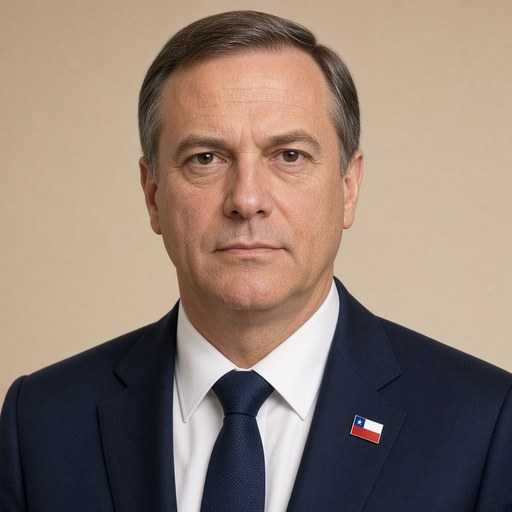
His Excellency the President of the Republic, José Antonio Kast, voluntarily submits to a drug detection test.
 José Antonio Kast · Leader of the Republican Party (Chile)
- Context
- Kast addressed the press on April 8, 2026, voluntarily submitting to a hair drug test to demonstrate compliance with Chile's new law requiring officials to undergo drug detection screening.
- Main themes
- Drug testing for public officials, transparency and integrity in government, anti-drug trafficking policy, hair sample testing methodology, public office accountability, declaration of interests and assets, legislative framework for drug detection, budget allocation for testing, organized crime, random testing for public servants
- Duration
- ~17 min
- Words
- 1,993
- Sentences
- 73
- Readability
- 44
- Grade
- 13.9
- Syntax
- 3.33
- Vocabulary
- 1.99
Translated from Spanish
The broad sphere of national life a sentence belongs to. Every sentence has an Arena, so it is the denominator the other indices are read against.
Other73 sentences in 31 paragraphs
Good morning.
As always, thank you for joining us, thank you for following up on the activities that I am responsible for, as well as for keeping track of the activities carried out by the ministers, the undersecretaries, the entire Government.
As you may have shown or will show, just a few minutes ago I voluntarily provided a hair sample, also paid for with my own resources – here is the payment for the hair sample – to be able to certify. Just as the ministers and undersecretaries have done, who also did it voluntarily, almost all of the ministers and almost all of the undersecretaries provided a hair sample voluntarily before they took their oath. I believe that only Minister Quiroz is left, along with two or three undersecretaries, but everyone was very clear that when they took on their respective positions, they had to have provided a hair sample or had to provide a hair sample.
This aligns with the law that was approved by Parliament in January of this year, and which was published in February of this year, and is in line with what we have proposed for a long time. In fact, four years ago I provided a hair sample at this same institution. I was attended to by the same person who took my sample four years ago. Today she also took my sample and said to me: today we meet again, after four years.
The regulation that was approved in January of this year, as I said, and published in February, is in line with what we seek, which is for all authorities to undergo tests to detect drug use. This is the most demanding method, the hair test. I must also say that it is the most expensive. Today a hair test costs just over 300,000 pesos.
The problem that arises with the regulation approved in February is that no budget was allocated to carry out this hair analysis that seeks to detect drug use, which is significantly more expensive than a urine test. We want to refine all of this because it is clear that if we state that we have a real problem with drug trafficking and organized crime, we must certify that any authority exercising a public position must be far removed from the networks of drug trafficking.
We see that drug trafficking is affecting various institutions. There are people who may be more or less vulnerable to this situation. Nothing is better than transparency, especially for those who hold public office. This is something that is directly related to integrity.
The regulation also states that upon assuming office, the issue of not clearly defining deadlines creates some difficulties. We all know that different authorities must declare their interests and assets. This is established, from the moment the person assumes, they have up to 30 days to present their declaration of interests and assets to the Comptroller's Office.
It is very complex for someone to have to go from taking an oath to undergoing a test or presenting their declaration of interests and assets on the same day because until they take the oath, they are not, in this case, a minister or undersecretary, until the decrees are issued. Therefore, from the moment a decree is issued, from the moment the person takes the oath, in our opinion, a peremptory deadline should be established for this to be done and then made public.
There is also an entire discussion about the publicity of the tests due to data protection. In our opinion, anyone who accepts a public position must sign, just as some were previously required to provide only a sworn declaration that they were not dependent on any substance or drugs, a sworn declaration was sufficient, I believe we need to take a step further. Those who wish to serve the public in front of the people must renounce certain protection norms. Just as we are required to declare our interests and assets and all those who hold a public position do so, with established sanctions for those who do not, well, we want this to be done, to be verifiable, to be periodic and public.
There are state institutions today that carry out random and very massive testing. We also want to reach that and we want to establish it step by step. We estimate that the first samples in cases of high-ranking authorities must be hair samples, and we could define whether, as the law currently states, it should be twice a year or if it can be once a year, one or the other.
That may be subject to legislative debate, but in our opinion, it is reasonable for a hair test to be conducted every year. Perhaps it could be done randomly, sampling the vast majority of people who hold public positions. Even going much further with public servants. So that we ultimately determine that all those who hold a paid position by the State, whether permanent, contracted, or honorary, must undergo a random test at some point, which could be a hair test or a urine test, which is significantly cheaper and also quite effective.
Today the current legislation, you know, is this Law No. 21,806 which was published on February 5, 2026. We would have liked this to have been in effect much earlier, to have been applied, because we were already coming from Decree 1215 of 2006, but very little progress had been made regarding those who had the obligation and duty to undergo this type of testing.
As we estimate that the regulation today from 2006 does not relate to the advancement of technology, with the infiltration we have today from drug trafficking and organized crime, we want to make modifications to this decree, to make Decree 1215 of 2006 much more precise, and that decree will be modified to incorporate the hair test in a standardized manner for ministers, undersecretaries, heads of services, and senior directors, with a detection window of 90 days from when this is carried out.
We will also guarantee funding, which was announced in the law I mentioned from February 2006, but there were no resources. We will guarantee that each year the resources are available to carry out these tests.
We will also guarantee publicity, because as I said, anyone who holds a public position will have, just as they must submit their declaration of interests and assets, to provide a certificate accredited by a laboratory recognized by the State to disclose whether or not they have a drug dependency.
Unless, of course, they have a medical prescription, which is understandable that someone may need to consume some type of medication for health reasons, that is understandable. But what we will establish is that this must be published, at least on the website of each service, 10 days after the results are available.
Also, you know that the results of a hair test take about 15 days to be available. Therefore, once the certificate is delivered, the person will have 10 days for the institution to make it public.
We will also establish a strict protocol for the custody, chain of custody, of the hair sample, of the urine sample, so that there is no doubt about the reliability.
We hope that, in coordination with the Ministry of Health, this will be operational within 30 days, so that the technical protocol for custody and the modifications we make to the decree will be available and functioning in the coming weeks.
Likewise, in the coming weeks, we will also send a bill. Because one thing is the decree and another is the bill that expands this request for tests, this requirement for tests to determine drug use for those who exercise public power.
This will consider, it will expand the concept of the Executive Power, it will ratify what is currently in the regulation approved in January 2026 and will also include the President of the Republic, because today the President of the Republic is not included. We want whoever exercises the command of the Nation to have the same obligations as a minister, an undersecretary, any public official. Why exclude the President of the Republic? And that this also be public, just like what will be required of ministers, undersecretaries, and officials.
We also hope that in this the Congress will support us to include those who hold positions of high public responsibility, such as governors, mayors, regional councilors, and councilors. This is regarding those who have executive command, which we believe should be governed by the same regulation. If the President is willing to do it, why wouldn’t a governor, a mayor, regional councilors, and councilors be willing to do it?
We will also propose to the Legislative Power that senators and deputies be clearly included. In this same condition, if they are public servants, if they are going to exercise the popular mandate to legislate, at least once a year, we do not say that, as they imposed on the Executive, it should be twice a year, at least once a year, each senator and each deputy should be willing to undergo a hair test and that this be administered and directed by the Comptroller's Office, to avoid any discussion. It is an independent body, an entity that has earned the respect of all citizens.
Therefore, we hope to count on the support of all parliamentarians, so that at least once a year, each senator, each deputy, they will determine if they want to extend it to their advisors or not, undergo this hair test or something more routine, but at least once a year the hair test for senators and deputies.
We also want to incorporate in this, and it will be legislative debate, the leadership of political parties. We believe that any political party that has parliamentary representation and receives public funds should certify that each person who holds a leadership position in a political party also certifies that they do not have a dependency or are not subject to any type of incentive or complex situation with drug trafficking and organized crime. But, as I said, the relationship with political parties is because there is public funding for political parties that have parliamentary representation.
We also want to propose for legislative debate that all those who run as candidates for any popular election, whether current or if a new popular election is established in the future, each person at the time of registration must certify a negative result at the time of their registration, having undergone one of these tests. I believe that this is a very important preventive measure and we say that it is at the time of registration, from there there will be a protocol to ensure that the person, once registered, must undergo this entire procedure, for the 15 days, before the facsimile of the vote is published, to ensure that the person is free from the influence of drugs.
I invite all political forces to join this. Citizens are expecting much greater transparency from their representatives. We must regain trust in each of the institutions, and that starts with our own will. Hopefully, before this becomes law, all parliamentarians, all mayors, all governors accept that citizens are demanding different standards.
I would hope that, just as I did voluntarily, as almost all ministers did, as almost all undersecretaries did voluntarily, from now on we can see that mayors across Chile, all 345 mayors across Chile, can undergo the hair test. That all parliamentarians and all senators, all governors, all councilors, all regional councilors, can dedicate some time and part of their resources to undergo this to begin regaining credibility.
Today I did it, and I hope that starting tomorrow everyone follows this same line and we begin to regain that credibility that has been so in doubt regarding the exercise of public function.
Thank you very much.
The original Spanish. The tags above are read on the English translation's sentences.
Muy buenos días.
Como siempre, gracias por acompañarnos, gracias por hacerle seguimiento a las actividades que me toca realizar, así como también le dan seguimiento a las actividades que realizan los ministros, los subsecretarios, todo el Gobierno.
Como pudieron mostrar o acreditar o van a mostrar, hace unos pocos minutos me hice una toma de pelo de manera voluntaria, pagada también con mis recursos –aquí está el pago de la toma de muestra de pelo– para poder acreditar. Así como lo han hecho los ministros, los subsecretarios, quienes también lo hicieron de forma voluntaria, casi en la totalidad de los ministros y casi la totalidad de los subsecretarios, se realizaron de manera voluntaria antes de que juraran una muestra de pelo. Creo que falta, igual que yo, falta solo el ministro Quiroz, creo que dos o tres subsecretarios, pero todos tenían muy claro que cuando entraran a cada uno de sus cargos tenían que haberse hecho la muestra de pelo o tenían que hacerse la muestra de pelo.
Esto va en consonancia con lo que fue la ley que aprobó el Parlamento en enero de este mismo año, y que se publicó en febrero de este año, y va en la línea de lo que nosotros hemos planteado, desde hace mucho tiempo. De hecho, hace cuatro años me hice muestra de pelo en esta misma institución. Me tocó con la misma persona que me hizo la muestra hace cuatro años. Hoy día también ella me tomó la muestra y me dijo: hoy nos vemos de nuevo, después de cuatro años.
La norma que se aprueba en enero de este año, como digo, y se publica en febrero, va en la línea de lo que nosotros buscamos, que es que todas las autoridades se realicen exámenes para detectar si hay consumo de drogas. Este es el método más exigente, el de pelo. También, debo decir que es el más costoso. Hoy día un examen de pelo está por poco por sobre los 300 mil pesos.
El problema que se genera con la norma aprobada en febrero es que no se dejó presupuesto para realizar esta toma, este análisis de pelo que busca el consumo de drogas, que es bastante más caro que el examen de orina. Nosotros todo esto lo queremos ir perfeccionando porque está claro que, si nosotros planteamos que tenemos un problema real de narcotráfico, de crimen organizado, tenemos que acreditar que cualquier autoridad que ejerce un cargo público debe estar muy lejos de lo que son las redes del narcotráfico.
Vemos que el narcotráfico va incidiendo en las distintas instituciones. Hay personas que pueden ser más o menos vulnerables a esta situación. Nada mejor que la transparencia, sobre todo en aquellos que ejercen cargos públicos. Eso es algo que va en directa relación con la probidad.
La norma también señala que, al asumir el cargo, el tema de no definir bien los plazos genera algunas dificultades. Todos sabemos que las distintas autoridades tienen que hacer declaración de intereses y patrimonio. Eso se establece, desde que la persona asume, hasta 30 días tiene para presentar en la primera instancia a la Contraloría su declaración de intereses y patrimonio.
Es muy complejo que el mismo día que alguien asuma tenga que ir del juramento a hacerse un examen o presentar el mismo día su declaración de intereses y patrimonio porque hasta que no jura no es en este caso ministro o subsecretario, hasta que no están emitidos los decretos. Por tanto, desde que se emite un decreto, desde que la persona jura, ahí a nuestro juicio debe establecerse un plazo perentorio para que esto se realice y después se haga público.
También, hay toda una discusión de la publicidad de los exámenes por la protección de datos. A nuestro juicio el que acepta ir a un cargo público tiene que firmar, así como a algunos antes se les exigía sólo una declaración jurada de que no tenía dependencia de ninguna sustancia o de drogas, bastaba con la declaración jurada, creo que tenemos que dar un paso más allá. Aquellos que quieren ejercer el servicio público de cara a las personas tienen que renunciar a ciertas normas de protección. Así como nosotros estamos obligados a hacer declaración de intereses y patrimonio y todos los que ejercen un cargo, un rol público lo hacen y hay sanciones establecidas a quien no lo haga, bueno, nosotros queremos que esto se haga, sea verificable, sea de manera periódica y de manera pública.
Hay instituciones hoy día del Estado que lo realizan de manera aleatoria y muy masiva. Nosotros también queremos llegar a eso y queremos ir estableciéndolo paso a paso. Estimamos que las primeras muestras en casos de autoridades de alto rango tienen que ser de pelo y podríamos definir si, como dice la ley hasta ahora, tiene que ser dos veces por año o si puede ser una vez al año, una u otra.
Eso podrá estar sujeto al debate legislativo, pero todos los años a nuestro juicio es razonable que se haga un examen de pelo. Quizás se podría ir de manera aleatoria, muestreando a la gran mayoría de las personas que ejercen cargos públicos. Incluso ir mucho más allá en los servidores públicos. Cosa de que finalmente determinemos que todos los que ejercen un cargo remunerado por el Estado, sea de planta, contrata u honorarios, tengan que someterse en algún momento aleatoriamente a un examen que puede ser el examen de pelo o el examen de orina, que es bastante más económico y también es bastante eficaz.
Hoy día la legislación vigente, ustedes saben, es esta Ley n° 21.806 que fue publicada el 5 de febrero del año 2026. Nos habría gustado que esto estuviera vigente mucho antes, que se hubiese aplicado, porque ya veníamos con el Decreto 1215 del año 2006, pero se había avanzado muy poco en aquellos que tenían la obligación y el deber de hacerse este tipo de exámenes.
Como estimamos que la norma hoy día del año 2006 no dice relación con el avance de la tecnología, con la infiltración que tenemos hoy día del narcotráfico, del crimen organizado, queremos hacerle modificaciones a este decreto, hacerlo mucho más preciso el Decreto 1215 del año 2006 y ese decreto va a ser modificado para incorporar el examen de pelo de manera estandarizada para ministros, subsecretarios, jefes de servicio, directores superiores, con una ventana de detección de 90 días desde que esto se realice.
También, vamos a garantizar el financiamiento, cosa que en la ley que les señalaba de febrero del 2006 estaba el anuncio, pero no estaban los recursos. Nosotros vamos a garantizar que cada año estén disponibles los recursos para ir haciendo estos exámenes.
También, vamos a garantizar la publicidad, porque como les decía, quien ejerce un cargo público tendrá, así como tiene que entregar su declaración de intereses y patrimonio, tendrá que entregar un certificado acreditado por un laboratorio reconocido por el Estado para dar a conocer si tiene o no dependencia de drogas.
Salvo, claro, que tenga una prescripción médica, que es entendible que alguien tenga que consumir algún tipo de fármaco por temas de salud, eso es entendible. Pero lo que sí vamos a establecer es que esto tiene que ser publicado, al menos en la página web de cada servicio, 10 días después de que estén los resultados.
También, ustedes saben que los resultados de un examen de pelo toman, para tenerlos a la vista, cerca de 15 días. Entonces, entregado el certificado tendrá la persona 10 días para que la institución lo haga público.
También, vamos a establecer un estricto protocolo de custodia, de cadena de custodia, de la muestra de pelo, de la muestra de orina, para que no haya ninguna duda en la confiabilidad.
Esperamos que, con coordinación con el Ministerio de Salud, esto esté operativo de aquí a 30 días, para que el protocolo técnico de la custodia y las modificaciones que hagamos al decreto estén disponibles y funcionando ya en las próximas semanas.
Asimismo, en las próximas semanas también vamos a enviar un proyecto de ley. Porque una cosa es el decreto y otra es el proyecto de ley que amplía esta solicitud de exámenes, esta exigencia de exámenes para determinar el consumo de drogas a quienes ejercen el poder público.
Esto va a considerar, va a ampliar el concepto del Poder Ejecutivo, va a ratificar lo que hoy en día está en la norma aprobada en enero del año 2026 y va a incluir también al Presidente de la República, porque hoy día el Presidente de la República no está incluido. Nosotros queremos que quien ejerza el mando de la Nación tenga las mismas obligaciones que tiene un ministro, un subsecretario, cualquier funcionario público. ¿Por qué excluir al Presidente de la República? Y que eso también sea público, igual que lo que se le va a exigir a los ministros, subsecretarios y funcionarios.
También, esperamos que en esto el Congreso nos apoye para que se incluya a quienes ejercen cargos de alta responsabilidad pública, como son los gobernadores, los alcaldes, los cores y los concejales. Eso es respecto de quien tiene mando ejecutivo, que creemos que tiene que regir la misma norma. Si el Presidente está dispuesto a hacerlo, ¿por qué no estaría dispuesto a hacerlo un gobernador, un alcalde, los cores y los concejales?
También, le vamos a plantear al Poder Legislativo, que se incluya de manera clara a senadores y diputados. En esta misma condición, si son servidores públicos, si van a ejercer el mandato popular para legislar, al menos una vez al año, no decimos que como ellos lo impusieron al Ejecutivo, que sea dos veces al año, al menos una vez al año, cada senador y cada diputado esté dispuesto a hacerse el examen de pelo y que esto sea administrado y dirigido por la Contraloría, para evitar cualquier discusión. Es un órgano independiente, un órgano que se ha ganado el respeto de toda la ciudadanía.
Por lo tanto, esperamos contar con el apoyo de todos los parlamentarios, para que una vez al año al menos, cada senador, cada diputado, ellos determinarán si quieren hacerlo extensivo a sus asesores o no, se realice este examen de pelo o algo más después rutinario, pero una vez al año al menos el examen de pelo, a los senadores y diputados.
También, queremos incorporar en esto, y será debate legislativo, a las directivas de los partidos políticos. Creemos que cualquier partido político que tenga representación parlamentaria y reciba fondos públicos, debiera acreditar que cada una de las personas que ejerce un cargo de dirección en un partido político, también acredite que no tiene dependencia o que no está sujeto de algún tipo de incentivo o de situación compleja con el narcotráfico y con el crimen organizado. Pero, como lo digo, la relación con los partidos políticos es porque hay financiamiento público para los partidos políticos que tienen representación parlamentaria.
También, queremos plantear para el debate legislativo, que todos los que vayan de candidatos a cualquier elección popular, que son las actuales o si a futuro se establece una nueva elección popular, cada persona al momento de inscribirse, deberá acreditar un resultado negativo al momento de su inscripción, habiéndose realizado uno de estos exámenes. Creo que eso es una medida preventiva muy importante y decimos que es al momento de la inscripción, a partir de ahí habrá un protocolo para que quede acreditado que la persona, una vez inscrita, tenga que realizar todo este procedimiento, por los 15 días, antes de que esté ya publicado el facsímil del voto, esté acreditado que la persona está libre de la influencia de la droga.
Vuelvo a invitar a todas las fuerzas políticas a que se sumen a esto. La ciudadanía está esperando mucha mayor transparencia de sus representantes. Tenemos que recuperar la confianza en cada una de las instituciones y eso parte por la propia voluntad. Ojalá antes de que esto sea ley, todos los parlamentarios, todos los alcaldes, todos los gobernadores acepten que la ciudadanía está exigiendo estándares distintos.
Yo esperaría que, así como yo lo hice de manera voluntaria, como también lo hicieron casi todos los ministros, casi todos los subsecretarios, de manera voluntaria, a partir de ahora nosotros podemos ver que los alcaldes a lo largo de todo Chile, los 345 alcaldes a lo largo de todo Chile, se puedan hacer el examen de pelo. Que todos los parlamentarios y todos los senadores, todos los gobernadores, todos los concejales, todos los cores, puedan destinar un tiempo y parte de sus recursos a hacerse esto para ir recuperando la credibilidad.
Hoy lo hice yo y espero que a partir de mañana todos sigan esta misma línea y vayamos de nuevo recuperando esa credibilidad que ha estado tan en duda respecto del ejercicio de la función pública.
Muchas gracias.