




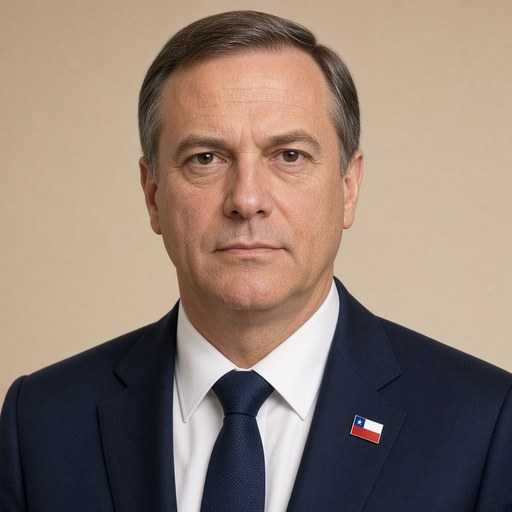
His Excellency the President of the Republic, José Antonio Kast, attends the second session of the Total Inspection Committee.
 José Antonio Kast · Leader of the Republican Party (Chile)
- Context
- Kast addressed the second session of the Total Inspection Committee in April 2026, emphasizing proper use of public resources and the importance of internal auditing across Chilean state agencies.
- Main themes
- Government resource management, internal auditing, public accountability, state efficiency, fiscal responsibility, public officials conduct, sanctions for misconduct, Comptroller General oversight, audit empowerment, administrative reform
- Duration
- ~17 min
- Words
- 2,049
- Sentences
- 128
- Readability
- 68
- Grade
- 7.6
- Syntax
- 2.80
- Vocabulary
- 1.90
Translated from Spanish
The broad sphere of national life a sentence belongs to. Every sentence has an Arena, so it is the denominator the other indices are read against.
Other128 sentences in 30 paragraphs
Good morning.
Thank you very much for being here. You do not know how important it is for you to be here and to feel like an essential part of the Government, and I do not mean this Government, because you have a role that transcends this Government. You are the ones responsible for ensuring that the resources of all Chileans are used well, invested well. As the minister said, that they are well focused, the resources are not infinite, and everyone knows that.
I want to thank the minister for the work he has done, which is intense, in various areas, on various fronts. To the undersecretary, what can I say, who also has to preside over this committee, this council. To Cristian, for taking on the challenge of coordinating this work that has been intense. To the undersecretaries, to my neighbor, Mr. Max Pavez, to the undersecretary of Finance, Juan Pablo Rodríguez.
To our DIPRES, who I joked with that he is whitening the mountains this month. But I want to especially thank him because all the comments I have received are of joy, not that they are called by DIPRES, but that Mr. Gómez has returned to lead DIPRES. It is a recognition from people who had a career, and that is valued and appreciated.
And to Francisco Riquelme, whom not everyone knew, but I believe that now everyone knows, they have already received some message, some email, asking for one of those spreadsheets that you were completing, those more than 800 spreadsheets that arrived. That is not a simple form many times.
But that effort is appreciated. What each one has done is greatly appreciated. What we ask is that you continue doing. The deadlines have been demanding. There one also realizes that the State has that strength. But sometimes it lacks believing that one is capable and that one has the means.
That is why when one is perhaps outside the State, one says: we are going to do this, that other thing. One never rules out doing more. But what we saw in the area of audits gave us the confidence to say: we can count on you. You have knowledge, you have experience, you know your areas of work. More than 500 State agencies received these emails, these instructions, which we thought of from day one. The second decree that I had to sign was related to the issue of the audit.
Perhaps not all Chileans know that in each State agency there is an auditor. We need that auditor to feel empowered, to feel independent, to not accept pressure.
Because you will also safeguard the authorities. When there are changes in Government, there are also changes in authorities. Not all of us are experts in administrative law, in auditing, and beyond whether one has one profession or another, one acquires knowledge over time that one puts at the disposal of the State, not of the current government.
It is very important that you have this very clear, that we will work permanently to ensure that resources are used well. Someone can make a mistake, and that can be corrected. We are also fortunate to have a supervisory body, which is the Comptroller General of the Republic.
If we, for A, B, or C reasons, make a mistake, you are the first to tell us: this is not going in the right direction. Madam Comptroller, I am speaking of you. In addition, we have that control that has also been established in recent times with a perspective. Each comptroller has their seal. The seal of the current administration of the Comptroller's Office is effectiveness, it is speed, and it has collaborated a lot so that your work, the work of the State, is also improving. Because we all fundamentally see that if there are customs that have become entrenched, those customs, if they are wrong, need to be changed.
We need to correct the course, as the course was corrected in the matter of medical licenses. As perhaps the course should have been corrected when some people during the pandemic used a benefit that did not correspond to them. Because it was intended for those people who did not have work, who did not have a contract. Some people in need, without perhaps the necessary warning from the more political authorities, used a benefit that did not correspond.
Well, we need to reorder things. This is not always about punishment for punishment, but today it is clear that there are certain things that cannot be done. The warnings have already been given. Therefore, if a complex situation is initiated as announced by the Comptroller's Office, well, it must have a sanction. An incorrect action must have a sanction.
When a public official misuses the resources of all Chileans, they know they cannot do it. They already knew. They violated a norm. Therefore, the sanction must be clear and must be, in some cases, what the law says and must be harsh. That is why, time and again, we are warning.
All public officials know that the second decree that was issued was that of audits. Therefore, from here on out, there must be a different way of facing situations. We all know when someone crosses the line. Therefore, no one could be surprised that if a summary is now initiated for a serious action, that summary could end in dismissal.
That is why this process of what you are doing is also a good warning. That is why your role is so important. That is why you must feel the independence to present situations according to what the law establishes, what can be done and what cannot be done. The law, for public officials, even for me, is quite strict.
All ministers, all undersecretaries attended the courses given by the Comptroller's Office. I managed to attend some virtual courses, I did not manage to do them all, but I did attend the in-person course. They were very clear about what we could and could not do. We are all informed. Therefore, the work you do, in my opinion, greatly facilitates what the Comptroller's Office has to do, which has an enormous job. Well, let us help that control body by doing our job well.
As the undersecretary said, this is just beginning. Yes, some said: oh, how good that we are going to this activity where we will be thanked for the work. Yes, we greatly appreciate it. But I want to say that there is much ahead. Because one does not change a complete State in a month. There are people who, of course, after the election say: tomorrow everything will be different. We told them: no, this will take time. Those who tell us: look, it has been a month, they still have not done this, this, this. Well, we are in a process reconfiguring some things, according to what the norm establishes, and we are moving forward step by step.
To some I have said, let us move forward without haste, but without pause. At times we are in a hurry, and you were very hurried to be able to reach these reports, but what is important is always to keep moving forward, with rigor, with precision, with the corresponding norms. Making the warnings so that everyone knows what is coming, raising the information, and that information must be systematized. Sometimes there is a lot of information and the data does not cross. So, one agency does not know what is happening in another. Today artificial intelligence helps us a lot with that.
At one point when I was a parliamentarian, I tried to gather information on how salaries were paid in municipalities. And to whom they were paid, because everyone had to publish it. Well, some published it in Excel, others uploaded a photo. There were like five different ways to inform how officials were paid. There was no artificial intelligence at that time, because this is quite some time ago, it was impossible to create a kind of matrix and see if it was all the same or not.
Well, today that can be done, because even artificial intelligence can read a photo, can see a different program, but we need to unify. It cannot be that each service invents a new spreadsheet, a new payment formula, a new purchasing formula in the SLEP. There was so much time to program it, and there are some SLEP that when they arrived to install themselves said: I do not have a salary payment program. And they had to develop their own system, which was not the same as the one the State had. I do not have a purchasing system like the purchasing system that the ministries have, I have to create a new program.
Why did each service, each ministry have to buy a different program? If the State can provide them with a unique system where the information crosses, and I assure you that DIPRES will be happy to have information in the same scheme, to be able to make information cross. That is also to anticipate great news for all services, we will cross the information. In every sense, because resources are scarce, and they must be used well. So, we do not need to hire a different program in each service that says what is wanted only for that unit. Well, in all of that we need to advance.
The trust is placed in you. You are truly an essential part of the State, and feel it that way. The officials will also feel it that way over time. Because many times the official says: oh, the audit has arrived. What do we do? It is like when one is in a municipality and says: oh, the Comptroller has arrived. We are not the Comptroller, but we are the audit. We are collaborating with the officials, we are not an adversary of the official, you are helping the official. In this I insist again, do not yield to pressure, but do it well. Be objective always.
When one was in school, there were different types of teachers. There were teachers who would take some to the board and put them there and destroy them. There were others who would dedicate a little more time to some and say: look, I think it goes this way, analyze it this way. Well, that prior work is also important, because people will understand the real importance of the function you are performing.
I understand that this is a new style, it is something different. I do not know how many times before you had gathered in a room like this. You are part of the auditors, you are not all. This is a message for everyone. Each of the regional governments, each of the regional delegates over time, because today they are in the installation, it is difficult, but I hope that each regional delegate does the same as the regional delegations and invites the auditors and tells them: we need your help.
Perhaps for some who have been around for less time, this is the first time. Well, I hope it is neither the first nor the last. And that later we can have not a formal session, like this one, where we are, at least I am thanking you, but that we can also have a working meeting.
Yesterday I had the opportunity to meet with the Minister of Transport, with the undersecretaries of Transport and Telecommunications, with the Seremis, who were in training and work sessions here in Santiago. At least for me, I am interested in giving time to each one. It was a little time, but I said: now tell me, what are the two urgent problems from Arica-Parinacota to Magallanes-Antártica Chilena. A dialogue is generated, which is important.
So, as I tell you, we look forward to seeing you on some occasion, where we can have more working meetings, where I can join as one more, to also gain knowledge and dimension the important work you do.
So, once again, thank you very much, and let us continue working, not for a government, let us continue working for Chile.
Thank you.
The original Spanish. The tags above are read on the English translation's sentences.
Muy buenos días.
Muchas gracias por estar acá. No saben lo importante que es que ustedes estén acá y que se sientan parte esencial del Gobierno, y no digo de este Gobierno, porque ustedes tienen un rol que trasciende a este Gobierno. Son aquellos encargados de velar porque los recursos de todos los chilenos se usen bien, se inviertan bien. Como dijo el ministro, que se focalicen bien, los recursos no son infinitos, y todos saben.
Quiero darle las gracias al ministro por el trabajo que ha realizado, que es intenso, en varias áreas, en varios frentes. A la subsecretaria, para qué decir, que además tiene que presidir este comité, este consejo. A Cristian, por asumir el desafío de coordinar este trabajo que ha sido intenso. A los subsecretarios, a mi vecino, al señor Max Pavez, al subsecretario de Hacienda, Juan Pablo Rodríguez.
A nuestro DIPRES, que le tiraba la broma que está blanqueando en este mes la cordillera. Pero le quiero agradecer especialmente porque todos los comentarios que me han llegado es de la alegría, no de que los llame la DIPRES, sino de que haya vuelto el señor Gómez a dirigir la DIPRES. Es un reconocimiento de personas que tenían trayectoria y eso se valora y se agradece.
Y a Francisco Riquelme, que no todos conocían, pero que yo creo que ya todos conocen, ya han recibido algún mensaje, algún mail, pidiéndole alguna de esas planillas que ustedes fueron completando, esas más de 800 planillas que llegaron. Que no es un formulario sencillo muchas veces.
Pero se agradece ese esfuerzo. Se agradece mucho lo que ha hecho cada uno. Lo que les pedimos es que sigan haciendo. Los plazos han sido exigentes. Ahí uno también se percata de que el Estado tiene esa fuerza. Pero a veces falta creer en que uno es capaz y que tiene los medios.
Por eso cuando uno está quizás fuera del Estado dice: vamos a hacer eso, esto otro. Uno no descarta nunca hacer más. Pero lo que vimos en el tema de auditorías nos dio la confianza de poder decir: contamos con ustedes. Ustedes tienen conocimiento, tienen trayectoria, conocen sus áreas de trabajo. Más de 500 reparticiones del Estado recibieron estos mails, estos instructivos, que los pensamos desde el primer día. El segundo decreto que me tocó firmar era referido al tema de la auditoría.
Quizás no todos los chilenos saben que en cada repartición del Estado hay un auditor. Nosotros necesitamos que ese auditor se sienta empoderado, que se sienta independiente, que no acepte presiones.
Porque ustedes van a resguardar también a las autoridades. Cuando hay cambios de Gobierno también hay cambios de autoridades. No todos somos expertos en derecho administrativo, en auditoría y más allá de si uno tiene una profesión u otra, uno va adquiriendo conocimientos en el tiempo que pone a disposición del Estado, no del gobierno de turno.
Eso es muy importante que ustedes lo tengan muy claro, que nosotros vamos a trabajar permanentemente porque los recursos se usen bien. Alguien se puede equivocar y eso se puede corregir. Nosotros tenemos además la fortuna de tener un órgano contralor, que es la Contraloría General de la República.
Si nosotros por A, B o C motivos nos equivocamos, primero están ustedes para decirnos: esto no va en la línea correcta. Señora contralora, estoy hablando de usted. Además, tenemos ese control que se ha ido instalando también en el último tiempo con una mirada. Cada contralor tiene su sello. El sello de la actual administración de la Contraloría es la ejecutividad, es la rapidez y ha colaborado mucho para que el trabajo de ustedes, el trabajo del Estado, también vaya siendo mejor. Porque todos en el fondo vamos viendo que, si hay costumbres que se fueron arraigando, esas costumbres si están mal hay que cambiarlas.
Hay que enmendar el rumbo, como se enmendó el rumbo en el tema de las licencias médicas. Como quizás se debería haber enmendado el rumbo cuando algunas personas en época de pandemia utilizaron un beneficio que no les correspondía. Porque estaba pensado en aquellas personas que no tenían trabajo, que no tenían contrato. Algunas personas en la necesidad, sin la advertencia quizás necesaria de las autoridades más políticas, usaron un beneficio que no correspondía.
Bueno, nosotros tenemos que volver a ordenar las cosas. Esto no es siempre por la sanción por la sanción, pero hoy día está claro que hay ciertas cosas que no se pueden hacer. Las advertencias ya están dadas. Por lo tanto, si se inicia una situación compleja anunciada por la Contraloría, bueno, tiene que tener una sanción. Una acción incorrecta tiene que tener una sanción.
Cuando un funcionario público mal utiliza recursos de todos los chilenos, él sabe que no lo puede hacer. Él ya sabía. Infringió una norma. Por lo tanto, la sanción tiene que ser clara y tiene que ser, en algunos casos, la que dice la ley y tiene que ser dura. Por eso, una y otra vez, vamos advirtiendo.
Todos los funcionarios públicos saben que el segundo decreto que se dictó fue el de las auditorías. Por lo tanto, de aquí para adelante tiene que haber una forma distinta de enfrentar las situaciones. Todos sabemos cuándo alguien cruza la línea. Por lo tanto, nadie podría extrañarse de que, si ahora se inicia un sumario por una acción grave, ese sumario puede terminar en la destitución.
Por eso, este proceso de lo que ustedes están haciendo es también una buena advertencia. Por eso el rol de ustedes es tan importante. Por eso ustedes tienen que sentir la independencia para plantear las situaciones de acuerdo a lo que establece la ley, qué es lo que se puede hacer y lo que no se puede hacer. La ley, para los funcionarios públicos, incluso para mí, es bastante estricta.
Todos los ministros, todos los subsecretarios fueron a los cursos que dictó la Contraloría. Yo alcancé a estar en algunos cursos virtuales, no los alcancé a hacer todos, pero sí estuve en el curso presencial. Fueron muy claros en lo que podíamos y no podíamos hacer. Todos estamos informados. Por lo tanto, el trabajo que ustedes hacen, a mi juicio, facilita mucho lo que tiene que hacer la Contraloría, que tiene un trabajo enorme. Bueno, ayudémosle a ese órgano de control, haciendo nosotros bien el trabajo.
Como decía la subsecretaria, esto recién comienza. Sí algunos dijeron: oh, qué bueno que vamos a esta actividad donde nos van a agradecer el trabajo. Sí, se lo agradecemos enormemente. Pero quiero decir que queda mucho por delante. Porque uno no cambia un Estado completo en un mes. Hay personas que, claro, después de la elección dicen: qué mañana todo va a ser distinto. Nosotros les decíamos: no, esto va a tomar un tiempo. Aquellos que nos dicen: miren, llevan un mes, todavía no hacen esto, esto, esto. Bueno, nosotros vamos en un proceso reconfigurando algunas cosas, de acuerdo a lo que establece la norma, y vamos avanzando paso a paso.
A algunos les he dicho, avancemos sin prisa, pero sin pausa. En algunos momentos estamos con harta prisa, y ustedes tuvieron mucha prisa para poder llegar a estos informes, pero lo importante es siempre seguir adelante, con rigor, con precisión, con las normas que correspondan. Haciendo las advertencias para que cada uno sepa lo que viene, levantando la información, y esa información tiene que ser sistematizada. A veces hay mucha información y los datos no se cruzan. Entonces, no sabe una repartición lo que está ocurriendo en otra. Hoy día la inteligencia artificial en eso nos ayuda mucho.
En algún minuto cuando era parlamentario, trataba de levantar la información de cómo se pagaban las remuneraciones en los municipios. Y a quiénes se les pagaban, porque todos tenían que publicarlo. Bueno, algunos lo publicaban en Excel, otros subían una foto. Eran como cinco maneras distintas de informar cómo se les pagaba a los funcionarios. No había en esa época, porque esto es bastante tiempo atrás, no había inteligencia artificial. Era imposible sacar una especie de matriz y ver si era todo igual o no.
Bueno, hoy día eso se puede hacer, porque incluso la inteligencia artificial puede leer una foto, puede ver un programa distinto, pero nosotros tenemos que ir unificando. No puede ser esto que cada servicio invente una nueva planilla, una nueva fórmula de pago, una nueva fórmula de compra en los SLEP. Tanto tiempo había para programarlo, y hay algunos SLEP que cuando llegaban a instalarse decían: yo no tengo un programa de pago de remuneraciones. Y tenía que desarrollar su propio sistema, que no era el mismo que tenía el Estado. Yo no tengo un sistema de compras como es el sistema de compras que tienen los ministerios, tengo que hacer un programa nuevo.
¿Por qué cada servicio, cada ministerio tenía que comprar un programa distinto? Sí el Estado puede proveerles un sistema único donde se cruce la información, y le aseguro que la DIPRES va a estar feliz de que haya información en el mismo esquema, para poder hacer cruces de información. Eso también es anticiparles una gran noticia a todos los servicios, vamos a cruzar la información. En todo sentido, porque los recursos son escasos, y hay que usarlos bien. Entonces, no necesitamos contratar en cada servicio un programa distinto que diga lo que se quiere solo para esa unidad. Bueno, en todo eso tenemos que avanzar.
La confianza está puesta en ustedes. Ustedes de verdad son parte esencial del Estado, y siéntanlo así. Lo van a sentir así también los funcionarios con el tiempo. Porque muchas veces el funcionario dice: uy, llegó la auditoría. ¿Qué hacemos? Es como cuando uno está en un municipio y dice: uy, llegó la Contraloría. Nosotros no somos la Contraloría, pero somos la auditoría. Estamos colaborando con los funcionarios, no somos un adversario del funcionario, ustedes le están ayudando al funcionario. En eso vuelvo a insistir, no cedan a las presiones, pero háganlo bien. Sean objetivos siempre.
Uno cuando estaba en el colegio tenía distintos tipos de profesores. Había profesores que a unos los sacaba al pizarrón y los ponía y los destruían. Había otros que a unos les dedicaban un poco más de tiempo y les decían: mira, yo creo que va por aquí, analízalo por acá. Bueno, ese trabajo previo también es importante, porque las personas van a entender la real importancia de la función que ustedes están haciendo.
Este yo entiendo que es un nuevo estilo, es algo distinto. No sé cuántas veces antes se habían reunido en un salón como este. Ustedes son una parte de los auditores, no son todos. Esto es un mensaje para todos. Cada uno de los gobiernos regionales, cada uno de los delegados regionales en el tiempo, porque hoy en día están en la instalación, es difícil, pero yo espero que cada delegado regional haga lo mismo que las delegaciones regionales e invite a los auditores y decirles: necesitamos su ayuda.
Quizás para algunos que llevan menos tiempo, esta es la primera vez. Bueno, espero que no sea ni la primera ni la última. Y que después podamos tener no una sesión formal, así como esta, donde nosotros le estamos, yo al menos le estoy dando las gracias, sino que podamos tener también una reunión de trabajo.
Ayer me tocó reunirme con el ministro de Transportes, con los subsecretarios de Transportes y Telecomunicaciones, con los Seremis, que estaban jornadas de capacitación y de trabajo, aquí en Santiago. Al menos a mí me interesa darle tiempo a cada una. Era poquito de tiempo, pero le decía: ya dígame, cuáles son los dos problemas urgentes desde Arica-Parinacota hasta Magallanes-Antártica Chilena. Se va generando un diálogo, que es importante.
Entonces, como les digo, los esperamos en alguna ocasión, donde podamos tener reuniones más de trabajo, donde yo me pueda incorporar como uno más, para ir también tomando conocimiento y dimensionar el trabajo importante que ustedes hacen.
Así que, una vez más, muchas, muchas gracias y sigamos trabajando, no por un gobierno, sigamos trabajando por Chile.
Gracias.