




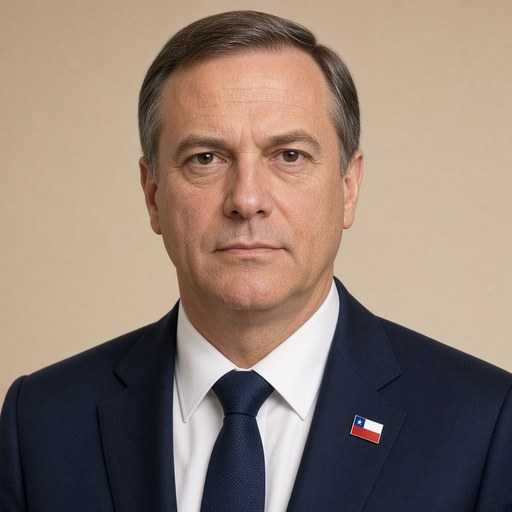
His Excellency the President of the Republic, José Antonio Kast, leads the commemoration of May 1st at the Workers' Hospital.
 José Antonio Kast · Leader of the Republican Party (Chile)
- Context
- Kast addressed workers and officials at the Workers' Hospital in Chile on May 1, 2026, leading the national Labour Day commemoration as President.
- Main themes
- Workers' day commemoration, labor dignity and tribute, public-private collaboration in healthcare, condemnation of political violence, peaceful protest, workplace solidarity, Chilean social harmony, rehabilitation and health services, legislative cooperation
- Duration
- ~17 min
- Words
- 2,040
- Sentences
- 105
- Readability
- 57
- Grade
- 10.1
- Syntax
- 2.92
- Vocabulary
- 1.98
Translated from Spanish
The broad sphere of national life a sentence belongs to. Every sentence has an Arena, so it is the denominator the other indices are read against.
Other105 sentences in 33 paragraphs
Good, good morning.
First of all, I greet those who work in these buildings, because they do a great job on a day that is their day. Thanks to them, many people regain their health.
I was changing the podium, but there, as ACHS says, I saw Bastián and I said, there it is summarized, it is everything that is said there, which is love, it is homeland, and it is solidarity. I believe that the testimony we saw from Bastián completely reflects what is achieved in this institution and in so many other institutions that look after the health of our compatriots. I saw the emotion of your dad, seeing the video and seeing everything you had achieved. It sets us a challenge, which is the challenge that there are no limits in the face of difficulties.
Chile also has no limits today, beyond the difficulties we are going through. I hope that the great march announced by the president will be a peaceful march, a march where the importance of the worker is truly unveiled. Beyond the legitimate differences we may have, beyond the debate, the minimum wage, so many debates we can have that are legitimate. But I also invite you to isolate the violent ones.
The president of the Senate is here, the president of the Christian Social Party, the president of the Green Social Regionalist Front, already recognized as a party, ratified as a party, for which I congratulated him. But I also ask you to take responsibility for caring for the property of all. I also see great leaders who have already committed to the work.
I invite you to make it a day of tribute to the worker. Not to be surprised at night by how many establishments were destroyed, by how many properties were destroyed, because they are properties that allow work.
When we authorize the violent ones, or we do not authorize them because no one authorizes them, when we allow those violent ones to break into a place, to break the properties that we have for the benefit of all of us, we are harming precisely what we say we care for and we risk the lives of other people. How many people are left injured after those acts of irrational violence? People we find now can lose a foot, can suffer the consequences of a blow. Well, let’s avoid that. We do not need violence to reach agreements or to discuss, and then democratically things will be resolved in Parliament.
There is the president of the Senate, to whom I thank for harmonizing the normal difficulties of legislative work, of which I was a part and I had the opportunity to share with some of you in the Chamber of Deputies.
I greatly appreciate the invitation from the Chilean Safety Association because I had the opportunity to visit a first-level hospital. I also appreciate the public-private collaboration, of which I have been a witness this week in O'Higgins at the Teletón, in Temuco with the TROI of the Vivir Más Feliz Foundation.
And everywhere the public-private articulation. You spoke of the hyperbaric chamber in Aysén. How much did it cost for the first public hyperbaric chamber to arrive in Quellón and it was not used? Because there were no trained people to use it. Therefore, what is done there clearly needs to be shared and integrated. The private world and the public world integrated provide very good solutions, and we experienced that during the pandemic.
I thank and reiterate my greeting to the workers of this institution, because they help, care for, and accompany people. We witnessed the emotion of a co-worker, “colleague,” as he said. The president called him “compañero” and I said: “oh, but are they colleagues?” Yes. But the emotion of that person, meeting someone who went and greeted him, who were us, because his family was far away. It is difficult for the family to be able to arrive. That is also a challenge.
In the past, there was the House of the Peasant Mother, because when someone was going to have their child, the family was very far away and there was a place where the family could arrive and accompany that person, and I lived it firsthand because my mother was a volunteer at that home.
Today, May 1st, I want to greet all the people present here and all those who work so hard to support their families, as the president of the CUT said, collaborating committedly in those places where they perform their functions and putting their effort into lifting our country.
Although in the world of work, in different countries, that logic of conflict has been accentuated, Chile must move in a different direction. That is the invitation. Because work is a space where we can combine the talent, effort, and capabilities that each one has to put them at the service of realizing a project of economic, social, technological, artistic, or any kind of development that allows us to grow as a country.
Work needs to return to being a space of encounter, where mutual trust and good disposition prevail. Work is a shared task that allows us to fully develop as individuals and provides us with opportunities for sustenance for our families.
Workers, entrepreneurs, small and large business owners, we all form part of the same Chile and together we can move forward. Let us leave behind that theory of conflict. Chile has changed, Chile has advanced, Chile allows dialogues. The work that is so necessary and that dignifies so much is what is currently lacking for thousands of compatriots.
Because we celebrate Labor Day, but there are more than 900,000 Chileans who cannot celebrate having formal work, dignified work. There are more than 900,000 unemployed people, because there are 2.5 million people who live from informal work and we also have to worry about them. They suffer the consequences of different policies, which are the ones that in some way have also led us to lose formality and also to lose sources of work for those more than 900,000 people.
The figure from the INE was mentioned. We have been at 39 months with an unemployment rate that is too high for our nation, above 8%. That lack of work hits harder, and women and young people were also mentioned, who have less qualification, in some cases, or training, and are exposed to informality and the temporality of their work.
Those are more than 2.5 million Chileans who live from informal work and without social protection. That is to say, one in four workers. Today, one could not aspire to this, nor to something similar. That is a harsh reality, which reflects something we have insisted on. We are facing a labor emergency.
Modernity, it was also pointed out, presents us with new challenges. The emergence of artificial intelligence, technological advances, create the need to create new job opportunities, which allow what is properly human to remain irreplaceable. Yesterday we were with ministers in the Aysén Region, and we saw all the tourism potential that exists there, all that can be done. There, in the tourism sector, the irreplaceable appears again, humanity, the encounter. That is something where Chile can grow exponentially.
Today there are also educated people who are unemployed, or do not work in what they would like. Well, we need to, together with academia, see what is happening. Why are there so many young people who arrive at university with tremendous hope, receive a professional degree, and then do not find work in the area for which they prepared? There are other opportunities, but they need to be shown that opportunity. I studied Law, and look where I am.
We also need to worry about those older people, who due to technology, often find themselves on the fringes of work. Well, Ximena Lincolao, our Minister of Science, is very busy with what is called digital literacy. We need to generate good labor reconversion programs that allow the incorporation of skills, talents, and experiences of people to face technological progress without fear.
We have an urgency, we have the urgency to facilitate access to work for young people, giving them opportunities without asking for that experience that they will never acquire, and that closes the doors for them. Well, they have no experience, they have no work. Later, they are of a very advanced age, they have no work. I mean, they have experience and they still have no work. That has to change.
I greatly value the call made by the minister for that table, which in a month will present us with alternatives to address the two major difficulties faced by the unemployed, women and young people. We need to generate job opportunities that allow for greater labor adaptability, greater adaptability of employment to respond to both the personal and family needs of workers, as well as the requirements of those who need to undertake, and need the help of workers who are committed to the development of their entrepreneurship and of the homeland.
Adaptability allows for considering the particular needs of those who offer work and those who seek it. Thus, to the extent of the encounter, mutual consideration, we all push Chile in the same direction, which is upward, towards development. That is the common endeavor, which allows us to realize that by working together we can be better and we can generate reciprocal trust, that trust that we need so much.
As a Government, we want to put ourselves at the service of that objective, dignified work, stable work, work that allows for projecting a life and that helps us focus on the family, promoting its sustenance.
Ten days ago, in that line, we presented to the country our project for Reconstruction and Economic and Social Development. The number one objective of that project is to enhance work, dignified work, well-paid work. For this, we also seek to support SMEs, those entrepreneurs who, through a tax credit, will also be able to formally hire their collaborators, because we need to incentivize formal work and reactivate our economy.
That tax credit will help thousands of SMEs. We estimate that more than 230,000 SMEs will benefit. In Chile, there are more than 1.3 million SMEs. What happens with the other million? Well, they cannot hire anyone, they cannot afford to hire someone, and we believe and estimate that that million SMEs could also, over time, ask for the collaboration of someone else to develop their entrepreneurship. Formal employment is very important.
On the other hand, economic development, with all the new investments we hope will come to Chile, and we have had very good news from people who want to invest in Chile, because it is a country that is regaining certainty, security to undertake, will generate thousands of job opportunities.
It will take time, this is not automatic. We come with those 39 months that lead us to this labor emergency. But we are working for more and better work. Our country needs an economy that promotes initiative, that promotes entrepreneurship, that gives us greater growth and that always has its gaze on the development of the person. If we look at the person, we will look at the family and the community, because work is much more than an economic activity.
The president of the CUT said it. We cannot see a person and that the person says, “only my body is my contribution to work, only my labor capacity is valued.” “One is body, spirit,” you said, and there must be a mind, a soul, a healthy body, to be able to give the best of oneself for a common project, which is to move our country forward. That human development, that complement, those opportunities are what will advance future generations.
I invite everyone, all sectors, all political sectors, all business and labor sectors, to make that effort to have more and better work, because there is no better social policy, there is no better public policy than full employment. I invite you to work together for more and better work.
Thank you very much and happy Labor Day.
The original Spanish. The tags above are read on the English translation's sentences.
Muy, muy buenos días.
En primer lugar, saludo a quienes trabajan en estos edificios, porque realizan una gran labor en el día que es su día. Gracias a ellos, muchas personas recuperan la salud.
Está cambiado de podio, pero ahí como dice ACHS, veía a Bastián y decía, ahí se resume, es todo lo que dice ahí, que es amor, es patria y es solidaridad. Creo que el testimonio que vimos de Bastián refleja por completo lo que se logra en esta institución y en tantas otras instituciones que velan por la salud de nuestros compatriotas. Veía la emoción de tu papá, de ver el video y de ver todo lo que habías logrado. Nos fija un desafío, que es el desafío de que no hay límites frente a las dificultades.
Chile tampoco tiene límites hoy día, más allá de las dificultades por las cuales estamos pasando. Espero que esa gran marcha que anuncia el presidente, sea una marcha pacífica, sea una marcha donde de verdad se devele la importancia del trabajador. Más allá de las diferencias legítimas que podemos tener, más allá del debate, del sueldo mínimo, de tantos debates que podemos tener que son legítimos. Pero también los invito a que aislemos a los violentistas.
Está aquí la presidenta del Senado, la presidenta del Partido Social Cristiano, el presidente del Frente Regionalista Verde Social, ya reconocido como partido, ratificado como partido, por lo cual lo felicité. Pero pedirles a ustedes también que nos hagamos responsables de cuidar los bienes de todos. Veo ahí también a grandes dirigentes que ya se han comprometido con el trabajo.
Invitarlos a que sea un día de homenaje al trabajador. No que nos sorprendamos en la noche por cuántos locales fueron destruidos, por cuántos bienes fueron destruidos, porque son bienes que permiten trabajo.
Cuando nosotros autorizamos a los violentistas, o no los autorizamos porque nadie los autoriza, cuando nosotros permitimos que esos violentistas descerrajen un local, que rompan los bienes que tenemos de utilidad para todos nosotros, estamos perjudicando precisamente lo que decimos cuidar y arriesgamos la vida de otras personas. ¿Cuántas personas quedan lesionadas después de esos actos de violencia irracionales? Personas a quienes nos encontramos ahora pueden perder un pie, pueden sufrir las consecuencias de un golpe. Bueno, evitemos eso. Sí no necesitamos la violencia para llegar a acuerdos o para discutir, y después democráticamente las cosas se van a resolver en el Parlamento.
Ahí está la presidenta del Senado, a quien le doy las gracias por ir armonizando las dificultades normales que tiene el trabajo legislativo, del cual fui parte y me tocó compartir con algunos de ustedes en la Cámara de Diputados.
Agradezco mucho la invitación de la Asociación Chilena de Seguridad porque tuve la oportunidad de visitar un hospital de primer nivel. Agradezco también la colaboración pública-privada, de la cual he sido testigo en esta semana en O'Higgins en la Teletón, en Temuco con el TROI de la Fundación Vivir Más Feliz.
Y en todas partes la articulación pública-privada. Usted hablaba de la cámara hiperbárica en Aysén. ¿Cuánto costó que la primera cámara hiperbárica pública llegara a Quellón y no se utilizó? Porque no había personas capacitadas para usarla. Por lo tanto, lo que ahí se realiza, claramente hay que compartirlo e integrarlo. El mundo privado y el mundo público integrados dan muy buenas soluciones y lo vivimos para el tema de la pandemia.
Agradezco y vuelvo a reiterar el saludo a los trabajadores de esta institución, porque ellos ayudan, cuidan y acompañan a las personas. Fuimos testigos de la emoción de un compañero de trabajo, “colega”, como le decía. El presidente le decía “compañero” y yo le decía: “ah, pero ¿son colegas?” Sí. Pero la emoción de esa persona, de encontrarse con alguien que iba y lo saludaba, que éramos nosotros, porque su familia estaba lejos. Le cuesta a la familia poder llegar. Ese también es un desafío.
Antiguamente, existía la Casa de la Madre Campesina, porque cuando alguien iba a tener su niño, la familia quedaba muy lejos y había un lugar donde la familia podía llegar y acompañar a esa persona y lo viví en primera persona porque mi madre era voluntaria de ese hogar.
Hoy, 1° de mayo, quiero saludar a todas las personas que están aquí presentes y a todos los que con tanto esfuerzo trabajan para sostener a sus familias, como lo decía el presidente de la CUT, colaborando comprometidamente en aquellos lugares donde desempeñan sus funciones y poniendo su esfuerzo para levantar nuestro país.
Si bien en el mundo del trabajo, en distintos países, se ha venido acentuando esa lógica de conflicto, Chile debe avanzar en una dirección distinta. Esa es la invitación. Porque el trabajo es un espacio donde podemos conjugar el talento, el esfuerzo y las capacidades que cada uno tiene para ponerlos al servicio de la realización de un proyecto de desarrollo económico, social, tecnológico, artístico o de cualquier índole que nos permita crecer como país.
El trabajo necesita volver a ser un espacio de encuentro, donde prime la confianza mutua y la buena disposición. El trabajo es una tarea compartida que nos permite desarrollarnos plenamente como personas y nos brinda oportunidades de sustento para nuestras familias.
Trabajadores, emprendedores, pequeños, grandes empresarios, todos formamos parte de un mismo Chile y juntos podemos salir adelante. Dejemos atrás esa teoría del conflicto. Chile ha cambiado, Chile ha avanzado, Chile permite los diálogos. El trabajo que es tan necesario y que tanto dignifica es lo que hoy está faltando a miles de compatriotas.
Porque celebramos el Día del Trabajo, pero hay más de 900 mil chilenos que no pueden celebrar tener un trabajo formal, un trabajo digno. Son más de 900 mil personas desempleadas, porque hay 2,5 millones de personas que viven del trabajo informal y también tenemos que preocuparnos de ellas. Sufren las consecuencias de distintas políticas, que son las que de alguna manera también nos han llevado a perder la formalidad y también a perder fuentes de trabajo para esas más de 900 mil personas.
Se mencionaba la cifra del INE. Llevamos 39 meses con un índice de desempleo demasiado alto para nuestra nación, sobre el 8%. Esa falta de trabajo golpea con más fuerza, y también se mencionó a mujeres y jóvenes, quienes tienen menos calificación, en algunos casos, o capacitación, y viven expuestos a la informalidad y a la temporalidad de su labor.
Esos son más de 2,5 millones de chilenos que viven del trabajo informal y sin protección social. Es decir, uno de cada cuatro trabajadores. Hoy día no podría aspirar a esto, ni a algo similar. Esa es una realidad dura, que refleja algo que hemos sostenido de manera insistente. Estamos frente a una emergencia laboral.
La modernidad, también se señalaba, nos presenta nuevos desafíos. El surgimiento de la inteligencia artificial, los avances tecnológicos, generan la necesidad de crear nuevas oportunidades de empleo, que permitan que lo propiamente humano siga siendo insustituible. Ayer estuvimos con ministros en la Región de Aysén, y veíamos todo el potencial turístico que hay ahí, todo lo que se puede hacer. Ahí, en el tema del turismo, aparece de nuevo lo insustituible, la humanidad, el encuentro. Eso es algo donde Chile puede crecer exponencialmente.
Hoy también existen personas ilustradas que están sin trabajo, o no trabajan en lo que ellos quisieran. Bueno, tenemos que, junto con la academia, ver qué está pasando. ¿Por qué hay tantos jóvenes que llegan a la universidad con una tremenda ilusión, reciben un título profesional, y después no encuentran trabajo en el área para la que se prepararon? Hay otras oportunidades, pero hay que hacerlos ver esa oportunidad. Yo estudié Derecho, y miren dónde estoy.
También hay que preocuparse de aquellas personas mayores, que por la tecnología, muchas veces, quedan al borde del trabajo. Bueno, Ximena Lincolao, nuestra ministra de Ciencias, está muy ocupada en lo que se denomina la alfabetización digital. Necesitamos generar buenos programas de reconversión laboral que permitan la incorporación de habilidades, de talentos, y experiencias de las personas para enfrentar sin miedo el progreso tecnológico.
Tenemos una urgencia, tenemos la urgencia de facilitar el acceso al trabajo para los jóvenes, dándoles oportunidades sin pedirles esa experiencia que nunca van a adquirir, y les cierra las puertas. Bueno, no tiene experiencia, no tiene trabajo. Después, tiene una edad muy avanzada, no tiene trabajo. O sea, tiene experiencia y tampoco tiene trabajo. Eso tiene que cambiar.
Valoro mucho el llamado que hace el ministro para esa mesa, que en un mes nos plantee alternativas para enfrentar las dos dificultades mayores que tienen los que están desempleados, las mujeres y los jóvenes. Necesitamos generar oportunidades de trabajo que permitan una mayor adaptabilidad laboral, una mayor adaptabilidad del empleo para responder tanto a las necesidades personales y familiares de los trabajadores, como a los requerimientos de quienes necesitan emprender, y necesitan contar con la ayuda de los trabajadores que están comprometidos con el desarrollo de su emprendimiento y de la patria.
La adaptabilidad permite considerar necesidades particulares de quienes ofrecen trabajo y de quienes lo buscan. Así, en la medida del encuentro, la mutua consideración, empujamos todos el Chile hacia el mismo camino, que es hacia arriba, hacia el desarrollo. Ese es el empeño común, el que nos permite darnos cuenta que trabajando juntos podemos ser mejores y podemos generar confianza recíproca, esa confianza que tanto necesitamos.
Como Gobierno queremos ponernos al servicio de ese objetivo, trabajo digno, trabajo estable, trabajo que permita proyectar una vida y que nos ayude a poner el foco en la familia, promoviendo su sustento.
Hace 10 días, en esa línea, presentamos al país nuestro proyecto de Reconstrucción y Desarrollo Económico y Social. El objetivo número uno de ese proyecto es potenciar el trabajo, el trabajo digno, el trabajo bien remunerado. Para ello también procuramos apoyar a las pymes, a aquellos emprendedores que, por medio de un crédito tributario, podrán también contratar formalmente a sus colaboradores, porque necesitamos incentivar el trabajo formal y reactivar nuestra economía.
Ese crédito tributario ayudará a miles de pymes. Consideramos que son más de 230 mil pymes que se van a ver favorecidas. En Chile hay más de un millón 300 mil pymes. ¿Qué pasa con el otro millón? Bueno, no pueden contratar a nadie, no les da para poder contratar a alguien y creemos y estimamos que ese millón de pymes también podría, en el tiempo, pedirle la colaboración a alguien más para desarrollar su emprendimiento. El empleo formal es muy importante.
Por otra parte, el desarrollo económico, con todas las nuevas inversiones que esperamos que vayan llegando a Chile, y hemos tenido muy buenas noticias de personas que quieren invertir en Chile, porque es un país que va recuperando la certeza, la seguridad para emprender, va a generar miles de oportunidades de trabajo.
Va a tomar un tiempo, esto no es automático. Venimos con esos 39 meses que nos llevan a esta emergencia laboral. Pero estamos trabajando por más y mejor trabajo. Nuestro país necesita una economía que promueva la iniciativa, que promueva el emprendimiento, que nos dé mayor crecimiento y que siempre tenga la mirada en el desarrollo de la persona. Si miramos la persona, vamos a mirar la familia y la comunidad, porque el trabajo es mucho más que una actividad económica.
Lo decía el presidente de la CUT. Nosotros no podemos ver a una persona y que la persona dice, “solo mi cuerpo es mi entrega al trabajo, solo se valora mi capacidad laboral”. “Uno es cuerpo, espíritu” decía usted y tiene que haber una mente, un alma, un cuerpo sano, para poder entregar lo mejor de uno para un proyecto que es común, que es sacar adelante a nuestro país. Ese desarrollo humano, ese complemento, esas oportunidades son las que van a sacar adelante a las futuras generaciones.
Los invito a todos, a todos los sectores, a todos los sectores políticos, a todos los sectores empresariales y laborales, a que hagamos ese esfuerzo por tener más y mejor trabajo, porque no hay mejor política social, no hay mejor política pública que el pleno empleo. A eso los invito, a trabajar unidos, por tener más y mejor trabajo.
Muchas gracias y muy feliz Día del Trabajador.