




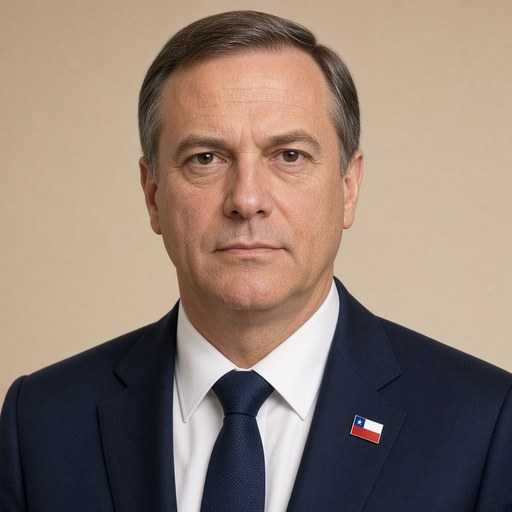
His Excellency the President of the Republic, José Antonio Kast, participates in the launch of the Route 7 Planning Plan, Austral Highway. The ministers of Public Works, Martín Arrau, of Transport and Telecommunications, Louis de Grange, and of E.
 José Antonio Kast · Leader of the Republican Party (Chile)
- Context
- Kast addressed officials and media at the launch of the Route 7 Austral Highway Planning Plan in Aysén, Chile, on April 30, 2026.
- Main themes
- Austral Highway development, national sovereignty, infrastructure investment, regional connectivity, Aysén integration, public works transparency, economic reactivation, tourism and local development, cross-party unity, historical pioneers, digital connectivity, mining and aquaculture
- Duration
- ~9 min
- Words
- 1,024
- Sentences
- 57
- Readability
- 67
- Grade
- 8.4
- Syntax
- 2.73
- Vocabulary
- 1.87
Translated from Spanish
The broad sphere of national life a sentence belongs to. Every sentence has an Arena, so it is the denominator the other indices are read against.
Other57 sentences in 16 paragraphs
I want to thank each one of you for being here, I want to thank the media who have accompanied us to this place, where there is that sign that says “End of the Pavement,” where a new milestone begins.
More than 50 years ago, Chile took a huge leap because it gradually allowed, over the years, Aysén, which was practically an island, to integrate into the national territory. Today we take a leap that may not be as great as the one taken at that time.
I reiterate my gratitude, as the governor did, to the Army of Chile, because I have had the opportunity to travel the route and I have seen many people who worked on that project, who lost someone they knew while working and are still here. Many of these people fell in love with the area and built families, built a homeland here. Along with those settlers who arrived by rivers or opened paths. In the 1930s, there were already people arriving and building a homeland.
What begins today is not just this Government's initiative; it is for all of Chile. It is a projection, because the governor also pointed out to me, here we are not talking about extreme areas, we are talking about sovereignty. And it is something we must engrave in our minds. Here we are building sovereignty. Sovereignty is built in every place where there is a compatriot making a homeland.
The investment will be enormous. If we analyze what has been invested in the last 10 years and what will be invested now each year, every year it will quintuple the investment made year by year in the last 10. From this, job opportunities will also arise; there will be a reactivation simply from the act of building this road.
I also highlight the work of the Ministry of Public Works and the minister, who has been committed and has also worked to explain and present everything so that this is very transparent and everyone can analyze what is being accomplished step by step. Many times it is said we are going to pave so many kilometers, but then it is very difficult to know which kilometers were paved. Whether it was to a standard like this, or if it was a lower standard road. Everything is detailed so that anyone can analyze over time what is being done.
This is looking to the future, much beyond the presidential term. We want to focus in these four years to advance in these almost one billion dollars that will be invested in these four years. But it is the starting point for this to continue to the southernmost part of Chile. We were talking with the minister and he told me: “yes, we will go with paths,” because there are places much further south where there is no road at all. And those transporters who arrived in Santiago in Chile for Chile also marked a milestone. They said: “we want to travel Chile for Chile. That is sovereignty; we do not want to come in and out.”
Here we build a homeland. As I always say, after the rain, the sun comes out. So, I let everyone speak first so that we could have this special moment. But I reiterate, the Austral route is realized with the work of the people who, in any weather, keep moving forward. Today we have great machinery. Fifty years ago it was with shovels, with picks, people who climbed; each one of those who has traveled the Carretera Austral sometimes sees those walls and says how incredible. And they did not do it with machinery as modern as we have today. With logs, with tree cutting to be able to open this path.
I reiterate my thanks to the work teams of the Ministry of Public Works, to the Army of Chile, and also to Carabineros de Chile who are with us, the general of the area who safeguards us, because once it is built we also have to take care of it, because people can sometimes be a bit reckless.
I want to thank the Minister of Transport and Telecommunications who is here and is also heading south, or is he not going now? He is coming back with me.
But the minister has a great role because connectivity is not only road-based, but also digital; strong support is required in public transport. The Minister of Economy and Mining is here so that we can advance in local development.
We are also joined by the Undersecretary of Tourism, because tourism is a tremendous opportunity for the region. Just as aquaculture has been, we have talked with the mayors to ensure that this is well integrated and that there is greater connection between the business world and the citizens. And in mining issues, we can also advance with respect for the environment. Everything that generates work and investment for the country is welcome.
I thank the parliamentarians who are also here showing that we work together on this. When one builds a project like this, there are no political colors. We may have political differences on various issues, but when there is progress, when there is national development, we will never lose sight of that. We will be there; the deputy is also somewhere around here. There she is, the deputy.
In this, there is full unity. We may have, as I said, some differences, but when we talk about infrastructure, when we talk about improving the quality of life of people, we are all united. So, thank you very much to each one of you.
Mayors who are here, thank you for your work. What a pride it is to be in your municipality along with your councilors who are also here with us. And to the regional government, I reiterate my thanks to you and to each one of those who are part of your group. So, a round of applause for you. There is also a mayor from the northern area, from Cisnes, which is where the route begins.
So, truly, thank you very much.
The original Spanish. The tags above are read on the English translation's sentences.
Quiero agradecer la presencia de cada uno de ustedes, quiero agradecerles a los medios de comunicación que nos han acompañado hasta este lugar, donde está ese cartel que dice “Fin del Pavimento”, donde comienza un nuevo hito.
Hace más ya de 50 años, Chile dio un salto enorme porque permitió de a poco y en el transcurso de los años que Aysén, que era prácticamente una isla, se integrara al territorio nacional. Hoy damos un salto quizás no tan grande como el que se dio en ese momento.
Reitero mi agradecimiento, que lo hizo el gobernador, al Ejército de Chile, porque me ha tocado recorrer la ruta y he visto a muchas personas que trabajaron esa obra, que perdieron a alguien conocido trabajando y siguen acá. Muchas de las personas se enamoraron de la zona e hicieron familia, hicieron patria acá. Junto con aquellos colonos que llegaban por los ríos o abriendo sendas. En los años 30 ya había personas que llegaban y hacían patria.
Lo que hoy día comienza es algo que no es de este Gobierno, es de Chile entero. Es una proyección, porque me lo señaló también el gobernador, aquí no hablamos de zonas extremas, hablamos de soberanía. Y es algo que tenemos que grabarnos a fuego. Aquí estamos haciendo soberanía. La soberanía se construye en cada lugar donde hay un compatriota haciendo patria.
La inversión va a ser enorme. Si nosotros analizamos lo que se ha invertido en los últimos 10 años y lo que se va a invertir ahora por año, cada año va a quintuplicar la inversión que se hizo año a año en los últimos 10. De eso también va a nacer fuentes de trabajo, va a haber una reactivación por el mismo hecho de construir esta carretera.
Destaco también el trabajo del Ministerio de Obras Públicas y del ministro, que se ha jugado y además se jugó explicando y planteando todo para que esto sea muy transparente y cada uno pueda ir analizando lo que se va cumpliendo etapa por etapa. Muchas veces se dice vamos a pavimentar tantos kilómetros, pero después cuesta mucho saber cuáles eran los kilómetros pavimentados. Si era de un estándar como este, si era una ruta de menor estándar. Ahí está todo detallado para que cualquiera pueda ir analizando en el tiempo lo que se está haciendo.
Esto es mirar hacia el futuro, mucho más allá del periodo presidencial. Nosotros queremos aplicarnos en estos cuatro años para avanzar en estos casi mil millones de dólares que se van a invertir en estos cuatro años. Pero es el puntapié inicial para que esto continúe hasta el lugar más austral de Chile. Veníamos hablando con el ministro y me decía: “sí, vamos a ir con sendas”, porque hay lugares mucho más al sur donde no hay ningún camino. Y esos transportistas que llegaron a Santiago en el Chile por Chile también marcaron un hito. Dijeron: “nosotros queremos recorrer Chile por Chile. Eso es soberanía, no queremos entrar y salir”.
Aquí se hace patria. Como digo siempre, después de la lluvia sale el sol. Entonces, dejé hablar a todos primero para que tuviéramos este momento especial. Pero reitero, la ruta austral se concreta con el trabajo de las personas que, con cualquier clima, siguen adelante. Hoy día tenemos grandes maquinarias. Hace 50 años era con pala, con picota, gente que se trepaba, cada uno de los que ha recorrido la Carretera Austral de repente ve esos murallones y dice qué increíble. Y no lo hicieron con maquinaria tan moderna como la que tenemos hoy día. Con polines, con corte de árboles para poder ir abriendo esta senda.
Reitero mis agradecimientos a los equipos de trabajo del Ministerio de Obras Públicas, al Ejército de Chile, también a Carabineros de Chile que nos acompaña el general de la zona aquí que resguarda, porque una vez que ya se construye también tenemos que cuidarnos, porque la gente a veces es algo imprudente.
Agradecerle al ministro de Transporte y Telecomunicaciones que está aquí y sigue rumbo al sur también, o no va ahora, ¿no? Vuelve conmigo,
Pero el ministro tiene un gran rol porque la conectividad no solamente es vial, sino que también es digital, en el transporte público se requiere un apoyo fuerte. Está el ministro de Economía y de Minería para que avancemos en el desarrollo local.
Nos acompaña también la subsecretaria de Turismo, porque el turismo es una tremenda oportunidad para la región. Así como lo ha sido el tema de la acuicultura, hemos hablado con los alcaldes para que esto sea bien integrado y que haya una mayor conexión entre el mundo de la empresa y la ciudadanía. Y en temas de minería también se puede ir avanzando con el respeto al medio ambiente. Todo lo que genere trabajo e inversión para el país es bienvenido.
Les agradezco a los parlamentarios también que están acá mostrando que con esto trabajamos en conjunto. Cuando uno construye una obra como esta, no hay colores políticos. Podemos tener diferencias políticas en distintos temas, pero cuando hay avance, cuando hay desarrollo nacional, ahí nunca nosotros nos vamos a perder. Vamos a estar, también está la diputada en alguna parte por ahí. Ahí está la diputada.
En esto hay plena unidad. Podemos tener, como les digo, algunas diferencias, pero cuando hablamos de infraestructura, cuando hablamos de mejorar la calidad de vida de las personas, estamos todos unidos. Así que, muchas gracias a cada uno.
Señores alcaldes que están acá, gracias por el trabajo. Qué orgullo estar en su comuna junto con sus concejales que nos acompañan aquí también. Y al gobierno regional, reiterar los agradecimientos a usted y a cada uno de los que integran su grupo. Así que un aplauso por ustedes. Hay un alcalde de la zona norte también, de Cisnes, que es donde parte la ruta.
Así que, de verdad, muchas gracias.