




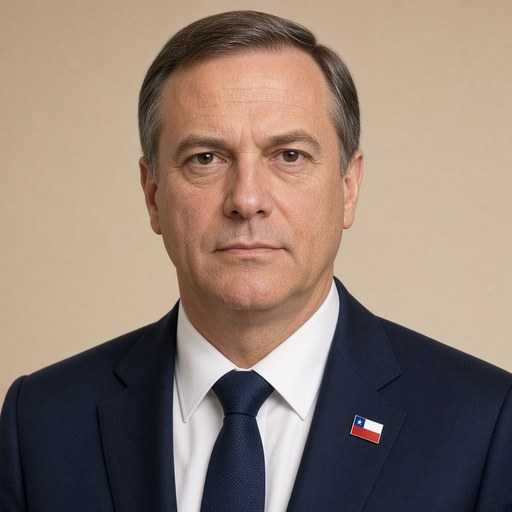
His Excellency the President of the Republic, José Antonio Kast, participates in a meeting of the Ministry of Public Works. The Minister of the portfolio, Martín Arrau, the Minister of Transport and Telecommunications, Louis de Grange, and the Minister of Economy, Daniel Ma, are in attendance.
 José Antonio Kast · Leader of the Republican Party (Chile)
- Context
- Kast addressed a Ministry of Public Works field meeting in the Aysén region on April 30, 2026, to discuss connectivity and regional development priorities.
- Main themes
- Infrastructure connectivity, public works investment, regional development, tourism, aquaculture, private investment, employment, geopolitical integration, Carretera Austral, Aysén region, digital connectivity, government field visit
- Duration
- ~16 min
- Words
- 1,940
- Sentences
- 72
- Readability
- 49
- Grade
- 13.1
- Syntax
- 3.20
- Vocabulary
- 2.00
Translated from Spanish
The broad sphere of national life a sentence belongs to. Every sentence has an Arena, so it is the denominator the other indices are read against.
Other72 sentences in 28 paragraphs
Good, good morning.
Thank you very much to everyone for being here. What you see here is what we call the Government on the ground. Today I have the pleasure of being accompanied by four ministries; you might say there are three, but we have a co-minister as someone said yesterday, and I realized that we have the Minister of Mining and the Minister of Economy, very well accompanied by the Undersecretary of Tourism, and also the Minister of Transport and Telecommunications, which is also very important, and you have already seen the Minister of Public Works with his entire team.
Beyond having a Government on the ground, I was looking at Deputy Alinco, with whom I was a colleague, a friend, right? Colleagues. I misspoke, parliamentary colleagues, friends as well. A round of applause for Deputy Alinco.
I also thank the deputy, the senators, because this is a state policy, beyond the political differences we may have in different visions of what we want to do, connectivity changes lives. Land connectivity, lake connectivity, digital connectivity, is a radical change in the quality of life of people, especially in the most extreme, most isolated areas.
If I remember correctly, the first time I came to the area via the Carretera Austral must have been about 40 years ago, and I was surprised. One, by the lack of connectivity many times, and I recounted yesterday, there at Lake Rosselot, we had to go up in a little boat, we brought an outboard motor and went up, and it was a wonderful thing to see there. The same goes for what it meant to pass through the Cuesta Queulat, to see that cut in the Piedra del Gato, where several people also died trying to achieve that integration of Chile.
Realizing how important it is from a geopolitical point of view to have that connection Chile for Chile. That is something that transcends different governments. All governments have tried to advance with the restrictions that each one may have. For us here, beyond the economic restrictions we have as a nation, this is a very fundamental work that also includes the Los Lagos Region in everything that is the Palena area, because the idea is that trucks have those bridges here, that they do not have the restriction – as I mentioned last night – of the sign, because the bridge was designed for a specific weight, and since repairs are not made, the modification that is made is the entry sign. So, it goes from 40, 30, 20 to 10 tons.
All of that ultimately also makes things more expensive that arrive here. Yes, indeed, things here are more expensive because a truck with a trailer cannot come, it cannot put a ramp, because it does not pass through the bridges. And what it implies is Chile for Chile, where there are very committed transporters who have already arrived in Santiago from Puerto Natales, they arrive at Puerto Yungay, and there they go connecting as they say, until they reach Santiago, and that will have an important change.
That we are today in a regional government where the different authorities of the region are represented is a significant milestone for us. We have already done this in other regions, and as I mentioned at the beginning, it is a way to be on the ground where the ministers have already made several visits to different localities. Here the Minister of Public Works had already come before.
The development of the area has certain pillars, one of the greatest pillars that Aysén can have going forward is tourism. You are already pioneers in tourism, but that can be developed much more. What is already being done regarding the new airport is very relevant, because that, as the undersecretary said, will allow tourists to come directly to Balmaceda, and from there spread throughout the region.
The issue of aquaculture has also been a very relevant support for the region, both for this region and for Magallanes and Los Lagos, it is fundamental in creating job opportunities.
We also need to look at other investments; there are proposals for old mining investments that were halted due to connectivity issues, due to safety issues, and that could help a lot with employability. This region has an unemployment rate perhaps lower than others, quite lower, but it could be one of the first regions where one could say there is full employment, both due to state intervention, but above all due to the arrival of private investment.
The first time I came to the region, it was said that this was the region – from the state's point of view – most socialist, because almost everything depended on state investment. If we as a state put the issue of digital, lake, and land connectivity at the service of the citizens, well, it will start to reverse, and there will be much, much more private investment and there can be a complement between the public and the private. That is something virtuous for the different regions; we have seen in different places how things complement each other, and for us, it would be very relevant to achieve it.
As the minister said, this is not a one-year plan; what we are proposing here is a 4 to 5-year plan, but there has to be continuity, and that is what we expect. And the deadlines that the minister mentions will always be in sight; in that we also want to be very transparent so that people, the parliamentarians year after year, and the President when he has to make a public account, can show the progress or where we are facing difficulties. But that people know what is happening.
We have done it, for example, in security; we are publishing weekly a figure that is always dramatic, the number of homicides. But that also presents us with a challenge, because if we do not inform the citizens, how can they compare whether things are improving or not?
We are always asked, well, what indices will be used to measure when the Government ends? With the same indices that we have measured previous governments, in terms of investment, in terms of jobs, in terms of the number of homes.
Yesterday several housing committees approached us that have been applying for many years, and that for us is a challenge; it is a challenge of housing on the side of the committees, not to regularize situations of usurpation or situations of violence.
In terms of economy and mining, as we mentioned last night, we have had very good news from people who, having certainty about what is being sought, are willing to increase their investments in the nation.
In the area of transport, the minister has also traveled to several areas to see how to alleviate the difficult situation of rising fuel prices. It is very complex, but we have been addressing the issue from the focus of spending. One thing is a general subsidy, and the other, when resources are not available, is to focus on the most vulnerable people in terms of public transport fares, in terms of heating, in terms of artisanal fishing. And there we are seeing how, with the resources we have, we can strengthen the most needy people.
I return to the issue of tourism because clearly, Chile is a tourist power, and we have all the conditions to ensure that Chile grows in the area of tourism, just as we do in the area of mining investment, aquaculture investment, and in different areas.
The issue of tourism, from Arica and Parinacota to Magallanes and the Chilean Antarctic, is tremendous, tremendous potential. This requires promoting the Chile brand much more. Many of us have seen how the Uruguay brand has been enhanced in the world, and it is a small country. Peru too, the Peru brand, which is a country that has certain degrees of insecurity, with accessibility much more difficult than ours.
Everyone recognizes that Chile has connectivity along Route 5, which is projected on Route 7 and others, an initial level of security for tourists, which we have had serious difficulties with in recent years, and an important level of connectivity. And that will improve. Technology is advancing, and we want that technology to be usable by a person in the city, in the urban area, as well as in the rural area.
Years ago, when Senator Sandoval was around, he spoke to me about internal borders, and he explained very well something that Roberto Recabal also mentioned, there in the Villa O’Higgins area; we have to take care of our internal borders. Just as in Visviri, in Colchane, our neighbors have been enhancing the lives of many people in the areas close to the border, we also have to do it. The same happens there in Puerto Williams with Ushuaia; Ushuaia has an international airport, and we are already making progress; we are going to move from airstrips to airports.
But we have the same potential as our neighbors; we have better infrastructure at the national level, and we have to help Chileans who are building a homeland in those remote places to have the same conditions. That is the mandate that this Government has.
The good thing is that most of the ministers know Chile quite well. I believe that the one who knows it best is Minister Arrau; as I said yesterday, he has traveled it by bicycle, by car, by truck, on foot, by plane, in whatever means of transport you can imagine, he has traveled Chile. After him, I must be the one who knows Chile the best from traveling all over the place; I will never forget that in four days I think I traveled from Lago Verde to Villa O'Higgins by truck, entering each of the places. It was a complete tour of the region; I was surprised, but I had been coming for 40 years, being clear that the area requires the same quality of life that we have in others, with all the difficulties it has, but we will advance in that.
So once again to everyone, and especially to the regional government for the contribution it will make not only here in the area of the road but in other matters where there is a strong investment from the regional government. That is appreciated because people see investment, investment that improves the quality of life.
So, Governor, I also want to thank you and thank the presence of the parliamentarians because they are the ones who in these items will have to make a decision on how to move forward. Yesterday in Temuco, the TROI was inaugurated, which is a Comprehensive Oncological Treatment Center for Children, and someone recalled there that it had been due to a line item that Senator José García Ruminot established more than 10 or 12 years ago. And he said: “open a line item so that this center receives funding.” That allowed the regional government in that place to invest nearly 1 billion pesos, which, combined with the private investment of a foundation, the Vivir Más Feliz foundation, plus the investment from the state, we now have a cancer care center for children worth 4 billion. And that was integrated between civil society, the central government, and the regional government.
It was a great moment, and I believe that here too, in that line, great things can be done; I insist again, to improve the quality of life of the inhabitants of Aysén.
Thank you very much.
The original Spanish. The tags above are read on the English translation's sentences.
Muy, muy buenos días.
Muchas gracias a todos por la asistencia. Ustedes lo que ven acá es lo que denominamos el Gobierno en terreno. Me tocó hoy día estar acompañado por 4 ministerios, ustedes dicen hay 3, pero tenemos un biministro como dijo alguien ayer, y ahí caí en cuenta que estaba el ministro de Minería y el ministro de Economía, muy bien acompañado por la subsecretaria de Turismo, y también el ministro de Transportes y Telecomunicaciones, que también es muy importante, y ustedes ya vieron al ministro de Obras Públicas con todo su equipo.
Más allá de tener un Gobierno en terreno. Estaba mirando ahí al diputado Alinco en el cual fuimos compañeros, amigos, ¿no? Colegas. Me equivoqué de concepto, colegas de Parlamento, amigos también. Un aplauso para el diputado Alinco.
También le agradezco a la diputada, a los senadores, porque esta es una política de Estado, más allá de las diferencias políticas que podamos tener en distintas visiones de lo que queremos hacer, la conectividad cambia la vida. La conectividad terrestre, la conectividad lacustre, la conectividad digital, es un cambio radical en la calidad de vida de las personas, sobre todo en las zonas más extremas, más aisladas.
Si algo recuerdo que la primera vez que vine a la zona por la Carretera Austral debe haber sido hace unos 40 años, y quedé sorprendido. Uno, por la falta de conectividad muchas veces, y ayer lo relataba, ahí en el Lago Rosselot, había que subir como en un botecito, traíamos un motor fuera de borda y subimos, y era una cosa maravillosa lo que se podía apreciar ahí. Lo mismo lo que significaba pasar por la Cuesta Queulat, ver ese corte en la Piedra del Gato, donde fallecieron también varias personas procurando esa integración de Chile.
Darse cuenta de lo importante desde el punto de vista geopolítico, que es tener esa conexión Chile por Chile. Eso es algo que trasciende a los distintos gobiernos. Todos los gobiernos han tratado de avanzar con las restricciones que cada uno pueda tener. Para nosotros aquí, más allá de las restricciones económicas que tenemos como nación, esto es una obra muy fundamental que incluye también la Región de Los Lagos en todo lo que es la zona de Palena, porque la idea es que los camiones tengan aquí esos puentes, que no tengan la restricción –como planteaba anoche– del cartel, porque el puente fue diseñado para un peso específico, y como no se le hacen las reparaciones, la modificación que se hace es el cartel de entrada. Entonces, va pasando de 40, 30, 20 y a 10 toneladas.
Todo eso al final también encarece las cosas que llegan acá. Sí efectivamente las cosas aquí son más caras porque no puede venir un camión con acoplado, no puede poner una rampa, porque no pasa por los puentes. Y lo que implica el Chile por Chile, donde hay transportistas muy comprometidos que ya han llegado a Santiago desde Puerto Natales, llegan a Puerto Yungay, y ahí se van conejeando como se dice, hasta llegar a Santiago, y eso va a tener un cambio importante.
Que estemos hoy día en un gobierno regional donde están representadas las distintas autoridades de la región, para nosotros es un hito relevante. Ya lo hemos hecho en otras regiones, y como planteé al inicio, es una manera de estar en terreno donde los ministros ya han tenido varias visitas a distintas localidades. Aquí el ministro de las Públicas ya había venido antes.
El desarrollo de la zona tiene ciertos puntales, uno de los mayores puntales que puede tener Aysén en adelante es el turismo. Ustedes ya son pioneros en temas turísticos, pero eso se puede desarrollar mucho más. Es muy relevante lo que ya se está haciendo en el tema del nuevo aeropuerto, porque eso, como lo decía la subsecretaria, va a permitir traer turistas directamente a Balmaceda, y de ahí desplegarse por la región.
El tema de la acuicultura también ha sido un soporte muy relevante para la región, tanto para esta región como para Magallanes y Los Lagos, es fundamental en la creación de fuentes de trabajo.
También tenemos que ir viendo otras inversiones, hay planteamientos de inversiones mineras antiguas que se dejaron de producir por temas de conectividad, por temas de seguridad, y eso podría ayudar mucho a la empleabilidad. Esta región tiene una tasa de desempleo quizás menor que otras, bastante menor, pero podría ser de las primeras regiones donde uno podría decir hay pleno empleo, tanto por la intervención del Estado, pero sobre todo por la llegada de inversión privada.
La primera vez que vine a la región, se decía que esta era la región –desde el punto de vista del Estado– más socialista, porque casi todo dependía de la inversión del Estado. Si nosotros como Estado ponemos al servicio de la ciudadanía el tema de la conectividad digital, lacustre y terrestre, bueno, se va a ir revirtiendo, y va a haber mucha, mucha más inversión privada y puede haber un complemento entre lo público y lo privado. Eso es algo virtuoso para las distintas regiones, lo hemos visto en distintas partes cómo se van complementando las cosas, y para nosotros sería muy relevante lograrlo.
Como dijo el ministro, esto no es a un año plazo, lo que nosotros planteamos aquí es a 4 a 5 años plazo, pero tiene que haber una continuidad, y eso es lo que esperamos. Y los plazos que señala el ministro van a estar siempre a la vista, en eso también queremos ser siempre muy transparentes para que las personas, los parlamentarios año a año, y el Presidente cuando tenga que hacer cuenta pública, pueda ir mostrando los avances o donde estamos con dificultades. Pero que la gente sepa lo que está pasando.
Lo hemos hecho, por ejemplo, en seguridad, estamos publicando semanalmente una cifra que siempre es dramática, el número de homicidios. Pero eso también nos pone un desafío, porque si a la ciudadanía no le vamos informando contra qué compara si se está mejorando o no.
Siempre nos preguntan, bueno, ¿con qué índices se van a medir cuando termine el Gobierno? Con los mismos índices que hemos medido los gobiernos anteriores, en temas de inversión, en temas de trabajo, en temas de cantidad de viviendas.
Ayer se acercaron varios comités de viviendas que llevan bastantes años postulando, y ese para nosotros es un desafío, es un desafío de viviendas por el lado de los comités, no de regularizar situaciones de usurpación o de situaciones de violencia.
En temas de economía y minería, como lo planteábamos anoche, hemos tenido muy buenas noticias de personas que teniendo certeza que es lo que se busca, están dispuestas a aumentar sus inversiones en la nación.
En el tema del transporte, también el ministro ha recorrido varias zonas para ver cómo paliar la difícil situación del alza de los combustibles. Es muy complejo, pero hemos ido abordando el tema desde la focalización del gasto. Una cosa es un subsidio general, y lo otro, cuando no se tienen los recursos, es ir a focalizar a las personas más vulnerables en el tema de los pasajes del transporte público, en el tema de la calefacción, en el tema de la pesca artesanal. Y ahí vamos viendo cómo con los recursos que tenemos ir fortaleciendo a las personas más necesitadas.
Vuelvo al tema del turismo, porque claramente, Chile es una potencia turística, y tenemos todas las condiciones para lograr que Chile crezca por el área del turismo, así como lo hacemos en el área de la inversión minera, la inversión acuícola, y en distintas áreas.
El tema del turismo, desde Arica y Parinacota hasta Magallanes y la Antártica Chilena, es un tremendo, tremendo potencial. Eso requiere promover mucho más la marca Chile. Muchos hemos visto cómo la marca Uruguay se ha potenciado en el mundo, y es un país pequeñito. Perú también, la marca Perú, que es un país que tiene ciertos grados de inseguridad, de accesibilidad mucho más difíciles que los nuestros.
Todos reconocen que Chile tiene una conectividad a lo largo de la Ruta 5, que se proyecta en la Ruta 7 y otras, un nivel de seguridad inicial para los turistas, que hemos tenido dificultades serias en los últimos años, y un nivel de conectividad importante. Y eso va a mejorar. La tecnología va avanzando, y nosotros queremos que esa tecnología la pueda usar una persona en la ciudad, en la zona urbana, como también en la zona rural.
Años atrás, cuando estaba el senador Sandoval, me hablaba de las fronteras internas, y me explicaba muy bien algo que también planteaba Roberto Recabal, ahí en la zona de Villa O’Higgins, nosotros tenemos que cuidar nuestras fronteras internas. Así como en Visviri, en Colchane, nuestros vecinos han ido potenciando la vida de muchas personas en el entorno cercano a la frontera, nosotros también tenemos que hacerlo. Lo mismo pasa ahí en Puerto Williams con Ushuaia, Ushuaia tiene un aeropuerto internacional, y nosotros ya vamos avanzando, vamos a pasar de aeródromos a aeropuerto.
Pero tenemos las mismas potencialidades que tienen los vecinos, tenemos mejor infraestructura a nivel nacional, y tenemos que ir ayudándoles a los chilenos que hacen patria en esos lugares alejados, a tener las mismas condiciones. Ese es el mandato que tiene este Gobierno.
Lo bueno es que la mayoría de los ministros conocen bastante bien Chile. Yo creo que el que mejor lo conoce, sí, es el ministro Arrau, como dije ayer, lo ha recorrido en bicicleta, en auto, en camioneta, a pie, en avión, en el medio de transporte que ustedes se imaginan, ha recorrido Chile. Después de él, debo ser yo el que más conoce Chile en recorridos por todos lados, no podré olvidar jamás que en cuatro días creo que hice desde Lago Verde hasta Villa O'Higgins en camioneta, entrando a cada uno de los lugares. Fue un recorrido completo de la región, quedé sorprendido, pero ya venía desde hace 40 años, teniendo claro que la zona requiere la misma calidad de vida que tenemos en otros, con todas las dificultades que tiene, pero en eso vamos a avanzar.
Así que una vez más a todos, y sobre todo al gobierno regional por el aporte que va a hacer no solamente aquí en el tema de la ruta, sino en otras materias donde hay una inversión fuerte del gobierno regional. Eso se agradece porque las personas ven inversión, inversión que mejora la calidad de vida.
Así que, Gobernador, también agradecerle a usted y agradecerles la presencia a los parlamentarios porque son ellos los que en estos ítems van a tener que tomar una decisión de cómo avanzar. Ayer en Temuco se inauguró el tema del TROI, que es un Centro de Tratamiento Oncológico Integral para Niños, y alguien recordaba ahí que había sido por una glosa que había instalado el senador José García Ruminot hace más de 10 o 12 años atrás. Y decía: “ábrase una glosa para que este centro reciba aporte”. Eso permitió que el gobierno regional en ese lugar pudiera invertir cerca de 1.000 millones de pesos que, unidos a la inversión privada de una fundación, de la fundación Vivir Más Feliz, más la inversión del Estado, ahí tenemos hoy día un centro de atención para niños con cáncer de 4.000 millones. Y eso fue integrado entre la sociedad civil, el gobierno central y el gobierno regional.
Fue un gran momento y creo que aquí también en esa línea se pueden hacer grandes cosas, vuelvo a insistir, para mejorar la calidad de vida de los habitantes de Aysén.
Muchas gracias.