




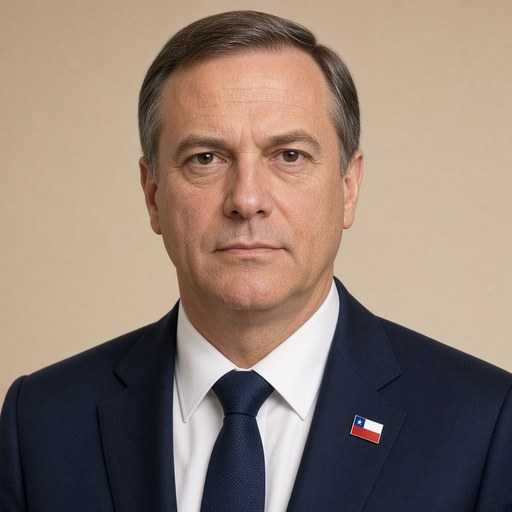
His Excellency the President of the Republic, José Antonio Kast, participates in the second session of the committee "Chile Moves Forward," where measures will be presented to assist families.
 José Antonio Kast · Leader of the Republican Party (Chile)
- Context
- President Kast presented the second session of the 'Chile Moves Forward' committee on April 1, 2026, announcing measures to aid Chilean families affected by rising fuel costs due to war.
- Main themes
- Economic relief measures for families, fuel price increases, war's economic impact on Chile, public transport fare freeze, artisanal fishing support, liquefied gas subsidies, municipal collaboration, kerosene price relief, transport sector support, social vulnerability assistance
- Duration
- ~8 min
- Words
- 995
- Sentences
- 40
- Readability
- 44
- Grade
- 13.1
- Syntax
- 3.08
- Vocabulary
- 2.11
Translated from Spanish
The broad sphere of national life a sentence belongs to. Every sentence has an Arena, so it is the denominator the other indices are read against.
Other40 sentences in 21 paragraphs
Good morning.
As always, I thank you for joining us for each of our presentations.
I will start with something unusual. Today is the birthday of our spokesperson minister. So, let’s give her a round of applause.
Now, I would like to thank the Minister of Energy who is with us, the Minister of Finance, the Minister of the Interior, our Undersecretary of Fisheries, our Subdere, and our Undersecretary of Transport.
Additionally, I greatly appreciate the presence of the mayor and president of the Chilean Association of Municipalities, Mr. Gustavo Alessandri, the president of the Association of Municipalities of Chile, Mr. José Manuel Palacios, and the president of AMUR, the Association of Rural Municipalities, Rodrigo Contreras.
You know that we are going through difficult, unanticipated times. The effects of the war have impacted all families in Chile. In this Plan Chile Sale Adelante, we have sought to implement measures to assist the most vulnerable families, those families that have been affected by urgent and necessary measures that the Government has had to take to address this situation.
We have seen complex situations, and our plan is not static, and we have reiterated that. We are analyzing each situation that the Chilean family faces on a daily basis that has difficulties.
The initial plan included freezing public transport fares, both at the level of the Metropolitan Region and also working with governors throughout Chile, so that this fare is also respected at the regional level.
We also processed a legislative matter that we are going to implement so that kerosene reaches the price it had at the beginning of February. We hope that this will be functioning in the coming weeks.
As you know, we also considered an extraordinary contribution to taxis, shared taxis, and school transport, with a specific bonus for a couple of months while the effects of the war persist.
We also had a very good meeting with various transport unions, where we explained the reasons for the rise in oil prices. We committed, along with the Minister of Finance, the Minister of Transport, and the Minister of Public Works, to improve conditions on the road, to provide a greater degree of safety.
It is also important to always highlight that this is not an issue of the transporters, because to some extent some people have attributed responsibility to the transporters, and that is not the case. They play a significant role in transporting, moving all of Chile, delivering products everywhere, but clearly, they are not responsible for the war or the rise in fuel prices.
Also, today, together with the Undersecretary of Fisheries, who is with us, we identified the issue of artisanal fishing. Artisanal fishing is also affected by the rise in oil prices, depending on the type of engine they use. For them, we have seen a special measure that considers more than 9,000 vessels registered in the Artisanal Fishing Registry.
It is important to point out that in order to receive this benefit, certain cumulative requirements must be met, all of which are necessary to apply for this benefit, which would last a maximum period depending on the price, and I insist on this, this is temporary and depending on fuel prices, a maximum period of 6 months for 9,000 vessels, as I mentioned, but that have a length equal to or less than 12 meters, that are registered with effective activity during the year 2025, and that have an accredited activity in the month in which this bonus is requested.
These requirements are essential, and all must be met in order to provide this special emergency bonus to the families of artisanal fishing.
The second measure, and I thank each of the associations of municipalities that represent the vast majority of municipalities across the country for their collaboration, is to see how we can reach the homes of the most vulnerable families regarding liquefied gas.
On one hand, as you know, we worked on the issue of kerosene, but we understand that it is not enough, and with the collaboration and ideas from the mayors, we have reached an agreement that based on the Social Household Registries, considering the vulnerability of the people, and I will explain at the end of the conference how this amount is achieved, we can make a transfer discussed with the municipalities through Subdere – the Subdere is also with us here – along with the Minister of the Interior, of 225 million dollars, which will benefit a large number of very vulnerable families. But this will be done through municipalities, which are those that have the necessary information about each of these families to ensure the proper use and delivery of this benefit.
Here, I want to reiterate a call to the citizens, to collaborate with us, because this is a critical moment, an emergency moment. We all have something to contribute, whether in ideas or in behaviors we exhibit during this time.
A call to manifest peacefully, a call to the youth, to also recognize that this is a critical period and we need all the collaboration. Today we need young people to respect their teachers. What we have seen in recent days is dramatic, and what we witnessed after the murder of the inspector in Calama is that violence is present in schools. We all must be responsible for stopping this. Parents, guardians, directors, teachers, but above all, students. There must be a significant change in attitude.
To the citizens, in general, I must say that the war unfortunately continues. We are making every effort on our part to help bring it to an end. But as long as this continues, the measures that have been taken by the Government are necessary to face something that could prolong over time.
Now I would like to give the floor to the mayors, representatives of the associations, and I will conclude this press point with the words of the Minister of Finance.
The original Spanish. The tags above are read on the English translation's sentences.
Muy buenos días.
Como siempre, les agradezco que nos acompañen en cada una de nuestras exposiciones.
Voy a partir con algo inusual. Hoy día está de cumpleaños nuestra ministra vocera. Así que, le vamos a dar un aplauso.
Ahora sí, les doy las gracias a la ministra de Energía que nos acompaña, al ministro de Hacienda, al ministro del Interior, a nuestro subsecretario de Pesca, a nuestro Subdere y nuestro subsecretario de Transportes.
Además, les agradezco mucho la presencia al alcalde y presidente de la Asociación Chilena de Municipalidades, don Gustavo Alessandri, al presidente de la Asociación de Municipalidades de Chile, don José Manuel Palacios, y al presidente de la AMUR, de la Asociación de Municipios Rurales, Rodrigo Contreras.
Ustedes saben que estamos pasando por momentos difíciles, no buscados. El efecto de la guerra ha golpeado a todas las familias en Chile. Hemos buscado, en este Plan Chile Sale Adelante, las medidas paliativas para ir en ayuda de aquellas familias más vulnerables, aquellas familias que se han visto afectadas por medidas urgentes y necesarias que ha tenido que tomar el Gobierno para enfrentar esta situación.
Hemos visto situaciones complejas y nuestro plan no es estático, y eso lo hemos reiterado. Nosotros estamos analizando cada situación que vive en el día a día aquella familia chilena que tiene dificultades.
El plan inicial consideró el congelamiento de las tarifas del transporte público, tanto a nivel de la Región Metropolitana, como también un trabajo con los gobernadores a lo largo de todo Chile, para que esta tarifa también se respete a nivel regional.
También, se tramitó un tema de ley que vamos a ya implementar para que la parafina llegue a ese valor que tenía a inicios de febrero. Esperamos que eso ya esté funcionando en las próximas semanas.
También se consideró, como ustedes saben, un aporte extraordinario a taxis, taxis colectivos y al transporte escolar, con un bono específico por un par de meses mientras esté el efecto de la guerra.
También tuvimos una muy buena reunión con distintos gremios del transporte, donde se explicó el porqué del alza del petróleo. Nos comprometimos, junto con el ministro de Hacienda, el ministro de Transporte y el ministro de Obras Públicas, a mejorar las condiciones en la ruta, a dar mayor grado de seguridad.
También, destacar siempre que este no es un tema de los transportistas, porque en alguna medida algunas personas les han atribuido la responsabilidad a los transportistas y eso no es así. Ellos cumplen un gran rol de transportar, de mover a Chile completo, de llegar con los productos a todas partes, pero claramente no es responsabilidad de ellos tampoco el tema de la guerra ni el alza de los combustibles.
También, hoy día, junto con el subsecretario de Pesca, que nos acompaña, identificamos el tema de la pesca artesanal. La pesca artesanal también se ve afectada por el alza del petróleo, de la bencina, dependiendo del tipo de motor que usen. Para ellos hemos visto una medida especial que considera a más de 9.000 embarcaciones que están inscritas en el Registro Pesquero Artesanal.
Es importante señalar que para que se pueda dar este beneficio, se tienen que cumplir algunos requisitos copulativos, que son todos necesarios para poder postular a este beneficio, que duraría un periodo máximo dependiendo del valor, y vuelvo a insistir en esto, esto es transitorio y dependiendo de los valores de los combustibles, un periodo máximo de 6 meses para 9.000 embarcaciones, como les digo, pero que tengan una eslora igual o inferior a 12 metros, que estén con un registro de actividad efectiva durante el año 2025 y que tengan una actividad acreditada en el mes que se solicite esta bonificación.
Estos requisitos son esenciales, que concurran todos para poder entregar esta bonificación especial de emergencia a las familias de la pesca artesanal.
La segunda medida, y ahí le agradezco la colaboración a cada una de las asociaciones de municipios que representan a la gran mayoría de los municipios de todo el país, para ver cómo nosotros llegamos a los hogares de las familias más vulnerables en el tema del gas licuado.
Por un lado, como ustedes saben, se trabajó el tema de la parafina, pero entendemos que no es suficiente, y con la colaboración y con las ideas de los alcaldes hemos llegado a un acuerdo de que en base a los Registros Sociales de Hogares, considerando la vulnerabilidad de las personas, y va a explicar al fin de la conferencia el cómo se logra este monto, podemos hacer un traspaso conversado con los municipios a través de la Subdere –nos acompaña también aquí el Subdere– junto con el ministro del Interior, de 225 millones de dólares, que va a beneficiar a un gran número de familias muy vulnerables. Pero esto se hará vía municipios, que son aquellos que tienen los antecedentes necesarios de cada una de estas familias para poder hacer buen uso y buena entrega de este beneficio.
Aquí volver a reiterar un llamado a la ciudadanía, que nos colaboren todos, porque es un momento crítico, un momento de emergencia. Todos tenemos algo que aportar, sea en ideas o en conductas que realicemos durante este tiempo.
Un llamado a manifestarse en paz, un llamado a los jóvenes, a que también asuman que este es un periodo crítico y necesitamos toda la colaboración. Hoy día necesitamos que los jóvenes respeten a sus profesores. Lo que hemos visto en estos días es dramático y lo que hemos visto después del asesinato de la inspectora en Calama es que la violencia está en los establecimientos escolares. Tenemos que todos ser responsables de parar esto. Los padres apoderados, los directores, los profesores, pero sobre todo los alumnos. Tiene que haber un cambio de actitud importante.
A la ciudadanía, en general, decirle que la guerra lamentablemente sigue. Estamos haciendo por nuestra parte todos los esfuerzos para colaborar en que eso termine. Pero mientras esto continúe, las medidas que se han tomado como Gobierno son las necesarias para enfrentar algo que podría prolongarse en el tiempo.
Ahora quiero darles la palabra a los señores alcaldes, representantes de las asociaciones, y terminaría este punto de prensa con las palabras del ministro de Hacienda.