




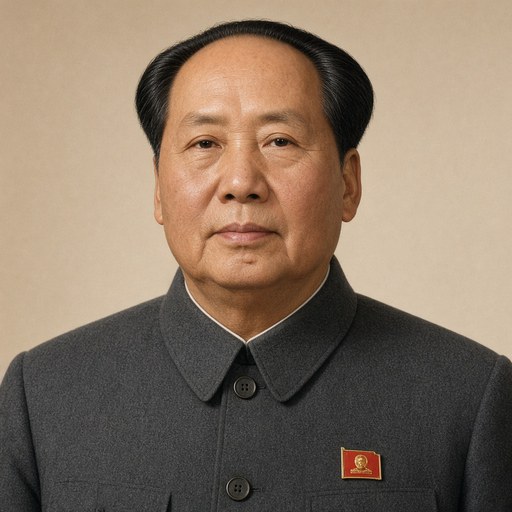
Be a Complete Revolutionary
 Mao Zedong · Chairman of the Central People's Government of the People's Republic of China
- Context
- Mao addressed the closing session of the People's Political Consultative Conference National Committee on June 23, 1950, endorsing the Agrarian Reform Law and urging unity, criticism and self-criticism, and passing the land reform test.
- Main themes
- Land reform and the Agrarian Reform Law, the tests of war and land reform, the coming test of socialism, who counts as a revolutionary, criticism and self-criticism, the revolutionary united front, the people's democratic dictatorship, alliance with the Soviet Union and People's Democracies, the Common Programme, advisory sessions of the People's Political Consultative Conference, the peasantry and industrialization, reassurance to the national bourgeoisie
- Duration
- ~13 min
- Words
- 1,547
- Sentences
- 58
- Readability
- 39
- Grade
- 14.5
- Syntax
- 3.36
- Vocabulary
- 1.98
Translated from Chinese Source: GitHub qinglee/maoxuan (毛泽东选集) ↗
The broad sphere of national life a sentence belongs to. Every sentence has an Arena, so it is the denominator the other indices are read against.
Other58 sentences in 5 paragraphs
This session has summed up the experience of the past period and decided on our various policies.
This work of summing up experience and deciding on policies has been done by all of us together. It has been done by representatives of all the nationalities, all the democratic classes, all the democratic parties, all the people's organizations and democratic personages from all walks of life, gathered together. Here we have not only the members of the National Committee of the People's Political Consultative Conference, but also many working personnel of the Central People's Government, of the people's governments (military and administrative committees) of the major administrative regions and of the people's governments of the provinces and municipalities, attending and taking part in the discussions as observers; and also representatives of the consultative committees of the people's representative conferences of all circles in the provinces and municipalities, attending and taking part in the discussions as observers; and also many specially invited patriotic personages, attending and taking part in the discussions as observers. In this way we are able to pool a wide range of opinions, review our past work and decide on our policies for the future. I hope that we will continue to use this method from now on, and I hope that the people's governments (military and administrative committees) of the major administrative regions and the people's governments of the provinces and municipalities will also adopt it. For the time being our sessions are still advisory in nature. In practice, however, the decisions we make at such sessions will of course be adopted and put into effect by the Central People's Government, and they should be adopted and put into effect.
We have unanimously approved the report on the work of the National Committee and the various reports on the work of the Central People's Government. These include reports on land reform, political work, military work, economic and financial work, taxation, cultural and educational work, and the work of the courts, and all of them are good reports. They appropriately sum up the experience of our work in the past period and lay down the policies for our work in the future. The reason this session has had so many items on its agenda is that, since our new state was founded, work in every field has been in the process of being started and developed, and the people of the whole country are vigorously carrying on the great struggle of a genuine people's revolution on every front. On the military front, on the economic front, on the ideological front and on the land reform front, these are struggles of unprecedented magnitude. Every field of work needs to be summed up and needs guidance on policy, and so we have had this many items on our agenda. Under the law our sessions are held twice a year, and one of them will be a session with many items on the agenda and the other a session with fewer items. China is a big country with an actual population of more than 475 million, and it is in the great historical period of the people's revolution. These circumstances required us to act this way, and so we did. I think we were right to do so.
This session has had many items on its agenda, and the central item has been the reform of the old land system. Everyone has endorsed the report by Vice-Chairman Liu Shaoqi and the Draft Agrarian Reform Law proposed by the Central Committee of the Communist Party of China, and has made a number of useful amendments and additions to the draft law. This is very good. I express my joy and offer my congratulations that the hundreds of millions of rural people of New China have gained the opportunity to stand up, and that the country has gained the basic conditions for industrialization. The bulk of China's population is peasants. The revolution was won with the help of the peasants, and the country's industrialization can succeed only with the help of the peasants. Therefore the working class should actively help the peasants carry out land reform, and the urban petty bourgeoisie and the national bourgeoisie should also support this reform, while all the democratic parties and people's organizations should take this attitude all the more. War and land reform are two "tests" which, in the historical period of New Democracy, put all the people and all the political parties of China to the test. Whoever sides with the revolutionary people is a revolutionary. Whoever sides with imperialism, feudalism and bureaucrat-capitalism is a counter-revolutionary. Whoever sides with the revolutionary people only in words but acts otherwise is a revolutionary in words only. Whoever sides with the revolutionary people not only in words but also in deeds is a revolutionary in the full sense. The test of war is basically behind us. We all came through this test very well, and the people of the whole country are satisfied. Now we have to pass the test of land reform, and I hope that we will all pass it as well as we passed the test of war. If everyone studies more, consults more, straightens out their thinking, falls into step and forms a great anti-feudal united front, we will be able to lead and help the people pass this test smoothly. Once the test of war and the test of land reform are behind us, the remaining test will be easy to pass. That is the test of socialism, the test of carrying out socialist transformation throughout the country. As long as people have contributed in the revolutionary war and in the revolutionary reform of the land system, and go on contributing in the years of economic and cultural construction ahead, then when the time comes to nationalize private industry and socialize agriculture (and that time is still in the distant future), the people will not forget them, and their future will be bright. This is how our country will advance steadily: through war, through the reforms of New Democracy, and in the future, once the country's economic and cultural undertakings are greatly flourishing, once all the conditions are ripe, and once the people of the whole country have thought it over fully and given their consent, we can enter the new era of socialism calmly and properly. I think it is necessary to make this clear, so that people can have confidence and will not hesitate and worry, thinking: who knows when you will no longer want me, and then, however much I wish to serve the people, I will have no chance to do so. No, that will not happen. As long as someone is genuinely willing to serve the people, has really helped and done good deeds during the period when the people were still in difficulty, and keeps on doing so consistently without giving up halfway, the people and the people's government have no reason to reject him, and no reason to deny him a living or the opportunity to serve.
In pursuit of this long-range goal, abroad we must firmly unite with the Soviet Union, with all the People's Democracies and with all the forces of peace and democracy throughout the world, and on this there must not be the slightest hesitation or wavering. At home we must unite all the nationalities, all the democratic classes, all the democratic parties, all the people's organizations and all patriotic and democratic personages, and we must consolidate the great and prestigious revolutionary united front we have already built. Whoever contributes to consolidating this revolutionary united front, we welcome, and he is right. Whoever harms the work of consolidating this revolutionary united front, we oppose, and he is wrong. To consolidate the revolutionary united front, we must use the method of criticism and self-criticism. The chief standard to apply in using this method is our present fundamental law, the Common Programme. At this session we have used the method of criticism and self-criticism on the basis of the Common Programme. It is a very good method. It is a very good method for encouraging everyone to uphold the truth and correct mistakes, and it is the only correct method by which all the revolutionary people in a people's state can educate and remould themselves. The people's democratic dictatorship has two methods. Towards the enemy it uses the method of dictatorship. That is to say, for as long as necessary, it does not let them take part in political activity, compels them to obey the laws of the people's government, and compels them to engage in labour and through labour remoulds them into new people. Towards the people it is the opposite. It uses not compulsion but democratic methods. That is to say, it must let them take part in political activity, and rather than compelling them to do this or that, it uses democratic methods to educate and persuade them. This educational work is self-education within the ranks of the people, and criticism and self-criticism is the basic method of self-education. I hope that all the nationalities, all the democratic classes, all the democratic parties, all the people's organizations and all patriotic and democratic personages throughout the country will adopt this method.
The original Chinese. The tags above are read on the English translation's sentences.
此次会议总结了过去时期的经验,决定了各项方针。
这种总结经验和决定方针的工作,是我们大家一起来做的,是各民族、各民主阶级、各民主党派、各人民团体和各界民主人士的代表人物集合在一起来做的。这里,不但有人民政协全国委员会的委员们,而且有中央人民政府、各大行政区人民政府(军政委员会)及各省市人民政府的许多工作人员列席参加讨论,而且有各省市各界人民代表会议协商委员会的代表们列席参加讨论,而且有许多特邀的爱国人士列席参加讨论。这样,我们就能集中广泛的意见,检查过去的工作,决定今后的方针。这种方法,我希望我们以后继续采用,并且希望各大行政区人民政府(军政委员会)和各省市人民政府也采用这种方法。我们的会议在暂时还是建议性质的会议。但是在实际上,我们在这种会议上所做的决定,中央人民政府是当然会采纳并见之实行的,是应当采纳并见之实行的。
我们一致同意了全国委员会的会务报告和中央人民政府的各项工作报告。这里有土地改革工作、政治工作、军事工作、经济和财政工作、税收工作、文化和教育工作、法院工作等项报告,这些报告都是好的。在这些报告中,适当地总结了过去时期的工作经验,规定了今后的工作方针。我们这次会议所以有这样多的议题,是因为我们的新国家成立以后,各方面工作都在开创,都在发展,全国人民正在蓬蓬勃勃地在各个战线上开展真正人民革命的伟大斗争,在军事战线上,在经济战线上,在思想战线上,在土地改革的战线上都是从古未有的极其伟大的斗争,各项工作都待总结,都待指示方针,所以我们有了这样多的议题。我们的会议按法律规定是每年开会两次,其中将有一次为议题众多的会议,一次为议题较少的会议。中国是一个大国,实际的人口超过四亿七千五百万,又处在人民革命的伟大历史时期,这种情况要求我们这样做,我们也就这样做了,我想我们是做得对的。
我们这次会议议题众多,中心的议题是将旧有土地制度加以改革的问题。大家同意刘少奇副主席的报告及中共中央建议的土地改革法草案,并对土地改革法草案作了若干有益的修改和补充。这是很好的,我为新中国数万万农村人民获得翻身机会和国家获得工业化的基本条件而表示高兴,表示庆贺。中国的主要人口是农民,革命靠了农民的援助才取得了胜利,国家工业化又要靠农民的援助才能成功,所以工人阶级应当积极地帮助农民进行土地改革,城市小资产阶级和民族资产阶级也应当赞助这种改革,各民主党派、各人民团体更应当采取这种态度。战争和土改是在新民主主义的历史时期内考验全中国一切人们、一切党派的两个“关”。什么人站在革命人民方面,他就是革命派,什么人站在帝国主义、封建主义、官僚资本主义方面,他就是反革命派。什么人只是口头上站在革命人民方面而在行动上则另是一样,他就是一个口头革命派,如果不但在口头上而且在行动上也站在革命人民方面,他就是一个完全的革命派。战争一关,已经基本上过去了,这一关我们大家都过得很好,全国人民是满意的。现在是要过土改一关,我希望我们大家都和过战争关一样也过得很好。大家多研究,多商量,打通思想,整齐步伐,组成一条伟大的反封建统一战线,就可以领导人民和帮助人民顺利地通过这一关。只要战争关、土改关都过去了,剩下的一关就将容易过去的,那就是社会主义的一关,在全国范围内实行社会主义改造的那一关。只要人们在革命战争中,在革命的土地制度改革中有了贡献,又在今后多年的经济建设和文化建设中有所贡献,等到将来实行私营工业国有化和农业社会化的时候(这种时候还在很远的将来),人民是不会把他们忘记的,他们的前途是光明的。我们的国家就是这样地稳步前进,经过战争,经过新民主主义的改革,而在将来,在国家经济事业和文化事业大为兴盛了以后,在各种条件具备了以后,在全国人民考虑成熟并在大家同意了以后,就可以从容地和妥善地走进社会主义的新时期。我认为讲明这一点是有必要的,这样可以使人们有信心,不致彷徨顾虑,不知道什么时候你们不要我了,我虽想为人民效力也没有机会了。不,不会这样的,只要谁肯真正为人民效力,在人民还有困难的时期内确实帮了忙,做了好事,并且是一贯地做下去,并不半途而废,那末,人民和人民的政府是没有理由不要他的,是没有理由不给他以生活的机会和效力的机会的。
在这个远大目标上,在国外,我们必须坚固地团结苏联、各人民民主国家及全世界一切和平民主力量,对此不可有丝毫的游移和动摇。在国内,我们必须团结各民族、各民主阶级、各民主党派、各人民团体及一切爱国民主人士,必须巩固我们这个已经建立的伟大的有威信的革命统一战线。不论什么人,凡对于这个革命统一战线的巩固工作有所贡献者,我们就欢迎他,他就是正确的;凡对于这个革命统一战线的巩固工作有所损害者,我们就反对他,他就是错误的。要达到巩固革命统一战线的目的,必须采取批评和自我批评的方法。采取这种方法时所用的标准,主要是我们现时的根本大法即《共同纲领》。我们在这次会议中,即根据《共同纲领》,采取了批评和自我批评的方法。这是一个很好的方法,是推动大家坚持真理、修正错误的很好的方法,是人民国家内全体革命人民进行自我教育和自我改造的唯一正确的方法。人民民主专政有两个方法。对敌人说来是用专政的方法,就是说在必要的时期内,不让他们参与政治活动,强迫他们服从人民政府的法律,强迫他们从事劳动并在劳动中改造他们成为新人。对人民说来则与此相反,不是用强迫的方法,而是用民主的方法,就是说必须让他们参与政治活动,不是强迫他们做这样做那样,而是用民主的方法向他们进行教育和说服的工作。这种教育工作是人民内部的自我教育工作,批评和自我批评的方法就是自我教育的基本方法。我希望全国各民族、各民主阶级、各民主党派、各人民团体和一切爱国民主人士,都采用这种方法。