




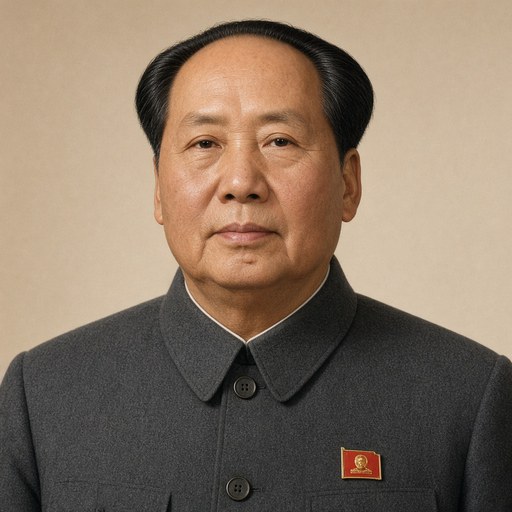
Unite and Draw a Clear Line Between Ourselves and the Enemy
 Mao Zedong · Chairman of the Central People's Government of the People's Republic of China
- Context
- Mao addressed an audience of Chinese leaders and united front figures on August 4, 1952, reviewing the Korean War, the Three Antis and Five Antis campaigns and economic recovery, and urging unity and a clear line between ourselves and the enemy.
- Main themes
- Korean War and the War to Resist US Aggression and Aid Korea, negotiations alongside fighting, tunnel fortifications and grain supply, Three Antis and Five Antis campaigns, increasing production and practising economy, financial stabilization and war expenditure, reasons the United States cannot sustain a long war, ten years of peace for industrial construction, united front with democratic parties, line between ourselves and the enemy, religious circles and Buddhism, failure of the 1911 Revolution
- Duration
- ~11 min
- Words
- 1,282
- Sentences
- 73
- Readability
- 61
- Grade
- 9.1
- Syntax
- 2.85
- Vocabulary
- 1.97
Translated from Chinese Source: GitHub qinglee/maoxuan (毛泽东选集) ↗
The broad sphere of national life a sentence belongs to. Every sentence has an Arena, so it is the denominator the other indices are read against.
Other73 sentences in 20 paragraphs
Over this past year, we have been fighting, negotiating and stabilizing all at the same time.
The situation in the Korean War settled down after July last year, but at that time we were not yet sure whether the financial and economic situation at home could be stabilized. In the past we only spoke of "prices being basically stable and revenue and expenditure being close to balance," which meant that prices could not yet be stabilized and revenue and expenditure were not yet in balance. Revenue was low and expenditure was high; this was a problem. Therefore, the Central Committee of the Communist Party of China held a meeting in September last year and put forward increasing production and practising strict economy. In October, at the Third Session of the First National Committee of the Chinese People's Political Consultative Conference, I again put forward increasing production and practising economy. In the movement to increase production and practise economy, quite serious problems of corruption, waste and bureaucratism were exposed, and in December the "Three Antis" campaign was launched, followed by the "Five Antis" campaign. Now the "Three Antis" and "Five Antis" campaigns have ended in victory, the problems have become completely clear, and all under heaven is settled.
Last year, the expenses of the War to Resist US Aggression and Aid Korea were roughly equal to the expenses of domestic construction, half and half. This year is different: war expenses are estimated to be only half of last year's. Our troops have now been reduced, but their equipment has been strengthened. We fought for more than twenty years in the past and never had an air force; others simply bombed us. Now we have an air force, and we have anti-aircraft guns, artillery and tanks. The War to Resist US Aggression and Aid Korea is a great school; we are carrying out a great exercise there, and this exercise is better than running military academies. If we fight for another year next year, the entire army can take turns going there to be trained once.
In this war, we originally faced three problems: first, whether we could fight; second, whether we could hold our positions; third, whether we would have food to eat.
The question of whether we could fight was resolved within two or three months. The enemy had more artillery than we did, but his morale was low: much steel, little spirit.
The question of whether we could hold our positions was also resolved last year. The method was to burrow into tunnels. We dug two layers of fortifications; when the enemy attacked, we went into the tunnels. Sometimes the enemy occupied the surface, but what lay below still belonged to us. Once the enemy had entered the position, we would counterattack and inflict enormous casualties on him. This is how we used native methods to take on foreign guns. The enemy could do very little against us.
The problem of food, that is, the problem of guaranteeing supplies, could not be solved for a long time. At that time we did not know to dig tunnels and store grain in them. Now we know. Every division has three months' grain, every one has storehouses, and there are even auditoriums; life is very good.
Now the policy is clear, the positions are consolidated, supplies are guaranteed, and every soldier understands that we must persevere to the end.
In what year will the fighting finally end, and how long will the negotiations go on? I say: we will still negotiate, we will still fight, and there will still be peace.
Why will there still be peace? There will be no Thirty Years' War or Hundred Years' War, because fighting on for a long time is very unfavourable to the United States.
First, it costs lives. In their struggle to hold on to more than ten thousand prisoners, they have lost more than thirty thousand men. They have far fewer people than we do, after all.
Second, it costs money. They have to spend more than ten billion US dollars a year. We spend much less than they do, and this year we are spending half of what we spent last year. The money recovered in the "Three Antis" and "Five Antis" campaigns is enough to fight for a year and a half. The money saved through increasing production and practising economy can be used entirely for domestic construction.
Third, they have contradictions, both international and domestic, that are difficult to overcome.
Fourth, there is also a strategic problem. The strategic focus of the United States is Europe. When they sent troops to invade Korea, they did not expect us to send troops to aid Korea.
Our affairs are comparatively easy to manage. On domestic matters we can be completely our own masters. But we are not America's chief of staff; America's chief of staff is one of their own people. Therefore, as to whether the Korean War will go on, we and the Korean side can only decide half of it.
In short, as far as the United States is concerned, the general trend is such that not making peace is to its disadvantage.
Talk of a Third World War breaking out at any moment is meant to frighten people. We must strive to win ten years' time to build up industry and lay a solid foundation.
Everyone must unite well and draw a clear line between ourselves and the enemy. The reason we have strength today is the unity of the people of the whole country, the cooperation of those of us sitting here, and the cooperation of all the democratic parties and all the people's organizations. Unity and drawing a clear line between ourselves and the enemy are extremely important. Mr. Sun Yat-sen was a good man, but why did the Revolution of 1911 that he led fail? The reasons were: first, the land was not distributed; second, he did not know to suppress counter-revolutionaries; third, the opposition to imperialism was not sharp enough. Besides the line between ourselves and the enemy, there is also, internally, the line between right and wrong. Comparing the two, the line between right and wrong is the second kind of line. For example, for the majority of corrupt elements it is still a question of right and wrong; they can still be reformed, and they are different from counter-revolutionaries.
The democratic parties and religious circles must carry out education, so as not to be taken in by imperialism and not to stand on the side of the enemy. Take Buddhism, for example: it has relatively few links with imperialism and is basically linked with feudalism. Because of the land question, opposition to feudalism reached the monks, and those who were struck were the abbots, elders and the like. Once this small minority was overthrown, the "Lu Zhishens" were liberated. I do not believe in Buddhism, but I am not against organizing a Buddhist association, uniting to draw a clear line between ourselves and the enemy. Will a day come when the united front is to be abolished? I do not favour abolishing it. As for anyone at all, so long as he truly draws a clear line between ourselves and the enemy and serves the people, we will unite with him.
Our country has a future and has hope. In the past we wondered whether the national economy could be restored in three years. After two and a half years of struggle, the national economy has now been restored, and planned construction has already begun. Everyone must unite, draw a clear line between ourselves and the enemy, and enable our country to advance steadily.
The original Chinese. The tags above are read on the English translation's sentences.
去年这一年,我们是边打,边谈,边稳。
朝鲜战争的局势,去年七月以后定下来了,但是国内的财政经济状况,能不能稳下来,那时还没有把握。过去只是讲“物价基本稳定,收支接近平衡”,意思是说,物价还不能稳定,收支还没有平衡。收入少,支出多,这是个问题。因此,中共中央在去年九月开了一次会,提出增加生产,厉行节约。十月,我又在政协第一届全国委员会第三次会议上,提出增产节约。在增产节约运动中,揭发出相当严重的贪污、浪费、官僚主义的问题,到十二月开展了“三反”运动,接着又开展了“五反”运动。现在“三反”“五反”运动胜利结束,问题完全清楚了,天下大定。
去年抗美援朝战争的费用,和国内建设的费用大体相等,一半一半。今年不同,战争费用估计只要用去年的一半。现在我们的部队减少了,但是装备加强了。我们过去打了二十几年仗,从来没有空军,只有人家炸我们。现在空军也有了,高射炮、大炮、坦克都有了。抗美援朝战争是个大学校,我们在那里实行大演习,这个演习比办军事学校好。如果明年再打一年,全部陆军都可以轮流去训练一回。
这次战争,我付本来存在三个问题:一、能不能打;二、能不能守;三、有没有东西吃。
能不能打,这个问题两三个月就解决了。敌人大炮比我们多,但士气低,是铁多气少。
能不能守,这个问题去年也解决了。办法是钻洞子。我们挖两层工事,敌人攻上来,我们就进地道。有时敌人占领了上面,但下面还是属于我们的。等敌人进入阵地,我们就反攻,给他极大的杀伤。我们就是用这种土办法拉洋炮。敌人对我们很没有办法。
吃的问题,也就是保证给养的问题,很久不能解决。当时就不晓得挖洞子,把粮食放在洞子里。现在晓得了。每个师都有三个月粮食,都有仓库,还有礼堂,生活很好。
现在是方针明确,阵地巩固,供给有保证,每个战士都懂得要坚持到底。
究竟打到那一年为止,谈判到什么时候?我说,谈还是要谈,打还是要打,和还是要和。
为什么和还是要和呢?三十年战争、百年战争是不会有的,因为长期打下去对美国很不利。
一、要死人。他们为扣留一万多个俘虏奋斗,就死掉了三万多人。他们的人总比我们少得多。
二、要用钱。他们一年要用一百多亿美元。我们用的钱比他们少得多,今年比去年又减少一半。“三反”“五反”清理出来的钱,可以打一年半。增产节约出来的钱,就可以完全用在国内建设上。
三、他们国际国内都有难以克服的矛盾。
四、还有一个战略问题。美国的战略重点是欧洲。他们出兵侵略朝鲜,没有料到我们出兵援助朝鲜。
我们的事情比较好办。国内的事我们可以完全作主。但是,我们不是美国的参谋长,美国的参谋长是他们自己的人。所以,朝鲜战争是否打下去,我们和朝鲜一方只能作一半主。
总之,对美国来说,大势所趋,不和不利。
说马上要打第三次世界大战,是吓唬人的。我们要争取十年工夫建设工业,打下强固的基础。
大家要好好团结起来,划清敌我界限。今天我们之所以有力量,是因为全国人民的团结,我们在座的人的合作,各民主党派、各人民团体的合作。团结和划清敌我界限是非常重要的。孙中山先生是个好人,但他领导的辛亥革命为什么失败了?其原因:一、没有分土地;二、不晓得镇压反革命;三、反帝不尖锐。除了划清敌我界限之外,在内部还有个是非界限。两者相比,是非界限是第二种界限。比如贪污分子大多数还是个是非问题,还是可以改造的,他们与反革命不同。
各民主党派和宗教界要进行教育,不要上帝国主义的当,不要站在敌人方面。拿佛教来说,它同帝国主义联系较少,基本上是和封建主义联系着。因为土地问题,反封建就反到了和尚,受打击的是住持、长老之类。这少数人打倒了,“鲁智深”解放了。我不信佛教,但也不反对组织佛教联合会,联合起来划清敌我界限。统一战线是否到了有一天要取消?我是不主张取消的。对任何人,只要他真正划清敌我界限,为人民服务,我们都是要团结的。
我们国家有前途,有希望。过去我们想,国民经济是否三年可以恢复。经过两年半的奋斗,现在国民经济已经恢复,而且已经开始有计划的建设了。大家要团结起来,划清敌我界限,使我们的国家稳步前进。