




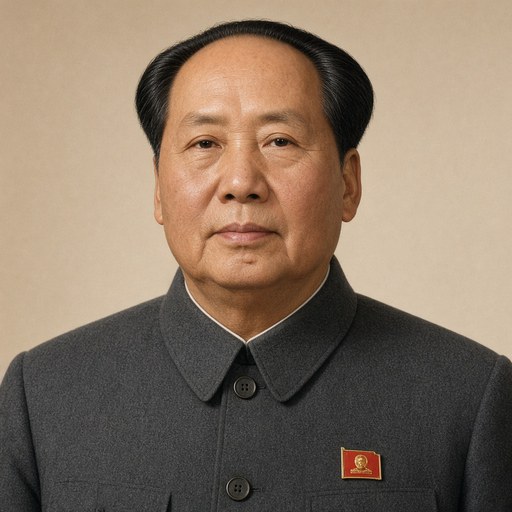
On Coalition Government
 Mao Zedong · Chairman of the Central Committee of the Communist Party of China
- Context
- Mao addressed the Communist Party of China's congress, apparently its Seventh National Congress, in April 1945, calling for a democratic coalition government, denouncing Kuomintang policy and setting out the Party's tasks in the War of Resistance.
- Main themes
- Democratic provisional coalition government, defeat of Japanese aggressors, two lines in the War of Resistance, people's war, Liberated Areas of China, Kuomintang passive resistance and dictatorship, international situation and defeat of fascism, Eighth Route and New Fourth Armies, Party rectification and self-criticism, ties with the masses, new-democratic China
- Duration
- ~216 min
- Words
- 25,871
- Sentences
- 877
- Readability
- 35
- Grade
- 15.5
- Syntax
- 3.27
- Vocabulary
- 2.23
Translated from Chinese Source: GitHub qinglee/maoxuan (毛泽东选集) ↗
The broad sphere of national life a sentence belongs to. Every sentence has an Arena, so it is the denominator the other indices are read against.
Other877 sentences in 254 paragraphs
I. THE BASIC DEMANDS OF THE CHINESE PEOPLE
Our congress is meeting in the following circumstances. After nearly eight years of resolute, heroic and indomitable struggle against the Japanese aggressors, after enduring countless hardships and making countless sacrifices, the Chinese people face a new situation: the sacred and just war against the fascist aggressors throughout the world has won decisive victories, and the moment is near when the Chinese people, in coordination with the Allied countries, will defeat the Japanese aggressors. But China is still not united, and China still faces a grave crisis. In these circumstances, what should we do? Beyond all doubt, China urgently needs to unite the representatives of all parties and groups and of those without party affiliation and to set up a democratic provisional coalition government, so as to carry out democratic reforms, overcome the present crisis, mobilize and unify all the anti-Japanese forces of the whole of China, fight effectively in coordination with the Allied countries, defeat the Japanese aggressors and liberate the Chinese people from their hands. After that, a national assembly must be convened on a broad democratic basis to set up a formal democratic government, likewise of a coalition character and including still more broadly the representatives of all parties and groups and of those without party affiliation, which will lead the whole liberated people in building China into a new country that is independent, free, democratic, united, prosperous and powerful. In a word, follow the line of unity and democracy, defeat the aggressors and build a new China.
We believe that only by doing this can we reflect the basic demands of the Chinese people. Therefore my report will deal chiefly with these demands. Whether China should set up a democratic coalition government has become a question of great concern to the Chinese people and to democratic public opinion in the Allied countries. My report will therefore place particular emphasis on explaining this question.
In the eight years of the War of Resistance Against Japan, the work of the Communist Party of China has overcome many difficulties and achieved great successes; but in the present situation, serious difficulties still lie before our Party and the people. The present situation demands that our Party undertake further urgent and still more practical work, continue to overcome difficulties, and strive to fulfil the basic demands of the Chinese people.
II. THE INTERNATIONAL AND DOMESTIC SITUATION
Can the Chinese people achieve the basic demands we have set forth above? That will depend on the degree of their political consciousness, unity and effort. But the present international and domestic situation provides the Chinese people with extremely favourable conditions. If the Chinese people make good use of these conditions and press forward actively, resolutely and with redoubled effort, there is no doubt that they will defeat the aggressors and build a new China. The Chinese people should redouble their efforts and fight to accomplish their sacred task.
What is the present international situation?
The present military situation is that the Soviet army is already attacking Berlin, the British, American and French allied forces are striking in coordination at the remnants of Hitler's army, and the Italian people have risen in revolt. All this will finally destroy Hitler. Once Hitler is destroyed, the defeat of the Japanese aggressors will not be far off. Contrary to the expectations of the reactionaries at home and abroad, the forces of fascist aggression will certainly be overthrown and the forces of people's democracy will certainly be victorious. The world will advance towards progress and by no means towards reaction. Of course we must be fully vigilant and bear in mind that some temporary and even serious twists and turns may still occur in history; in many countries the reactionary forces which are unwilling to see the people of their own and other countries achieve unity, progress and liberation are still strong. Whoever overlooks this will make political mistakes. But the general trend of history is already determined and cannot be changed. This is unfavourable only to the fascists and to the reactionaries of all countries who in fact help the fascists, while for the people of all countries and their organized democratic forces it is good tidings. The people, and the people alone, are the motive force in the making of world history. The Soviet people have built up a mighty strength and have served as the main force in defeating fascism. The efforts of the Soviet people, together with those of the peoples of the other anti-fascist Allied countries, have made the defeat of fascism possible. The war has educated the people, and the people will win the war, win peace and win progress.
This new situation is very different from that at the time of the First World War. At that time there was as yet no Soviet Union, nor was there the level of political consciousness now found among the people of many countries. The two world wars belong to two entirely different eras.
The defeat of the fascist aggressor countries, the end of the Second World War and the achievement of international peace do not mean that there will be no more struggle. The widely scattered remnants of the fascist forces will certainly continue to make trouble; within the camp fighting the war against fascist aggression there are forces that are anti-democratic and oppress other nations, and they will continue to oppress the people of various countries and the colonies and semi-colonies. Therefore, after international peace is achieved, the struggle between the anti-fascist masses and the remnant fascist forces, between democracy and anti-democracy, and between national liberation and national oppression will still fill the greater part of the world. Only through long effort, by overcoming the remnant fascist forces, the anti-democratic forces and all imperialist forces, can the people win the broadest victory. That day will by no means come quickly or easily, but it will inevitably come. Victory in the anti-fascist Second World War opens the way to victory in this post-war struggle of the people. And only when this latter struggle has been won can a stable and lasting peace be assured.
What is the present domestic situation?
China's prolonged war has cost and will continue to cost the Chinese people great sacrifices; but at the same time it is precisely this war that has steeled the Chinese people. This war has awakened and united the Chinese people to a degree unmatched by any of their great struggles in the last hundred years. On the one hand, the Chinese people face not only a powerful national enemy but also powerful domestic reactionary forces which in fact help the national enemy. But on the other hand, the Chinese people not only have a higher level of political consciousness than ever before, but also have the powerful Liberated Areas of China and a nationwide democratic movement that is mounting day by day. These are the favourable domestic conditions. If it can be said that all the people's struggles in China in the last hundred years ended in failure or setbacks because certain necessary international and domestic conditions were lacking, then this time it is different; compared with all previous occasions, all the necessary conditions are present. The possibility of avoiding defeat and winning victory fully exists. If we can unite the people of the whole country, struggle hard and give appropriate guidance, we can win.
The confidence of the Chinese people that they can unite to defeat the aggressors and build a new China has now greatly increased. The time has come for the Chinese people to overcome all difficulties and achieve their basic demands, which are of great historic significance. Is there any doubt about this? I think there is none.
Such is the general international and domestic situation at present.
III. THE TWO LINES IN THE WAR OF RESISTANCE AGAINST JAPAN
The Key to China's Problems
In speaking of the domestic situation, we must also make a concrete analysis of China's War of Resistance Against Japan.
China is one of the five largest countries taking part in the world anti-fascist war and the main country fighting the Japanese aggressors on the Asian mainland. The Chinese people have not only played a very great role in the War of Resistance, but will play a very great role in safeguarding world peace after the war and a decisive role in safeguarding peace in the East. In the eight years of the War of Resistance, China has made great efforts for her own liberation and to help the Allied countries. These efforts have come mainly from the Chinese people. The great masses of officers and men of the Chinese army have shed their blood fighting at the front; China's workers, peasants, intellectuals and industrialists have worked hard in the rear; Chinese living overseas have contributed money to the war; and all the anti-Japanese political parties, except for anti-popular elements, have made their contribution to the war. In short, the Chinese people have fought heroically against the Japanese aggressors with their blood and sweat for eight long years. But for many years the Chinese reactionaries have spread rumours and misled public opinion so as to keep the truth about the role played by the Chinese people in the War of Resistance from becoming known to the world. At the same time, no one has yet made a comprehensive summing-up of the various experiences of China's eight years of resistance. Our congress should therefore make an appropriate summing-up of these experiences, in order to educate the people and to provide a basis for the formulation of our Party's policies.
When it comes to summing up experience, everyone can see very clearly that there have been two different guiding lines in China: one that is capable of defeating the Japanese aggressors, and another that not only cannot defeat them but in certain respects actually helps the Japanese aggressors and harms the War of Resistance.
The policy of passive resistance to Japan adopted by the Kuomintang government and its reactionary policy of actively oppressing the people at home have brought about military reverses, the loss of large parts of the country's territory, financial and economic crises, oppression of the people, hardship in the people's livelihood and the undermining of national unity. This reactionary policy has hindered the mobilization and unification of all the anti-Japanese forces of the Chinese people for the effective prosecution of the war, and has hindered the awakening and unity of the Chinese people. Yet the movement of the Chinese people towards awakening and unity has not stopped; it has developed tortuously under the double oppression of the Japanese aggressors and the Kuomintang government. Two lines have long existed clearly in China: the line of the Kuomintang government, which oppresses the Chinese people and carries on passive resistance, and the line of the Chinese people, who are awakening and uniting to wage a people's war. Herein lies the key to all of China's problems.
History Has Followed a Tortuous Road
To make clear why this question of two lines is the key to all of China's problems, we must look back at the history of our War of Resistance.
The Chinese people's War of Resistance Against Japan has developed along a tortuous road. This war began as early as 1931. On September 18, 1931, the Japanese aggressors occupied Shenyang, and within a few months they had occupied the three northeastern provinces. The Kuomintang government adopted a policy of non-resistance. But the people of the three northeastern provinces and some of the patriotic troops there, under the leadership of or with the assistance of the Communist Party of China and against the will of the Kuomintang government, organized the Anti-Japanese Volunteers and the Anti-Japanese United Army of the three northeastern provinces and waged heroic guerrilla warfare. This heroic guerrilla warfare grew at one time to a very large scale and, despite many difficulties and setbacks, was never wiped out by the enemy. In 1932, when the Japanese aggressors attacked Shanghai, a group of patriots within the Kuomintang, once again against the will of the Kuomintang government, led the Nineteenth Route Army in resisting the attack. In 1933, when the Japanese aggressors attacked Jehol and Chahar, another group of patriots within the Kuomintang, for the third time against the will of the Kuomintang government and in cooperation with the Communist Party, organized the Anti-Japanese Allied Army to resist. But in all these wars of resistance, while aid was given by the Chinese people, the Communist Party of China, other democratic groups and patriotic overseas Chinese, the Kuomintang government, in accordance with its policy of non-resistance, gave no aid whatsoever. On the contrary, both the anti-Japanese actions in Shanghai and Chahar were sabotaged by the Kuomintang government with its own hands. In 1933, the People's Government set up in Fujian by the Nineteenth Route Army was also destroyed by the Kuomintang government.
Why did the Kuomintang government of that time adopt a policy of non-resistance? The main reason was that in 1927 the Kuomintang had wrecked the cooperation between the two parties, the Kuomintang and the Communist Party, and wrecked the unity of the Chinese people.
In 1924, Dr. Sun Yat-sen accepted the proposal of the Communist Party of China and convened the First National Congress of the Kuomintang with the participation of Communists, adopted the Three Great Policies of alliance with Russia, cooperation with the Communist Party and assistance to the peasants and workers, founded the Whampoa Military Academy, and brought about a national united front of the Kuomintang, the Communist Party and the people of all walks of life. As a result, in 1924–25 the reactionary forces in Guangdong were swept away, and in 1926–27 the victorious Northern Expedition was carried out, the greater part of the Yangtze and Yellow River valleys was occupied, the government of the Northern warlords was defeated, and a people's liberation struggle broader than any in Chinese history was launched. But in the spring and summer of 1927, at the critical moment when the Northern Expedition was advancing, this national united front of the Kuomintang, the Communist Party and the people of all walks of life, which represented the cause of the Chinese people's liberation, together with all its revolutionary policies, was wrecked by the treacherous and anti-popular policy of "party purification" and massacre pursued by the Kuomintang authorities. Yesterday's allies, the Communist Party of China and the Chinese people, were regarded as enemies, and yesterday's enemies, the imperialists and the feudalists, were regarded as allies. In this way a sudden, perfidious attack was launched against the Communist Party of China and the Chinese people, and China's vigorous Great Revolution was buried. From then on, civil war replaced unity, dictatorship replaced democracy, and a dark China replaced a bright China. But the Communist Party of China and the Chinese people were neither cowed nor conquered nor exterminated. They picked themselves up, wiped off the blood, buried their fallen comrades and went into battle again. They held high the great banner of revolution, took up armed resistance, set up people's governments over large areas of China, carried out the reform of the land system, created a people's army, the Chinese Red Army, and preserved and developed the revolutionary forces of the Chinese people. Dr. Sun Yat-sen's revolutionary Three People's Principles, which had been abandoned by the Kuomintang reactionaries, were carried on by the Chinese people, the Communist Party of China and other democrats.
After the Japanese aggressors invaded the three northeastern provinces, the Communist Party of China in 1933 proposed to all the Kuomintang troops attacking the revolutionary base areas and the Red Army that an armistice agreement be concluded on three conditions, namely, cessation of attacks, the granting of freedoms and rights to the people, and the arming of the people, so that all could unite to resist Japan. But the Kuomintang authorities rejected this proposal.
From then on, on the one hand, the Kuomintang government's civil war policy became ever more frenzied; on the other hand, the Chinese people's call to stop the civil war and unite to resist Japan grew ever louder. Various patriotic people's organizations were set up in Shanghai and many other places. Between 1934 and 1936, the main forces of the Red Army in various places north and south of the Yangtze, under the leadership of our Party's Central Committee, went through untold hardships and moved to the Northwest, where they joined forces with the Red Army of the Northwest. In those same two years, the Communist Party of China, adapting itself to the new situation, decided upon and carried out the new and complete political line of the Anti-Japanese National United Front, with unity against Japan and the establishment of a new-democratic republic as the goals of its struggle. On December 9, 1935, the student masses of Peiping, under the leadership of our Party, launched a heroic patriotic movement, formed the Chinese National Liberation Vanguard, and spread this patriotic movement to all the major cities of the country. On December 12, 1936, two groups of patriots within the Kuomintang who advocated resistance to Japan, the Northeastern Army and the Seventeenth Route Army, joined forces in courageously opposing the reactionary policy of the Kuomintang authorities of compromise with Japan and massacre at home, and staged the famous Xi'an Incident. At the same time, other patriots in the Kuomintang were also dissatisfied with the then policy of the Kuomintang authorities. In these circumstances the Kuomintang authorities were compelled to abandon their civil war policy and to accept the demands of the people. The peaceful settlement of the Xi'an Incident became the turning point in the situation: domestic cooperation under new conditions took shape and the nationwide War of Resistance was launched. On the eve of the Lugouqiao Incident, in May 1937, our Party convened a national conference of historic significance, which approved the new political line adopted by the Central Committee since 1935.
In the period from the Lugouqiao Incident of July 7, 1937, to the fall of Wuhan in October 1938, the Kuomintang government was comparatively active in the war against Japan. During this period, the large-scale offensive of the Japanese aggressors and the rising national indignation of the whole people caused the Kuomintang government still to place the emphasis of its policy on opposing the Japanese aggressors, and so a high tide of resistance by the army and the people of the whole country came about fairly smoothly and for a time there was a new and vigorous atmosphere. At that time the people of the whole country, we Communists and the other democratic parties all placed great hopes in the Kuomintang government; that is, we hoped that, taking advantage of this moment of national peril and popular enthusiasm, it would vigorously carry out democratic reforms and put Dr. Sun Yat-sen's revolutionary Three People's Principles into practice. But these hopes came to nothing. In those two years, on the one hand there was fairly active resistance; on the other hand, the Kuomintang authorities still opposed launching a people's war in which the broad masses would take part and still restricted the people from uniting on their own initiative for anti-Japanese and democratic activities. On the one hand, the attitude of the Kuomintang government towards the Communist Party of China and the other anti-Japanese parties changed somewhat compared with the past; on the other hand, it still refused them equal status and restricted their activities in many ways. Many patriotic political prisoners were not released. Most important of all, the Kuomintang government still maintained the oligarchic dictatorship it had maintained since launching the civil war in 1927, and failed to establish a democratic coalition government embracing the whole nation.
At the very beginning of this period, we Communists pointed out that there were two lines in China's War of Resistance: either a total war of the people, in which case there would be victory, or a partial war that oppressed the people, in which case there would be defeat. We also pointed out that the war would be protracted and would inevitably meet with many difficulties and hardships, but that thanks to the efforts of the Chinese people, final victory would belong to the Chinese people.
The People's War
During this period, the main forces of the Chinese Red Army led by the Communist Party of China, which had moved to the Northwest, were reorganized as the Eighth Route Army of the Chinese National Revolutionary Army, while the guerrilla units of the Chinese Red Army that had remained in various places north and south of the Yangtze were reorganized as the New Fourth Army of the Chinese National Revolutionary Army, and both went in succession to fight in north and central China. During the period of civil war the Chinese Red Army had preserved and developed the democratic traditions of the Whampoa Military Academy and the National Revolutionary Army of the Northern Expedition period, and had grown at one time to several hundred thousand men. Owing to the ruthless destruction wrought by the Kuomintang government in the southern base areas, the losses suffered on the 25,000-li Long March and other causes, its numbers had been reduced to only a few tens of thousands by the beginning of the War of Resistance. Thereupon some people looked down on this army and thought that resistance to Japan should rely mainly on the Kuomintang. But the people are the best judges. They knew that although the Eighth Route and New Fourth Armies were small in number at that time, they were very high in quality, that they alone could wage a genuine people's war, and that once they reached the anti-Japanese front and became one with the broad masses of the people there, their prospects would be boundless. The people were right. As I make this report, our army has grown to 910,000 men, and the people's militia in the villages, who do not leave production, number more than 2,200,000. Although our regular army is still much smaller in numbers than the present Kuomintang army (including both the Central and the provincial troops), yet judged by the number of Japanese and puppet troops it is fighting and the extent of the battlefronts it covers, by its combat effectiveness, by the broad masses of the people who fight in coordination with it, and by its political quality, internal unity and so on, it has become the main force in China's War of Resistance Against Japan.
This army is powerful because all who have joined it have a conscious discipline; they have come together and they fight not for the private interests of a few individuals or a narrow clique, but for the interests of the broad masses of the people and of the whole nation. To stand firmly with the Chinese people and to serve them wholeheartedly is the sole purpose of this army.
Guided by this purpose, this army has an indomitable spirit; it is determined to vanquish all enemies and never to yield to them. No matter what the difficulties and hardships, so long as a single man remains, he will fight on.
Guided by this purpose, this army has achieved a fine unity internally and externally. Internally, there is unity between officers and men, between higher and lower ranks, and among military work, political work and rear-service work; externally, there is unity between the army and the people, between the army and the government, and between our forces and friendly forces. All conduct that harms unity must be overcome.
Guided by this purpose, this army has a correct policy for winning over enemy officers and men and for dealing with prisoners of war. All those on the enemy side who surrender, who come over to our side, or who after laying down their arms wish to join in the fight against the common enemy are welcomed and given appropriate education. No prisoner of war may be killed, maltreated or insulted.
Guided by this purpose, this army has developed a whole series of strategies and tactics essential to a people's war. It is skilled in flexible, mobile guerrilla warfare in accordance with changing concrete conditions, and it is also skilled in mobile warfare.
Guided by this purpose, this army has developed a whole series of methods of political work essential to a people's war, the task of which is to struggle for the unity of our army, for unity with friendly armies, for unity with the people, for the disintegration of the enemy forces and for the guarantee of victory in battle.
Guided by this purpose, under conditions of guerrilla warfare, the entire army can engage, and indeed has engaged, in the production of grain and daily necessities during intervals between fighting and training, so as to become wholly, half or partly self-supporting, thereby overcoming economic difficulties, improving the army's living conditions and lightening the burden on the people. In the various military base areas, every possibility has also been used to set up many small-scale military industries.
This army is also powerful because it has the armed organizations of the broad masses, the people's self-defence corps and the militia, fighting in coordination with it. In the Liberated Areas of China, all young and able-bodied men and women are organized in the anti-Japanese people's self-defence corps on a voluntary and democratic basis and without leaving production. The best of the self-defence corps, apart from those who join the army or the guerrilla units, are organized in the militia. Without the coordination of these armed forces of the masses, it would be impossible to defeat the enemy.
This army is also powerful because it is divided into two parts, the main forces and the regional forces, the former being available for operations beyond any one locality at any time, while the latter's task is confined to defending their own localities and attacking the local enemy in coordination with the militia and the self-defence corps. This division has won the sincere support of the people. Without this correct division, if, for example, attention were paid only to the role of the main forces and the role of the regional forces were neglected, it would likewise be impossible to defeat the enemy under the conditions of the Liberated Areas of China. Among the regional forces, many armed working teams have been organized, which are well trained and comparatively better qualified in military, political and mass work; they penetrate deep into the rear of the enemy's rear, strike at the enemy and arouse the masses to anti-Japanese struggle, thereby supporting the frontal operations of the various Liberated Areas, and they have achieved great success.
In the Liberated Areas of China, under the leadership of the democratic governments, all the anti-Japanese people are called upon to organize themselves in workers', peasants', youth, women's, cultural and other occupational and working bodies and to throw themselves enthusiastically into all kinds of work in support of the army. This work includes not only mobilizing the people to join the army, transporting grain for the army, giving preferential treatment to the families of anti-Japanese soldiers and helping the army solve its material difficulties, but also mobilizing the guerrillas, the militia and the self-defence corps to carry out raids and demolition campaigns, reconnoitre the enemy, root out traitors, transport and protect the wounded, and directly assist the army in its operations. At the same time, the people throughout the Liberated Areas are enthusiastically engaged in political, economic, cultural and public health construction. In this respect the most important thing is to mobilize the whole population to produce grain and daily necessities, and to have all government offices and schools, except in special circumstances, engage in production for self-support in their spare time from work or study, in coordination with the self-support production of the people and the army, thereby creating a great upsurge of production in support of the protracted War of Resistance. In the Liberated Areas of China, enemy devastation is extremely severe, and floods, droughts and insect pests occur frequently. But the democratic governments of the Liberated Areas have led the entire people in overcoming, in an organized way, and are still overcoming, all kinds of difficulties, and the great mass movements for exterminating locusts, controlling floods and providing disaster relief have achieved unprecedented results, enabling the War of Resistance to be sustained over a long period. In short, everything for the front, everything for defeating the Japanese aggressors and liberating the Chinese people: this is the general slogan and the general policy of the whole army and people of the Liberated Areas of China.
This is a genuine people's war. Only such a people's war can defeat the national enemy. The Kuomintang has failed precisely because it has desperately opposed a people's war.
Once the armies of the Liberated Areas of China are equipped with modern weapons, they will become still more powerful and will be able to defeat the Japanese aggressors finally.
The Two Battlefronts
From the very beginning, China's War of Resistance has been divided into two battlefronts: the Kuomintang front and the Liberated Areas front.
After the fall of Wuhan in October 1938, the Japanese aggressors stopped their strategic offensive against the Kuomintang front and gradually shifted their main military forces to the Liberated Areas front; at the same time, playing on the defeatist mood of the Kuomintang government, they declared their willingness to seek a compromise peace with it, lured the traitor Wang Jingwei out of Chongqing, set up a puppet government in Nanjing and pursued a policy of national deception. From this time on, the Kuomintang government began to change its policy, gradually shifting its emphasis from resisting Japan to opposing the Communist Party and the people. This showed itself first in the military sphere. It adopted a policy of passive resistance to Japan, preserving its military strength and placing the heavy burden of fighting on the Liberated Areas front, letting the Japanese invaders attack the Liberated Areas on a large scale while it "sat on the mountain top to watch the tigers fight."
In 1939, the Kuomintang government adopted the reactionary so-called "Measures for Restricting the Activities of Alien Parties" and abolished all the rights the people and the anti-Japanese parties had won in the early period of the War of Resistance. From then on, in the Kuomintang areas, the Kuomintang government drove all the democratic parties, first and foremost the Communist Party of China, underground. The prisons and concentration camps in every province of the Kuomintang areas were filled with Communists, patriotic young people and other fighters for democracy. In the five years from 1939 to the autumn of 1943, the Kuomintang government launched three large-scale "anti-Communist onslaughts," splitting national unity and creating a grave danger of civil war. It was during this period that the "dissolution" of the New Fourth Army and the annihilation of more than 9,000 of its troops in southern Anhui took place, events which shocked China and the world. To this day, the attacks by Kuomintang troops on the troops of the Liberated Areas have not stopped, and there is no sign of any intention to stop them. Meanwhile, all manner of slander and abuse pours from the mouths of the Kuomintang reactionaries. It is these reactionaries who have fabricated such labels and verdicts as "traitor party," "traitor army," "traitor areas," and "sabotaging the War of Resistance and endangering the state" to slander the Communist Party, the Eighth Route Army, the New Fourth Army and the Liberated Areas. On July 7, 1939, the Central Committee of the Communist Party of China issued a manifesto which, in view of the crisis at the time, put forward the slogans: "Persist in the War of Resistance and oppose capitulation; persist in unity and oppose splitting; persist in progress and oppose retrogression." In accordance with these timely slogans, our Party in those five years vigorously repulsed three reactionary, anti-popular "anti-Communist onslaughts" and overcame the crisis of the time.
During these years there was in fact no serious fighting on the Kuomintang front. The edge of the Japanese aggressors' sword was turned mainly against the Liberated Areas. By 1943, 64 per cent of the Japanese forces invading China and 95 per cent of the puppet troops were being engaged by the army and people of the Liberated Areas, while the Kuomintang front was engaging no more than 36 per cent of the Japanese forces and 5 per cent of the puppet troops.
In 1944, when the Japanese aggressors undertook operations to open up a continental line of communications, the Kuomintang troops were thrown into confusion and showed no capacity to resist. Within a few months, vast areas of Henan, Hunan, Guangxi and Guangdong provinces fell into enemy hands. Only then did some change occur in the proportion of the enemy engaged on the two fronts. Yet even as I make this report, of the 40 divisions totalling 580,000 men of the Japanese army invading China (not counting those in Manchuria), the Liberated Areas front is engaging 22½ divisions with 320,000 men, or 56 per cent, while the Kuomintang front is engaging no more than 17½ divisions with 260,000 men, or only 44 per cent. As for the puppet troops, the situation remains entirely unchanged.
It should also be pointed out that the puppet troops, numbering over 800,000 (including regular puppet troops and puppet local armed forces), consist mostly of units led over to the enemy by Kuomintang generals or units formed by Kuomintang officers who have gone over to the enemy. The Kuomintang reactionaries supplied these puppet troops in advance with the treasonous fallacy of "saving the nation by a devious path," and afterwards supported them morally and organizationally so that they could work with the Japanese aggressors against the Liberated Areas of the Chinese people. In addition, they have mobilized large forces, numbering as many as 797,000 men, to blockade and attack the Shaanxi-Gansu-Ningxia Border Region and the other Liberated Areas. Owing to the Kuomintang government's policy of news blockade, many Chinese and foreigners have been unable to learn of this grave state of affairs. Owing to the Kuomintang government's policy of news blockade, many Chinese and foreigners have been unable to learn of this grave state of affairs.
The Liberated Areas of China
The Liberated Areas of China led by the Communist Party of China now have a population of 95.5 million. They extend from Inner Mongolia in the north to Hainan Island in the south; wherever the enemy has gone, for the most part, the Eighth Route Army, the New Fourth Army or other people's armies are active. These vast Liberated Areas of China comprise 19 major Liberated Areas, covering the greater or lesser parts of the provinces of Liaoning, Jehol, Chahar, Suiyuan, Shaanxi, Gansu, Ningxia, Shanxi, Hebei, Henan, Shandong, Jiangsu, Zhejiang, Anhui, Jiangxi, Hubei, Hunan, Guangdong and Fujian. Yan'an is the guiding centre of all the Liberated Areas. Within these vast Liberated Areas, the Shaanxi-Gansu-Ningxia Border Region west of the Yellow River, with a population of only 1.5 million, is just one of the 19 Liberated Areas, and apart from the eastern Zhejiang and Qiongya areas it is the smallest in population. Some people, not understanding this, think that the so-called Liberated Areas of China consist mainly of the Shaanxi-Gansu-Ningxia Border Region. This is a misunderstanding created by the Kuomintang government's blockade policy. In all these Liberated Areas, all the necessary policies of the Anti-Japanese National United Front have been carried out, and governments have been or are being set up which are elected by the people and based on cooperation between Communists and representatives of the other anti-Japanese parties and of those without party affiliation, that is, local coalition governments. The strength of the entire people in the Liberated Areas has been mobilized. All this has enabled the Liberated Areas of China, under the pressure of a powerful enemy, under blockade and attack by Kuomintang troops and without any outside aid, to stand firm and grow day by day, reducing the enemy-occupied areas and expanding their own, becoming the model of a democratic China and the main force for cooperating with the Allies in operations, driving out the Japanese aggressors and liberating the Chinese people. The armies of the Liberated Areas of China — the Eighth Route Army, the New Fourth Army and other people's forces — have played a heroic and exemplary role not only in fighting the war against Japan but also in carrying out the various democratic policies of the Anti-Japanese National United Front. On September 22, 1937, the Central Committee of the Communist Party of China issued a manifesto declaring that "Dr. Sun Yat-sen's Three People's Principles are what China needs today, and our Party is ready to fight for their complete realization"; this declaration has been put fully into practice in the Liberated Areas of China.
The Kuomintang Areas
The main ruling clique within the Kuomintang has persisted in dictatorial rule and carried out a policy of passive resistance to Japan and an anti-popular domestic policy. As a result, its armies have shrunk by more than half and most of them have virtually lost their combat effectiveness; a deep rift has opened between it and the broad masses of the people, creating a grave crisis of impoverishment, seething discontent and widespread popular revolts; and its role in the War of Resistance has not only been greatly reduced but has become an obstacle to the mobilization and unification of all the anti-Japanese forces of the Chinese people.
Why has such a grave situation arisen under the leadership of the main ruling clique of the Kuomintang? Because the interests this clique represents are those of China's big landlords, big bankers and big compradors. This reactionary stratum, made up of a tiny minority, monopolizes all the important military, political, economic and cultural institutions under the Kuomintang government. They put the preservation of their own minority interests first and resistance to Japan second. They too talk about "the nation above all," but their actions do not accord with the demands of the majority of the nation. They too talk about "the state above all," but by the state they mean the feudal-fascist dictatorial state of the big landlords, big bankers and big compradors, not a democratic state of the masses of the people. They therefore fear the people's rising up, fear the democratic movement, and fear a serious mobilization of the whole people for the War of Resistance. This is the root cause of their policy of passive resistance to Japan and of their reactionary domestic policy of opposing the people, opposing democracy and opposing the Communist Party. In every sphere they pursue such a dual policy. For example: on the one hand they are resisting Japan, but on the other they pursue a policy of passive resistance, and they are constantly singled out by the Japanese aggressors as targets for inducement to surrender. On the one hand they talk of developing China's economy, but on the other they in fact accumulate bureaucrat capital, that is, the capital of the big landlords, big bankers and big compradors, monopolize the main arteries of China's economy, and ruthlessly oppress the peasants, the workers, the petty bourgeoisie and the liberal bourgeoisie. On the one hand they talk of introducing "democracy" and "returning political power to the people," but on the other they in fact ruthlessly suppress the people's democratic movement and refuse to carry out the slightest democratic reform. On the one hand they declare that "the Communist question is a political question and should be solved by political means," but on the other they ruthlessly oppress the Communist Party of China militarily, politically and economically, regard the Communist Party as their so-called "enemy number one" and the Japanese aggressors as "enemy number two," and every day actively prepare for civil war and scheme to wipe out the Communist Party. On the one hand they talk of building a "modern state," but on the other they in fact desperately cling to the feudal-fascist dictatorship of the big landlords, big bankers and big compradors. On the one hand they formally maintain diplomatic relations with the Soviet Union, but on the other they in fact take a hostile attitude towards it. On the one hand they chime in with the American isolationists in the theory of "Asia first, Europe second," thereby prolonging the life of fascist Germany, and hence of all fascism, and prolonging their own fascist rule over the Chinese people; on the other hand they play opportunist games in diplomacy and pose as anti-fascist heroes. If you ask where all these self-contradictory dual policies come from, they come from one root, the social stratum of the big landlords, big bankers and big compradors.
The Kuomintang, however, is a complex party. Though it is ruled and led by this reactionary clique representing the big landlords, big bankers and big compradors, it is not wholly identical with this reactionary clique. Some of its leaders do not belong to this clique and are even attacked, excluded or slighted by it. Not a few of its cadres, of its rank-and-file members and of the members of the Three People's Principles Youth League are dissatisfied with the leadership of this clique, and some even oppose it. This is the case in the Kuomintang armies, government offices, economic institutions and cultural institutions controlled by this reactionary clique. These armies and institutions harbour not a few democratic elements. Moreover, this reactionary clique is itself divided into several factions which struggle against one another; it is not a tightly knit whole. It would undoubtedly be quite inappropriate to regard the Kuomintang as a homogeneous body of reactionaries.
A Comparison
The Chinese people have drawn a clear comparison between the Liberated Areas of China and the Kuomintang areas.
Is it not clear enough? Of the two lines, the line of people's war and the line of passive resistance in opposition to people's war, the results are these: the one has been victorious, even in the adverse circumstances of the Liberated Areas of China and without any outside aid; the other has failed, even in the extremely favourable position of the Kuomintang areas and with supplies from foreign countries.
The Kuomintang government attributes its failure to a lack of weapons. But we ask: is it the Kuomintang troops or the troops of the Liberated Areas that lack weapons? The troops of the Liberated Areas of China are the worst armed of all Chinese troops; they can only capture weapons from the enemy and make them themselves under the most adverse conditions.
Are not the troops directly under the Kuomintang Central Government much better armed than the provincial troops? Yet in combat effectiveness most of the Central troops are inferior to the provincial troops.
The Kuomintang has vast manpower resources, but under its wrong conscription policy it finds it extremely difficult to replenish its forces. Although the Liberated Areas of China are cut apart by the enemy and engaged in constant fighting, they can mobilize manpower inexhaustibly, because the system of militia and self-defence corps, which suits the needs of the people, is universally applied and because the misuse and waste of manpower is prevented.
The Kuomintang holds vast areas rich in grain, and the people supply it with 70 million to 100 million shidan of grain every year, but most of it is pocketed by those who handle it, so that the Kuomintang troops are constantly short of food and the soldiers are emaciated and sallow with hunger. The main parts of the Liberated Areas of China lie behind the enemy lines and are devastated by the enemy's policy of "burn all, kill all, loot all"; some of them, like northern Shaanxi, are barren; yet they have solved the grain problem well by developing agricultural production with their own hands.
In the Kuomintang areas the economic crisis is extremely grave; most of industry has gone bankrupt, and even such daily necessities as cloth have to be shipped in from the United States. But the Liberated Areas of China are able to meet their own needs for cloth and other necessities by developing industry.
In the Kuomintang areas, the workers, peasants, shop assistants, government employees, intellectuals and cultural workers live in the utmost misery. In the Liberated Areas of China, all the people have food to eat, clothes to wear and work to do.
Profiteering from the national crisis in the War of Resistance, officials who are at the same time merchants, rampant corruption and the abandonment of all sense of shame are among the characteristics of the Kuomintang areas. Plain living and hard struggle, setting an example by one's own conduct, engaging in production in addition to one's work, encouraging honesty and prohibiting corruption are among the characteristics of the Liberated Areas of China.
In the Kuomintang areas the people are deprived of all freedoms. In the Liberated Areas of China the people are given full freedom.
Who is to blame for these anomalies confronting the Kuomintang rulers? Others, or themselves? The lack of foreign aid, or the Kuomintang government's dictatorship, corruption and incompetence? Is this not clear enough?
Who Is "Sabotaging the War of Resistance and Endangering the State"?
Is it not precisely the Kuomintang government that, on irrefutable evidence, has sabotaged the Chinese people's War of Resistance and endangered the Chinese people's state? For ten full years this government devoted itself wholeheartedly to civil war, turning its sword against its own compatriots and neglecting all national defence, and by its policy of non-resistance it gave away the four northeastern provinces. When the Japanese aggressors pushed south of the Great Wall, it fought back in panic and retreated from Lugouqiao all the way to Guizhou Province. Yet the Kuomintang people say: "The Communist Party is sabotaging the War of Resistance and endangering the state." (See the resolution of the Eleventh Plenary Session of the Central Executive Committee of the Kuomintang, September 1943.) Their only evidence is that the Communist Party has united the people of all walks of life to create the Liberated Areas of China, which are heroically resisting Japan. The logic of these Kuomintang people is so different from the logic of the Chinese people that it is no wonder so many questions cannot be reasoned out.
Two questions:
First, what exactly caused the Kuomintang government to abandon so vast a territory and so many people, from Heilongjiang to Lugouqiao and from Lugouqiao to Guizhou? Was it not the policy of non-resistance, the policy of passive resistance to Japan and the anti-popular domestic policy adopted by the Kuomintang government?
Second, what exactly enabled the Liberated Areas of China to defeat the long and ruthless attacks of the Japanese and puppet troops, to recover so vast a territory from the national enemy and to liberate so many people? Was it not the correct line of people's war?
So-called "Disobedience to Government and Military Orders"
The Kuomintang government also constantly accuses the Communist Party of China of "disobeying government and military orders." But all we can say is this: fortunately the Chinese Communists have retained the common sense of the Chinese people and have not obeyed those so-called "government and military orders" which would in fact have handed back to the Japanese aggressors the Liberated Areas of China, wrested from the Japanese aggressors by the Chinese people through untold hardships. Such were, for example, the so-called "Measures for Restricting the Activities of Alien Parties" of 1939; the so-called "dissolution of the New Fourth Army" and "withdrawal to the north of the old course of the Yellow River" of 1941; the so-called "dissolution of the Communist Party of China" of 1943; the so-called "abolition within a time limit of all troops in excess of ten divisions" of 1944; and the proposal made in the recent negotiations that we hand over our armies and local governments to the Kuomintang, in exchange for which no coalition government would be permitted and only a few Communists would be taken into the Kuomintang dictatorial government as officials, an arrangement described as a "concession" on the part of the Kuomintang government, and so on. Fortunately we did not obey these things, and so we have preserved for the Chinese people a piece of clean land and a heroic anti-Japanese army. Should not the Chinese people celebrate this "disobedience"? Is the Kuomintang government not yet satisfied with having handed over to the Japanese aggressors, by its own fascist government orders and defeatist military orders, the vast territory and population from Heilongjiang to Guizhou? Apart from the Japanese aggressors and the reactionaries, who welcome these "government and military orders," is there any patriotic Chinese with a conscience who welcomes them? Without a coalition government that is not a matter of form but of substance, not a fascist dictatorship but democratic, can anyone imagine that the Chinese people would allow the Chinese Communists to hand over on their own authority these liberated Liberated Areas of China and these people's armies, which have rendered meritorious service in the War of Resistance, to the defeatist and fascist Kuomintang fascist dictatorial government? Were it not for the Liberated Areas of China and their armies, would the Chinese people's cause of resistance to Japan be where it is today? Could the future of our nation even be imagined?
The Danger of Civil War
Up to now the main ruling clique within the Kuomintang has persisted in its reactionary policy of dictatorship and civil war. There are many indications that they long ago prepared, and are now preparing especially, to launch civil war as soon as the troops of a certain Allied country have cleared the Japanese aggressors out of a considerable part of the Chinese mainland. They also hope that the generals of certain Allied countries will perform in China the function that the British General Scobie performed in Greece. They have hailed the work of slaughter done by Scobie and the reactionary Greek government. They are trying to plunge China back into the sea of civil war of 1927–37. Under the smokescreen of "convening a national assembly" and a "political settlement," the main ruling clique of the Kuomintang is now furtively preparing for civil war. If our countrymen do not pay attention, do not expose its plot and stop its preparations, then one fine morning they will hear the roar of the guns of civil war.
Negotiations
In order to defeat the Japanese aggressors and build a new China, and in order to prevent civil war, the Communist Party of China, having obtained the agreement of other democratic groups, put forward at the session of the People's Political Council in September 1944 the demand that the Kuomintang one-party dictatorship be abolished immediately and a democratic coalition government be established. Undoubtedly this demand was timely, and within a few months it won a response from the broad masses of the people.
We have held many negotiations with the Kuomintang government on how to abolish the one-party dictatorship, establish a coalition government and carry out the necessary democratic reforms, but all our proposals have been rejected by the Kuomintang government. The Kuomintang is not only unwilling to abolish the one-party dictatorship and to set up a coalition government, but it is also unwilling to carry out a single one of the urgently needed democratic reforms, such as abolishing the secret service, rescinding the reactionary decrees suppressing the people's freedoms, releasing political prisoners, recognizing the legal status of all parties, recognizing the Liberated Areas, and withdrawing the troops blockading and attacking the Liberated Areas. That is why political relations in China are in so grave a state.
Two Prospects
Viewing the situation as a whole and in the light of the analysis of all the actual international and domestic conditions given above, I ask everyone not to think that everything in our cause will go smoothly and beautifully. No, that is not so. The fact is that two possibilities, good and bad, and two prospects, good and bad, both exist. Fascist dictatorship continues and democratic reform is not permitted; the emphasis is placed not on opposing the Japanese aggressors but on opposing the people; even after the Japanese aggressors are defeated, civil war may still break out in China, dragging China back into her old state, so full of suffering, of being neither independent, free, democratic, united, prosperous nor powerful. This is one possibility, one prospect. This possibility, this prospect, still exists; it will not seem to vanish or disappear of itself simply because the international situation is good, the political consciousness of the people at home has risen and the organized forces of the people have grown. Those who hope that China will realize this possibility, this prospect, are, within China, the anti-popular clique in the Kuomintang and, abroad, those reactionaries who harbour imperialist ideas. This is one aspect, an aspect to which we must pay attention.
But on the other hand, viewing the situation as a whole and in the light of the same analysis of all the internal and external conditions, we have all the more confidence and courage to strive for the second possibility, the second prospect. That is, to overcome all difficulties, unite the people of the whole country, abolish the Kuomintang's fascist dictatorship, carry out democratic reforms, consolidate and expand the anti-Japanese forces, thoroughly defeat the Japanese aggressors and build China into a new country that is independent, free, democratic, united, prosperous and powerful. Those who hope that China will realize this possibility, this prospect, are, within China, the broad masses of the people, the Communist Party of China and other democratic groups and, abroad, all the nations that treat us as equals, progressive people in foreign countries and the masses of the people abroad.
We understand clearly that before us and the Chinese people there are still great difficulties, many obstacles and many detours to be made. But we understand equally well that we, together with the people of the whole country, can certainly overcome all difficulties and obstacles and accomplish China's historic tasks. To do our utmost to oppose the first possibility and strive for the second, to oppose the first prospect and strive for the second, is the great task of ourselves and of the people of the whole country. The main aspects of the international and domestic situation are favourable to us and to the people of the whole country. This I have already made quite clear above. We hope that the Kuomintang authorities, in view of the general trend of the world and the aspirations of the Chinese people, will resolutely change their present mistaken policies, so that the War of Resistance may be won, the Chinese people may suffer less, and a new China may soon be born. They must understand that, however tortuous the road, the task of the independence and liberation of the Chinese people will be accomplished, and the time for it has already come. The great aspirations cherished by countless martyrs over the last hundred years and more must be realized by our generation; whoever tries to block them will in the end be unable to do so.
IV. THE POLICY OF THE COMMUNIST PARTY OF CHINA
Above I have given an analysis of the two lines in China's War of Resistance Against Japan. Such an analysis is absolutely necessary, because even now many people among the broad masses of the Chinese do not understand the concrete situation in China's War of Resistance. In the Kuomintang areas and abroad, many people have been blindfolded by the Kuomintang government's blockade policy. Before the party of Chinese and foreign journalists visited the Liberated Areas of China in 1944, many people there knew practically nothing about the Liberated Areas. The Kuomintang government was so afraid that the truth about the Liberated Areas would leak out that, as soon as that party of journalists returned in 1944, it shut the door and has not allowed a single journalist to visit the Liberated Areas since. The Kuomintang government likewise suppresses the truth about the Kuomintang areas. I therefore feel it is our duty to make the truth about the "two areas" as clear as possible to the people. Only when the whole situation in China is clear can it be understood why the policies of China's two largest political parties, the Communist Party of China and the Kuomintang, differ so greatly and why there is such a struggle between two lines. Only then will people understand that the dispute between the two parties is not, as some say, merely an unnecessary, unimportant or even petulant quarrel, but a dispute of principle on which the life or death of hundreds of millions of people depends.
In the present grave situation in China, the Chinese people, all the democratic parties and democrats in China, and all the people of foreign countries who are concerned about the situation in China, hope that the present disunity will give way to unity and that China will carry out democratic reforms, and they wish to know the policy of the Communist Party of China on the solution of many of the important problems of the day. Our Party members, of course, are even more concerned about these matters.
Our policy of the Anti-Japanese National United Front has always been clear, and it has been tested in eight years of war. Our congress should draw conclusions from it as a guide for our future struggle.
I shall now explain a number of definite conclusions on important questions of policy which our Party has reached for the solution of China's problems.
Our General Programme
In order to mobilize and unify all the anti-Japanese forces of the Chinese people, thoroughly wipe out the Japanese aggressors and build an independent, free, democratic, united, prosperous and powerful new China, the Chinese people, the Communist Party of China and all the anti-Japanese democratic parties urgently need a common programme agreed upon by all.
Such a common programme may be divided into two parts, general and specific. Let us first take up the general programme and then come to the specific programme.
On the main premise of thoroughly wiping out the Japanese aggressors and building a new China, we Communists, at the present stage of China's development, are in agreement with the overwhelming majority of the Chinese population on the following basic points. First, China's state system should not be a feudal, fascist, anti-popular state system under the dictatorship of the big landlords and big bourgeoisie, because this anti-popular system has been proved a complete failure by the eighteen years' rule of the main ruling clique of the Kuomintang. Second, China cannot, and therefore should not, attempt to establish a state of the old-type democratic dictatorship of the national bourgeoisie alone, because, on the one hand, the national bourgeoisie in China has proved very weak economically and politically and, on the other hand, China has long since had a new factor: the awakened Chinese proletariat and its leader, the Communist Party of China, which have shown great capacity in the political arena in China and have led the broad masses of the peasantry, the urban petty bourgeoisie, the intellectuals and other democratic elements. Third, at the present stage, when the task of the Chinese people is still to fight national and feudal oppression and when the necessary social and economic conditions are still lacking in China, it is also impossible for the Chinese people to institute a socialist state system.
What, then, do we propose? We propose that, after the thorough defeat of the Japanese aggressors, a state system be established which is a united-front democratic alliance based on the overwhelming majority of the people of the whole country and under the leadership of the working class. We call this a new-democratic state system.
This is a state system which truly suits the demands of the overwhelming majority of the Chinese population, because, first, it has won and can win the consent of millions of industrial workers and tens of millions of handicraft workers and farm labourers; second, it has also won and can win the consent of the peasantry, which constitutes 80 per cent of China's population, that is, 360 million out of a population of 450 million; and third, it has also won and can win the consent of the broad urban petty bourgeoisie, the national bourgeoisie, the enlightened gentry and other patriots.
Naturally, there are still contradictions among these classes, notably the contradiction between labour and capital; consequently each class has its own particular demands. To deny the existence of these contradictions and different demands would be hypocritical and wrong. But throughout the stage of New Democracy, these contradictions and different demands will not, and should not be allowed to, grow to the point of overriding the common demands. These contradictions and different demands can be adjusted. With such adjustment, these classes can together accomplish the political, economic and cultural construction of the new-democratic state.
The new-democratic politics which we advocate consist in overthrowing external national oppression and abolishing internal feudal and fascist oppression, and in establishing, after these have been overthrown and abolished, not a political system of the old democracy but a political system of a united front of all democratic classes. These views of ours are in complete accord with the revolutionary views of Dr. Sun Yat-sen. In the Manifesto of the First National Congress of the Kuomintang, which he wrote, Dr. Sun said: "The so-called democratic system in modern states is usually monopolized by the bourgeoisie and has become simply an instrument for oppressing the common people. On the other hand, the Kuomintang's Principle of Democracy means a democratic system shared by all the common people and not privately owned by the few." This is Dr. Sun's great political directive. The Chinese people, the Communist Party of China and all other democrats must respect this directive and resolutely carry it out, and must wage a resolute struggle against any persons or groups that violate or oppose it, so as to protect and develop this entirely correct political principle of New Democracy.
The organizational principle of the new-democratic state power should be democratic centralism, with people's congresses at the various levels determining the major policies and electing the governments. It is both democratic and centralized, that is, centralized on the basis of democracy and democratic under centralized guidance. This is the only system that can give full expression to broad democracy, with the people's congresses at the various levels holding high authority, and at the same time ensure centralized handling of state affairs, with the governments at the various levels administering in a centralized way all the affairs entrusted to them by the people's congresses at the corresponding levels and safeguarding all the essential democratic activities of the people.
The army and the other armed forces are an important part of the apparatus of the new-democratic state power; without them the state cannot be defended. All the armed forces of the new-democratic state, like all its other organs of power, belong to the people and protect the people; they are entirely different from the old-type armies, police and the like, which belong to a few and oppress the people.
The new-democratic economy which we advocate likewise accords with Dr. Sun's principles. On the land question, Dr. Sun advocated "land to the tiller." On the question of industry and commerce, Dr. Sun said in the Manifesto referred to above: "Enterprises, whether Chinese-owned or foreign-owned, which are monopolistic in character or which are too large for private management, such as banks, railways and shipping lines, shall be operated and administered by the state, so that private capital cannot dominate the livelihood of the people; this is the main principle of the regulation of capital." At the present stage, we are in complete agreement with these views of Dr. Sun's on economic questions.
Some people suspect that the Chinese Communists are opposed to the development of individuality, the development of private capitalism and the protection of private property, but they are mistaken. National oppression and feudal oppression cruelly fetter the development of the individuality of the Chinese people, fetter the development of private capitalism and destroy the property of the broad masses. The task of the new-democratic system we advocate is precisely to remove these fetters and stop this destruction, to guarantee that the broad masses can freely develop their individuality within the framework of society, can freely develop such private capitalist economy as does not "dominate the livelihood of the people" but benefits it, and to protect all legitimate private property.
In accordance with Dr. Sun's principles and the experience of the Chinese revolution, China's economy at the present stage must be composed of state enterprise, private enterprise and cooperative enterprise. And the state here must certainly not be one "privately owned by the few," but a new-democratic state "shared by all the common people" under the leadership of the proletariat.
New-democratic culture should likewise be "shared by all the common people"; that is, it should be a national, scientific and mass culture, and should by no means be a culture "privately owned by the few."
All the above is the general or basic programme which we Communists advocate at the present stage, throughout the stage of the bourgeois-democratic revolution. In relation to our future or maximum programme of socialism and communism, this is our minimum programme. The implementation of this programme will advance China one step from her present state and social condition, that is, from a colonial, semi-colonial and semi-feudal state and society to a new-democratic state and society.
The political leadership of the proletariat, and the state-owned economy and cooperative economy under the leadership of the proletariat, as provided for in this programme, are socialist elements. But the implementation of this programme will not yet turn China into a socialist society.
We Communists never conceal our political views. Our future or maximum programme is to carry China forward to socialism and communism; this is definite and beyond all doubt. The name of our Party and our Marxist world outlook unequivocally point to this supreme ideal of the future, infinitely bright and infinitely beautiful. On joining the Party, every Communist has two clearly defined goals in mind, to struggle for the present new-democratic revolution and to struggle for socialism and communism in the future, heedless of the ignorant and base hostility, slander, abuse or ridicule of the enemies of communism, which we must firmly repel. As for well-meaning sceptics, we should not repel them but give them well-meaning and patient explanations. All this is extremely clear, extremely definite and altogether unambiguous.
But all Chinese Communists and all sympathizers with communism in China must struggle for the goal of the present stage, struggle against national and feudal oppression, to free the Chinese people from their tragic colonial, semi-colonial and semi-feudal fate, and to establish an independent, free, democratic, united, prosperous and powerful China of a new-democratic character under the leadership of the proletariat, whose main content is the liberation of the peasants, that is, a China of the character of Dr. Sun Yat-sen's revolutionary Three People's Principles. And this is indeed what we have done; we Communists, together with the broad masses of the Chinese people, have fought heroically for this for twenty-four years.
If any Communist or sympathizer does not fight for this goal, if he looks down upon this bourgeois-democratic revolution and relaxes his efforts the slightest bit, slacks off the slightest bit, shows the slightest lack of loyalty or zeal, or is unprepared to give his blood and his life, while talking glibly about socialism and communism, then he is wittingly or unwittingly, to a greater or lesser extent, betraying socialism and communism and is not a conscious and loyal Communist. It is a law of Marxism that socialism can be attained only by way of democracy. And in China the fight for democracy is still a long one. Without a new-democratic, united and coalition state, without the development of a new-democratic state economy, without the development of private capitalist and cooperative economy, without the development of a national, scientific and mass culture, that is, a new-democratic culture, without the liberation and development of the individuality of hundreds of millions of people, in short, without a thoroughgoing democratic revolution of a new type, bourgeois in character and led by the Communist Party, it is sheer utopianism to try to build a socialist society on the ruins of a colonial, semi-colonial and semi-feudal society.
Some people do not understand why the Communists, far from fearing capitalism, actually advocate its development under certain conditions. Our answer is simply this: to replace the oppression of foreign imperialism and domestic feudalism by a certain degree of capitalist development is not only an advance but an unavoidable process. It benefits not only the bourgeoisie but also the proletariat, or rather benefits the proletariat even more. What China has too much of today is foreign imperialism and domestic feudalism, not domestic capitalism; on the contrary, we have too little capitalism. Strange to say, some spokesmen of the Chinese bourgeoisie dare not openly advocate the development of capitalism, but approach the question in a roundabout way. Others even flatly deny that China should allow capitalism a necessary degree of development, and say that a socialist society can be reached at one bound, that the Three People's Principles and socialism can be "accomplished at one stroke." Obviously, some of these phenomena reflect the weakness of the Chinese national bourgeoisie, while others are deceptive tactics of the big landlords and big bourgeoisie towards the masses. We Communists, on the basis of our understanding of the Marxist laws of social development, know clearly that under the conditions of China, under the new-democratic state system, it is necessary, in addition to the state's own economy, the individual economy of the labouring people and the cooperative economy, to give facilities for the development of the private capitalist economy within the limits in which it cannot dominate the livelihood of the people, in order that society may advance. As for us Chinese Communists, we will not let any empty talk or deception befuddle our clear heads.
Some people suspect that the Communists are not sincere in acknowledging that "the Three People's Principles are what China needs today, and our Party is ready to fight for their complete realization." This is because they do not understand that the basic tenets of the Three People's Principles which we accept, as expounded by Dr. Sun Yat-sen in 1924 in the Manifesto of the First National Congress of the Kuomintang, accord with certain basic tenets of our Party's programme for the present stage, that is, our minimum programme. It should be pointed out that these Three People's Principles of Dr. Sun's and our Party's programme for the present stage agree only in certain basic tenets and not in everything. Our Party's new-democratic programme is, of course, much more comprehensive than Dr. Sun's; in particular, the development of the Chinese revolution in the twenty years since Dr. Sun's death has brought a tremendous development in our Party's new-democratic theory, programme and practice, and they will develop still further in the future. But in their basic character, these Three People's Principles of Dr. Sun's are a new-democratic programme distinct from the old Three People's Principles that preceded them; of course they are "what China needs today," and of course "our Party is ready to fight for their complete realization." For Chinese Communists, fighting for our Party's minimum programme and fighting for Dr. Sun's revolutionary, or new, Three People's Principles are basically (not in every respect) one and the same thing, not two different things. Hence it has been proved in the past and present, and will be proved in the future, that the Chinese Communists are the most loyal and most thoroughgoing executors of the revolutionary Three People's Principles.
Some people wonder whether, once in power, the Communist Party will follow Russia's example and establish the dictatorship of the proletariat and a one-party system. Our answer is that a new-democratic state of an alliance of several democratic classes is different in principle from a socialist state under the dictatorship of the proletariat. Beyond all doubt, our new-democratic system will be built under the leadership of the proletariat and under the leadership of the Communist Party, but throughout the period of New Democracy China cannot, and therefore should not, have a system of dictatorship by one class or of monopoly of the government apparatus by one party. So long as any other political party, social group or individual outside the Communist Party adopts a cooperative and not a hostile attitude towards the Communist Party, we have no reason not to cooperate with them. Russian history has shaped the Russian system. There the social system of exploitation of man by man has been abolished, and the newest type of democracy, namely, the socialist political, economic and cultural system, has been realized; all the anti-socialist parties have been discarded by the people, who support only the Bolshevik Party; thus the situation in Russia took shape, and for them it is entirely necessary and reasonable. But even in Russia, where the Bolshevik Party is the only party, the organs of state power still embody a system of alliance of workers, peasants and intellectuals, or of alliance between Party members and non-Party people; it is not that only the working class or only Bolsheviks may work in the organs of state power. The history of China at the present stage will shape China's system at the present stage, and for a long time to come there will exist a particular form which is entirely necessary and reasonable for us and at the same time different from the Russian system, namely, a new-democratic form of state and of political power based on the alliance of several democratic classes.
Our Specific Programme
On the basis of the general programme set forth above, our Party should also have specific programmes for different periods. Throughout the stage of the bourgeois-democratic revolution, over a period of several decades, our general new-democratic programme remains unchanged. But in the various phases within this great stage, conditions have changed and are changing, and it is only natural that our specific programme should change accordingly. For instance, during the Northern Expedition, the Agrarian Revolutionary War and the War of Resistance Against Japan, our general new-democratic programme did not change, but our specific programmes did change in the three periods, because our enemies and our allies changed in those three periods.
The Chinese people are now in the following situation: (1) the Japanese aggressors have not yet been defeated; (2) the Chinese people urgently need to unite and carry out democratic reforms, so as to achieve national unity, rapidly mobilize and unify all the anti-Japanese forces and defeat the Japanese aggressors in coordination with the Allies; (3) the Kuomintang government is undermining national unity and obstructing such democratic reforms. In these circumstances, what is our specific programme, that is, what are the immediate demands of the Chinese people?
We consider the following demands appropriate and minimal.
Mobilize all forces and, in coordination with the Allies, thoroughly defeat the Japanese aggressors and establish international peace; demand the abolition of the Kuomintang one-party dictatorship and the establishment of a democratic coalition government and a joint supreme command; demand the punishment of pro-Japanese elements, fascists and defeatists who are undermining national unity and opposing the people, so as to achieve national unity; demand the punishment of reactionaries who are creating the danger of civil war, so as to ensure internal peace; demand the punishment of traitors, punitive action against officers who have surrendered to the enemy, and the punishment of Japanese spies; demand the abolition of all reactionary secret service agencies and activities which suppress the people, and the abolition of concentration camps; demand the repeal of all reactionary laws and decrees suppressing the people's freedom of speech, the press, assembly, association, thought, belief and the person, so that the people may enjoy full freedoms and rights; demand the recognition of the legal status of all democratic parties; demand the release of all patriotic political prisoners; demand the withdrawal of all troops encircling and attacking the Liberated Areas of China and their dispatch to the anti-Japanese front; demand recognition of all the anti-Japanese armed forces and popularly elected governments of the Liberated Areas of China; demand the consolidation and expansion of the Liberated Areas and their armed forces and the recovery of all lost territory; demand help for the people of the occupied areas in organizing underground forces and preparing armed uprisings; demand that the Chinese people be allowed to arm themselves on their own initiative to defend their homes and their country; demand the political and military reform of those troops under the direct command of the Kuomintang supreme command which constantly lose battles, constantly oppress the people and constantly discriminate against troops not of their own clique, and the punishment of the generals responsible for the debacles; demand improvement of the conscription system and of the living conditions of officers and men; demand preferential treatment for the families of soldiers fighting Japan, so that the officers and men at the front may fight with their minds at ease; demand preferential treatment for the families of soldiers who have died for their country and for disabled soldiers, and help for demobilized soldiers in making a living and finding employment; demand the development of war industries to facilitate the war; demand the fair distribution of the Allies' military and financial aid among all the armies fighting Japan; demand the punishment of corrupt officials and the establishment of clean government; demand better treatment for middle and lower-grade government employees; demand that democratic rights be granted to the Chinese people; demand the abolition of the oppressive baojia system; demand relief for refugees and victims of natural disasters; demand the establishment of large relief funds for extensive relief to the suffering people of the occupied areas after their recovery; demand the abolition of exorbitant taxes and levies and the institution of a unified progressive tax; demand rural reform, the reduction of rent and interest, appropriate protection of tenant rights, low-interest loans for poor peasants, and the organization of the peasants to facilitate the development of agricultural production; demand the outlawing of bureaucrat capital; demand the abolition of the present policy of economic control; demand that unbridled inflation and unbridled price increases be checked; demand assistance to private industry and facilities for it in obtaining loans, purchasing raw materials and marketing its products; demand improvement of the workers' living conditions, relief for unemployed workers and the organization of the workers to facilitate the development of industrial production; demand the abolition of Kuomintang indoctrination in education and the development of a national, scientific and mass culture and education; demand guarantees of a decent livelihood for teachers and other school staff and of academic freedom; demand the protection of the interests of young people, women and children, relief for young students who have had to discontinue their studies, the organization of young people and women to take part on an equal footing in all work beneficial to the War of Resistance and to social progress, freedom of marriage and equality between men and women, and beneficial education for young people and children; demand better treatment for the national minorities within China and the right of national self-government for each minority; demand the protection of the interests of overseas Chinese and assistance to those who return to China; demand protection for foreign nationals who have fled to China from the oppression of the Japanese aggressors, and support for their struggle against the Japanese aggressors; demand the improvement of Sino-Soviet relations; and so on. To achieve all this, the most important thing is to demand the immediate abolition of the Kuomintang one-party dictatorship and the establishment of a democratic, coalition, provisional central government embracing the whole nation and including representatives of all the anti-Japanese parties and of those without party affiliation. Without this prerequisite, it would be impossible to carry out even slightly serious reforms throughout the country, that is, in the Kuomintang areas.
These are the voices of the broad masses of the Chinese people and also of the broad democratic public opinion of the Allied countries.
A minimum specific programme agreed upon by all the anti-Japanese democratic parties is absolutely necessary, and we are prepared to consult with them on the basis of the programme set out above. Different parties may have different demands, but all the parties should agree upon a common programme.
For the Kuomintang areas such a programme is for the time being still a programme of demands; for the occupied areas it is a programme that can be put into effect only after their recovery, except for the item on organizing underground forces to prepare armed uprisings; for the Liberated Areas it is a programme that has long been in effect and should continue to be carried out.
The immediate demands or specific programme of the Chinese people set out above contain many important wartime and post-war questions which need to be explained below. In explaining them, we shall criticize some of the erroneous views of the main ruling clique of the Kuomintang and also answer some questions raised by other people.
1. Wipe Out the Japanese Aggressors Completely, Allow No Compromise Halfway
The Cairo Conference rightly decided that the Japanese aggressors must be made to surrender unconditionally. But the Japanese aggressors are now carrying on activities behind the scenes in an attempt to secure a compromise peace, and the pro-Japanese elements in the Kuomintang government, through the puppet government in Nanjing, are also carrying on dealings with Japanese secret emissaries without being checked. Therefore the danger of a compromise halfway has not entirely passed. The Cairo Conference also decided that the four northeastern provinces, Taiwan and the Penghu Islands should be returned to China, which is very good. But given the present policy of the Kuomintang government, it is impossible to rely on it to fight its way to the Yalu River and recover all the lost territory. In these circumstances, what should the Chinese people do? The Chinese people should demand that the Kuomintang government wipe out the Japanese aggressors completely and allow no compromise halfway. All plotting for compromise must be stopped immediately. The Chinese people should demand that the Kuomintang government change its present policy of passive resistance and use all its military forces actively against Japan. The Chinese people should expand their own armies, the Eighth Route Army, the New Fourth Army and other people's armies, and wherever the enemy has penetrated they should, on their own initiative, develop anti-Japanese armed forces extensively, preparing to cooperate directly with the Allies in operations and to recover all the lost territory, and should by no means rely solely on the Kuomintang. To defeat the Japanese aggressors is the sacred right of the Chinese people. If the reactionaries try to deprive the Chinese people of this sacred right, to suppress their anti-Japanese activities or to undermine their anti-Japanese forces, then, after persuasion has failed, the Chinese people should strike back resolutely in self-defence. For such reactionary acts of the Chinese reactionaries, which betray the interests of the nation, are entirely helpful to the Japanese aggressors.
2. Abolish the Kuomintang One-Party Dictatorship and Establish a Democratic Coalition Government
In order to wipe out the Japanese aggressors completely, democratic reforms must be carried out throughout the country. And this cannot be done without abolishing the Kuomintang one-party dictatorship and establishing a democratic coalition government.
The so-called one-party dictatorship of the Kuomintang is in fact the dictatorship of the anti-popular clique within the Kuomintang; it is the wrecker of China's national unity, it bears the responsibility for the defeats on the Kuomintang front, and it is the fundamental obstacle to the mobilization and unification of the anti-Japanese forces of the Chinese people. From the bitter experience of eight years of war the Chinese people have come to know its iniquities profoundly and quite naturally demand its immediate abolition. This anti-popular dictatorship is also the breeding ground of civil war, and unless it is abolished immediately, the calamity of civil war will descend once more.
The cry of the Chinese people for the abolition of this anti-popular dictatorship has become so widespread and so loud that even the Kuomintang authorities themselves have had to admit publicly the need to "end the period of political tutelage ahead of time," which shows how far this so-called "political tutelage" or "one-party dictatorship" has lost popular support and prestige. In China there is no longer anyone who dares to say that "political tutelage" or "one-party dictatorship" has any merit or should not be abolished or "ended." This is a major change in the present situation.
That it should be "ended" is settled and beyond all doubt. But on how to end it, opinions differ. One side says: end it immediately and set up a democratic provisional coalition government. The other says: wait a while before ending it, convene a "national assembly" and "return political power to the people," but not to a coalition government.
What does this mean?
It shows two ways of doing things: doing it genuinely and doing it falsely.
The first way is to do it genuinely. That is, to proclaim immediately the abolition of the Kuomintang one-party dictatorship, to set up a provisional central government composed of representatives of the Kuomintang, the Communist Party, the Democratic League and those without party affiliation, and to issue a democratic administrative programme, such as the immediate demands of the Chinese people we have put forward above, so as to restore national unity and defeat the Japanese aggressors. To discuss these matters, a round-table conference of representatives of all parties and of those without party affiliation should be convened to reach agreement and set to work. This is a policy of unity, and the Chinese people resolutely support it.
The second way is to do it falsely. That is, in disregard of the demands of the broad masses of the people and all the democratic parties, to insist on convening a so-called "national assembly" rigged single-handedly by the anti-popular clique in the Kuomintang, and to have it adopt a so-called "constitution" which in fact upholds dictatorship and opposes democracy, so that the illegitimate so-called National Government, which was appointed privately by a few dozen Kuomintang members, has no basis whatsoever in the popular will and has been forced upon the people, may be given a cloak of legality and may go through the motions of "returning political power to the people," while in fact it will still be "returned" to the anti-popular clique in the Kuomintang. Whoever disagrees will be accused of undermining "democracy" and "unity," and this will provide a "reason" for issuing an order for a punitive expedition against him. This is a policy of splitting, and the Chinese people resolutely oppose it.
The steps our anti-popular heroes are preparing to take in accordance with this splitting policy are in danger of driving them into a blind alley. They are preparing to put a noose around their own necks and let it stay there for ever, and the name of this noose is "national assembly." Their original intention is to use the so-called "national assembly" as a magic weapon, first, to block the coalition government, second, to maintain their dictatorial rule and, third, to prepare a justification for civil war. But the logic of history will move in the opposite direction from what they imagine, and they will "lift a rock only to drop it on their own feet." For now everybody knows that in the Kuomintang areas the people have no freedom, that in the areas occupied by the Japanese invaders the people cannot take part in elections, and that the Kuomintang government does not recognize the Liberated Areas of China, where there is freedom. In these circumstances, where are the national representatives to come from? Where is the "national assembly" to come from? What they are clamouring to convene is the so-called national assembly fabricated single-handedly by the Kuomintang dictatorial government eight years ago, during the civil war. If this assembly is convened, it will inevitably provoke the whole nation to rise against it, and then, we would like to ask, how will our anti-popular heroes get off the stage? In the final analysis, if the fake national assembly is convened, it will only drive them into a blind alley.
We Communists propose two steps for ending the Kuomintang one-party dictatorship. The first step, in the present period, is to set up a provisional coalition government by agreement among the representatives of all parties and groups and of those without party affiliation. The second step, in the future, is to convene a national assembly after free and unrestricted elections and to set up a formal coalition government. In both cases it is a coalition government, uniting the representatives of all classes and political parties willing to take part, under a common democratic programme, to fight for resistance to Japan now and for national construction in the future.
No matter what the Kuomintang or any other party, group or individual may think, whether they like it or not, whether they are conscious of it or not, this is the only road China can take. This is a historical law, an inevitable and irresistible trend, which no force can reverse.
On this question and on all other questions concerning democratic reform, we Communists declare: no matter how the Kuomintang authorities may still persist in their wrong policies and use negotiations as a means of playing for time and placating public opinion, as soon as they are willing to give up their present wrong policies and agree to democratic reforms, we are willing to resume negotiations with them. But the negotiations must be based on the general policy of resistance, unity and democracy; we cannot agree to any so-called measures, plans or other empty talk that depart from this general policy, however fine they may sound.
3. Freedom for the People
At present the Chinese people's struggle for freedom is directed first and foremost against the Japanese aggressors. But the Kuomintang government deprives the people of their freedom and ties them hand and foot, so that they cannot fight the Japanese aggressors. Unless this problem is solved, it will be impossible to mobilize and unify all the anti-Japanese forces throughout the country. In our programme we have put forward the demands for the abolition of the one-party dictatorship, the establishment of a coalition government, the abolition of the secret service, the repeal of decrees suppressing freedom, the punishment of traitors, spies, pro-Japanese elements, fascists and corrupt officials, the release of political prisoners, recognition of the legal status of all democratic parties, the withdrawal of troops encircling and attacking the Liberated Areas, recognition of the Liberated Areas, the abolition of the baojia system, and many other economic, cultural and mass-movement demands, precisely in order to untie the ropes binding the people, so that they may have freedom to resist Japan, to unite and to achieve democracy.
Freedom is won by the people; it is not bestowed by anyone. The people of the Liberated Areas of China have already won freedom, and the people elsewhere can and should win it too. The more freedom the Chinese people win and the greater the organized democratic forces become, the greater the possibility of establishing a unified provisional coalition government. Once such a coalition government is set up, it will in turn give the people full freedom and so consolidate its own foundations. Only then will it be possible, after the Japanese aggressors are overthrown, to hold free and unrestricted elections throughout the country, produce a democratic national assembly and set up a unified formal coalition government. Without freedom for the people, there can be no national assembly or government truly elected by the people. Is this not clear?
Freedom of speech, the press, assembly, association, thought, belief and the person are the people's most important freedoms. In China, only the Liberated Areas have fully realized them.
In 1925, in his testament on his deathbed, Dr. Sun Yat-sen said: "For forty years I have devoted myself to the cause of the national revolution with the aim of winning freedom and equality for China. My experience during these forty years has firmly convinced me that to achieve this aim we must arouse the masses of the people and unite in a common struggle with those nations of the world which treat us as equals." The unworthy descendants who have betrayed Dr. Sun, instead of arousing the masses of the people, oppress them and strip them completely of their freedoms and rights of speech, the press, assembly, association, thought, belief and the person; and they call the Communist Party, the Eighth Route Army, the New Fourth Army and the Liberated Areas, which really arouse the masses and really protect their freedoms and rights, the "traitor party," the "traitor army" and the "traitor areas." We hope this era in which right and wrong are turned upside down will soon pass. If it is prolonged, the Chinese people will lose their patience.
4. Unity for the People
In order to wipe out the Japanese aggressors, prevent civil war and build a new China, a divided China must be turned into a united China; this is the historic task of the Chinese people.
But how is China to be united? By the autocratic unification of a dictator or by the democratic unification of the people? Ever since Yuan Shikai, the Northern warlords laid stress on autocratic unification. But what was the result? Contrary to the wishes of these warlords, what they got was not unification but division, and in the end they themselves tumbled from the stage. The anti-popular clique in the Kuomintang has copied Yuan Shikai's old road, pursued autocratic unification and waged civil war for ten full years, with the result that it let in the Japanese aggressors and itself shrank back to Mount Emei. And now from the mountain top it is again shouting its theory of autocratic unification. To whom is it shouting? Is there any patriotic Chinese with a conscience who is willing to listen? Having lived through sixteen years of rule by the Northern warlords and eighteen years of Kuomintang dictatorship, the people have had ample experience and their eyes are clear. They want democratic unification by the masses of the people, not autocratic unification by a dictator. As early as 1935 we Communists put forward the policy of the Anti-Japanese National United Front, and there has not been a day since when we have not fought for it. In 1939, when the Kuomintang enforced its reactionary "Measures for Restricting the Activities of Alien Parties," creating a crisis of capitulation, splitting and retrogression, and the Kuomintang people were loudly proclaiming their theory of autocratic unification, we said again: there must be unification, not on the basis of capitulation but on the basis of resistance, not on the basis of splitting but on the basis of unity, not on the basis of retrogression but on the basis of progress. Only the latter kind of unification is genuine unification; all the rest is false. Six more years have passed, and the question remains the same.
Can there be unification without freedom for the people and without democratic government by the people? Once these exist, there will be unification at once. The Chinese people's movement for freedom, democracy and a coalition government is at the same time a movement for unification. When we put forward in our specific programme many demands for freedom and democracy and the demand for a coalition government, it was precisely for this purpose. It is now common knowledge to very many people that unless the dictatorship of the anti-popular clique in the Kuomintang is abolished and a democratic coalition government is established, not only will it be impossible to carry out any democratic reform in the Kuomintang areas or to mobilize all the army and people there to overthrow the Japanese aggressors, but things will develop into the calamity of civil war. Why do so many democrats, with or without party affiliation, including many democrats within the Kuomintang, unanimously demand the establishment of a coalition government? Because they clearly see the crisis of the present situation and know that this crisis cannot be overcome, nor the aims of unity against the enemy and unity in national construction achieved, by any other means.
5. The People's Army
If the Chinese people want freedom, unification and a coalition government, and want to overthrow the Japanese aggressors completely and build a new China, they cannot do without an army that stands on the side of the people. At present the only armies that stand thoroughly on the side of the people are the Eighth Route and New Fourth Armies of the Liberated Areas, which are not very large, and this is far from enough. Yet the anti-popular clique in the Kuomintang is constantly scheming to undermine and destroy the armies of the Liberated Areas. In 1944 the Kuomintang government put forward a so-called "memorandum" requiring the Communist Party to "disband within a time limit" four-fifths of the armies of the Liberated Areas. In 1945, in the latest negotiations, it again demanded that the Communist Party hand over all the armies of the Liberated Areas to it, after which it would grant the Communist Party "legal status."
These people say to the Communists: hand over your army and I will give you freedom. According to this doctrine, parties that have no army should enjoy freedom. But from 1924 to 1927, when the Communist Party of China had only a very small armed force, freedom vanished as soon as the Kuomintang government launched its "party purification" and massacre. Today the China Democratic League and the democrats in the Kuomintang have no army, and at the same time they have no freedom. For eighteen years the workers, peasants and students and all the progressive circles in culture, education and industry under the Kuomintang government have had no army, and at the same time they have had no freedom. Is it because these democratic parties and the people have organized some army, carried out some "feudal separatism," set up some "traitor areas," or violated some "government and military orders," that they have been denied freedom? Not at all. Quite the contrary, it is precisely because they have done none of these things.
"The army belongs to the state" — this is perfectly correct; there is no army in the world that does not belong to a state. But what kind of state? A feudal-fascist dictatorial state of the big landlords, big bankers and big compradors, or a new-democratic state of the masses of the people? China should establish only a new-democratic state and, on that basis, a new-democratic coalition government; all the armies of China should belong to this government of this state, so as to safeguard the people's freedom and effectively oppose foreign aggressors. As soon as a new-democratic coalition government comes into being in China, the armies of the Liberated Areas of China will be handed over to it immediately. But all the Kuomintang armies must be handed over to it at the same time.
In 1924 Dr. Sun Yat-sen said: "Today should mark the beginning of a new era in the national revolution.... The first step is to unite the armed forces with the people; the second step is to make the armed forces the armed forces of the people." It is precisely because the Eighth Route and New Fourth Armies have followed this policy and have become "the armed forces of the people," that is, a people's army, that they are able to win battles. In the early part of the Northern Expedition the Kuomintang army took Dr. Sun's "first step," and it therefore won victories. From the latter part of the Northern Expedition to the present, it has abandoned even the "first step" and has taken an anti-popular stand, and so it has grown more corrupt and degenerate day by day; while it is "expert at civil war," it cannot but be a "novice" at "foreign war." All patriotic officers with a conscience in the Kuomintang army should rise to revive Dr. Sun's spirit and reform their armies.
In the work of reforming the old armies, all officers who can be educated should be given appropriate education to help them acquire correct views and discard outmoded ones, so that they may continue to serve in the people's army.
To fight for the creation of a people's army of China is the responsibility of the people of the whole country. Without a people's army, the people have nothing. On this question there must be no mere empty talk.
We Communists are willing to support the work of reforming China's armies. The Eighth Route and New Fourth Armies should regard as friendly forces, and give appropriate assistance to, all armies that are willing to unite with the people and oppose the Japanese aggressors and that do not oppose the Liberated Areas of China.
6. The Land Problem
In order to wipe out the Japanese aggressors and build a new China, it is necessary to reform the land system and liberate the peasants. Dr. Sun Yat-sen's thesis of "land to the tiller" is correct for the present period, the period of a revolution of a bourgeois-democratic character.
Why do we call the revolution of the present period "a revolution of a bourgeois-democratic character"? Because the target of this revolution is not the bourgeoisie in general but national and feudal oppression; the measures taken in this revolution are directed in general not at abolishing private property but at protecting it; and the result of this revolution will be to enable the working class to gather strength and so lead China in the direction of socialism, though for a fairly long period capitalism will still be allowed to develop to an appropriate extent. "Land to the tiller" means transferring the land from the feudal exploiters to the peasants, turning the private property of the feudal landlords into the private property of the peasants, liberating the peasants from feudal land relations and thereby making it possible to transform an agricultural country into an industrial one. Thus "land to the tiller" is in nature a bourgeois-democratic and not a proletarian-socialist demand; it is the demand of all revolutionary democrats and not of us Communists alone. The difference is that under Chinese conditions only we Communists treat this demand with special seriousness, not only talking about it but putting it into practice. Who are the revolutionary democrats? Besides the proletariat, which is the most thoroughgoing revolutionary democrat, the peasantry is the biggest revolutionary democrat. The overwhelming majority of the peasants, that is, all except the rich peasants who have feudal tails, actively demand "land to the tiller." The urban petty bourgeoisie are also revolutionary democrats, and "land to the tiller," by developing agricultural productivity, is to their advantage. The national bourgeoisie is a vacillating class; needing markets, they too favour "land to the tiller," but since most of them have connections with the land, many of them are also afraid of "land to the tiller." Sun Yat-sen was the earliest revolutionary democrat in China; representing the revolutionary section of the national bourgeoisie, the urban petty bourgeoisie and the rural peasantry, he carried out armed revolution and put forward the slogans of "equalization of land ownership" and "land to the tiller." Unfortunately, when he held power he did not take the initiative in reforming the land system. Since the anti-popular clique in the Kuomintang seized power, it has completely betrayed Sun Yat-sen's views. It is precisely this anti-popular clique that is now resolutely opposed to "land to the tiller," because it represents the stratum of big landlords, big bankers and big compradors. In China there is no political party exclusively representing the peasants, and the parties of the national bourgeoisie have no resolute land programme; therefore the Communist Party of China, which has drawn up and carried out a resolute land programme, fought earnestly for the peasants' interests and thereby won the broadest masses of the peasantry as its great ally, has become the leader of the peasants and of all revolutionary democrats.
From 1927 to 1936 the Communist Party of China carried out a thoroughgoing reform of the land system and realized Dr. Sun's "land to the tiller." It was the anti-popular clique within the Kuomintang, that body which gathered together all the unworthy descendants of Sun Yat-sen, that came out baring its fangs and brandishing its claws and waged a ten-year war against the people, that is, a war against "land to the tiller."
During the War of Resistance, the Communist Party of China made a big concession by replacing the policy of "land to the tiller" with the policy of reducing rent and interest. This concession was correct; it helped bring the Kuomintang into the War of Resistance and lessened the resistance of the landlords in the Liberated Areas to our mobilization of the peasants against Japan. Unless there are special obstacles, we are prepared to continue this policy after the war, first carrying out the reduction of rent and interest throughout the country and then taking appropriate measures to achieve "land to the tiller" step by step.
But those who have betrayed Dr. Sun not only oppose "land to the tiller" but even oppose the reduction of rent and interest. The Kuomintang government does not carry out the laws and decrees it has itself promulgated, such as the "25 per cent reduction of rent"; only we have carried them out in the Liberated Areas, and for this very reason we stand accused, and the areas are labelled "traitor areas."
During the War of Resistance there appeared the theory of two stages, a stage of national revolution and a stage of democratic revolution and revolution for the people's livelihood. This theory is wrong.
"With a powerful enemy before us, the question of democratic reform and reform of the people's livelihood should not be raised; it can wait until the Japanese have gone." This is the fallacy of the anti-popular clique in the Kuomintang, whose aim is to prevent the War of Resistance from being won completely. Some people have actually echoed it and become tails of this fallacy.
"With a powerful enemy before us, it will be impossible to establish anti-Japanese base areas and resist Japan's attacks unless the questions of democracy and the people's livelihood are solved." This is the view of the Communist Party of China, and we have acted accordingly, with very good results.
During the War of Resistance, the reduction of rent and interest and all other democratic reforms serve the War of Resistance. In order to lessen the landlords' opposition to the War of Resistance, we have only reduced rent and interest without abolishing the landlords' ownership of land, while at the same time encouraging the landlords to shift their assets into industry and having the enlightened gentry take part, along with the representatives of other sections of the people, in anti-Japanese social work and government work. As for the rich peasants, we have encouraged them to develop production. All this is included in the line of resolutely carrying out democratic reform in the countryside, and it is absolutely necessary.
There are two lines: either resolutely oppose the solution by the Chinese peasants of the questions of democracy and the people's livelihood, and so become corrupt, incompetent and incapable of resisting Japan; or resolutely support the Chinese peasants in solving these questions, and so gain the greatest of all allies, comprising 80 per cent of the population, and build up a formidable fighting force. The former is the line of the Kuomintang government, the latter the line of the Liberated Areas of China.
To vacillate between the two, professing support for the peasants but not resolutely carrying out the reduction of rent and interest, arming the peasants and establishing democratic political power in the countryside, is the line of the opportunists.
The anti-popular clique in the Kuomintang has mobilized all its forces and loosed every kind of poisoned arrow at the Communist Party of China, open and covert, military and political, with bloodshed and without. In terms of its social nature, the dispute between the two parties is essentially over the question of relations in the countryside. Just where have we offended the anti-popular clique in the Kuomintang? Is it not precisely on this question? Is it not precisely on this question that the anti-popular clique in the Kuomintang has been of great help to the Japanese aggressors, and is that not why it is welcomed and encouraged by them? The so-called "the Communist Party is sabotaging the War of Resistance and endangering the state," the so-called "traitor party," "traitor army" and "traitor areas," the so-called "disobedience to government and military orders" — do they not all arise precisely because the Communist Party of China has done serious work on this question that truly accords with the interests of the nation?
The peasants are the forerunners of the Chinese workers. In the future, tens of millions more peasants will go to the cities and enter factories. If China needs to build up powerful national industries and many large modern cities, there will have to be a long process of transforming the rural inhabitants into urban inhabitants.
The peasants are the main market for China's industry. Only they can supply the most abundant grain and raw materials and absorb the largest quantities of manufactured goods.
The peasants are the source of China's armies. The soldiers are peasants in military uniform, the mortal enemies of the Japanese aggressors.
The peasants are the main political force for democracy in China at the present stage. Chinese democrats will achieve nothing unless they rely on the support of the 360 million peasants.
The peasants are the chief concern of China's cultural movement at the present stage. If the 360 million peasants are left out, will not the elimination of illiteracy, the popularization of education, literature and art for the masses and public health become largely empty talk?
In saying this I am of course not ignoring the political, economic and cultural importance of the rest of the people, some 90 million, and in particular I am not ignoring the working class, which is politically the most conscious and therefore qualified to lead the whole revolutionary movement. There should be no misunderstanding on this point.
It is absolutely necessary not only for the Chinese Communists but for all democrats to understand all this.
When the land system has been reformed, even if only in a preliminary way, as with the reduction of rent and interest, the peasants' interest in production increases. Then, by helping the peasants, on a voluntary basis, to organize themselves gradually in agricultural producers' cooperatives and other cooperatives, productive forces will develop. For the present these agricultural producers' cooperatives can only be collective, mutual-aid labour organizations based on the individual peasant economy (on the peasants' private property), such as labour-exchange teams, mutual-aid groups and work-exchange gangs, but even so the rise in labour productivity and the increase in output have been remarkable. This system has already developed widely in the Liberated Areas of China and should be extended as far as possible in the future.
One point should be noted here: cooperative organizations such as labour-exchange teams existed among the peasants long ago, but at that time they were merely a means by which the peasants relieved their own wretched lot. In the Liberated Areas of China the labour-exchange teams have now changed in form and content; they have become a means by which the peasant masses develop their production and strive for a prosperous life.
In the final analysis, whether the policy and practice of any Chinese political party has a good or bad, large or small effect on the Chinese people depends on whether, and to what extent, it helps to develop the productive forces of the Chinese people, on whether it fetters or liberates them. Only the wiping out of the Japanese aggressors, the carrying out of land reform, the emancipation of the peasants, the development of modern industry and the establishment of an independent, free, democratic, united, prosperous and powerful new China can liberate the productive forces of Chinese society, and only these will be welcomed by the Chinese people.
Another point should also be noted here: intellectuals who go from the cities to work in the countryside find it hard to understand the characteristic feature of the countryside that it is still based on a scattered and backward individual economy, and in the Liberated Areas there is the further feature that, for the time being, they are cut apart by the enemy and in a guerrilla war environment. Because they do not understand these features, they often inappropriately approach rural problems and handle rural work from the standpoint of their life or work in the cities, thereby becoming divorced from the actual situation in the countryside and unable to become one with the peasants. This must be overcome by means of education.
The great mass of revolutionary intellectuals in China should awaken to the need to merge themselves with the peasants. The peasants need them and are waiting for their help. They should go to the countryside with enthusiasm, take off their student clothes and put on coarse cloth, be willing to start with any small job, and there learn the needs of the peasants, help the peasants to awaken and organize, and fight to accomplish one of the most important tasks of China's democratic revolution, namely, the democratic revolution in the countryside.
After the Japanese aggressors have been wiped out, the land of the Japanese aggressors and of the leading traitors should be confiscated and distributed to peasants who have no land or little land.
7. The Problem of Industry
In order to defeat the Japanese aggressors and build a new China, it is necessary to develop industry. But under the rule of the Kuomintang government, which depends on foreign countries for everything, the financial and economic policy destroys all the economic life of the people. The few small industries in the Kuomintang areas cannot but be largely bankrupt. Without political reform, all productive forces are doomed to destruction, in agriculture as in industry.
On the whole, it is impossible to develop industry without an independent, free, democratic and united China. To wipe out the Japanese aggressors is to seek independence. To abolish the Kuomintang one-party dictatorship, establish a democratic and unified coalition government, turn the armed forces of the whole country into the people's armed forces, carry out land reform and liberate the peasants is to seek freedom, democracy and unity. Without independence, freedom, democracy and unity, it is impossible to build industry on a really large scale. Without industry there can be no solid national defence, no well-being for the people, no prosperity or power for the nation. The history of the 105 years since the Opium War of 1840, and especially the history of the eighteen years since the Kuomintang came to power, has made this crucial point clear to the Chinese people. A China that is not poor and weak but prosperous and powerful is bound up with a China that is not colonial or semi-colonial but independent, not semi-feudal but free and democratic, not divided but united. For many years many people have dreamed of developing industry, building up national defence, bringing well-being to the people and making the nation prosperous and powerful in a semi-colonial, semi-feudal and divided China, but all their dreams have been shattered. Many well-meaning educators, scientists and students, absorbed in their work or studies and taking no interest in politics, thought they could serve the country with their knowledge, but this too turned out to be a dream and was shattered. This is good news, for the shattering of these childish dreams is the starting point for China's prosperity and strength. The Chinese people have learned a great deal in the War of Resistance; they know that after the Japanese aggressors are defeated it will be necessary to build a new-democratic China that is independent, free, democratic, united, prosperous and powerful, and that these conditions are interrelated and none can be dispensed with. If this is so, there is hope for China. The liberation of the productive forces of the Chinese people and the possibility of their full development depend on the realization of new-democratic political conditions throughout China. More and more people understand this day by day.
Once the new-democratic political conditions have been secured, the Chinese people and their government must take practical steps to build heavy and light industry step by step over a number of years, transforming China from an agricultural into an industrial country. The new-democratic state cannot be consolidated unless it has a solid economy as its foundation, a progressive agriculture far more developed than at present, and large-scale industry holding a predominant share in the national economy, together with corresponding communications, trade, finance and so on.
We Communists are willing to work together with all the democratic parties and all sections of industry throughout the country to strive for this goal. The Chinese working class will play a great role in this task.
Since the First World War the Chinese working class has begun to fight consciously for China's independence and liberation. In 1921 it gave birth to its vanguard, the Communist Party of China, and from then on China's struggle for liberation entered a new stage. In the three periods of the Northern Expedition, the Agrarian Revolutionary War and the War of Resistance Against Japan, the Chinese working class and the Communist Party of China have made very great efforts and extremely valuable contributions to the cause of the liberation of the Chinese people. In the struggle for the final defeat of the Japanese aggressors, and especially in the struggle to recover the big cities and the key lines of communication, the Chinese working class will play a very great role. It can be predicted that after the War of Resistance, the efforts and contributions of the Chinese working class will be even greater. The task of the Chinese working class is to struggle not only for the establishment of a new-democratic state but also for China's industrialization and the modernization of her agriculture.
Under the new-democratic state system, a policy of adjusting the relations between labour and capital will be adopted. On the one hand, the interests of the workers will be protected; according to different circumstances, an eight- to ten-hour working day will be instituted, together with suitable unemployment relief and social insurance, and the rights of trade unions will be safeguarded. On the other hand, reasonable profits for state, private and cooperative enterprises that are properly managed will be guaranteed, so that both the public and private sectors, both labour and capital, will work together to develop industrial production.
After the Japanese aggressors are defeated, the enterprises and property of the Japanese aggressors and of the leading traitors should be confiscated and placed at the disposal of the government.
8. The Problem of Culture, Education and Intellectuals
The calamities inflicted on the Chinese people by national and feudal oppression include calamities to our national culture. The progressive cultural and educational institutions and progressive cultural workers and educators have suffered especially severely. To sweep away national and feudal oppression and to build a new-democratic state, we need large numbers of people's educators and teachers, people's scientists, engineers, technicians, doctors, journalists, writers, men of letters, artists and rank-and-file cultural workers. They must have the spirit of serving the people and do arduous work. All intellectuals who have rendered meritorious service in the work of serving the people should be respected and regarded as valuable assets of the state and of society. China is a country whose culture has been left backward by national and feudal oppression; the Chinese people's struggle for liberation urgently needs intellectuals, and the problem of intellectuals is therefore especially important. In the people's liberation struggles of the past half-century, and especially in the struggles since the May Fourth Movement and in the eight years of the War of Resistance, the great mass of revolutionary intellectuals has played a very great role in the cause of the Chinese people's liberation. They will play an even greater role in the struggles to come. Hence the people's government should, in the future, systematically train all kinds of intellectual cadres from among the broad masses of the people and at the same time take care to unite with and educate all the useful intellectuals already available.
The elimination of illiteracy among 80 per cent of the population is an important task for the new China.
All slavish, feudal and fascist culture and education should be swept away by appropriate and resolute measures.
Active steps should be taken to prevent and cure the people's diseases and to extend the people's medical and health services.
As for the old-type cultural workers, educators and doctors, the attitude should be to educate them by appropriate methods, so that they acquire new viewpoints and new methods and serve the people.
The aim of China's national culture and education should be new-democratic; that is, China should establish her own new culture and education, national, scientific and of the masses of the people.
As for foreign culture, a policy of excluding everything foreign would be wrong; we should absorb as much as possible of progressive foreign culture as a model for developing China's new culture. A policy of blind imitation would also be wrong; we should absorb foreign culture critically, on the basis of the actual needs of the Chinese people. The new culture created in the Soviet Union should serve as an example for us in building our people's culture. Similarly, as regards ancient Chinese culture, we should neither reject it wholesale nor copy it blindly, but take it over critically so as to help advance China's new culture.
9. The Problem of the Minority Nationalities
The anti-popular clique in the Kuomintang denies that there are many nationalities in China and calls all the minority nationalities other than the Han "clans." In its treatment of the minority nationalities it has entirely carried on the reactionary policy of the Qing government and of the Northern warlord governments, oppressing and exploiting them in every way. Clear proof of this is the massacre of the Mongolian people of the Ikh Juu League in 1943, the armed suppression of the minority nationalities in Xinjiang from 1944 up to now, and the massacres of the Hui people in Gansu in recent years. This is the erroneous Han chauvinist thinking on nationalities and an erroneous policy on nationalities.
In 1924 Dr. Sun Yat-sen wrote in the Manifesto of the First National Congress of the Kuomintang: "The Kuomintang's Principle of Nationalism has a twofold meaning: first, the liberation of the Chinese nation by itself; second, the equality of all the nationalities in China." "The Kuomintang solemnly declares that it recognizes the right to self-determination of all the nationalities in China, and that after the victory of the revolution against imperialism and the warlords, a free and united Republic of China (a free union of all the nationalities) will be established."
The Communist Party of China is in full agreement with Dr. Sun's policy on nationalities as stated above. The Communists must actively help the broad masses of the people of all the minority nationalities to fight for the realization of this policy; they must help the broad masses of the minority nationalities, including all their leaders who have ties with the masses, to win their political, economic and cultural liberation and development, and to form their own armies to safeguard the interests of the masses. Their spoken and written languages, their manners and customs and their religious beliefs should be respected.
For many years the Shaanxi-Gansu-Ningxia Border Region and the Liberated Areas in north China have taken a correct attitude towards the Mongol and Hui nationalities, and their work there has been successful.
10. The Problem of Foreign Policy
The Communist Party of China agrees with the Atlantic Charter and with the decisions of the international conferences of Moscow, Cairo, Teheran and the Crimea, because these decisions all contribute to the defeat of the fascist aggressors and the maintenance of world peace.
The basic principle of the foreign policy of the Communist Party of China is to establish and consolidate diplomatic relations with all countries and to settle all questions of mutual relations, such as cooperation in military operations, peace conferences, trade and investment, on the basis of the complete defeat of the Japanese aggressors, the maintenance of world peace, mutual respect for national independence and equality, and the mutual promotion of the interests and friendship of states and peoples.
With regard to the establishment of an organization to safeguard international peace and security after the war, the Communist Party of China fully agrees with the proposals made at Dumbarton Oaks and with the decisions on this question taken at the Crimea Conference. The Communist Party of China welcomes the San Francisco United Nations Conference. It has already sent its own representative as a member of the Chinese delegation to the San Francisco Conference in order to express the will of the Chinese people.
We hold that the Kuomintang government must cease its hostile attitude towards the Soviet Union and speedily improve Sino-Soviet relations. The Soviet Union was the first country to renounce the unequal treaties and conclude new, equal treaties with China. At the time of the First National Congress of the Kuomintang convened by Dr. Sun Yat-sen in 1924 and during the subsequent Northern Expedition, the Soviet Union was the only country that helped China's war of liberation. After the War of Resistance broke out in 1937, the Soviet Union was again the first country to help China against the Japanese aggressors. The Chinese people are grateful to the Soviet government and the Soviet people for this help. We believe that a final and thorough settlement of the problems of the Pacific is impossible without the participation of the Soviet Union.
We ask the governments of all the Allied countries, and first of all the governments of the United States and Britain, to pay serious attention to the voice of the broadest masses of the Chinese people and not to let their own foreign policies run counter to the will of the Chinese people and thereby impair their friendship with the Chinese people. We hold that if any foreign government helps the Chinese reactionaries and opposes the Chinese people's cause of democracy, it will be making a very great mistake.
The Chinese people welcome the measures taken by many foreign governments in renouncing their unequal treaties with China and concluding new, equal treaties. But we hold that the conclusion of equal treaties does not in itself mean that China has actually won genuine equality. Such actual and genuine equality can never depend solely on the grant of foreign governments; it must be won mainly through the efforts of the Chinese people themselves, and the way to make that effort is to build China into a new-democratic country politically, economically and culturally; otherwise there will be only nominal independence and equality, not real independence and equality. That is to say, the present policy of the Kuomintang government can never bring China genuine independence and equality.
We hold that after the defeat and unconditional surrender of the Japanese aggressors, in order to eradicate Japanese fascism and militarism and the political, economic and social causes that gave rise to them, it is necessary to help all the democratic forces of the Japanese people to establish a democratic system of the Japanese people. Unless there is a democratic system of the Japanese people, it will be impossible to wipe out Japanese fascism and militarism thoroughly or to ensure peace in the Pacific.
We hold that the decision of the Cairo Conference on the independence of Korea is correct, and the Chinese people should help the Korean people to win liberation.
We hope that India will become independent. For an independent and democratic India is needed not only by the Indian people but also by world peace.
As for the countries of Southeast Asia — Burma, Malaya, Indonesia, Vietnam and the Philippines — we hope that after the defeat of the Japanese aggressors their peoples will win the right to establish independent and democratic state systems. As for Thailand, it should be dealt with in the same way as the fascist satellite states of Europe.
This, in the main, is our explanation of the specific programme.
Let me say again, without a democratic coalition government embracing the whole nation, it will be impossible to put any of these specific programmes into effect smoothly throughout China.
In the twenty-four years in which it has fought for the cause of the liberation of the Chinese people, the Communist Party of China has won a position such that any political party or social group, Chinese or foreign, which adopts an attitude of disregarding the views of the Communist Party of China on questions concerning China is making a very great mistake and is bound to fail. There have been people, in the past and now, who have tried to go their own way and disregard our views, but none of them have got anywhere. Why is this? For no other reason than that our views accord with the interests of the broadest masses of the Chinese people. The Communist Party of China is the most faithful spokesman of the Chinese people, and whoever fails to respect the Communist Party of China in fact fails to respect the broadest masses of the Chinese people and is bound to fail.
Tasks in the Kuomintang Areas
I have explained fully above our Party's general programme and specific programme. Undoubtedly these programmes must be carried out throughout China; the whole international and domestic situation has opened up this prospect before the Chinese people. But at present the situation differs in the Kuomintang areas, the occupied areas and the Liberated Areas, and this obliges us to make distinctions in carrying out the programmes. Different conditions give rise to different tasks. Some of these tasks I have already mentioned above; others need to be added below.
In the Kuomintang areas the people have no freedom for patriotic activity and the democratic movement is regarded as illegal, but active work by many social strata, many democratic parties and many democrats is growing. In January this year the China Democratic League issued a manifesto demanding an end to the Kuomintang one-party dictatorship and the establishment of a coalition government. Many similar manifestos have been issued by various sections of society. Many people within the Kuomintang have also increasingly expressed doubts and dissatisfaction about the policies of their own leading bodies, are increasingly aware of the danger of their party's isolation from the broad masses of the people, and are demanding timely democratic reform. A democratic movement is developing in Chongqing and elsewhere among workers, peasants, cultural circles, students, educators, women, industrialists and merchants, government employees and even some army men. All this shows that the democratic movement of all the oppressed strata is gradually converging on a common goal. One weakness of the present movement is that the basic sections of society have not yet joined in on a broad scale, and that the peasants, workers, soldiers and lower-grade government employees and teachers, whose position is very important and whose lives are unbearably hard, have not yet been organized. Another weakness is that many of the democrats taking part in the movement still lack a clear and firm grasp of the basic policy of launching struggles on democratic principles in order to change the situation. But the objective situation is compelling all the oppressed strata, parties and social groups gradually to awaken and unite. No matter how the Kuomintang government suppresses it, it cannot stop the growth of this movement.
The democratic movement of all the oppressed strata, parties and groups in the Kuomintang areas should develop broadly and gradually unite their scattered forces to fight for national unity, the establishment of a coalition government, the defeat of the Japanese aggressors and the building of a new China. The Communist Party of China and the people of the Liberated Areas should give them every possible assistance.
In the Kuomintang areas, the Communists should continue to carry out the policy of a broad Anti-Japanese National United Front. Whoever it may be, even someone who opposed us only yesterday, so long as he does not oppose us today, we should cooperate with him and strive for the common goal.
Tasks in the Occupied Areas of China
In the occupied areas, the Communists should call on all the anti-Japanese people to follow the example of France and Italy, organize themselves in various bodies, organize underground forces and prepare armed uprisings, so that when the time is ripe they can wipe out the Japanese aggressors from within in coordination with the armies attacking from without. The devastation, plunder, rape and humiliation inflicted on our brothers and sisters in the occupied areas by the Japanese aggressors and their faithful running dogs have roused the burning anger of every Chinese, and the hour of revenge is drawing near. Inspired by the victories on the European battlefront and the victories of the Eighth Route and New Fourth Armies, the people of the occupied areas have become much more strongly anti-Japanese. They urgently need to organize so that they can win liberation as quickly as possible. We must therefore put work in the occupied areas on a par with work in the Liberated Areas. Large numbers of cadres must go to work in the occupied areas. Large numbers of activists must be trained and promoted from among the people of the occupied areas to take part in the work there. Of all the occupied areas, the four northeastern provinces have been occupied longest and are the industrial centre and main troop base of the Japanese aggressors; we should intensify our underground work there. As for the people of the Northeast who have fled south of the Great Wall, we should strengthen our unity with them in preparation for the recovery of the lost territory.
In all the occupied areas, the Communists should carry out the broadest possible policy of the Anti-Japanese National United Front. Whoever it may be, so long as he opposes the Japanese aggressors and their faithful running dogs, we must unite with him to fight for the overthrow of the common enemy.
A warning should be given to all the puppet troops, puppet police and other personnel who help the enemy against their compatriots: they must quickly recognize their criminal conduct, turn back in time and help their compatriots against the enemy, so as to atone for their crimes. Otherwise, on the day the enemy collapses, national discipline will show them no leniency.
The Communists should carry out work of winning over and persuading all puppet organizations that have a mass following, so that the deceived masses will come over to the front against the national enemy. At the same time, investigations should be made into the traitors who have committed heinous crimes and refuse to repent, so that they can be punished according to law after the recovery of our territory.
The reactionaries in the Kuomintang who are betraying the nation by organizing traitors to oppose the Chinese people, the Communist Party of China, the Eighth Route Army, the New Fourth Army and the other people's armies must be warned to repent quickly. Otherwise, after the recovery of our territory, they will certainly be punished together with the traitors and will never be pardoned.
Tasks in the Liberated Areas of China
Our Party's entire new-democratic programme has been put into effect in the Liberated Areas with marked success, and enormous anti-Japanese strength has been built up; from now on this strength should be developed and consolidated in every way.
Under present conditions, the armies of the Liberated Areas should launch extensive attacks on all places occupied by the enemy and puppet troops which can be taken, in order to expand the Liberated Areas and reduce the occupied areas.
But at the same time it must be borne in mind that the enemy is still strong and may still launch attacks on the Liberated Areas. The army and people of the Liberated Areas must be ready at all times to smash the enemy's attacks and must pay attention to all the work of consolidating the Liberated Areas.
The armies, guerrilla units, militia and self-defence corps of the Liberated Areas should be expanded, and their consolidation and training should be intensified to increase their fighting strength, so as to prepare sufficient forces for the final defeat of the aggressors.
In the Liberated Areas, on the one hand, the army should carry out the work of supporting the government and cherishing the people; on the other hand, the democratic governments should lead the people in supporting the army and giving preferential treatment to the families of anti-Japanese fighters, so as to improve relations between the army and the people still further.
In the work of the various local coalition governments and in social work, the Communists should continue to cooperate well with all anti-Japanese democrats on the basis of the new-democratic programme.
Similarly, in military work the Communists should cooperate well with all anti-Japanese democrats who are willing to cooperate with us, both inside and outside the armies of the Liberated Areas.
In order to raise the enthusiasm of the masses of workers and peasants for resistance to Japan and for production, the policies of reducing rent and interest and of improving the treatment of workers and staff must be fully carried out. Cadres in the Liberated Areas must strive to learn how to do economic work. All possible forces must be mobilized to develop agriculture, industry and trade in the Liberated Areas on a large scale and to improve the living conditions of the army and the people. For this purpose, labour emulation must be carried out and labour heroes and model workers must be rewarded. When the Japanese aggressors have been driven out of the cities, our cadres must quickly learn how to do economic work in the cities.
In order to raise the level of political consciousness of the masses of the people in the Liberated Areas, first of all of the broad masses of workers, peasants and soldiers, and to train large numbers of cadres, cultural and educational work in the Liberated Areas must be developed. In promoting their work, the cultural and educational workers in the Liberated Areas should adopt suitable content and forms in accordance with the present characteristics of the countryside and the needs and wishes of the rural people.
In promoting all work in the Liberated Areas, we must be very sparing of local manpower and material resources, plan everywhere for the long term, and avoid misuse and waste. This is necessary not only for defeating the Japanese aggressors but also for building a new China.
In promoting all work in the Liberated Areas, we must pay great attention to helping local people manage local affairs and to training large numbers of local cadres from among the best of the local people. Unless all those who have come from other places become one with the local people and help the local cadres with ardent zeal, diligently, conscientiously and in a manner suited to the circumstances, and cherish them as their own brothers and sisters, it will be impossible to accomplish the great task of the democratic revolution in the countryside.
Wherever the Eighth Route Army, the New Fourth Army and the other people's armies go, they should immediately help the local people to organize not only militia and self-defence corps led by local cadres, but also local units and regional forces led by local cadres. Then main units and main forces led by local people can come into being. This is a very important task. Unless it is accomplished, it will be impossible to build solid anti-Japanese base areas or to develop the people's army.
Of course, all local people should warmly welcome and help the revolutionary cadres and people's armies that come from other places.
Everyone's attention must be drawn to the question of how to deal with hidden saboteurs of the nation. For open enemies, open saboteurs of the nation, are easy to identify and easy to deal with, while hidden enemies, hidden saboteurs of the nation, are not easy to identify and therefore not easy to deal with. Hence we must take a serious attitude towards the latter, and at the same time be cautious in dealing with them.
In accordance with the principle of freedom of religious belief, the Liberated Areas of China permit all religions to exist. Whether Protestant, Catholic, Islamic, Buddhist or any other religion, so long as their adherents abide by the laws of the people's government, the people's government will protect them. Believers and non-believers alike have their freedom, and no coercion or discrimination is allowed.
Our congress should propose to the people of the Liberated Areas that a conference of people's representatives of the Liberated Areas of China be convened in Yan'an as soon as possible, to discuss unifying the activities of all the Liberated Areas, strengthening the anti-Japanese work in the Liberated Areas, aiding the anti-Japanese democratic movement of the people in the Kuomintang areas and the underground movement of the people in the occupied areas, and promoting the unity of the people of the whole country and the establishment of a coalition government. The Liberated Areas of China have now become the centre of gravity of the broad masses of the people throughout the country in resisting Japan and saving the nation; the hopes of the broad masses of the people of the whole country are placed in us, and it is our duty not to disappoint them. The convening of a conference of people's representatives of the Liberated Areas of China will give a great impetus to the cause of the national liberation of the Chinese people.
V. LET THE WHOLE PARTY UNITE AND STRUGGLE TO ACCOMPLISH ITS TASKS
Comrades, now that we understand our tasks and the policies for accomplishing them, what kind of working style should we adopt in carrying out these policies and accomplishing these tasks?
The present international and domestic situation holds out a bright future for us and for the Chinese people and offers unprecedentedly favourable conditions; this is obvious and beyond all doubt. But at the same time serious difficulties still exist. Whoever sees only the bright side and not the difficulties will be unable to struggle well for the accomplishment of the Party's tasks.
Together with the Chinese people, our Party, throughout the twenty-four years of its history and in the eight years of the War of Resistance, has created a tremendous strength for the Chinese people, and the achievements of our work are obvious and beyond all doubt. But at the same time there are still shortcomings in our work. Whoever sees only the achievements and not the shortcomings will likewise be unable to struggle well for the accomplishment of the Party's tasks.
In the twenty-four years since its birth in 1921, the Communist Party of China has been through three great struggles, namely, the Northern Expedition, the Agrarian Revolutionary War and the War of Resistance Against Japan, which is still going on. From its very beginning our Party has been a party based on the theory of Marxism-Leninism, because this ideology is the crystallization of the most correct and most revolutionary scientific thought of the proletariat of the whole world. As soon as the universal truth of Marxism-Leninism was integrated with the concrete practice of the Chinese revolution, the face of the Chinese revolution was transformed and the whole historical stage of New Democracy came into being. Armed with Marxist-Leninist theory and ideology, the Communist Party of China has brought a new style of work to the Chinese people, a style of work which consists essentially of integrating theory with practice, forging close links with the masses of the people, and practising self-criticism.
The universal truth of Marxism-Leninism, which reflects the practical struggle of the proletariat throughout the world, becomes an invincible weapon of the Chinese people when it is integrated with the concrete practice of the revolutionary struggle of the Chinese proletariat and the broad masses of the people. This is exactly what the Communist Party of China has done. Our Party has grown and progressed through a resolute struggle against all dogmatism and empiricism that violate this truth. Dogmatism is divorced from concrete practice, while empiricism mistakes fragmentary experience for universal truth; both these opportunist ideas run counter to Marxism. In its twenty-four years of struggle our Party has overcome and is overcoming these erroneous ideas, and it has thereby become tremendously consolidated ideologically. Our Party now has 1,210,000 members. The overwhelming majority of them joined during the War of Resistance, and various impure ideas exist among them. The same is true of some of those who joined before the War of Resistance. The rectification movement of the past few years has been very effective and has corrected many of these impure ideas. This work should be continued and inner-Party ideological education should be developed on a larger scale in the spirit of "learning from past mistakes to avoid future ones and curing the sickness to save the patient." The leading cadres of the Party at all levels must be made to understand that the close integration of theory and practice is one of the hallmarks distinguishing us Communists from all other political parties. Mastering ideological education is therefore the central link in uniting the whole Party for great political struggles. Unless this task is fulfilled, none of the Party's political tasks can be accomplished.
Another hallmark distinguishing us Communists from any other political party is our very close ties with the broadest masses of the people. To serve the people wholeheartedly and never for a moment divorce ourselves from the masses; to proceed in all cases from the interests of the people and not from the interests of individuals or small groups; to identify our responsibility to the people with our responsibility to the leading bodies of the Party — these are our starting points. Communists must be ready at all times to uphold the truth, because all truth accords with the interests of the people; Communists must be ready at all times to correct their mistakes, because all mistakes are against the interests of the people. Twenty-four years of experience tell us that the right tasks, policies and styles of work invariably conform to the demands of the masses at a given time and place and always strengthen our ties with the masses, and the wrong tasks, policies and styles of work invariably fail to conform to the demands of the masses at a given time and place and always alienate us from the masses. The reason why such evils as dogmatism, empiricism, commandism, tailism, sectarianism, bureaucracy and an arrogant attitude in work are definitely harmful and intolerable, and why anyone suffering from these maladies must overcome them, is that they alienate us from the masses. Our congress should call upon the whole Party to be vigilant and to see to it that no comrade at any link in the chain of our work becomes divorced from the masses. Every comrade should be taught to love the masses of the people and to listen attentively to their voice; wherever he goes, he should become one with the masses and, instead of standing above them, should immerse himself among them; according to their level of political consciousness, he should awaken or raise that consciousness and help the masses gradually to organize themselves on the principle of entirely voluntary consent, and gradually to unfold all the struggles that are necessary and permitted by the internal and external circumstances of the given time and place. In all work, commandism is wrong, because it goes beyond the level of political consciousness of the masses and violates the principle of voluntary consent; it is a case of rashness. Our comrades must not assume that everything they themselves understand is understood by the broad masses. Whether the masses understand it and whether they are ready to act can be discovered only by going into their midst and making investigations. If we do so, we can avoid commandism. In all work, tailism is also wrong, because it falls below the level of political consciousness of the masses and violates the principle of leading the masses forward; it is a case of dilatoriness. Our comrades must not assume that the masses have no understanding of what they themselves do not yet understand. It often happens that the broad masses have outpaced us and are eager to advance a step, while our comrades fail to act as their leaders and instead reflect the views of some backward elements, mistaking them for those of the broad masses, and so become the tail of the backward elements. In short, every comrade must be brought to understand that the supreme test of all the words and deeds of a Communist is whether they conform to the highest interests of the broadest masses of the people and whether they are supported by the broadest masses of the people. Every comrade must be helped to understand that so long as we rely on the people, believe firmly in the inexhaustible creative power of the masses and hence trust the people and become one with them, we can surmount any difficulty, and no enemy can crush us, while we can crush any enemy.
Conscientious practice of self-criticism is yet another hallmark distinguishing our Party from all other political parties. As we say, dust will accumulate if a room is not cleaned regularly, and our faces will get dirty if they are not washed regularly. Our comrades' minds and our Party's work may also collect dust, and also need sweeping and washing. The proverb "Running water does not go stale and a door-hinge is never worm-eaten" means that constant motion prevents the inroads of germs and other organisms. For us, to check up regularly on our work and in the process develop a democratic style of work, to fear neither criticism nor self-criticism, and to apply such good popular Chinese maxims as "Say all you know and say it without reserve," "Blame not the speaker but be warned by his words," and "Correct mistakes if you have committed them and guard against them if you have not" — this is the only effective way to prevent all kinds of political dust and germs from contaminating the minds of our comrades and the body of our Party. The reason why the rectification movement, whose purpose was "learning from past mistakes to avoid future ones and curing the sickness to save the patient," was so very effective was that the criticism and self-criticism we carried out in it were correct and not distorted, conscientious and not perfunctory. We Chinese Communists, who take the highest interests of the broadest masses of the Chinese people as our starting point, are fully convinced of the justice of our cause, do not balk at any personal sacrifice and are ready at all times to give our lives for the cause; can we then be reluctant to discard any idea, viewpoint, opinion or method that does not suit the needs of the people? Can we welcome any political dust or germs that would soil our clean faces or eat into our healthy bodies? Countless revolutionary martyrs have laid down their lives in the interests of the people, and our hearts are filled with pain as we, the living, think of them; can there be any personal interest, then, that we would not sacrifice, or any error that we would not discard?
Comrades, when this congress closes, we shall go to the battlefront and, in accordance with its resolutions, fight for the final defeat of the Japanese aggressors and the building of a new China. To achieve this aim, we must unite with the people of the whole country. Let me repeat: we shall unite with any class, any political party, any social group or any individual, so long as they are in favour of defeating the Japanese aggressors and building a new China. To achieve this aim, we must firmly unite all the forces of our Party on the organizational and disciplinary principles of democratic centralism. We shall unite with any comrade, so long as he is willing to abide by the Party's programme, Constitution and decisions. During the Northern Expedition our Party had no more than 60,000 members, and most of them were later scattered by the enemies of the time; during the Agrarian Revolutionary War it had no more than 300,000 members, and most of them, too, were later scattered by the enemies of the time. Now we have more than 1,200,000 members, and this time we must on no account let ourselves be scattered by the enemy. If we can draw on the experience of these three periods, adopt an attitude of modesty and guard against arrogance, unite better with all our comrades inside the Party and unite better with the people of the whole country outside it, it can be guaranteed that, far from being scattered by the enemy, we shall certainly wipe out the Japanese aggressors and their faithful running dogs resolutely, thoroughly, cleanly and completely, and, after wiping them out, build a new-democratic China.
The experience of the three revolutions, and especially of the War of Resistance Against Japan, has given us and the Chinese people this conviction: without the efforts of the Communist Party of China, without the Chinese Communists as the mainstay of the Chinese people, China's independence and liberation would be impossible, and so would the industrialization of China and the modernization of her agriculture.
Comrades, I firmly believe that we, the Communist Party of China, with the experience of three revolutions, can accomplish our great political tasks.
Thousands upon thousands of martyrs have heroically laid down their lives for the people ahead of us; let us hold high their banner and march forward along the path crimson with their blood!
A new-democratic China will soon be born. Let us hail that great day!
The original Chinese. The tags above are read on the English translation's sentences.
一 中国人民的基本要求
我们的大会是在这种情况之下开会的:中国人民在其对于日本侵略者作了将近八年的坚决的英勇的不屈不挠的奋斗,经历了无数的艰难困苦和自我牺牲之后,出现了这样的新局面——整个世界上反对法西斯侵略者的神圣的正义的战争,已经取得了有决定意义的胜利,中国人民配合同盟国打败日本侵略者的时机,已经迫近了。但是中国现在仍然不团结,中国仍然存在着严重的危机。在这种情况下,我们应该怎样做呢?毫无疑义,中国急需把各党各派和无党无派的代表人物团结在一起,成立民主的临时的联合政府,以便实行民主的改革,克服目前的危机,动员和统一全中国的抗日力量,有力地和同盟国配合作战,打败日本侵略者,使中国人民从日本侵略者手中解放出来。然后,需要在广泛的民主基础之上,召开国民代表大会,成立包括更广大范围的各党各派和无党无派代表人物在内的同样是联合性质的民主的正式的政府,领导解放后的全国人民,将中国建设成为一个独立、自由、民主、统一和富强的新国家。一句话,走团结和民主的路线,打败侵略者,建设新中国。
我们认为只有这样做,才是反映了中国人民的基本要求。因此,我的报告,主要地就是讨论这些要求。中国应否成立民主的联合政府,已成了中国人民和同盟国民主舆论界十分关心的问题。因此,我的报告将着重地说明这个问题。
中国共产党在八年抗日战争中的工作,已经克服了很多的困难,获得了巨大的成绩;但是在目前形势下,在我们党和人民面前,还有严重的困难。目前的时局,要求我们党进一步地从事紧急的和更加切实的工作,继续地克服困难,为完成中国人民的基本要求而奋斗。
二 国际形势和国内形势
中国人民能不能实现我们在上面提出的那些基本要求呢?这要依靠中国人民的觉悟、团结和努力的程度来决定。但是目前的国际国内形势,对中国人民提供了极其有利的条件。中国人民如果能很好地利用这些条件,积极地坚决地再接再厉地向前奋斗,战胜侵略者和建设新中国,是毫无疑义的。中国人民应当加倍努力,为完成自己的神圣任务而奋斗。
目前的国际形势是怎样的呢?
目前的军事形势是苏军已经攻击柏林,英美法联军也正在配合打击希特勒残军,意大利人民又已经发动了起义。这一切,将最后地消灭希特勒。希特勒被消灭以后,打败日本侵略者就为时不远了。和中外反动派的预料相反,法西斯侵略势力是一定要被打倒的,人民民主势力是一定要胜利的。世界将走向进步,决不是走向反动。当然应该提起充分的警觉,估计到历史的若干暂时的甚至是严重的曲折,可能还会发生;许多国家中不愿看见本国人民和外国人民获得团结、进步和解放的反动势力,还是强大的。谁要是忽视了这些,谁就将在政治上犯错误。但是,历史的总趋向已经确定,不能改变了。这种情况,仅仅不利于法西斯和实际上帮助法西斯的各国反动派,而对于一切国家的人民及其有组织的民主势力,则都是福音。人民,只有人民,才是创造世界历史的动力。苏联人民创造了强大力量,充当了打倒法西斯的主力军。苏联人民加上其它反法西斯同盟国的人民的努力,使打倒法西斯成为可能。战争教育了人民,人民将赢得战争,赢得和平,又赢得进步。
这一新形势,和第一次世界大战时代的形势大不相同。在那时,还没有苏联,也没有现在许多国家的人民的觉悟程度。两次世界大战是两个完全不同的时代。
法西斯侵略国家被打败、第二次世界大战结束、国际和平实现以后,并不是说就没有了斗争。广泛地散布着的法西斯残余势力,一定还要捣乱;反法西斯侵略战争的阵营中存在着反民主的和压迫其它民族的势力,他们仍然要压迫各国人民和各殖民地半殖民地。所以,国际和平实现以后,反法西斯的人民大众和法西斯残余势力之争,民主和反民主之争,民族解放和民族压迫之争仍将充满世界的大部分地方。只有经过长期的努力,克服了法西斯残余势力、反民主势力和一切帝国主义势力,才能有最广泛的人民的胜利。到达这一天,决不是很快和很容易的,但是必然要到达这一天。反法西斯的第二次世界大战的胜利,给这个战后人民斗争的胜利开辟了道路。也只有这后一种斗争胜利了,巩固的和持久的和平才有保障。
目前的国内形势是怎样的呢?
中国的长期战争,使中国人民付出了并且还将再付出重大的牺牲;但是同时,正是这个战争,锻炼了中国人民。这个战争促进中国人民的觉悟和团结的程度,是近百年来中国人民的一切伟大的斗争没有一次比得上的。在中国人民面前,不但存在着强大的民族敌人,而且存在着强大的实际上帮助民族敌人的国内反动势力,这是一方面。但是另一方面,中国人民不但已经有了比过去任何时候都高的觉悟程度,而且有了强大的中国解放区和日益高涨着的全国性的民主运动。这是国内的有利条件。如果说,中国近百年来一切人民斗争都遭到了失败或挫折,而这是因为缺乏国际的和国内的若干必要的条件,那末,这一次就不同了,比较以往历次,一切必要的条件都具备了。避免失败和取得胜利的可能性充分地存在着。如果我们能够团结全国人民,努力奋斗,并给以适当的指导,我们就能够胜利。
中国人民团结起来打败侵略者和建设新中国的信心,现在是极大地增强了。中国人民克服一切困难,实现其具有伟大历史意义的基本要求的时机,已经到来了。这一点还有疑义吗?我以为没有疑义了。
这些,就是目前国际和国内的一般形势。
三 抗日战争中的两条路线
中国问题的关键
谈到国内形势,我们还应对中国抗日战争加以具体的分析。
中国是全世界参加反法西斯战争的五个最大的国家之一,是在亚洲大陆上反对日本侵略者的主要国家。中国人民不但在抗日战争中起了极大的作用,而且在保障战后世界和平上将起极大的作用,在保障东方和平上则将起决定的作用。中国在八年抗日战争中,为了自己的解放,为了帮助各同盟国,曾经作了伟大的努力。这种努力,主要地是属于中国人民方面的。中国军队的广大官兵,在前线流血战斗,中国的工人、农民、知识界、产业界,在后方努力工作,海外华侨输财助战,一切抗日政党,除了那些反人民分子外,都对战争有所尽力。总之,中国人民以自己的血和汗同日本侵略者英勇地奋战了八年之久。但是多年以来,中国反动分子造作谣言,蒙蔽舆论,不使中国人民在抗日战争中所起作用的真相为世人所知。同时,对于中国八年抗日战争的各项经验,也还没有人作出全面的总结来。因此,我们的大会,应当对这些经验作出适当的总结,借以教育人民,并为我党决定政策的根据。
提到总结经验,那末,大家可以很清楚地看到,在中国有两条不同的指导路线,一条是能够打败日本侵略者的,一条是不但不能打败日本侵略者,而且在某些方面说来它是在实际上帮助日本侵略者危害抗日战争的。
国民党政府所采取的对日消极作战的政策和对内积极摧残人民的反动政策,招致了战争的挫折,大部国土的沦陷,财政经济的危机,人民的被压迫,人民生活的痛苦,民族团结的破坏。这种反动政策妨碍了动员和统一一切中国人民的抗日力量进行有效的战争,妨碍了中国人民的觉醒和团结。但是,中国人民的觉醒和团结的运动并没有停止,它是在日本侵略者和国民党政府的双重压迫之下曲折地发展着。两条路线:国民党政府压迫中国人民实行消极抗战的路线和中国人民觉醒起来团结起来实行人民战争的路线,很久以来,就明显地在中国存在着。这就是一切中国问题的关键所在。
走着曲折道路的历史
为了使大家明了何以这个两条路线问题是一切中国问题的关键所在,必须回溯一下我们抗日战争的历史。
中国人民的抗日战争,是在曲折的道路上发展起来的。这个战争,还是在一九三一年就开始了。一九三一年九月十八日,日本侵略者占领沈阳,几个月内,就把东三省占领了。国民党政府采取了不抵抗政策。但是东三省的人民,东三省的一部分爱国军队,在中国共产党领导或协助之下,违反国民党政府的意志,组织了东三省的抗日义勇军和抗日联军,从事英勇的游击战争。这个英勇的游击战争,曾经发展到很大的规模,中间经过许多困难挫折,始终没有被敌人消灭。一九三二年,日本侵略者进攻上海,国民党内的一派爱国分子,又一次违反国民党政府的意志,率领十九路军,抵抗了日本侵略者的进攻。一九三三年,日本侵略者进攻热河、察哈尔,国民党内的又一派爱国分子,第三次违反国民党政府的意志,并和共产党合作,组织了抗日同盟军,从事抵抗。但是一切这些抗日战争,除了中国人民、中国共产党、其它民主派别和海外爱国华侨给了援助之外,国民党政府根据其不抵抗政策,是没有给任何援助的。相反地,上海、察哈尔两次抗日行动,都被国民党政府一手破坏了。一九三三年,十九路军在福建成立的人民政府,也被国民党政府破坏了。
那时的国民党政府为什么采取不抵抗政策呢?主要的原因,在于国民党在一九二七年破坏了国共两党的合作,破坏了中国人民的团结。
一九二四年,孙中山先生接受了中国共产党的建议,召集了有共产党人参加的国民党第一次全国代表大会,订出了联俄、联共、扶助农工的三大政策,建立了黄埔军校,实现了国共两党和各界人民的民族统一战线,因而在一九二四年至一九二五年,扫荡了广东的反动势力,在一九二六年至一九二七年,举行了胜利的北伐战争,占领了长江流域和黄河流域的大部,打败了北洋军阀政府,发动了中国历史上空前广大的人民解放斗争。但是到了一九二七年春夏之交,正当北伐战争向前发展的紧要关头,这个代表中国人民解放事业的国共两党和各界人民的民族统一战线及其一切革命政策,就被国民党当局的叛卖性的反人民的“清党”政策和屠杀政策所破坏了。昨天的同盟者——中国共产党和中国人民,被看成了仇敌,昨天的敌人——帝国主义者和封建主义者,被看成了同盟者。就是这样,背信弃义地向着中国共产党和中国人民来一个突然的袭击;生气蓬勃的中国大革命就被葬送了。从此以后,内战代替了团结,独裁代替了民主,黑暗的中国代替了光明的中国。但是,中国共产党和中国人民并没有被吓倒,被征服,被杀绝。他们从地下爬起来,揩干净身上的血迹,掩埋好同伴的尸首,他们又继续战斗了。他们高举起革命的大旗,举行了武装的抵抗,在中国的广大区域内,组织了人民的政府,实行了土地制度的改革,创造了人民的军队——中国红军,保存了和发展了中国人民的革命力量。被国民党反动分子所抛弃的孙中山先生的革命的三民主义,由中国人民、中国共产党和其它民主分子继承下来了。
到了日本侵略者打入东三省以后,中国共产党就在一九三三年,向一切进攻革命根据地和红军的国民党军队提议:在停止进攻、给予人民以自由权利和武装人民这样三个条件之下,订立停战协定,以便一致抗日。但是国民党当局拒绝了这个提议。
从此以后,一方面,是国民党政府的内战政策越发猖狂;另一方面,是中国人民要求停止内战一致抗日的呼声越发高涨。各种人民爱国组织,在上海和其它许多地方建立起来。一九三四年至一九三六年,长江南北各地的红军主力,在我们党中央领导之下,经历了千辛万苦,移到了西北,并和西北红军汇合在一起。就在这两年,中国共产党适应新的情况,决定并执行了抗日民族统一战线的新的完整的政治路线,以团结抗日和建立新民主主义共和国为奋斗目标。一九三五年十二月九日,北平学生群众,在我们党领导之下,发动了英勇的爱国运动,成立了中华民族解放先锋队,并把这种爱国运动推广到了全国各大城市。一九三六年十二月十二日,国民党内部主张抗日的两派爱国分子——东北军和十七路军,联合起来,勇敢地反对国民党当局的对日妥协和对内屠杀的反动政策,举行了有名的西安事变。同时,国民党内的其它爱国分子,也不满意国民党当局的当时政策。在这种形势下,国民党当局被迫地放弃了内战政策,承认了人民的要求。西安事变的和平解决成了时局转换的枢纽:在新形势下的国内的合作形成了,全国的抗日战争发动了。在卢沟桥事变的前夜,即一九三七年五月,我们党召集了一个具有历史意义的全国代表会议,这个会议批准了党中央自一九三五年以来的新的政治路线。
从一九三七年七月七日卢沟桥事变到一九三八年十月武汉失守这一个时期内,国民党政府的对日作战是比较努力的。在这个时期内,日本侵略者的大举进攻和全国人民民族义愤的高涨,使得国民党政府政策的重点还放在反对日本侵略者身上,这样就比较顺利地形成了全国军民抗日战争的高潮,一时出现了生气蓬勃的新气象。当时全国人民,我们共产党人,其它民主党派,都对国民党政府寄予极大的希望,就是说,希望它乘此民族艰危、人心振奋的时机,厉行民主改革,将孙中山先生的革命三民主义付诸实施。可是,这个希望是落空了。就在这两年,一方面,有比较积极的抗战;另一方面,国民党当局仍旧反对发动广大民众参加的人民战争,仍旧限制人民自动团结起来进行抗日和民主的活动。一方面,国民党政府对待中国共产党及其它抗日党派的态度比较过去有了一些改变;另一方面,仍旧不给各党派以平等地位,并多方限制它们的活动。许多爱国政治犯并没有释放。最主要的是国民党政府仍旧保持其自一九二七年发动内战以来的寡头专政制度,未能建立举国一致的民主的联合政府。
还在这一时期的开始,我们共产党人就指出中国抗日战争的两条路线:或者是人民的全面的战争,这样就会胜利;或者是压迫人民的片面的战争,这样就会失败。我们又指出:战争将是长期的,必然要遇到许多艰难困苦;但是由于中国人民的努力,最后胜利必归于中国人民。
人民战争
这一时期内,中国共产党领导的移到了西北的中国红军主力,改编为中国国民革命军第八路军,留在长江南北各地的中国红军游击部队,则改编为中国国民革命军新编第四军,相继开赴华北华中作战。内战时期的中国红军,保存了并发展了北伐时期黄埔军校和国民革命军的民主传统,曾经扩大到几十万人。由于国民党政府在南方各根据地内的残酷的摧毁、万里长征的消耗和其它原因,到抗日战争开始时,数量减少到只剩几万人。于是有些人就看不起这支军队,以为抗日主要地应当依靠国民党。但是人民是最好的鉴定人,他们知道八路军新四军这时数量虽小,质量却很高,只有它才能进行真正的人民战争,它一旦开到抗日的前线,和那里的广大人民相结合,其前途是无限的。人民是正确的,当我在这里做报告的时候,我们的军队已发展到了九十一万人,乡村中不脱离生产的民兵发展到了二百二十万人以上。不管现在我们的正式军队比起国民党现存的军队来(包括中央系和地方系)在数量上要少得多,但是按其所抗击的日军和伪军的数量及其所担负的战场的广大说来,按其战斗力说来,按其有广大的人民配合作战说来,按其政治质量及其内部统一团结等项情况说来,它已经成了中国抗日战争的主力军。
这个军队之所以有力量,是因为所有参加这个军队的人,都具有自觉的纪律;他们不是为着少数人的或狭隘集团的私利,而是为着广大人民群众的利益,为着全民族的利益,而结合,而战斗的。紧紧地和中国人民站在一起,全心全意地为中国人民服务,就是这个军队的唯一的宗旨。
在这个宗旨下面,这个军队具有一往无前的精神,它要压倒一切敌人,而决不被敌人所屈服。不论在任何艰难困苦的场合,只要还有一个人,这个人就要继续战斗下去。
在这个宗旨下面,这个军队有一个很好的内部和外部的团结。在内部——官兵之间,上下级之间,军事工作、政治工作和后勤工作之间;在外部——军民之间,军政之间,我友之间,都是团结一致的。一切妨害团结的现象,都在必须克服之列。
在这个宗旨下面,这个军队有一个正确的争取敌军官兵和处理俘虏的政策。对于敌方投诚的、反正的、或在放下武器后愿意参加反对共同敌人的人,一概表示欢迎,并给予适当的教育。对于一切俘虏,不许杀害、虐待和侮辱。
在这个宗旨下面,这个军队形成了为人民战争所必需的一系列的战略战术。它善于按照变化着的具体条件从事机动灵活的游击战争,也善于作运动战。
在这个宗旨下面,这个军队形成了为人民战争所必需的一系列的政治工作,其任务是为团结我军,团结友军,团结人民,瓦解敌军和保证战斗胜利而斗争。
在这个宗旨下面,在游击战争的条件下,全军都可以并且已经是这样做了:利用战斗和训练的间隙,从事粮食和日用必需品的生产,达到军队自给、半自给或部分自给之目的,借以克服经济困难,改善军队生活和减轻人民负担。在各个军事根据地上,也利用了一切可能性,建立了许多小规模的军事工业。
这个军队之所以有力量,还由于有人民自卫军和民兵这样广大的群众武装组织,和它一道配合作战。在中国解放区内,一切青年、壮年的男人和女人,都在自愿的民主的和不脱离生产的原则下,组织在抗日人民自卫军之中。自卫军中的精干分子,除加入军队和游击队者外,则组织在民兵的队伍中。没有这些群众武装力量的配合,要战胜敌人是不可能的。
这个军队之所以有力量,还由于它将自己划分为主力兵团和地方兵团两部分,前者可以随时执行超地方的作战任务,后者的任务则固定在协同民兵、自卫军保卫地方和进攻当地敌人方面。这种划分,取得了人民的真心拥护。如果没有这种正确的划分,例如说,如果只注意主力兵团的作用,忽视地方兵团的作用,那末,在中国解放区的条件下,要战胜敌人也是不可能的。在地方兵团方面,组织了许多经过良好训练,在军事、政治、民运各项工作上说来都是比较地更健全的武装工作队,深入敌后之敌后,打击敌人,发动民众的抗日斗争,借以配合各个解放区正面战线的作战,收到了很大的成效。
在中国解放区,在民主政府领导之下,号召一切抗日人民组织在工人的、农民的、青年的、妇女的、文化的和其它职业和工作的团体之中,热烈地从事援助军队的各项工作。这些工作不但包括动员人民参加军队,替军队运输粮食,优待抗日军人家属,帮助军队解决物质困难,而且包括动员游击队、民兵和自卫军,展开袭击运动和爆炸运动,侦察敌情,清除奸细,运送伤兵和保护伤兵,直接帮助军队的作战。同时,全解放区人民又热烈地从事政治、经济、文化、卫生各项建设工作。在这方面,最重要的是动员全体人民从事粮食和日用品的生产,并使一切机关、学校,除有特殊情形者外,一律于工作或学习之暇,从事生产自给,以配合人民和军队的生产自给,造成伟大的生产热潮,借以支持长期的抗日战争。在中国解放区,敌人的摧残是异常严重的;水、旱、虫灾,也时常发生。但是,解放区民主政府领导全体人民,有组织地克服了和正在克服着各种困难,灭蝗、治水、救灾的伟大群众运动,收到了史无前例的效果,使抗日战争能够长期地坚持下去。总之,一切为着前线,一切为着打倒日本侵略者和解放中国人民,这就是中国解放区全体军民的总口号、总方针。
这就是真正的人民战争。只有这种人民战争,才能战胜民族敌人。国民党之所以失败,就是因为它拚命地反对人民战争。
中国解放区的军队一旦得到新式武器的装备,它就会更加强大,就能够最后地打败日本侵略者了。
两个战场
中国的抗日战争,一开始就分为两个战场:国民党战场和解放区战场。
一九三八年十月武汉失守后,日本侵略者停止了向国民党战场的战略性的进攻,逐渐地将其主要军事力量移到了解放区战场;同时,针对着国民党政府的失败情绪,声言愿意和它谋取妥协的和平,并将卖国贼汪精卫诱出重庆,在南京成立伪政府,实施民族的欺骗政策。从这时起,国民党政府开始了它的政策上的变化,将其重点由抗日逐渐转移到反共反人民。这首先表现在军事方面。它采取了对日消极作战的政策,保存军事实力,而把作战的重担放在解放区战场上,让日寇大举进攻解放区,它自己则“坐山观虎斗”。
一九三九年,国民党政府采取了反动的所谓《限制异党活动办法》,将抗战初期人民和各抗日党派争得的某些权利,一概取消。从此时起,在国民党统治区内,国民党政府将一切民主党派,首先和主要地是将中国共产党,打入地下。在国民党统治区各个省份的监狱和集中营内,充满了共产党人、爱国青年及其它民主战士。从一九三九年起直至一九四三年秋季为止的五年之内,国民党政府发动了三次大规模的“反共高潮”,分裂国内的团结,造成严重的内战危险。震动中外的“解散”新四军和歼灭皖南新四军部队九千余人的事变,就是发生在这个时期内。直到现时为止,国民党军队向解放区军队进攻的事件还未停止,并且看不出任何准备停止的征象。在这种情况下,一切污蔑和谩骂,都从国民党反动分子的嘴里喷出来。什么“奸党”、“奸军”、“奸区”,什么“破坏抗战、危害国家”等等污蔑共产党、八路军、新四军和解放区的称号和断语,都是这些反动分子制造出来的。一九三九年七月七日,中国共产党中央委员会发表宣言,针对着当时的危机,提出了这样的口号:“坚持抗战,反对投降;坚持团结,反对分裂;坚持进步,反对倒退。”按照这些适合时宜的口号,我们党在五年之内,有力地打退了三次反动的反人民的“反共高潮”,克服了当时的危机。
在这几年内,国民党战场实际上没有严重的战争。日本侵略者的刀锋,主要地向着解放区。到一九四三年,侵华日军的百分之六十四和伪军的百分之九十五,为解放区军民所抗击;国民党战场所担负的,不过日军的百分之三十六和伪军的百分之五而已。
一九四四年,日本侵略者举行打通大陆交通线的作战了,国民党军队表现了手足无措,毫无抵抗能力。几个月内,就将河南、湖南、广西、广东等省广大区域沦于敌手。仅在此时,两个战场分担的抗敌的比例,才起了一些变化。然而就在我做这个报告的时候,在侵华日军(满洲的未计在内)四十个师团,五十八万人中,解放区战场抗击的是二十二个半师团,三十二万人,占了百分之五十六;国民党战场抗击的,不过十七个半师团,二十六万人,仅占百分之四十四。抗击伪军的情况则完全无变化。
还应指出,数达八十万以上的伪军(包括伪正规军和伪地方武装在内),大部分是国民党将领率部投敌,或由国民党投敌军官所组成的。国民党反动分子事先即供给这些伪军以所谓“曲线救国”的叛国谬论,事后又在精神上和组织上支持他们,使他们配合日本侵略者反对中国人民的解放区。此外,则动员大批军队封锁和进攻陕甘宁边区及各解放区,其数量达到了七十九万七千人之多。这种严重情形,在国民党政府的新闻封锁政策下,很多的中国人外国人都无法知道。
中国解放区
中国共产党领导的中国解放区,现在有九千五百五十万人口。其地域,北起内蒙,南至海南岛,大部分敌人所到之处,都有八路军、新四军或其它人民军队的活动。这个广大的中国解放区,包括十九个大的解放区,其地域包括辽宁、热河、察哈尔、绥远、陕西、甘肃、宁夏、山西、河北、河南、山东、江苏、浙江、安徽、江西、湖北、湖南、广东、福建等省的大部分或小部分。延安是所有解放区的指导中心。在这个广大的解放区内,黄河以西的陕甘宁边区,只有人口一百五十万,是十九个解放区中的一个;而且除了浙东、琼崖两区之外,按其人口说来,它是一个最小的。有些人不明了这种情形,以为所谓中国解放区,主要就是陕甘宁边区。这是国民党政府的封锁政策造成的一个误会。在所有这些解放区内,实行了抗日民族统一战线的全部必要的政策,建立了或正在建立民选的共产党人和各抗日党派及无党无派的代表人物合作的政府,亦即地方性的联合政府。解放区内全体人民的力量都动员起来了。所有这一切,使得中国解放区在强敌压迫之下,在国民党军队的封锁和进攻的情况之下,在毫无外援的情况之下,能够屹立不摇,并且一天一天发展,缩小敌占区,扩大自己的区域,成为民主中国的模型,成为配合同盟国作战、驱逐日本侵略者、解放中国人民的主要力量。中国解放区的军队——八路军、新四军和其它人民军队,不但在对日战争的作战上,起了英勇的模范的作用,在执行抗日民族统一战线的各项民主政策上,也是起了模范作用的。一九三七年九月二十二日,中国共产党中央委员会发表宣言,承认“孙中山先生的三民主义为中国今日之必需,本党愿为其彻底实现而奋斗”,这一宣言,在中国解放区是完全实践了。
国民党统治区
国民党内的主要统治集团,坚持独裁统治,实行了消极的抗日政策和反人民的国内政策。这样,就使得它的军队缩小了一半以上,并且大部分几乎丧失了战斗力;使得它自己和广大人民之间发生了深刻的裂痕,造成了民生凋敝、民怨沸腾、民变蜂起的严重危机;使得它在抗日战争中的作用,不但是极大地减少了,并且变成了动员和统一中国人民一切抗日力量的障碍物。
为什么在国民党主要统治集团领导下会产生这种严重情况呢?因为这个集团所代表的利益是中国的大地主、大银行家、大买办阶层的利益。这些极少数人所形成的反动阶层,垄断着国民党政府管辖之下的军事、政治、经济、文化的一切重要的机构。他们将保全自己少数人的利益放在第一位,而把抗日放在第二位。他们也说什么“民族至上”,但是他们的行为却不符合于民族中大多数人民的要求。他们也说什么“国家至上”,但是他们所指的国家,就是大地主、大银行家、大买办阶层的封建法西斯的独裁国家,并不是人民大众的民主国家。因此,他们惧怕人民起来,惧怕民主运动,惧怕认真地动员全民的抗日战争。这就是他们对日消极作战的政策,对内的反人民、反民主、反共的反动政策的总根源。他们在各方面都采取这样的两面政策。例如:一面虽在抗日,一面又采取消极的作战政策,并且还被日本侵略者经常选择为诱降的对象。一面在口头上宣称要发展中国经济,一面又在实际上积累官僚资本,亦即大地主、大银行家、大买办的资本,垄断中国的主要经济命脉,而残酷地压迫农民,压迫工人,压迫小资产阶级和自由资产阶级。一面在口头上宣称实行“民主”,“还政于民”,一面又在实际上残酷地压迫人民的民主运动,不愿实行丝毫的民主改革。一面在口头上宣称“共党问题为一政治问题,应用政治方法解决”,一面又在军事上、政治上、经济上残酷地压迫中国共产党,把共产党看成他们的所谓“第一个敌人”,而把日本侵略者看成“第二个敌人”,并且每天都在积极地准备内战,处心积虑地要消灭共产党。一面在口头上宣称要建立一个“近代国家”,一面又在实际上拚死命保持那个大地主、大银行家、大买办的封建法西斯独裁统治。一面和苏联在形式上保持外交关系,一面又在实际上采取仇视苏联的态度。一面同美国孤立派合唱“先亚后欧论”,借以延长法西斯德国也就是延长一切法西斯的寿命,延长自己对于中国人民的法西斯统治的寿命,一面又在外交上投机取巧,把自己打扮成为反法西斯的英雄。要问如此种种的自相矛盾的两面政策从何而来,就是来自大地主、大银行家、大买办社会阶层这一个总根源。
但是,国民党是一个复杂的政党。它虽被这个代表大地主、大银行家、大买办阶层的反动集团所统治,所领导,却并不整个儿等于这个反动集团。它有一部分领袖人物不属于这个集团,而且被这个集团所打击、排斥或轻视。它有不少的干部、党员群众和三民主义青年团的团员群众并不满意这个集团的领导,而且有些甚至是反对它的领导的。在被这个反动集团所统制的国民党的军队、国民党的政府机关、国民党的经济机关和国民党的文化机关中,都存在着这种情形。在这些军队和机关里,包藏着不少的民主分子。这个反动集团,其中又分为几派,互相斗争,并不是一个严密的统一体。把国民党看成清一色的反动派,无疑是很不适当的。
比较
中国人民从中国解放区和国民党统治区,获得了明显的比较。
难道还不明显吗?两条路线,人民战争的路线和反对人民战争的消极抗日的路线,其结果:一条是胜利的,即使处在中国解放区这种环境恶劣和毫无外援的地位;另一条是失败的,即使处在国民党统治区这种极端有利和取得外国接济的地位。
国民党政府把自己的失败归咎于缺乏武器。但是试问:缺乏武器的是国民党的军队呢,还是解放区的军队?中国解放区的军队是中国军队中武器最缺乏的军队,他们只能从敌人手里夺取武器和在最恶劣条件下自己制造武器。
国民党中央系军队的武器,不是比起地方系军队来要好得多吗?但是比起战斗力来,中央系却多数劣于地方系。
国民党拥有广大的人力资源,但是在它的错误的兵役政策下,人力补充却极端困难。中国解放区处在被敌人分割和战斗频繁的情况之下,因为普遍实施了适合人民需要的民兵和自卫军制度,又防止了对于人力资源的滥用和浪费,人力动员却可以源源不竭。
国民党拥有粮食丰富的广大地区,人民每年供给它七千万至一万万市担的粮食,但是大部分被经手人员中饱了,致使国民党的军队经常缺乏粮食,士兵饿得面黄肌瘦。中国解放区的主要部分隔在敌后,遭受敌人烧杀抢“三光”政策的摧残,其中有些是像陕北这样贫瘠的区域,但是却能用自己动手、发展农业生产的方法,很好地解决了粮食问题。
国民党区域经济危机极端严重,工业大部分破产了,连布匹这样的日用品也要从美国运来。中国解放区却能用发展工业的方法,自己解决布匹和其它日用品的需要。
在国民党区域,工人、农民、店员、公务人员、知识分子以及文化工作者,生活痛苦,达于极点。中国解放区的全体人民都有饭吃,有衣穿,有事做。
利用抗战发国难财,官吏即商人,贪污成风,廉耻扫地,这是国民党区域的特色之一。艰苦奋斗,以身作则,工作之外,还要生产,奖励廉洁,禁绝贪污,这是中国解放区的特色之一。
国民党区域剥夺人民的一切自由。中国解放区则给予人民以充分的自由。
国民党统治者面前摆着这些反常的状况,怪谁呢?怪别人,还是怪他们自己呢?怪外国缺少援助,还是怪国民党政府的独裁统治和腐败无能呢?这难道还不明白吗?
“破坏抗战、危害国家”的是谁?
真凭实据地破坏了中国人民的抗战和危害了中国人民的国家的,难道不正是国民党政府吗?这个政府一心一意地打了整十年的内战,将刀锋向着同胞,置一切国防事业于不顾,又用不抵抗政策送掉了东北四省。日本侵略者打进关内来了,仓皇应战,从卢沟桥退到了贵州省。但是国民党人却说:“共产党破坏抗战,危害国家。”(见一九四三年九月国民党十一中全会的决议案)唯一的证据,就是共产党联合了各界人民创造了英勇抗日的中国解放区。这些国民党人的逻辑,和中国人民的逻辑是这样的不相同,无怪乎很多问题都讲不通了。
两个问题:
第一个,究竟什么原因使得国民党政府抛弃了从黑龙江到卢沟桥,又从卢沟桥到贵州省这样广大的国土和这样众多的人民?难道不是由于国民党政府所采取的不抵抗政策、消极的抗日政策和反人民的国内政策吗?
第二个,究竟什么原因使得中国解放区战胜了敌伪军长期的残酷的进攻,从民族敌人手里恢复了这样广大的国土,解放了这样众多的人民?难道不是由于人民战争的正确路线吗?
所谓“不服从政令、军令”
国民党政府还经常以“不服从政令、军令”责备中国共产党。但是我们只能这样说:幸喜中国共产党人还保存了中国人民的普通常识,没有服从那些实际上是把中国人民艰难困苦地从日本侵略者手里夺回来的中国解放区再送交日本侵略者的这种所谓“政令、军令”,例如,一九三九年的所谓《限制异党活动办法》,一九四一年的所谓“解散新四军”和“退至旧黄河以北”,一九四三年的所谓“解散中国共产党”,一九四四年的所谓“限期取消十个师以外的全部军队”,以及在最近谈判中提出来的所谓将军队和地方政府移交给国民党,其交换条件是不许成立联合政府,只许收容几个共产党员到国民党独裁政府里去做官,并将这种办法称之为国民党政府的“让步”等等。幸喜我们没有服从这些东西,替中国人民保存了一片干净土,保存了一支英勇抗日的军队。难道中国人民不应该庆贺这一个“不服从”吗?难道国民党政府自己用自己的法西斯主义的政令和失败主义的军令,将黑龙江至贵州省的广大的土地、人民送交日本侵略者,还觉得不够吗?除了日本侵略者和反动派欢迎这些“政令、军令”之外,难道还有什么爱国的有良心的中国人欢迎这些东西吗?没有一个不是形式的而是实际的、不是法西斯独裁的而是民主的联合政府,能够设想中国人民会允许中国共产党人,擅自将这个获得了解放的中国解放区和抗日有功的人民军队,交给失败主义和法西斯主义的国民党法西斯独裁政府吗?假如没有中国解放区及其军队,中国人民的抗日事业还有今日吗?我们民族的前途还能设想吗?
内战危险
迄今为止,国民党内的主要统治集团,坚持着独裁和内战的反动方针。有很多迹象表明,他们早已准备,尤其现在正在准备这样的行动:等候某一个同盟国的军队在中国大陆上驱逐日本侵略者到了某一程度时,他们就要发动内战。他们并且希望某些同盟国的将领们在中国境内执行英国斯科比将军在希腊所执行的职务。他们对于斯科比和希腊反动政府的屠杀事业,表示欢呼。他们企图把中国抛回到一九二七年至一九三七年的国内战争的大海里去。国民党主要统治集团现在正在所谓“召开国民大会”和“政治解决”的烟幕之下,偷偷摸摸地进行其内战的准备工作。如果国人不加注意,不去揭露它的阴谋,阻止它的准备,那末,会有一个早上,要听到内战的炮声的。
谈判
为着打败日本侵略者和建设新中国,为着防止内战,中国共产党在取得了其它民主派别的同意之后,于一九四四年九月间的国民参政会上,提出了立即废止国民党一党专政、成立民主的联合政府一项要求。无疑地,这项要求是适合时宜的,几个月内,获得了广大人民的响应。
关于如何废止一党专政、成立联合政府以及实行必要的民主改革等项问题,我们和国民党政府之间曾经有过多次谈判,但是我们的一切建议都遭到了国民党政府的拒绝。国民党不但对一党专政不愿废止,对联合政府不愿成立,即对任何迫切需要的民主改革,例如,取消特务机关,取消镇压人民自由的反动法令,释放政治犯,承认各党派的合法地位,承认解放区,撤退封锁和进攻解放区的军队等等,也一项不愿实行。就是这样,使得中国的政治关系处在非常严重的局面之下。
两个前途
从整个形势看来,从上述一切国际国内的实际情况的分析看来,我请大家注意,不要以为我们的事业,一切都将是顺利的,美妙的。不,不是这样,事实是好坏两个可能性、好坏两个前途都存在着。继续法西斯独裁统治,不许民主改革;不是将重点放在反对日本侵略者方面,而是放在反对人民方面;即使日本侵略者被打败了,中国仍然可能发生内战,将中国拖回到痛苦重重的不独立、不自由、不民主、不统一、不富强的老状态里去。这是一个可能性,这是一个前途。这个可能性,这个前途,依然存在,并不因为国际形势好,国内人民觉悟程度增长和有组织的人民力量发展了,它就似乎没有了,或自然地消失了。希望中国实现这个可能性、实现这个前途的,在中国是国民党内的反人民集团,在外国是那些怀抱帝国主义思想的反动分子。这是一方面,这是必须注意的一方面。
但是,另一方面,同样是从整个形势看来,从上述一切内外情况的分析看来,使我们更有信心地更有勇气地去争取第二个可能性,第二个前途。这就是克服一切困难,团结全国人民,废止国民党的法西斯独裁统治,实行民主改革,巩固和扩大抗日力量,彻底打败日本侵略者,将中国建设成为一个独立、自由、民主、统一和富强的新国家。希望中国实现这个可能性、实现这个前途的,在中国是广大的人民,中国共产党及其它民主派别,在外国是一切以平等地位待我的民族,外国的进步分子,外国的人民大众。
我们清楚地懂得,在我们和中国人民面前,还有很大的困难,还有很多的障碍物,还要走很多的迂回路程。但是我们同样地懂得,任何困难和障碍物,我们和全国人民一道一定能够加以克服,而使中国的历史任务获得完成。竭尽全力地去反对第一个可能性,争取第二个可能性,反对第一个前途,争取第二个前途,是我们和全国人民的伟大任务。国际国内形势的主要方面,是有利于我们和全国人民的。这些,我在前面已经说得很清楚了。我们希望国民党当局,鉴于世界大势之所趋,中国人心之所向,毅然改变其错误的现行政策,使抗日战争获得胜利,使中国人民少受痛苦,使新中国早日诞生。须知不论怎样迂回曲折,中国人民独立解放的任务总是要完成的,而且这种时机已经到来了。一百多年来无数先烈所怀抱的宏大志愿,一定要由我们这一代人去实现,谁要阻止,到底是阻止不了的。
四 中国共产党的政策
上面,我已将中国抗日战争中的两条路线,给了一个分析。这样的一个分析是完全必要的。因为在广大的中国人中间,至今还有很多人不明白中国抗日战争中的具体情况。在国民党统治区,在国外,由于国民党政府的封锁政策,很多人被蒙住了眼睛。在一九四四年中外新闻记者参观团来到中国解放区以前,那里的许多人对于解放区几乎是什么也不知道的。国民党政府非常害怕解放区的真实情况泄露出去,所以在一九四四年的一次新闻记者团回去之后,立即将大门堵上,不许一个新闻记者再来解放区。对于国民党区域的真相,国民党政府也是同样地加以封锁。因此,我感到我们有责任将“两个区域”的真相尽可能使人们弄清楚。只有在弄清中国的全部情况之后,才有可能了解中国的两个最大政党——中国共产党和中国国民党的政策何以有这样的不同,何以有这样的两条路线之争。只有这样,才会使人们了解,两党的争论,不是如有些人们所说不过是一些不必要的,不重要的,或甚至是意气用事的争论,而是关系着几万万人民生死问题的原则的争论。
在目前中国时局的严重形势下,中国人民,中国一切民主党派和民主分子,一切关心中国时局的外国人民,都希望中国的分裂局面重趋于团结,都希望中国能实行民主改革,都愿意知道中国共产党对于解决当前许多重大问题上所持的政策。我们的党员对于这些,当然更加关心。
我们的抗日民族统一战线的政策历来是明确的,八年的战争考验了这些政策。我们的大会应该对此作出结论,作为今后奋斗的指针。
下面,我就来说明我们党在为解决中国问题而得出的关于重要政策方面的若干确定的结论。
我们的一般纲领
为着动员和统一中国人民一切抗日力量,彻底消灭日本侵略者,并建立独立、自由、民主、统一和富强的新中国,中国人民,中国共产党和一切抗日的民主党派,迫切地需要一个互相同意的共同纲领。
这种共同纲领,可以分为一般性的和具体性的两部分。我们先来说一般性的纲领,然后再说到具体性的纲领。
在彻底消灭日本侵略者和建设新中国的大前提之下,在中国的现阶段,我们共产党人在这样一个基本点上是和中国人口中的最大多数相一致的。这就是说:第一,中国的国家制度不应该是一个由大地主大资产阶级专政的、封建的、法西斯的、反人民的国家制度,因为这种反人民的制度,已由国民党主要统治集团的十八年统治证明为完全破产了。第二,中国也不可能、因此就不应该企图建立一个纯粹民族资产阶级的旧式民主专政的国家,因为在中国,一方面,民族资产阶级在经济上和政治上都表现得很软弱;另一方面,中国早已产生了一个觉悟了的,在中国政治舞台上表现了强大能力的,领导了广大的农民阶级、城市小资产阶级、知识分子以及其它民主分子的中国无产阶级及其领袖——中国共产党这样的新条件。第三,在中国的现阶段,在中国人民的任务还是反对民族压迫和封建压迫,在中国社会经济的必要条件还不具备时,中国人民也不可能实现社会主义的国家制度。
那末,我们的主张是什么呢?我们主张在彻底地打败日本侵略者之后,建立一个以全国绝对大多数人民为基础而在工人阶级领导之下的统一战线的民主联盟的国家制度,我们把这样的国家制度称之为新民主主义的国家制度。
这是一个真正适合中国人口中最大多数的要求的国家制度,因为,第一,它取得了和可能取得数百万产业工人,数千万手工业工人和雇佣农民的同意;其次,也取得了和可能取得占中国人口百分之八十,即在四亿五千万人口中占了三亿六千万的农民阶级的同意;又其次,也取得了和可能取得广大的城市小资产阶级、民族资产阶级、开明士绅及其它爱国分子的同意。
自然,这些阶级之间仍然是有矛盾的,例如劳资之间的矛盾,就是显着的一种;因此,这些阶级各有一些不同的要求。抹杀这种矛盾,抹杀这种不同要求,是虚伪的和错误的。但是,这种矛盾,这种不同的要求,在整个新民主主义的阶段上,不会也不应该使之发展到超过共同要求之上。这种矛盾和这种不同的要求,可以获得调节。在这种调节下,这些阶级可以共同完成新民主主义国家的政治、经济和文化的各项建设。
我们主张的新民主主义的政治,就是推翻外来的民族压迫,废止国内的封建主义的和法西斯主义的压迫,并且主张在推翻和废止这些之后不是建立一个旧民主主义的政治制度,而是建立一个联合一切民主阶级的统一战线的政治制度。我们的这种主张,是和孙中山先生的革命主张完全一致的。孙先生在其所著《中国国民党第一次全国代表大会宣言》里说:“近世各国所谓民权制度,往往为资产阶级所专有,适成为压迫平民之工具。若国民党之民权主义,则为一般平民所共有,非少数人所得而私也。”这是孙先生的伟大的政治指示。中国人民,中国共产党及其它一切民主分子,必须尊重这个指示而坚决地实行之,并同一切违背和反对这个指示的任何人们和任何集团作坚决的斗争,借以保护和发扬这个完全正确的新民主主义的政治原则。
新民主主义的政权组织,应该采取民主集中制,由各级人民代表大会决定大政方针,选举政府。它是民主的,又是集中的,就是说,在民主基础上的集中,在集中指导下的民主。只有这个制度,才既能表现广泛的民主,使各级人民代表大会有高度的权力;又能集中处理国事,使各级政府能集中地处理被各级人民代表大会所委托的一切事务,并保障人民的一切必要的民主活动。
军队和其它武装力量,是新民主主义的国家权力机关的重要部分,没有它们,就不能保卫国家。新民主主义国家的一切武装力量,如同其它权力机关一样,是属于人民和保护人民的,它们和一切属于少数人、压迫人民的旧式军队、旧式警察等等,完全不同。
我们主张的新民主主义的经济,也是符合于孙先生的原则的。在土地问题上,孙先生主张“耕者有其田”。在工商业问题上,孙先生在上述宣言里这样说:“凡本国人及外国人之企业,或有独占的性质,或规模过大为私人之力所不能办者,如银行、铁道、航路之属,由国家经营管理之,使私有资本制度不能操纵国民之生计,此则节制资本之要旨也。”在现阶段上,对于经济问题,我们完全同意孙先生的这些主张。
有些人怀疑中国共产党人不赞成发展个性,不赞成发展私人资本主义,不赞成保护私有财产,其实是不对的。民族压迫和封建压迫残酷地束缚着中国人民的个性发展,束缚着私人资本主义的发展和破坏着广大人民的财产。我们主张的新民主主义制度的任务,则正是解除这些束缚和停止这种破坏,保障广大人民能够自由发展其在共同生活中的个性,能够自由发展那些不是“操纵国民生计”而是有益于国民生计的私人资本主义经济,保障一切正当的私有财产。
按照孙先生的原则和中国革命的经验,在现阶段上,中国的经济,必须是由国家经营、私人经营和合作社经营三者组成的。而这个国家经营的所谓国家,一定要不是“少数人所得而私”的国家,一定要是在无产阶级领导下而“为一般平民所共有”的新民主主义的国家。
新民主主义的文化,同样应该是“为一般平民所共有”的,即是说,民族的、科学的、大众的文化,决不应该是“少数人所得而私”的文化。
上述一切,就是我们共产党人在现阶段上,在整个资产阶级民主革命的阶段上所主张的一般纲领,或基本纲领。对于我们的社会主义和共产主义制度的将来纲领或最高纲领说来,这是我们的最低纲领。实行这个纲领,可以把中国从现在的国家状况和社会状况向前推进一步,即是说,从殖民地、半殖民地和半封建的国家和社会状况,推进到新民主主义的国家和社会。
这个纲领所规定的无产阶级在政治上的领导权,无产阶级领导下的国营经济和合作社经济,是社会主义的因素。但是这个纲领的实行,还没有使中国成为社会主义社会。
我们共产党人从来不隐瞒自己的政治主张。我们的将来纲领或最高纲领,是要将中国推进到社会主义社会和共产主义社会去的,这是确定的和毫无疑义的。我们的党的名称和我们的马克思主义的宇宙观,明确地指明了这个将来的、无限光明的、无限美妙的最高理想。每个共产党员入党的时候,心目中就悬着为现在的新民主主义革命而奋斗和为将来的社会主义和共产主义而奋斗这样两个明确的目标,而不顾那些共产主义敌人的无知的和卑劣的敌视、污蔑、谩骂或讥笑;对于这些,我们必须给以坚决的排击。对于那些善意的怀疑者,则不是给以排击而是给以善意的和耐心的解释。所有这些,都是异常清楚、异常确定和毫不含糊的。
但是,一切中国共产党人,一切中国共产主义的同情者,必须为着现阶段的目标而奋斗,为着反对民族压迫和封建压迫,为着使中国人民脱离殖民地、半殖民地、半封建的悲惨命运,和建立一个在无产阶级领导下的以农民解放为主要内容的新民主主义性质的,亦即孙中山先生革命三民主义性质的独立、自由、民主、统一和富强的中国而奋斗。我们果然是这样做了,我们共产党人,协同广大的中国人民,曾为此而英勇奋斗了二十四年。
对于任何一个共产党人及其同情者,如果不为这个目标奋斗,如果看不起这个资产阶级民主革命而对它稍许放松,稍许怠工,稍许表现不忠诚、不热情,不准备付出自己的鲜血和生命,而空谈什么社会主义和共产主义,那就是有意无意地、或多或少地背叛了社会主义和共产主义,就不是一个自觉的和忠诚的共产主义者。只有经过民主主义,才能到达社会主义,这是马克思主义的天经地义。而在中国,为民主主义奋斗的时间还是长期的。没有一个新民主主义的联合统一的国家,没有新民主主义的国家经济的发展,没有私人资本主义经济和合作社经济的发展,没有民族的科学的大众的文化即新民主主义文化的发展,没有几万万人民的个性的解放和个性的发展,一句话,没有一个由共产党领导的新式的资产阶级性质的彻底的民主革命,要想在殖民地半殖民地半封建的废墟上建立起社会主义社会来,那只是完全的空想。
有些人不了解共产党人为什么不但不怕资本主义,反而在一定的条件下提倡它的发展。我们的回答是这样简单:拿资本主义的某种发展去代替外国帝国主义和本国封建主义的压迫,不但是一个进步,而且是一个不可避免的过程。它不但有利于资产阶级,同时也有利于无产阶级,或者说更有利于无产阶级。现在的中国是多了一个外国的帝国主义和一个本国的封建主义,而不是多了一个本国的资本主义,相反地,我们的资本主义是太少了。说也奇怪,有些中国资产阶级代言人不敢正面地提出发展资本主义的主张,而要转弯抹角地来说这个问题。另外有些人,则甚至一口否认中国应该让资本主义有一个必要的发展,而说什么一下就可以到达社会主义社会,什么要将三民主义和社会主义“毕其功于一役”。很明显地,这类现象,有些是反映着中国民族资产阶级的软弱性,有些则是大地主大资产阶级对于民众的欺骗手段。我们共产党人根据自己对于马克思主义的社会发展规律的认识,明确地知道,在中国的条件下,在新民主主义的国家制度下,除了国家自己的经济、劳动人民的个体经济和合作社经济之外,一定要让私人资本主义经济在不能操纵国民生计的范围内获得发展的便利,才能有益于社会的向前发展。对于中国共产党人,任何的空谈和欺骗,是不会让它迷惑我们的清醒头脑的。
有些人怀疑共产党人承认“三民主义为中国今日之必需,本党愿为其彻底实现而奋斗”,似乎不是忠诚的。这是由于不了解我们所承认的孙中山先生在一九二四年《中国国民党第一次全国代表大会宣言》里所解释的三民主义的基本原则,同我党在现阶段的纲领即最低纲领里的若干基本原则,是互相一致的。应当指出,孙先生的这种三民主义,和我党在现阶段上的纲领,只是在若干基本原则上是一致的东西,并不是完全一致的东西。我党的新民主主义纲领,比之孙先生的,当然要完备得多;特别是孙先生死后这二十年中中国革命的发展,使我党新民主主义的理论、纲领及其实践,有了一个极大的发展,今后还将有更大的发展。但是,孙先生的这种三民主义,按其基本性质说来,是一个和在此以前的旧三民主义相区别的新民主主义的纲领,当然这是“中国今日之必需”,当然“本党愿为其彻底实现而奋斗”。对于中国共产党人,为本党的最低纲领而奋斗和为孙先生的革命三民主义即新三民主义而奋斗,在基本上(不是在一切方面)是一件事情,并不是两件事情。因此,不但在过去和现在已经证明,而且在将来还要证明:中国共产党人是革命三民主义的最忠诚最彻底的实现者。
有些人怀疑共产党得势之后,是否会学俄国那样,来一个无产阶级专政和一党制度。我们的答复是:几个民主阶级联盟的新民主主义国家,和无产阶级专政的社会主义国家,是有原则上的不同的。毫无疑义,我们这个新民主主义制度是在无产阶级的领导之下,在共产党的领导之下建立起来的,但是中国在整个新民主主义制度期间,不可能、因此就不应该是一个阶级专政和一党独占政府机构的制度。只要共产党以外的其它任何政党,任何社会集团或个人,对于共产党是采取合作的而不是采取敌对的态度,我们是没有理由不和他们合作的。俄国的历史形成了俄国的制度,在那里,废除了人剥削人的社会制度,实现了最新式的民主主义即社会主义的政治、经济、文化制度,一切反对社会主义的政党都被人民抛弃了,人民仅仅拥护布尔什维克党,因此形成了俄国的局面,这在他们是完全必要和完全合理的。但是在俄国的政权机关中,即使是处在除了布尔什维克党以外没有其它政党的条件下,实行的还是工人、农民和知识分子联盟,或党和非党联盟的制度,也不是只有工人阶级或只有布尔什维克党人才可以在政权机关中工作。中国现阶段的历史将形成中国现阶段的制度,在一个长时期中,将产生一个对于我们是完全必要和完全合理同时又区别于俄国制度的特殊形态,即几个民主阶级联盟的新民主主义的国家形态和政权形态。
我们的具体纲领
根据上述一般纲领,我们党在各个时期中还应当有具体的纲领。在整个资产阶级民主革命阶段中,在几十年中,我们的新民主主义的一般纲领是不变的。但是在这个大阶段的各个小的阶段中,情形是变化了和变化着的,我们的具体纲领便不能不有所改变,这是当然的事情。例如,在北伐战争时期,在土地革命战争时期和在抗日战争时期,我们的新民主主义的一般纲领并没有变化,但其具体纲领,三个时期中是有了变化的,这是因为我们的敌军和友军在三个时期中发生了变化的缘故。
目前中国人民是处在这样的情况中:(一)日本侵略者还未被打败;(二)中国人民迫切地需要团结起来,实现一个民主的改革,以便造成民族团结,迅速地动员和统一一切抗日力量,配合同盟国打败日本侵略者;(三)国民党政府分裂民族团结,阻碍这种民主的改革。在这些情况下,我们的具体纲领即中国人民的现时要求是什么呢?
我们认为下面这些要求是适当的,并且是最低限度的。
动员一切力量,配合同盟国,彻底打败日本侵略者,并建立国际和平;要求废止国民党一党专政,建立民主的联合政府和联合统帅部;要求惩办那些分裂民族团结和反对人民的亲日分子、法西斯主义分子和失败主义分子,造成民族团结;要求惩办那些制造内战危机的反动分子,保障国内和平;要求惩办汉奸,讨伐降敌军官,惩办日本间谍;要求取消一切镇压人民的反动的特务机关和特务活动,取消集中营;要求取消一切镇压人民的言论、出版、集会、结社、思想、信仰和身体等项自由的反动法令,使人民获得充分的自由权利;要求承认一切民主党派的合法地位;要求释放一切爱国政治犯;要求撤退一切包围和进攻中国解放区的军队,并将这些军队使用于抗日前线;要求承认中国解放区的一切抗日军队和民选政府;要求巩固和扩大解放区及其军队,收复一切失地;要求帮助沦陷区人民组织地下军,准备武装起义;要求允许中国人民自动武装起来,保乡卫国;要求从政治上军事上改造那些由国民党统帅部直接领导的经常打败仗、经常压迫人民和经常排斥异己的军队,惩办那些应对溃败负责的将领;要求改善兵役制度和改善官兵生活;要求优待抗日军人家属,使前线官兵安心作战;要求优待殉国战士的遗族,优待残废军人,帮助退伍军人解决生活和就业问题;要求发展军事工业,以利作战;要求将同盟国的武器和财政援助公平地分配给抗战各军;要求惩办贪官污吏,实现廉洁政治;要求改善中下级公务员的待遇;要求给予中国人民以民主的权利;要求取消压迫人民的保甲制度;要求救济难民和救济灾荒;要求设立大量的救济基金,在国土收复后,广泛地救济沦陷区的受难人民;要求取消苛捐杂税,实行统一的累进税;要求实行农村改革,减租减息,适当地保证佃权,对贫苦农民给予低利贷款,并使农民组织起来,以利于发展农业生产;要求取缔官僚资本;要求废止现行的经济统制政策;要求制止无限制的通货膨胀和无限制的物价高涨;要求扶助民间工业,给予民间工业以借贷资本、购买原料和推销产品的便利;要求改善工人生活,救济失业工人,并使工人组织起来,以利于发展工业生产;要求取消国民党的党化教育,发展民族的科学的大众的文化教育;要求保障教职员生活和学术自由;要求保护青年、妇女、儿童的利益,救济失学青年,并使青年、妇女组织起来,以平等地位参加有益于抗日战争和社会进步的各项工作,实现婚姻自由,男女平等,使青年和儿童得到有益的学习;要求改善国内少数民族的待遇,允许各少数民族有民族自治的权利;要求保护华侨利益,扶助回国的华侨;要求保护因被日本侵略者压迫而逃来中国的外国人民,并扶助其反对日本侵略者的斗争;要求改善中苏邦交,等等。而要做到这一切,最重要的是要求立即取消国民党一党专政,建立一个包括一切抗日党派和无党派的代表人物在内的举国一致的民主的联合的临时的中央政府。没有这个前提条件,要想在全国范围内,就是说,在国民党统治区域进行稍为认真的改革,是不可能的。
这些都是中国广大人民的呼声,也是各同盟国广大民主舆论界的呼声。
一个为各个抗日民主党派互相同意的最低限度的具体纲领,是完全必要的,我们准备以上述纲领为基础和他们进行协商。各党可以有不同的要求,但是各党之间应该协定一个共同的纲领。
这样的纲领,对于国民党统治区,暂时还是一个要求的纲领;对于沦陷区,除组织地下军准备武装起义一项外,是一个要等到收复后才能实施的纲领;对于解放区,则是一个早已实施并应当继续实施的纲领。
在上述中国人民的目前要求或具体纲领中,包含着许多战时和战后的重大问题,需要在下面加以说明。在说明这些问题时,我们将批评国民党主要统治集团的一些错误观点,同时也将回答其它人们的一些疑问。
第一 彻底消灭日本侵略者,不许中途妥协
开罗会议决定应使日本侵略者无条件投降,这是正确的。但是,现在日本侵略者正在暗地里进行活动,企图获得妥协的和平;国民党政府中的亲日分子,经过南京傀儡政府,也正在和日本密使勾勾搭搭,并未遇到制止。因此,中途妥协的危险并未完全过去。开罗会议又决定将东北四省、台湾、澎湖列岛归还中国,这是很好的。但是根据国民党政府的现行政策,要想依靠它打到鸭绿江边,收复一切失地,是不可能的。在这种情形下,中国人民应该怎么办呢?中国人民应该要求国民党政府彻底消灭日本侵略者,不许中途妥协。一切妥协的阴谋活动,必须立刻制止。中国人民应该要求国民党政府改变现在的消极的抗日政策,将其一切军事力量用于积极对日作战。中国人民应该扩大自己的军队——八路军、新四军及其它人民军队,并在一切敌人所到之处,广泛地自动地发展抗日武装,准备直接配合同盟国作战,收复一切失地,决不要单纯地依靠国民党。打败日本侵略者,是中国人民的神圣的权利。如果反动分子要想剥夺中国人民的这种神圣的权利,要想压制中国人民的抗日活动,要想破坏中国人民的抗日力量,那末,中国人民在向他们劝说无效之后,应该站在自卫立场上给以坚决的回击。因为中国反动分子的这种背叛民族利益的反动行为,完全是帮助日本侵略者的。
第二 废止国民党一党专政,建立民主的联合政府
为着彻底消灭日本侵略者,必须在全国范围内实行民主改革。而要这样做,不废止国民党的一党专政,建立民主的联合政府,是不可能的。
所谓国民党的一党专政,实际上是国民党内反人民集团的专政,它是中国民族团结的破坏者,是国民党战场抗日失败的负责者,是动员和统一中国人民抗日力量的根本障碍物。从八年抗日战争的惨痛经验中,中国人民已经深刻地认识了它的罪恶,很自然地要求立即废止它。这个反人民的专政,又是内战的祸胎,如不立即废止,内战惨祸又将降临。
中国人民要求废止这个反人民专政的呼声是如此普遍而响亮了,使得国民党当局自己也不能不公开承认“提早结束训政”,可见这个所谓“训政”或“一党专政”的丧失人心,威信扫地,到了何种地步了。在中国,已经没有一个人还敢说“训政”或“一党专政”有什么好处,不应该废止或“结束”了,这是当前时局的一大变化。
应该“结束”是确定的了,毫无疑义的了。但是如何结束呢,可就意见分歧了。一个说:立即结束,成立民主的临时的联合政府。一个说:等一会再结束,召开“国民大会”,“还政于民”,却不能还政于联合政府。
这是什么意思呢?
这是两种做法的表现:真做和假做。
第一种,真做。这就是立即宣布废止国民党一党专政,成立一个由国民党、共产党、民主同盟和无党无派分子的代表人物联合组成的临时的中央政府,发布一个民主的施政纲领,如同我们在前面提出的那些中国人民的现时要求,以便恢复民族团结,打败日本侵略者。为着讨论这些事情,召集一个各党派和无党派的代表人物的圆桌会议,成立协议,动手去做。这是一个团结的方针,中国人民是坚决拥护这个方针的。
第二种,假做。不顾广大人民和一切民主党派的要求,一意孤行地召开一个由国民党反人民集团一手包办的所谓“国民大会”,在这个会上通过一个实际上维持独裁反对民主的所谓“宪法”,使那个仅仅由几十个国民党人私自委任的、完全没有民意基础的、强安在人民头上的、不合法的所谓国民政府,披上合法的外衣,装模作样地“还政于民”,实际上,依然是“还政”于国民党内的反人民集团。谁要不赞成,就说他是破坏“民主”,破坏“统一”,就有“理由”向他宣布讨伐令。这是一个分裂的方针,中国人民是坚决反对这个方针的。
我们的反人民的英雄们根据这种分裂方针所准备采取的步骤,有把他们自己推到绝路上去的危险。他们准备把一条绳索套在自己的脖子上,并且让它永远也解不开,这条绳索的名称就叫做“国民大会”。他们的原意是想把所谓“国民大会”当作法宝,祭起来,一则抵制联合政府,二则维持独裁统治,三则准备内战理由。可是,历史的逻辑将向他们所设想的反面走去,“搬起石头打自己的脚”。因为现在谁也明白,在国民党统治区域,人民没有自由,在日寇占领区域,人民不能参加选举,有了自由的中国解放区,国民党政府又不承认它,在这种情况下,哪里来的国民代表?哪里来的“国民大会”?现在叫着要开的,是那个还在内战时期,还在八年以前,由国民党独裁政府一手伪造的所谓国民大会。如果这个会开成了,势必闹到全国人民群起反对,请问我们的反人民的英雄们如何下台?归根结底,伪造国民大会如果开成了,不过将他们自己推到绝路上。
我们共产党人提出结束国民党一党专政的两个步骤:第一个步骤,目前时期,经过各党各派和无党无派代表人物的协议,成立临时的联合政府;第二个步骤,将来时期,经过自由的无拘束的选举,召开国民大会,成立正式的联合政府。总之,都是联合政府,团结一切愿意参加的阶级和政党的代表在一起,在一个民主的共同纲领之下,为现在的抗日和将来的建国而奋斗。
不管国民党人或任何其它党派、集团和个人如何设想,愿意或不愿意,自觉或不自觉,中国只能走这条路。这是一个历史法则,是一个必然的、不可避免的趋势,任何力量,都是扭转不过来的。
在这个问题和其它任何有关民主改革的问题上,我们共产党人声明:不管国民党当局现在还是怎样坚持其错误政策和怎样借谈判为拖延时间、搪塞舆论的手段,只要他们一旦愿意放弃其错误的现行政策,同意民主改革,我们是愿意和他们恢复谈判的。但是谈判的基础必须放在抗日、团结和民主的总方针上,一切离开这个总方针的所谓办法、方案,或其它空话,不管它怎样说得好听,我们是不能赞成的。
第三 人民的自由
目前中国人民争自由的目标,首先地和主要地是向着日本侵略者。但是国民党政府剥夺人民的自由,捆起人民的手足,使他们不能反对日本侵略者。不解决这个问题,就不能在全国范围内动员和统一一切抗日的力量。我们在纲领中提出了废止一党专政,成立联合政府,取消特务,取消镇压自由的法令,惩办汉奸、间谍、亲日分子、法西斯分子和贪官污吏,释放政治犯,承认各民主党派的合法地位,撤退包围和进攻解放区的军队,承认解放区,废止保甲制度,以及其它许多经济的文化的和民众运动的要求,就是为着解开套在人民身上的绳索,使人民获得抗日、团结和民主的自由。
自由是人民争来的,不是什么人恩赐的。中国解放区的人民已经争得了自由,其它地方的人民也可能和应该争得这种自由。中国人民争得的自由越多,有组织的民主力量越大,一个统一的临时的联合政府便越有成立的可能。这种联合政府一经成立,它将转过来给予人民以充分的自由,巩固联合政府的基础。然后才有可能,在日本侵略者被打倒之后,在全部国土上进行自由的无拘束的选举,产生民主的国民大会,成立统一的正式的联合政府。没有人民的自由,就没有真正民选的国民大会,就没有真正民选的政府。难道还不清楚吗?
人民的言论、出版、集会、结社、思想、信仰和身体这几项自由,是最重要的自由。在中国境内,只有解放区是彻底地实现了。
一九二五年,孙中山先生在其临终的遗嘱上说:“余致力国民革命凡四十年,其目的在求中国之自由平等。积四十年之经验,深知欲达到此目的,必须唤起民众及联合世界上以平等待我之民族共同奋斗。”背叛孙先生的不肖子孙,不是唤起民众,而是压迫民众,将民众的言论、出版、集会、结社、思想、信仰和身体等项自由权利剥夺得干干净净;对于认真唤起民众、认真保护民众自由权利的共产党、八路军、新四军和解放区,则称之为“奸党”、“奸军”、“奸区”。我们希望这种颠倒是非的时代快些过去。如果要延长这种颠倒是非的时间,中国人民将不能忍耐了。
第四 人民的统一
为着消灭日本侵略者,为着防止内战,为着建设新中国,必须将分裂的中国变为统一的中国,这是中国人民的历史任务。
但是如何统一呢?独裁者的专制的统一,还是人民的民主的统一呢?从袁世凯以来,北洋军阀强调专制的统一。但是结果怎么样呢?和这些军阀的志愿相反,所得的不是统一而是分裂,最后是他们自己从台上滚下去。国民党反人民集团抄袭袁世凯的老路,追求专制的统一,打了整整十年的内战,结果把一个日本侵略者打了进来,自己也缩上了峨眉山。现在又在山上大叫其专制统一论,这是叫给谁听呢?难道还有什么爱国的有良心的中国人愿意听它吗?经过了十六年的北洋军阀的统治,又经过了十八年的国民党的独裁统治,人民已经有了充分的经验,有了明亮的眼睛。他们要一个人民大众的民主的统一,不要独裁者的专制的统一。我们共产党人还在一九三五年就提出了抗日民族统一战线的方针,没有一天不为此而奋斗。一九三九年国民党推行其反动的《限制异党活动办法》,造成投降、分裂、倒退的危机,国民党人大叫其专制统一论的时候,我们又说:非统一于投降而统一于抗战,非统一于分裂而统一于团结,非统一于倒退而统一于进步。只有这后一种统一才是真统一,其它一切都是假统一。又过了六年了,问题还是一样。
没有人民的自由,没有人民的民主政治,能够统一吗?有了这些,立刻就统一了。中国人民争自由、争民主、争联合政府的运动,同时就是争统一的运动。我们在具体纲领中提出了许多争自由争民主的要求,提出了联合政府的要求,同时就是为了这个目的。不废止国民党内反人民集团的专政,成立民主的联合政府,不但在国民党统治区不能实行任何民主的改革,不能动员那里的全体军民打倒日本侵略者,而且还将发展为内战的惨祸,这是很多人都明白的常识了。为什么如此众多的有党有派无党无派的民主分子,包括国民党内的许多民主分子在内,一致要求成立联合政府?就因为他们看清楚了时局的危机,非如此不能克服这种危机,不能达到团结对敌和团结建国的目的。
第五 人民的军队
中国人民要自由,要统一,要联合政府,要彻底地打倒日本侵略者和建设新中国,没有一支站在人民立场上的军队,那是不行的。彻底地站在人民立场的军队,现在还只有解放区的不很大的八路军和新四军,还很不够。可是,国民党内的反人民集团却处心积虑地要破坏和消灭解放区的军队。一九四四年,国民党政府提出了一个所谓“提示案”,叫共产党“限期取消”解放区军队的五分之四。一九四五年,即最近的一次谈判,又叫共产党将解放区军队全部交给它,然后它给共产党以“合法地位”。
这些人们向共产党人说:你交出军队,我给你自由。根据这个学说,没有军队的党派该有自由了。但是一九二四年至一九二七年,中国共产党只有很少一点军队,国民党政府的“清党”政策和屠杀政策一来,自由也光了。现在的中国民主同盟和中国国民党的民主分子并没有军队,同时也没有自由。十八年中,在国民党政府统治下的工人、农民、学生以及一切要求进步的文化界、教育界、产业界,他们一概没有军队,同时也一概没有自由。难道是由于上述这些民主党派和人民组织了什么军队,实行了什么“封建割据”,成立了什么“奸区”,违反了什么“政令军令”,因此才不给自由的吗?完全不是。恰恰相反,正是因为他们没有这样做。
“军队是国家的”,非常之正确,世界上没有一个军队不是属于国家的。但是什么国家呢?大地主、大银行家、大买办的封建法西斯独裁的国家,还是人民大众的新民主主义的国家?中国只应该建立新民主主义的国家,并在这个基础之上建立新民主主义的联合政府;中国的一切军队都应该属于这个国家的这个政府,借以保障人民的自由,有效地反对外国侵略者。什么时候中国有一个新民主主义的联合政府出现了,中国解放区的军队将立即交给它。但是一切国民党的军队也必须同时交给它。
一九二四年,孙中山先生说:“今日以后,当划一国民革命之新时代。……第一步使武力与国民相结合;第二步使武力为国民之武力。”八路军、新四军正是因为实行了这种方针,成了“国民之武力”,就是说,成了人民的军队,所以能打胜仗。国民党军队在北伐战争的前期,做到了孙先生所说的“第一步”,所以打了胜仗。从北伐战争后期直至现在,连“第一步”也丢了,站在反人民的立场上,所以一天一天腐败堕落,除了“内战内行”之外,对于“外战”,就不能不是一个“外行”。国民党军队中一切爱国的有良心的军官们,应该起来恢复孙先生的精神,改造自己的军队。
在改造旧军队的工作中,对于一切可以教育的军官,应当给予适当的教育,帮助他们学得正确观点,清除陈旧观点,为人民的军队而继续服务。
为创造中国人民的军队而奋斗,是全国人民的责任。没有一个人民的军队,便没有人民的一切。对于这个问题,切不可只发空论。
我们共产党人愿意赞助改革中国军队的事业。八路军、新四军对于一切愿意团结人民、反对日本侵略者而不反对中国解放区的军队,都应该看作自己的友军,给以适当的协助。
第六 土地问题
为着消灭日本侵略者和建设新中国,必须实行土地制度的改革,解放农民。孙中山先生的“耕者有其田”的主张,是目前资产阶级民主主义性质的革命时代的正确的主张。
为什么把目前时代的革命叫做“资产阶级民主主义性质的革命”?这就是说,这个革命的对象不是一般的资产阶级,而是民族压迫和封建压迫;这个革命的措施,不是一般地废除私有财产,而是一般地保护私有财产;这个革命的结果,将使工人阶级有可能聚集力量因而引导中国向社会主义方向发展,但在一个相当长的时期内仍将使资本主义获得适当的发展。“耕者有其田”,是把土地从封建剥削者手里转移到农民手里,把封建地主的私有财产变为农民的私有财产,使农民从封建的土地关系中获得解放,从而造成将农业国转变为工业国的可能性。因此,“耕者有其田”的主张,是一种资产阶级民主主义性质的主张,并不是无产阶级社会主义性质的主张,是一切革命民主派的主张,并不单是我们共产党人的主张。所不同的,在中国条件下,只有我们共产党人把这项主张看得特别认真,不但口讲,而且实做。哪些人们是革命民主派呢?除了无产阶级是最彻底的革命民主派之外,农民是最大的革命民主派。农民的绝对大多数,就是说,除开那些带上了封建尾巴的富农之外,无不积极地要求“耕者有其田”。城市小资产阶级也是革命民主派,“耕者有其田”使农业生产力获得发展,对于他们是有利的。民族资产阶级是一个动摇的阶级,他们需要市场,他们也赞成“耕者有其田”;他们又多半和土地联系着,他们中的许多人就又惧怕“耕者有其田”。孙中山是中国最早的革命民主派,他代表民族资产阶级的革命派、城市小资产阶级和乡村农民,实行武装革命,提出了“平均地权”和“耕者有其田”的主张。但是可惜,在他掌握政权的时候并没有主动地实行过土地制度的改革。自国民党反人民集团掌握政权以后,便完全背叛了孙中山的主张。现在坚决地反对“耕者有其田”的,正是这个反人民集团,因为他们是代表大地主、大银行家、大买办阶层的。中国没有单独代表农民的政党,民族资产阶级的政党没有坚决的土地纲领,因此,只有制订和执行了坚决的土地纲领、为农民利益而认真奋斗、因而获得最广大农民群众作为自己伟大同盟军的中国共产党,成了农民和一切革命民主派的领导者。
一九二七年至一九三六年,中国共产党实行了彻底改革土地制度的办法,实现了孙先生的“耕者有其田”的主张。出而张牙舞爪,进行了十年反人民战争,亦即反“耕者有其田”的战争的,就是那个集中了孙中山一切不肖子孙在内的团体——国民党内的反人民集团。
抗日期间,中国共产党让了一大步,将“耕者有其田”的政策,改为减租减息的政策。这个让步是正确的,推动了国民党参加抗日,又使解放区的地主减少其对于我们发动农民抗日的阻力。这个政策,如果没有特殊阻碍,我们准备在战后继续实行下去,首先在全国范围内实现减租减息,然后采取适当方法,有步骤地达到“耕者有其田”。
但是背叛孙先生的人们不但反对“耕者有其田”,连减租减息也反对。国民党政府自己颁布的“二五减租”一类的法令,自己不实行,仅仅我们在解放区实行了,因此也就成立了罪状:名之曰“奸区”。
在抗日期间,出现了所谓民族革命阶段和民主民生革命阶段的两阶段论,这是错误的。
大敌当前,民主民生改革的问题不应该提起,等日本人走了再提好了。——这是国民党反人民集团的谬论,其目的是不愿抗日战争获得彻底胜利。有些人居然随声附和,作了这种谬论的尾巴。
大敌当前,不解决民主民生问题,就不能建立抗日根据地抵抗日本的进攻。——这是中国共产党的主张,并且已经这样作了,收到了很好的效果。
在抗日期间,减租减息及其它一切民主改革是为着抗日的。为了减少地主对于抗日的阻力,只实行减租减息,不取消地主的土地所有权,同时又奖励地主的资财向工业方面转移,并使开明士绅和其它人民的代表一道参加抗日的社会工作和政府工作。对于富农,则鼓励其发展生产。所有这些,是在坚决执行农村民主改革的路线里包含着的,是完全必要的。
两条路线:或者坚决反对中国农民解决民主民生问题,而使自己腐败无能,无力抗日;或者坚决赞助中国农民解决民主民生问题,而使自己获得占全人口百分之八十的最伟大的同盟军,借以组织雄厚的战斗力量。前者就是国民党政府的路线,后者就是中国解放区的路线。
动摇于两者之间,口称赞助农民,但不坚决实行减租减息、武装农民和建立农村民主政权,这是机会主义者的路线。
国民党反人民集团动员一切力量,向着中国共产党放出了一切恶毒的箭:明的和暗的,军事的和政治的,流血的和不流血的。两党的争论,就其社会性质说来,实质上是在农村关系的问题上。我们究竟在哪一点上触怒了国民党反人民集团呢?难道不正是在这个问题上面吗?国民党反人民集团之所以受到日本侵略者的欢迎和鼓励,难道不正是在这个问题上面,给日本侵略者帮了大忙吗?所谓“共产党破坏抗战、危害国家”,所谓“奸党”、“奸军”、“奸区”,所谓“不服从政令、军令”,难道不正是因为中国共产党在这个问题上做了真正符合于民族利益的认真的事业吗?
农民——这是中国工人的前身。将来还要有几千万农民进入城市,进入工厂。如果中国需要建设强大的民族工业,建设很多的近代的大城市,就要有一个变农村人口为城市人口的长过程。
农民——这是中国工业市场的主体。只有他们能够供给最丰富的粮食和原料,并吸收最大量的工业品。
农民——这是中国军队的来源。士兵就是穿起军服的农民,他们是日本侵略者的死敌。
农民——这是现阶段中国民主政治的主要力量。中国的民主主义者如不依靠三亿六千万农民群众的援助,他们就将一事无成。
农民——这是现阶段中国文化运动的主要对象。所谓扫除文盲,所谓普及教育,所谓大众文艺,所谓国民卫生,离开了三亿六千万农民,岂非大半成了空话?
我这样说,当然不是忽视其它约占人口九千万的人民在政治上经济上文化上的重要性,尤其不是忽视在政治上最觉悟因而具有领导整个革命运动的资格的工人阶级,这是不应该发生误会的。
认识这一切,不但中国共产党人,而且一切民主派,都是完全必要的。
土地制度获得改革,甚至仅获得初步的改革,例如减租减息之后,农民的生产兴趣就增加了。然后帮助农民在自愿原则下,逐渐地组织在农业生产合作社及其它合作社之中,生产力就会发展起来。这种农业生产合作社,现时还只能是建立在农民个体经济基础上的(农民私有财产基础上的)集体的互助的劳动组织,例如变工队、互助组、换工班之类,但是劳动生产率的提高和生产量的增加,已属惊人。这种制度,已在中国解放区大大发展起来,今后应当尽量推广。
这里应当指出一点,就是说,变工队一类的合作组织,原来在农民中就有了的,但在那时,不过是农民救济自己悲惨生活的一种方法。现在中国解放区的变工队,其形式和内容都起了变化;它成了农民群众为着发展自己的生产,争取富裕生活的一种方法。
中国一切政党的政策及其实践在中国人民中所表现的作用的好坏、大小,归根到底,看它对于中国人民的生产力的发展是否有帮助及其帮助之大小,看它是束缚生产力的,还是解放生产力的。消灭日本侵略者,实行土地改革,解放农民,发展现代工业,建立独立、自由、民主、统一和富强的新中国,只有这一切,才能使中国社会生产力获得解放,才是中国人民所欢迎的。
这里还要指出一点,就是说,从城市到农村工作的知识分子,不容易了解农村现时还是以分散的落后的个体经济为基础的这种特点;在解放区,则还要加上暂时还是被敌人分割的和游击战争的环境的特点。因为不了解这些特点,他们就往往不适当地带着他们在城市里生活或工作的观点去观察农村问题,去处理农村工作,因而脱离农村的实际情况,不能和农民打成一片。这种现象,必须用教育的方法加以克服。
中国广大的革命知识分子应该觉悟到将自己和农民结合起来的必要。农民正需要他们,等待他们的援助。他们应该热情地跑到农村中去,脱下学生装,穿起粗布衣,不惜从任何小事情做起,在那里了解农民的要求,帮助农民觉悟起来,组织起来,为着完成中国民主革命中一项极其重要的工作,即农村民主革命而奋斗。
在日本侵略者被消灭以后,对于日本侵略者和重要汉奸分子的土地应当没收,并分配给无地和少地的农民。
第七 工业问题
为着打败日本侵略者和建设新中国,必须发展工业。但是,在国民党政府统治之下,一切依赖外国,它的财政经济政策是破坏人民的一切经济生活的。国民党统治区内仅有的一点小型工业,也不能不处于大部分破产的状态中。政治不改革,一切生产力都遭到破坏的命运,农业如此,工业也是如此。
就整个来说,没有一个独立、自由、民主和统一的中国,不可能发展工业。消灭日本侵略者,这是谋独立。废止国民党一党专政,成立民主的统一的联合政府,使全国军队成为人民的武力,实现土地改革,解放农民,这是谋自由、民主和统一。没有独立、自由、民主和统一,不可能建设真正大规模的工业。没有工业,便没有巩固的国防,便没有人民的福利,便没有国家的富强。一八四〇年鸦片战争以来的一百零五年的历史,特别是国民党当政以来的十八年的历史,清楚地把这个要点告诉了中国人民。一个不是贫弱的而是富强的中国,是和一个不是殖民地半殖民地的而是独立的,不是半封建的而是自由的、民主的,不是分裂的而是统一的中国,相联结的。在一个半殖民地的、半封建的、分裂的中国里,要想发展工业,建设国防,福利人民,求得国家的富强,多少年来多少人做过这种梦,但是一概幻灭了。许多好心的教育家、科学家和学生们,他们埋头于自己的工作或学习,不问政治,自以为可以所学为国家服务,结果也化成了梦,一概幻灭了。这是好消息,这种幼稚的梦的幻灭,正是中国富强的起点。中国人民在抗日战争中学得了许多东西,知道在日本侵略者被打败以后,有建立一个新民主主义的独立、自由、民主、统一、富强的中国之必要,而这些条件是互相关联的,不可缺一的。果然如此,中国就有希望了。解放中国人民的生产力,使之获得充分发展的可能性,有待于新民主主义的政治条件在全中国境内的实现。这一点,懂得的人已一天一天地多起来了。
在新民主主义的政治条件获得之后,中国人民及其政府必须采取切实的步骤,在若干年内逐步地建立重工业和轻工业,使中国由农业国变为工业国。新民主主义的国家,如无巩固的经济做它的基础,如无进步的比较现时发达得多的农业,如无大规模的在全国经济比重上占极大优势的工业以及与此相适应的交通、贸易、金融等事业做它的基础,是不能巩固的。
我们共产党人愿意协同全国各民主党派,各部分产业界,为上述目标而奋斗。中国工人阶级在这个任务中将起伟大的作用。
中国工人阶级,自第一次世界大战以来,就开始以自觉的姿态,为中国的独立、解放而斗争。一九二一年,产生了它的先锋队——中国共产党,从此以后,使中国的解放斗争进入了新阶段。在北伐战争、土地革命战争和抗日战争三个时期中,中国工人阶级和中国共产党,对于中国人民的解放事业,作了极大的努力和极有价值的贡献。在最后打败日本侵略者的斗争中,特别是在收复大城市和交通要道的斗争中,中国工人阶级将起着极大的作用。在抗日结束以后,可以预断,中国工人阶级的努力和贡献将会是更大的。中国工人阶级的任务,不但是为着建立新民主主义的国家而斗争,而且是为着中国的工业化和农业近代化而斗争。
在新民主主义的国家制度下,将采取调节劳资间利害关系的政策。一方面,保护工人利益,根据情况的不同,实行八小时到十小时的工作制以及适当的失业救济和社会保险,保障工会的权利;另一方面,保证国家企业、私人企业和合作社企业在合理经营下的正当的赢利;使公私、劳资双方共同为发展工业生产而努力。
日本侵略者被打败以后,日本侵略者和重要汉奸分子的企业和财产,应当没收,归政府处理。
第八 文化、教育、知识分子问题
民族压迫和封建压迫所给予中国人民的灾难中,包括着民族文化的灾难。特别是具有进步意义的文化事业和教育事业,进步的文化人和教育家,所受灾难,更为深重。为着扫除民族压迫和封建压迫,为着建立新民主主义的国家,需要大批的人民的教育家和教师,人民的科学家、工程师、技师、医生、新闻工作者、著作家、文学家、艺术家和普通文化工作者。他们必须具有为人民服务的精神,从事艰苦的工作。一切知识分子,只要是在为人民服务的工作中着有成绩的,应受到尊重,把他们看作国家和社会的宝贵的财富。中国是一个被民族压迫和封建压迫所造成的文化落后的国家,中国的人民解放斗争迫切地需要知识分子,因而知识分子问题就特别显得重要。而在过去半世纪的人民解放斗争,特别是五四运动以来的斗争中,在八年抗日战争中,广大革命知识分子对于中国人民解放事业所起的作用,是很大的。在今后的斗争中,他们将起更大的作用。因此,今后人民的政府应有计划地从广大人民中培养各类知识分子干部,并注意团结和教育现有一切有用的知识分子。
从百分之八十的人口中扫除文盲,是新中国的一项重要工作。
一切奴化的、封建主义的和法西斯主义的文化和教育,应当采取适当的坚决的步骤,加以扫除。
应当积极地预防和医治人民的疾病,推广人民的医药卫生事业。
对于旧文化工作者、旧教育工作者和旧医生们的态度,是采取适当的方法教育他们,使他们获得新观点、新方法,为人民服务。
中国国民文化和国民教育的宗旨,应当是新民主主义的;就是说,中国应当建立自己的民族的、科学的、人民大众的新文化和新教育。
对于外国文化,排外主义的方针是错误的,应当尽量吸收进步的外国文化,以为发展中国新文化的借镜;盲目搬用的方针也是错误的,应当以中国人民的实际需要为基础,批判地吸收外国文化。苏联所创造的新文化,应当成为我们建设人民文化的范例。对于中国古代文化,同样,既不是一概排斥,也不是盲目搬用,而是批判地接收它,以利于推进中国的新文化。
第九 少数民族问题
国民党反人民集团否认中国有多民族存在,而把汉族以外的各少数民族称之为“宗族”。他们对于各少数民族,完全继承清朝政府和北洋军阀政府的反动政策,压迫剥削,无所不至。一九四三年对于伊克昭盟蒙族人民的屠杀事件,一九四四年直至现在对于新疆少数民族的武力镇压事件,以及近几年对于甘肃回民的屠杀事件,就是明证。这是大汉族主义的错误的民族思想和错误的民族政策。
一九二四年,孙中山先生在其所著的《中国国民党第一次全国代表大会宣言》里说:“国民党之民族主义,有两方面之意义:一则中国民族自求解放;二则中国境内各民族一律平等。”“国民党敢郑重宣言,承认中国以内各民族之自决权,于反对帝国主义及军阀之革命获得胜利以后,当组织自由统一的(各民族自由联合的)中华民国。”
中国共产党完全同意上述孙先生的民族政策。共产党人必须积极地帮助各少数民族的广大人民群众为实现这个政策而奋斗;必须帮助各少数民族的广大人民群众,包括一切联系群众的领袖人物在内,争取他们在政治上、经济上、文化上的解放和发展,并成立维护群众利益的少数民族自己的军队。他们的言语、文字、风俗、习惯和宗教信仰,应被尊重。
多年以来,陕甘宁边区和华北各解放区对待蒙回两民族的态度是正确的,其工作是有成绩的。
第十 外交问题
中国共产党同意大西洋宪章和莫斯科、开罗、德黑兰、克里米亚各次国际会议的决议,因为这些国际会议的决议都是有利于打败法西斯侵略者和维持世界和平的。
中国共产党的外交政策的基本原则,是在彻底打倒日本侵略者,保持世界和平,互相尊重国家的独立和平等地位,互相增进国家和人民的利益及友谊这些基础之上,同各国建立并巩固邦交,解决一切相互关系问题,例如配合作战、和平会议、通商、投资等等。
中国共产党对于保障战后国际和平安全的机构之建立,完全同意敦巴顿橡树林会议所作的建议和克里米亚会议对这个问题所作的决定。中国共产党欢迎旧金山联合国代表大会。中国共产党已经派遣自己的代表加入中国代表团出席旧金山会议,借以表达中国人民的意志。
我们认为国民党政府必须停止对于苏联的仇视态度,迅速地改善中苏邦交。苏联是第一个废除不平等条约并和中国订立平等新约的国家。在一九二四年孙中山先生召集的国民党第一次全国代表大会时和在其后进行北伐战争时,苏联是当时唯一援助中国解放战争的国家。在一九三七年抗日战争开始以后,苏联又是第一个援助中国反对日本侵略者的国家。中国人民对于苏联政府和苏联人民的这些援助,表示感谢。我们认为太平洋问题的最后的彻底的解决,没有苏联参加是不可能的。
我们要求各同盟国政府,首先是美英两国政府,对于中国最广大人民的呼声,加以严重的注意,不要使他们自己的外交政策违反中国人民的意志,因而损害同中国人民之间的友谊。我们认为任何外国政府,如果援助中国反动分子而反对中国人民的民主事业,那就将要犯下绝大的错误。
中国人民欢迎许多外国政府宣布废除对于中国的不平等条约,并和中国订立平等新约的措施。但是,我们认为平等条约的订立,并不就表示中国在实际上已经取得真正的平等地位。这种实际上的真正的平等地位,决不能单靠外国政府的给予,主要地应靠中国人民自己努力争取,而努力之道就是把中国在政治上经济上文化上建设成为一个新民主主义的国家,否则便只会有形式上的独立、平等,在实际上是不会有的。就是说,依据国民党政府的现行政策,决不会使中国获得真正的独立和平等。
我们认为在日本侵略者被打败并无条件投降之后,为着彻底消灭日本的法西斯主义、军国主义及其所由产生的政治、经济、社会的原因,必须帮助一切日本人民的民主力量建立日本人民的民主制度。没有日本人民的民主制度,便不能彻底地消灭日本法西斯主义和军国主义,便不能保证太平洋的和平。
我们认为开罗会议关于朝鲜独立的决定是正确的,中国人民应当帮助朝鲜人民获得解放。
我们希望印度独立。因为一个独立的民主的印度,不但是印度人民的需要,也是世界和平的需要。
对于南洋各国——缅甸、马来亚、印度尼西亚、越南、菲律宾,我们希望这些国家的人民在日本侵略者被打败以后,能够得到建立独立的民主的国家制度的权利。对于泰国,应当仿照对待欧洲法西斯附属国的方法去处理。
关于具体纲领的说明,主要的就是这样。
再说一遍,一切这些具体纲领,如果没有一个举国一致的民主的联合政府,就不可能顺利地在全中国实现。
中国共产党在其为中国人民的解放事业而奋斗的二十四年中,创造了这样的地位,就是说,不论什么政党或社会集团,也不论是中国人或外国人,在有关中国的问题上,如果采取不尊重中国共产党的意见的态度,那是极其错误而且必然要失败的。过去和现在都有这样的人,企图孤行己见,不尊重我们的意见,但是结果都行不通。这是什么缘故呢?不是别的,就是因为我们的意见,符合于最广大的中国人民的利益。中国共产党是中国人民的最忠实的代言人,谁要是不尊重中国共产党,谁就是在实际上不尊重最广大的中国人民,谁就一定要失败。
中国国民党统治区的任务
关于我党的一般纲领和具体纲领,我已在上面作了充分的说明。无疑地,这些纲领是要在全中国实行的;整个国际国内的形势,给中国人民展开了这种想望。但是,目前在国民党统治区,在沦陷区,在解放区,这三种地方互不相同的情势,不能不使我们在实行时要有所区别。不同的情形,产生不同的任务。这些任务,有些我已经在前面说到了,有些还须在下面加以补充。
在国民党统治区,人民没有爱国活动的自由,民主运动被认为非法,但是包括许多阶层、许多民主党派和民主分子的积极活动是在发展中。中国民主同盟,在今年一月发表了要求结束国民党一党专政和成立联合政府的宣言。社会各界发表同类性质的宣言的,还有许多。国民党内也有许多人,对于他们自己的领导机关的政策,日益表示怀疑和不满,日益感觉他们的党在广大人民中孤立起来的危险性,而要求有一种适合时宜的民主的改革。重庆等地的工人、农民、文化界、学生界、教育界、妇女界、工商界、公务人员乃至一部分军人的民主运动,正在发展。所有这些,预示着一切受压迫阶层的民主运动正在逐渐地向着同一的目标而汇合起来。目前运动的弱点,在于社会的基层分子还没有广泛地参加,地位非常重要而生活痛苦不堪的农民、工人、士兵和下层公教人员,还没有组织起来。目前运动的另一弱点,是参加运动的民主分子中,还有许多人对于根据民主原则发动斗争以求转变时局这一个基本方针,还缺乏明确的和坚决的精神。但是客观形势,正在迫着一切受压迫的阶层、党派和社会集团,逐渐地觉悟和团结起来。不管国民党政府如何镇压,也不能阻止这一运动的发展。
国民党统治区内被压迫的一切阶层、党派和集团的民主运动,应当有一个广大的发展,并把分散的力量逐渐统一起来,为着实现民族团结,建立联合政府,打败日本侵略者和建设新中国而斗争。中国共产党和解放区人民,应当给予他们以一切可能的援助。
在国民党统治区,共产党人应当继续执行广泛的抗日民族统一战线政策。不管什么人,哪怕昨天还是反对我们的,只要他今天不反对了,就应该同他合作,为共同的目标而奋斗。
中国沦陷区的任务
在沦陷区,共产党人应当号召一切抗日人民,学习法国和意大利的榜样,将自己组织于各种团体中,组织地下军,准备武装起义,一俟时机成熟,配合从外部进攻的军队,里应外合地消灭日本侵略者。日本侵略者及其忠实走狗,对于我沦陷区内的兄弟姊妹们的摧残、掠夺、奸淫和侮辱,激起了一切中国人的火一样的愤怒,报仇雪耻的时机快要到来了。沦陷区的人民,在欧洲战场的胜利和八路军新四军的胜利的鼓舞之下,极大地增高了他们的抗日情绪。他们迫切地需要组织起来,以便尽可能迅速地获得解放。因此,我们必须将沦陷区的工作提到和解放区的工作同等重要的地位上。必须有大批工作人员到沦陷区去工作。必须就沦陷区人民中训练和提拔大批的积极分子,参加当地的工作。在沦陷区中,东北四省沦陷最久,又是日本侵略者的产业中心和屯兵要地,我们应当加紧那里的地下工作。对于流亡到关内的东北人民,应当加紧团结他们,准备收复失地。
在一切沦陷区,共产党人应当执行最广泛的抗日民族统一战线政策。不管什么人,只要是反对日本侵略者及其忠实走狗的,就要联合起来,为打倒共同敌人而斗争。
应当向一切帮助敌人反对同胞的伪军伪警及其它人员提出警告:他们必须赶快认识自己的罪恶行为,及时回头,帮助同胞反对敌人,借以赎回自己的罪恶。否则,敌人崩溃之日,民族纪律是不会宽容他们的。
共产党人应当向一切有群众的伪组织进行争取说服工作,使被欺骗的群众站到反对民族敌人的战线上来。同时,对于那些罪大恶极不愿改悔的汉奸分子进行调查工作,以便在国土收复之后,依法惩治他们。
对于国民党内组织汉奸反对中国人民、中国共产党、八路军、新四军和其它人民军队的背叛民族的反动分子,必须向他们提出警告,叫他们早日悔罪。否则,在国土收复之后,必然要将他们和汉奸一体治罪,决不宽饶。
中国解放区的任务
我党的全部新民主主义的纲领已经在解放区实行了并且有了显着的成绩,聚集了巨大的抗日力量,今后应当从各方面发展和巩固这种力量。
在目前条件下,解放区的军队应向一切被敌伪占领而又可能攻克的地方,发动广泛的进攻,借以扩大解放区,缩小沦陷区。
但是同时应当注意,敌人在目前还是有力量的,它还可能向解放区发动进攻。解放区军民必须随时准备粉碎敌人的进攻,并注意解放区的各项巩固工作。
应当扩大解放区的军队、游击队、民兵和自卫军,并加紧整训,增强战斗力,为最后打败侵略者准备充分的力量。
在解放区,一方面,军队应实行拥政爱民的工作,另一方面,民主政府应领导人民实行拥军优抗的工作,更大地改善军民关系。
共产党人在各个地方性的联合政府的工作中,在社会工作中,应当继续同一切抗日民主分子,在新民主主义纲领的基础上,进行很好的合作。
同样,在军事工作中,共产党人应当同一切愿意和我们合作的抗日民主分子,在解放区军队的内部和外部,很好地合作。
为了提高工农劳动群众在抗日和生产中的积极性,减租减息和改善工人、职员待遇的政策,必须充分地执行。解放区的工作人员,必须努力学会做经济工作。必须动员一切可能的力量,大规模地发展解放区的农业、工业和贸易,改善军民生活。为此目的,必须实行劳动竞赛,奖励劳动英雄和模范工作者。在城市驱逐日本侵略者以后,我们的工作人员,必须迅速学会做城市的经济工作。
为着提高解放区人民大众首先是广大的工人、农民、士兵群众的觉悟程度和培养大批工作干部,必须发展解放区的文化教育事业。解放区的文化工作者和教育工作者在推进他们的工作时,应当根据目前的农村特点,根据农村人民的需要和自愿的原则,采用适宜的内容和形式。
在推进解放区的各项工作时,必须十分爱惜当地的人力物力,任何地方都要作长期打算,避免滥用和浪费。这不但是为着打败日本侵略者,而且是为着建设新中国。
在推进解放区的各项工作时,必须十分注意扶助本地人管理本地的事业,必须十分注意从本地人民优秀分子中大批地培养本地的工作干部。一切从外地去的人,如果不和本地人打成一片,如果不是满腔热情地勤勤恳恳地并适合情况地去帮助本地干部,爱惜他们,如同爱惜自己的兄弟姊妹一样,那就不能完成农村民主革命这个伟大的任务。
八路军、新四军及其它人民军队,每到一地,就应立即帮助本地人民,不但要组织以本地人民的干部为领导的民兵和自卫军,而且要组织以本地人民的干部为领导的地方部队和地方兵团。然后,就可以产生有本地人领导的主力部队和主力兵团。这是一项非常重要的任务。如果不能完成此项任务,就不能建立巩固的抗日根据地,也不能发展人民的军队。
当然,一切本地人,应当热烈地欢迎和帮助从外地去的革命工作人员和人民军队。
关于对待暗藏的民族破坏分子的问题,必须提起大家的注意。因为公开的敌人,公开的民族破坏分子,容易识别,也容易处置;暗藏的敌人,暗藏的民族破坏分子,就不容易识别,也就不容易处置。因此,对于这后一种人必须采取严肃态度,而在处理时又要采取谨慎态度。
根据信教自由的原则,中国解放区容许各派宗教存在。不论是基督教、天主教、回教、佛教及其它宗教,只要教徒们遵守人民政府法律,人民政府就给以保护。信教的和不信教的各有他们的自由,不许加以强迫或歧视。
我们的大会应向各解放区人民提议,尽可能迅速地在延安召开中国解放区人民代表会议,以便讨论统一各解放区的行动,加强各解放区的抗日工作,援助国民党统治区人民的抗日民主运动,援助沦陷区人民的地下军运动,促进全国人民的团结和联合政府的成立。中国解放区现在已经成了全国广大人民抗日救国的重心,全国广大人民的希望寄托在我们身上,我们有责任不要使他们失望。中国解放区人民代表会议的召集,将对中国人民的民族解放事业起一个巨大的推进作用。
五 全党团结起来,为实现党的任务而斗争
同志们,我们已经了解了我们的任务和我们为完成这些任务所采取的政策,那末,我们应该用怎样的工作态度去执行这些政策和完成这些任务呢?
目前国际国内的形势,在我们和中国人民面前显示了光明的前途,具备了前所未有的有利条件,这是显然的,毫无疑义的。但是同时,依然存在着严重的困难条件。谁要是只看见光明一面,不看见困难一面,谁就会不能很好地为实现党的任务而斗争。
我们的党和中国人民一道,不论在整个党的二十四年历史中,在八年抗日战争中,为中国人民创造了巨大的力量,我们的工作成绩是很显然的,毫无疑义的。但是同时,我们的工作中依然存在着缺点。谁要是只看见成绩一面,不看见缺点一面,谁也就不会很好地为实现党的任务而斗争。
中国共产党自从一九二一年诞生以来,在其二十四年的历史中,经历了三次的伟大斗争,这就是北伐战争、土地革命战争和现在还在进行中的抗日战争。我们的党从它一开始,就是一个以马克思列宁主义的理论为基础的党,这是因为这个主义是全世界无产阶级的最正确最革命的科学思想的结晶。马克思列宁主义的普遍真理一经和中国革命的具体实践相结合,就使中国革命的面目为之一新,产生了新民主主义的整个历史阶段。以马克思列宁主义的理论思想武装起来的中国共产党,在中国人民中产生了新的工作作风,这主要的就是理论和实践相结合的作风,和人民群众紧密地联系在一起的作风以及自我批评的作风。
反映了全世界无产阶级实践斗争的马克思列宁主义的普遍真理,在它同中国无产阶级和广大人民群众的革命斗争的具体实践相结合的时候,就成为中国人民百战百胜的武器。中国共产党正是这样做了。我们党的发展和进步,是从同一切违反这个真理的教条主义和经验主义作坚决斗争的过程中发展和进步起来的。教条主义脱离具体的实践,经验主义把局部经验误认为普遍真理,这两种机会主义的思想都是违背马克思主义的。我们党在自己的二十四年奋斗中,克服了和正在克服着这些错误思想,使得我们的党在思想上极大地巩固了。我们党现在已有了一百二十一万党员。其中绝大多数是在抗日时期入党的,在他们之中存在着各种不纯正的思想。在抗日以前入党的党员中,也有这种情形。几年来的整风工作收到了巨大的成效,使这些不纯正的思想受到了很多的纠正。今后应当继续这种工作,以“惩前毖后、治病救人”的精神,更大地展开党内的思想教育。必须使各级党的领导骨干都懂得,理论和实践这样密切地相结合,是我们共产党人区别于其它任何政党的显着标志之一。因此,掌握思想教育,是团结全党进行伟大政治斗争的中心环节。如果这个任务不解决,党的一切政治任务是不能完成的。
我们共产党人区别于其它任何政党的又一个显着的标志,就是和最广大的人民群众取得最密切的联系。全心全意地为人民服务,一刻也不脱离群众;一切从人民的利益出发,而不是从个人或小集团的利益出发;向人民负责和向党的领导机关负责的一致性;这些就是我们的出发点。共产党人必须随时准备坚持真理,因为任何真理都是符合于人民利益的;共产党人必须随时准备修正错误,因为任何错误都是不符合于人民利益的。二十四年的经验告诉我们,凡属正确的任务、政策和工作作风,都是和当时当地的群众要求相适合,都是联系群众的;凡属错误的任务、政策和工作作风,都是和当时当地的群众要求不相适合,都是脱离群众的。教条主义、经验主义、命令主义、尾巴主义、宗派主义、官僚主义、骄傲自大的工作态度等项弊病之所以一定不好,一定要不得,如果什么人有了这类弊病一定要改正,就是因为它们脱离群众。我们的代表大会应该号召全党提起警觉,注意每一个工作环节上的每一个同志,不要让他脱离群众。教育每一个同志热爱人民群众,细心地倾听群众的呼声;每到一地,就和那里的群众打成一片,不是高踞于群众之上,而是深入于群众之中;根据群众的觉悟程度,去启发和提高群众的觉悟,在群众出于内心自愿的原则之下,帮助群众逐步地组织起来,逐步地展开为当时当地内外环境所许可的一切必要的斗争。在一切工作中,命令主义是错误的,因为它超过群众的觉悟程度,违反了群众的自愿原则,害了急性病。我们的同志不要以为自己了解了的东西,广大群众也和自己一样都了解了。群众是否已经了解并且是否愿意行动起来,要到群众中去考察才会知道。如果我们这样做,就可以避免命令主义。在一切工作中,尾巴主义也是错误的,因为它落后于群众的觉悟程度,违反了领导群众前进一步的原则,害了慢性病。我们的同志不要以为自己还不了解的东西,群众也一概不了解。许多时候,广大群众跑到我们的前头去了,迫切地需要前进一步了,我们的同志不能做广大群众的领导者,却反映了一部分落后分子的意见,并且将这种落后分子的意见误认为广大群众的意见,做了落后分子的尾巴。总之,应该使每个同志明了,共产党人的一切言论行动,必须以合乎最广大人民群众的最大利益,为最广大人民群众所拥护为最高标准。应该使每一个同志懂得,只要我们依靠人民,坚决地相信人民群众的创造力是无穷无尽的,因而信任人民,和人民打成一片,那就任何困难也能克服,任何敌人也不能压倒我们,而只会被我们所压倒。
有无认真的自我批评,也是我们和其它政党互相区别的显着的标志之一。我们曾经说过,房子是应该经常打扫的,不打扫就会积满了灰尘;脸是应该经常洗的,不洗也就会灰尘满面。我们同志的思想,我们党的工作,也会沾染灰尘的,也应该打扫和洗涤。“流水不腐,户枢不蠹”,是说它们在不停的运动中抵抗了微生物或其它生物的侵蚀。对于我们,经常地检讨工作,在检讨中推广民主作风,不惧怕批评和自我批评,实行“知无不言,言无不尽”,“言者无罪,闻者足戒”,“有则改之,无则加勉”这些中国人民的有益的格言,正是抵抗各种政治灰尘和政治微生物侵蚀我们同志的思想和我们党的肌体的唯一有效的方法。以“惩前毖后,治病救人”为宗旨的整风运动之所以发生了很大的效力,就是因为我们在这个运动中展开了正确的而不是歪曲的、认真的而不是敷衍的批评和自我批评。以中国最广大人民的最大利益为出发点的中国共产党人,相信自己的事业是完全合乎正义的,不惜牺牲自己个人的一切,随时准备拿出自己的生命去殉我们的事业,难道还有什么不适合人民需要的思想、观点、意见、办法,舍不得丢掉的吗?难道我们还欢迎任何政治的灰尘、政治的微生物来玷污我们的清洁的面貌和侵蚀我们的健全的肌体吗?无数革命先烈为了人民的利益牺牲了他们的生命,使我们每个活着的人想起他们就心里难过,难道我们还有什么个人利益不能牺牲,还有什么错误不能抛弃吗?
同志们,我们的大会闭幕之后,我们就要上战场去,根据大会的决议,为着最后地打败日本侵略者和建设新中国而奋斗。为达此目的,我们要和全国人民团结起来。我重说一遍,不管什么阶级,什么政党,什么社会集团或个人,只要是赞成打败日本侵略者和建设新中国的,我们就要加以联合。为达此目的,我们要把我们党的一切力量在民主集中制的组织和纪律的原则之下,坚强地团结起来。不论什么同志,只要他是愿意服从党纲、党章和党的决议的,我们就要和他团结。我们的党,在北伐战争时期,不超过六万党员,后来大部分被当时的敌人打散了;在土地革命战争时期,不超过三十万党员,后来大部分也被当时的敌人打散了。现在我们有了一百二十多万党员,这一回无论如何不要被敌人打散。只要我们能吸取三个时期的经验,采取谦虚态度,防止骄傲态度,在党内,和全体同志更好地团结起来,在党外,和全国人民更好地团结起来,就可以保证,不但不会被敌人打散,相反地,一定要把日本侵略者及其忠实走狗坚决、彻底、干净、全部地消灭掉,并且在消灭他们之后,把一个新民主主义的中国建设起来。
三次革命的经验,尤其是抗日战争的经验,给了我们和中国人民这样一种信心:没有中国共产党的努力,没有中国共产党人做中国人民的中流砥柱,中国的独立和解放是不可能的,中国的工业化和农业近代化也是不可能的。
同志们,有了三次革命经验的中国共产党,我坚决相信,我们是能够完成我们的伟大政治任务的。
成千成万的先烈,为着人民的利益,在我们的前头英勇地牺牲了,让我们高举起他们的旗帜,踏着他们的血迹前进吧!
一个新民主主义的中国不久就要诞生了,让我们迎接这个伟大的日子吧!