




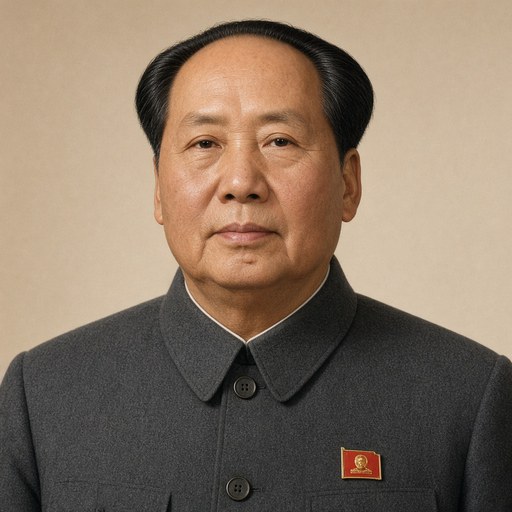
Speech at the Closing Session of the Eleventh Plenary Session of the Eighth Central Committee of the Communist Party of China
 Mao Zedong · Chairman of the Central Committee of the Communist Party of China
- Context
- Mao addressed the closing session of the Eleventh Plenary Session of the Eighth Central Committee on August 12, 1966, proposing that the Political Bureau prepare the Ninth Congress and defending the plenum's Cultural Revolution decision.
- Main themes
- Preparations for the Ninth Party Congress, decision on the Cultural Revolution, mass line, organizational guarantees for implementing the decision, adjustments to Political Bureau and Secretariat membership, allowing comrades who made mistakes to correct them, unity-criticism-unity, factions inside the Party, support of students and revolutionary teachers, results of the plenary session
- Duration
- ~5 min
- Words
- 616
- Sentences
- 33
- Readability
- 68
- Grade
- 8.4
- Syntax
- 2.90
- Vocabulary
- 1.85
Translated from Chinese Source: GitHub qinglee/maoxuan (毛泽东选集) ↗
The broad sphere of national life a sentence belongs to. Every sentence has an Arena, so it is the denominator the other indices are read against.
Other33 sentences in 3 paragraphs
On the question of the Ninth Congress, I'm afraid we need to make some preparations. On the question of when to convene the Ninth Congress, we need to make some preparations. It has been many years already; by the year after next it will be ten years since the Second Session of the Eighth Congress. Now, as for holding the Ninth Congress, it will probably be held at a suitable time sometime next year. We need to prepare now. I propose that we entrust the Political Bureau of the Central Committee and its Standing Committee with preparing this matter. Is that all right?
As for whether the questions decided at this plenary session are in the end correct or incorrect, that will depend on future practice. Those things we have decided seem to be welcomed by the masses. For example, one of the main decisions of the Centre is the one concerning the Cultural Revolution. The broad masses of students and revolutionary teachers support us, whereas the broad masses of revolutionary students and revolutionary teachers resisted those past policies, and we drew up this decision on the basis of that resistance. But whether this decision can actually be implemented still depends on the leaders at all levels, both those present here and those not present, to carry it out. Take relying on the masses, for example, the mass line: there are still two possibilities. One is to rely on them, the other is not to rely on them; one is to practise the mass line, the other is not to practise the mass line. On no account should we think that just because it is written in the decision, all Party committees and all comrades will carry it out. There will always be a small number of people who are unwilling to carry it out. It may be somewhat better than in the past, because in the past there was no such public decision, and this time there is an organizational guarantee. This time there have been some changes in organization: the adjustments to the members of the Political Bureau, the alternate members of the Political Bureau, the secretaries of the Secretariat and the Standing Committee guarantee the implementation of this resolution of the Centre and of the communiqué.
Comrades who have made mistakes must always be given a way out; they must be allowed to correct their mistakes. Do not think that because someone has made a mistake, he must not be allowed to correct it. Our policy is to learn from past mistakes to avoid future ones and to cure the sickness to save the patient; first observe, second help; unity–criticism–unity. This party of ours is not one where there are no parties outside the Party. I think there are parties outside the Party, and there are also factions inside the Party. It has always been so; this is a normal phenomenon. In the past we criticized the Kuomintang. The Kuomintang said there were no parties outside the Party and no factions inside the Party, and some people said, "No parties outside the Party: the thinking of emperors and kings. No factions inside the Party: a thousand oddities and ten thousand strange things." We Communists are the same. You say there are no factions inside the Party? There are. For example, on the question of mass movements there are two factions; it is only a question of which holds more and which holds less. If we had not held this plenary session and had gone on for a few more months, I think things would have become much worse. So I think this session has been a good one, and it has produced results.
The original Chinese. The tags above are read on the English translation's sentences.
关于第九次大会的问题,恐怕要准备一下。第九次大会什么时候召集的问题,要准备一下。已经多年了,八大二次会议到后年就十年了。现在要开九次大会大概是在明年一个适当的时候再开,现在要准备,建议委托中央政治局同它的常委会来筹备这件事,好不好?
至于这次全会所决定的问题,究竟是正确的还是不正确的,要看以后的实践。我们所决定的那些东西,看来群众是欢迎的。比如中央主要的一个决定就是关于文化大革命,广大的学生和革命教师是支持我们的,而过去那些方针,广大的革命学生跟革命教师是抵抗的,我们是根据这些抵抗来制定这个决定的。但是,究竟这个决定能不能实行,还是要靠我们在座的与不在座的各级领导去做。比如讲依靠群众吧,群众路线,还是有两种可能性:一种是依靠,一种是不依靠;一种是实行群众路线,一种是不实行群众路线。决不要以为,决定上写了,所有的党委,所有的同志就都会实行,总有一小部分人不愿意实行。可能比过去好一些,因为过去没有这样公开的决定,并且这次有组织的保证。这回组织有些改变,政治局委员、政治局候补委员、书记处书记、常委的调整,就保证了中央这个决议以及公报的实行。
对犯错误的同志总是要给他出路,要准许改正错误。不要认为别人犯了错误,就不许他改正错误。我们的政策是惩前毖后,治病救人,一看二帮,团结——批评——团结。我们这个党不是党外无党,我看是党外有党,党内也有派,从来都是如此,这是正常现象。我们过去批评国民党,国民党说党外无党,党内无派,有人就说,“党外无党,帝王思想。党内无派,千奇百怪”。我们共产党也是这样,你说党内无派?它就是有,比如说对群众运动就有两派,不过是占多占少的问题。如果不开这次全会,再搞几个月,我看事情就要坏得多。所以,我看这次会是开得好的,是有结果的。