




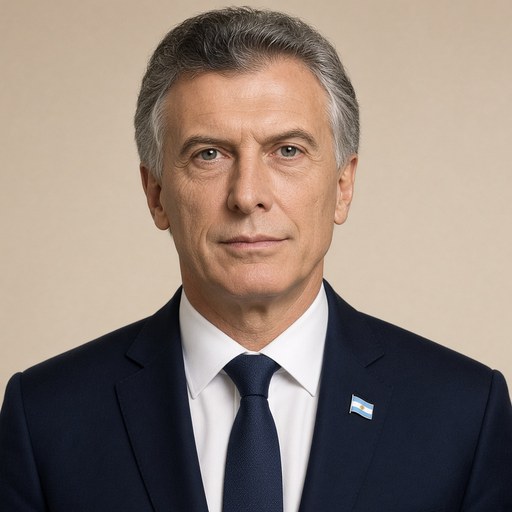
Words of President Macri while touring the construction works of a section of National Route 3, in Las Flores.
 Mauricio Macri · President of Argentina
- Context
- Macri addressed locals at Las Flores on July 2, 2019, during a tour of National Route 3 construction works, linking the project to Argentina's landmark EU-Mercosur trade deal.
- Main themes
- EU-Mercosur trade agreement, infrastructure development and road construction, regional diplomatic relations, economic opening and trade liberalization, investment attraction, Argentina's economic history, Mercosur unity, G20 diplomacy
- Duration
- ~17 min
- Words
- 2,002
- Sentences
- 88
- Readability
- 68
- Grade
- 9.5
- Syntax
- 2.98
- Vocabulary
- 1.85
Translated from Spanish
The broad sphere of national life a sentence belongs to. Every sentence has an Arena, so it is the denominator the other indices are read against.
Other88 sentences in 14 paragraphs
Good morning everyone. That we are here challenging the cold that has finally arrived, for a while, for a few days, for a few weeks, is also very important. The truth is that I am very happy. Thank you, Ramón, for having us here.
The truth is that we are gathered here for something that, as we were just discussing with the self-convened, has been demanded for more than 20 years. I look at this road and there are so many memories, dear Lunghi, so many times I came with my uncle Jorge, with my uncle Pachaco, along this road, passing trucks, and I would say “what a danger” all the time, how to survive all those trucks that circulated on such a small road, with those narrow bridges that were so difficult. But now, we are changing that story so that we can all walk this road as we should. That is what we want to return to, to be calm, that is what we want to return to, to be calm. That’s how the guys are, that’s how they are.
But also, as María Eugenia said, we have been negotiating this agreement with the European Union for more than 20 years. It took many years, many governments, and the truth is that I am very happy because a huge future opens up ahead, and I am very happy because we achieved this by betting on something that we are also betting on for the first time in our country: to dialogue, to listen to each other, to build good relationships, because if we did not restore relations with Uruguay, which had been blown up by the problem of the pulp mills. You remember, our Uruguayan brothers, we were at each other's throats. I crossed over to have a very nice barbecue that Tabaré gave me, and we solved all the problems of 10 years in 10 minutes. Then, with the Paraguayans whom we had wanted to expel from Mercosur over an issue of theirs. There were always tensions with the Brazilians too. And there we formed a team, we formed a team and said “this is good for everyone. We have to get it done.” And we got to work together. And then, of course, these relationships we built, these sympathies we generated. You saw it at the G20, when Merkel came, Macron came, Rutte from Holland came, Sánchez came, and they were all so excited about Argentina, they fell in love with us, with how good hosts we are, with what we organized, with that incredible show at the Colón where I cried, we all cried from emotion. All of that created this atmosphere that finally led to this signing, this signing that for me opens this agreement a panorama, a road that, if we travel it as we should, we will be able to grow a lot.
That is why I also want to tell the Argentines what this means, how it benefits us, because we all sense that it is good, but we have to understand why it is good. And it is good, first, because we will be able to sell more products and more services to many more people. Today we sell to 40 million. This is a market that opens up to us of 500 million people to whom we were already selling, some companies were already selling to them, but with very high tariffs, so it was very expensive. There were others who arrived, like our Chilean brothers who had a free trade agreement for a while, and they arrived with their wine without tax and beat ours. Or they arrived with garlic, with fruit, and now we arrive and we will be able to arrive with the same possibilities. And this is something very important and the truth is that this also generates that we can, in addition to services, by having a joint roadmap, agree on how we are going to respect the rules of the game, that we are not going to change the rules, the taxes, that we are going to be transparent in the agreements, in the tenders. That makes many of those companies that are in Europe will dare to come here and say “well, I am going to produce with the wonderful things that Argentines have, Argentine talent, products to export to Europe.” So, that is going to bring a lot of people to invest in our country because now they feel they have a contract that qualifies how we are going to do it.
And we must also take into account that they had the understanding and flexibility to accept that we were starting from a different starting point, we went, three and a half years ago, from being one of the most closed countries in the world. I will tell you something that will impress you: only Nigeria and Sudan were more closed in their economy than Argentina. And that closing off is what led us to poverty, to exclusion, to no growth. But also that level of closure requires a few years for us to all get back into practice, because precisely between 2011 and 2015 were the years of greatest destruction of industry in our country. Why? Because we had the controls that destroyed exports. 6,000 companies stopped exporting. We had all kinds of controls with this very nice gentleman who looked like Moreno, who made such a mess that he became famous worldwide for the mess he made. And his trips to Angola, which were not exactly about opening markets.
So today we are starting that process, but we require that companies get back into that routine, that the 9,000 companies that already export improve and that thousands more companies get on the path of improving, of being more competitive, more productive, with more quality, more volume. And that is already happening: we have already opened 170 markets apart from this agreement. And we also need time for the other partner, which exists in everything that is produced in the country, who is the other partner? That the State also does things better, because if we do not lower taxes, and here are the dear mayors, the municipal ones, if we do not lower provincial ones, if we do not finish eliminating the check tax, the withholdings definitely and all the distorting taxes we have, it will be difficult for our companies to compete and generate, by competing and winning markets, jobs because all we want is jobs, jobs, jobs all over the country. And also the State, which we are doing, has to simplify life for those who want to do something, not only for the ordinary citizen with remote procedures as we are doing now with the Driver's License, but all the procedures that a company has to do to be founded, to grow, to export, must be able to be done online. Today, we already have more than 2,000 remote procedures and the most important one, precisely, for export is the VUCE, which is the Single Window for Foreign Trade, which we created months ago and which allows 75 percent of export procedures to be digital, and that almost 80 percent of the time has been saved, that is, of every five hours spent on a procedure, four hours have been freed up. Why? To produce more, to create more. That is what we are doing as a State, simplifying life for them so they can do it.
And we also have to do this, infrastructure that gives us security, because also, if we are successful and have to transport more and carry more, we have to give security to the citizen who also needs to travel on the road. And to those who transport their work, give them a transport time that does not generate a cost that takes them out of the market. Today in Argentina, we have heard many times, from Jujuy, from Chaco, from many provinces, it costs more to take the product to the port than from the port to Shanghai or Rotterdam. And what does that do? That an Argentine is left without a job. And that is why we have made a revolution in road construction. We are already over 7,000 kilometers completed, doubling the highways and we already have 13,000 under construction. And we are doing more than in the last 65 years because, if we are connected, we can generate jobs and we can take care of our people. And we are also making a revolution with the trains. The Belgrano Cargas, which was dying when we arrived, losing 20 percent of the cargo per year, today has almost quadrupled it and continues to grow. We have built more kilometers of track than in the last 70 years and we will continue because we want to connect everyone. And the same goes for the ports.
And that is why it is also so important to fight against the mafia-like behaviors that still exist in Argentina, because every time someone wants to appropriate someone else's work, they ruin it, they leave them without a job. So, we need the trucks, the trains, the ports to function as they do in the orderly countries with which we will have to compete.
And also the airports. Why? Because more and more people are flying, we have more cargo space on planes to carry things. So, not only blueberries, lemons, salmon. We have started exporting many things, cherries. So, we have to fix the airports. This year we will finish fixing 30 airports in 19 provinces so that this country is truly federal and that from each province its production can go out to the world, and that each province can receive the tourist who wants to visit it.
All these things are happening now, it is not nonsense, it is not nonsense, they are real facts that are happening every day.
And, to finish, I want to tell you that it is very important to compete, we are all much better when we compete, we bring out things from within that we didn’t even know we had and that we can surpass ourselves. I am here because I believe in you, I truly believe in the enormous capacity you have to do.
And this exporting, which is not only agricultural products, but also industrial products, yesterday I met a young man who is starting to export espadrilles to the United States and Europe with Exporta Simple. And I ask him “how do you do it?” “I put design and it’s going great, and I have a factory in Cañuelas, here nearby, and I really hope that this doesn’t stop and I can grow because now I really have tools and I have what I need.” And in all let’s realize how we evolve when we compete.
Look at what happened with the Jaguars in rugby, before we played very occasionally against them and lost by a landslide. We decided to form a team, to compete all the time, and in the early moments, they killed us. We lost all the matches. And what happened? A couple of years passed, four years, and now we are playing them on equal terms and we are going to play them in the final. That means that Argentines can, gentlemen, Argentines can. And what they did, we are going to do in every corner of the country, and we are doing it.
That is why I say, more united than ever, let’s understand that, on this path, opening ourselves to the world, participating in the world, telling each other the truth, with transparency, with loyalty, we will be able to. Of course it can be done. So thank you for joining us, thank you, let’s go Las Flores, let’s go the province of Buenos Aires, and yes it can be done, of course it can be done. Come on, Argentines, it can be done. Thank you.
The original Spanish. The tags above are read on the English translation's sentences.
Buenos días a todos. Que estemos acá desafiando al frío que finalmente llegó, por un rato, por unos días, por unas semanas, pero también es muy importante. La verdad es que estoy muy contento. Gracias, Ramón, también por recibirnos acá.
La verdad es que estamos acá reunidos por algo que, recién hablábamos con los autoconvocados, se reclamaba hace más de 20 años. Yo miro esta ruta y son tantos recuerdos, querido Lunghi, tantas veces vine con mi tío Jorge, con mi tío Pachaco, por esta ruta, pasando camiones, y les decía “qué peligro” todo el tiempo, cómo sobrevivir a todos esos camiones que circulaban por una ruta tan chiquita, con esos puentes angostos tan difíciles. Pero, ahora, estamos cambiando esa historia para que todos podamos volver a caminar por esta ruta como corresponde. A eso queremos volver, a estar tranquilos todos, a eso es a lo que queremos volver, a estar tranquilos todos. Son así los muchachos, son así.
Pero también, como decía María Eugenia, hace más de 20 años que estábamos negociando este acuerdo con la Unión Europea. Costó muchos años, muchos gobiernos, y la verdad es que estoy muy contento porque se abre un enorme futuro por delante, y muy contento porque esto lo logramos porque apostamos a algo que estamos apostando también por primera vez en nuestro país: a dialogar, a escucharnos, a construir buenas relaciones, porque si no restablecíamos las relaciones con Uruguay, que habían sido dinamitadas con el problema de las pasteras. Se acuerdan, nuestros hermanos uruguayos, estábamos peleados a muerte. Yo crucé a comer un asado muy rico que me dio Tabaré, y arreglamos en 10 minutos todos los problemas de 10 años. Después, con los paraguayos que los habíamos querido expulsar del Mercosur por un tema de ellos. Con los brasileros también había siempre tensiones. Y ahí hicimos un equipo, hicimos equipo y dijimos “esto es bueno para todos. Tenemos que sacarlo”. Y nos pusimos a trabajar todos juntos. Y, después, por supuesto, estas relaciones que construimos, estas simpatías que generamos. Ustedes lo vieron en el G20, cuando vino Merkel, vino Macron, vino Rutte, el de Holanda, vino Sánchez, y que todos estaban tan entusiasmados con la Argentina, se enamoraron de nosotros, de lo buenos anfitriones que somos, de lo que organizamos, de ese espectáculo increíble en el Colón en el que yo lloré, lloramos todos de la emoción. Todo eso generó este clima que finalmente llevó a esta firma, esta firma que para mí abre este acuerdo un panorama, una ruta que, si la recorremos como corresponde, vamos a poder crecer mucho.
Por eso, quiero también decirles a los argentinos qué significa esto, en qué nos beneficia, porque todos intuimos que es bueno, pero tenemos que entender por qué es bueno. Y es bueno, primero, porque vamos a poder vender más productos y más servicios a mucha más gente. Hoy vendemos a 40 millones. Este es un mercado que se nos abre de 500 millones de personas a las cuales ya les vendíamos, algunas empresas ya les vendían, pero con aranceles muy altos, entonces era muy caro. Había otros que llegaban, como los hermanos chilenos que ya tenían acuerdo de libre comercio hace rato, y llegaban con su vino sin impuesto y le ganaba al nuestro. O llegaban con el ajo, con la fruta, y ahora llegamos nosotros y vamos a poder llegar con las mismas posibilidades. Y esto es algo muy importante y la verdad es que además esto genera que podamos, además de servicios, al tener una hoja de ruta en conjunto, nos pongamos de acuerdo en cómo vamos a respetar las reglas de juego, que no vamos a cambiar las reglas, los impuestos, que vamos a ser transparentes en los convenios, en las licitaciones. Eso hace que muchas de esas empresas que están en Europa se van a animar a venir acá a decir “bueno, yo voy a producir con las cosas maravillosas que tienen los argentinos, el talento argentino, productos para exportar a Europa”. Entonces, eso va a traer a mucha gente a invertir en nuestro país porque ahora siente que tiene un contrato que califica cómo lo vamos a hacer.
Y también hay que tener en cuenta que ellos tuvieron el entendimiento y la flexibilidad de aceptar que nosotros salíamos de un punto de partida distinto, nosotros pasamos, hace tres años y medio, de ser uno de los países más cerrados del mundo. Les voy a decir algo que les va a impresionar: solamente Nigeria y Sudán eran países mas cerrados en su economía que la Argentina. Y ese encerrarse es el que nos llevó a la pobreza, a la exclusión, al no crecimiento. Pero también ese nivel de encierro requiere de unos años para que todos volvamos a tener la práctica, porque justamente entre el 2011 y el 2015 fueron los años de mayor destrucción de la industria en nuestro país. ¿Por qué? Porque tuvimos el cepo que destruyó las exportaciones. 6.000 empresas dejaron de exportar. Tuvimos controles de todo tipo con este señor tan simpático que parecía Moreno, que hizo unos líos que se hizo hasta famoso mundialmente por los líos que armó. Y sus viajes a Angola, que eso no era justamente abrir mercados.
Entonces hoy empezamos ese proceso, pero requerimos que las empresas vuelvan a tener esa gimnasia, que las 9.000 empresas que ya exportan mejoren y que miles de empresas más se pongan en el camino de mejorar, de ser más competitivas, más productivas, con más calidad, más volumen. Y eso ya está pasando: ya hemos abierto 170 mercados aparte de este convenio. Y también necesitamos tiempo para que el otro socio, que existe en cada cosa que se produce en el país, que ¿quién es el otro socio? Que el Estado haga también las cosas mejor, porque si no bajamos los impuestos, y acá están los queridos intendentes, los municipales, no bajamos los provinciales, no terminamos de sacar el impuesto al cheque, las retenciones definitivamente y todos los impuestos distorsivos que tenemos, va a ser difícil que nuestras empresas puedan competir y generar, al competir y ganar mercados, empleo porque todo lo que queremos es empleo, empleo, empleo por todo el país. Y además el Estado, que lo estamos haciendo, tiene que simplificarle la vida a aquel que quiere hacer algo, no solo al ciudadano común con los trámites a distancia como estamos haciendo ahora con el Registro de Conducir, sino que todos los trámites que tenga que hacer una empresa para fundarse, para crecer, para exportar, tiene que poder hacerse por internet. Hoy, ya tenemos más de 2.000 trámites a distancia y el más importante, justo, para la exportación es la VUCE, que es la Ventanilla Única de Comercio Exterior, que hemos creado hace meses y que permite que el 75 por ciento de los trámites de exportación ya sean digitales, y que se haya ganado casi el 80 por ciento del tiempo, o sea, de cada cinco horas que empleaba para un trámite, ya cuatro horas se las ha liberado. ¿Para qué? Para producir más, para crear más. Eso es lo que estamos haciendo como Estado, simplificarles la vida para que lo puedan hacer.
Y también tenemos que hacer esto, infraestructura que nos dé seguridad, porque también, si somos exitosos y tenemos que transportar más y llevar más, tenemos que darle seguridad al ciudadano que también necesita viajar en la ruta. Y al que transporta su trabajo darle un tiempo de transporte que no genere un costo que lo saque del mercado. Hoy en la Argentina, lo hemos escuchando muchas veces, de Jujuy, de Chaco, de muchas provincias, cuesta más caro llevar el producto al puerto que del puerto a Shanghái o a Rotterdam. Y, ¿eso qué hace? Que un argentino se quede sin trabajo. Y, por eso, hemos hecho una revolución en la construcción de rutas. Estamos ya en más de 7.000 kilómetros terminados, duplicando las autopistas y ya tenemos 13.000 en obra. Y estamos haciendo más que en los últimos 65 años porque, si estamos conectados, podemos generar trabajo y podemos cuidar a nuestra gente. Y también estamos haciendo una revolución con los trenes. El Belgrano Cargas, que venía muriéndose cuando llegamos, pérdidas del 20 por ciento de la carga por año, hoy ya la casi cuadruplicó y sigue creciendo. Hemos hecho más kilómetros de vía que en los últimos 70 años y vamos a seguir porque queremos conectar a cada uno. Y lo mismo con los puertos.
Y, por eso, también es tan importante luchar contra los comportamientos mafiosos que todavía existen en la Argentina, porque cada vez que alguien se quiere apropiar del trabajo del otro lo arruina, lo deja sin trabajo. Entonces, necesitamos que el camión, que los trenes, que los puertos funcionen como funcionan en los países ordenados con los cuales vamos a tener que competir.
Y también los aeropuertos. ¿Por qué? Porque cada vez vuela más gente, tenemos más bodegas en los aviones para llevar cosas. Entonces, no solo arándanos, limones, salmón. Empezamos a exportar muchas cosas, cereza. Entonces, tenemos que arreglar los aeropuertos. Este año vamos a terminar de arreglar 30 aeropuertos en 19 provincias para que este país sea realmente federal y que de cada provincia pueda salir su producción al mundo, y a cada provincia pueda llegar el turista que lo quiere visitar.
Todas estas cosas están sucediendo ahora, no es sarasa, no es sanata, son hechos reales que están sucediendo todos los días.
Y, para terminar, quiero decirles que es muy importante competir, nosotros somos todos mucho mejores cuando competimos, sacamos cosas de adentro que ni sabíamos que las teníamos y que nos podemos superar. Yo estoy acá porque creo en ustedes, creo realmente en la capacidad enorme que tienen de hacer.
Y esto de exportar, que no solamente son productos del campo, también son productos de la industria, ayer me encontré con un joven que está empezando a exportar alpargatas a Estados Unidos y a Europa con Exporta Simple. Y le digo “¿cómo haces?”. “Puse diseño y me está yendo bárbaro, y tengo una fábrica en Cañuelas, acá cerca, y espero realmente que esto no pare y poder crecer porque realmente ahora tengo herramientas y tengo con qué”. Y en todo démonos cuenta cómo evolucionamos cuando competimos.
Miren lo que pasó con los Jaguares en el rugby, antes jugábamos muy de vez en cuando contra ellos y perdíamos por paliza. Nos decidimos a armar un equipo, a competir todo el tiempo, y en los primeros momentos nos mataron. Perdíamos todos los partidos. Y ¿qué pasó? Pasaron un par de años, cuatro años, y ahora estamos jugándoles de igual a igual y vamos a jugarles la final. Eso significa que los argentinos podemos, señores, los argentinos podemos. Y esto que hicieron ellos lo vamos a hacer en cada rincón del país, y lo estamos haciendo.
Por eso digo, más juntos que nunca, entendamos que, por este camino, abriéndonos al mundo, participando del mundo, diciéndonos la verdad, con transparencia, con lealtad, vamos a poder. Claro que se puede. Así que gracias por acompañarnos, gracias, vamos Las Flores, vamos la provincia de Buenos Aires, y sí se puede, claro que se puede. Vamos, argentinos, que se puede. Gracias.