




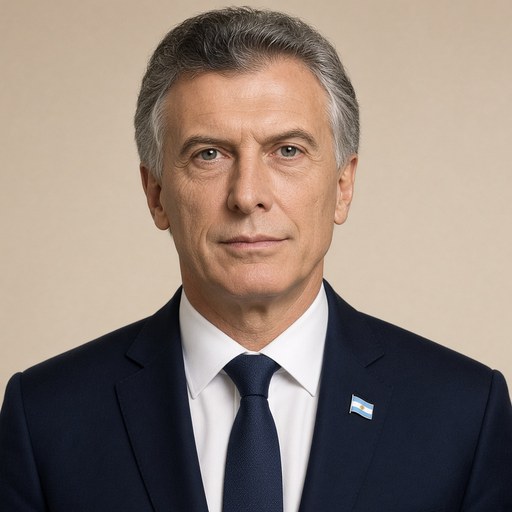
President Mauricio Macri at the International Day of Commemoration in Memory of the Victims of the Holocaust.
 Mauricio Macri · President of Argentina
- Context
- Macri addressed Argentina's International Day of Commemoration in Memory of the Victims of the Holocaust on January 28, 2019, honoring survivors and reaffirming commitment to remembrance.
- Main themes
- Holocaust remembrance, victims of Nazism, memory and education, Never Again, Jewish community, Argentina's role in Holocaust remembrance, International Holocaust Remembrance Alliance, diversity and coexistence, human rights, identity and loss, mass violence prevention
- Duration
- ~4 min
- Words
- 507
- Sentences
- 18
- Readability
- 45
- Grade
- 14.0
- Syntax
- 3.23
- Vocabulary
- 1.99
Translated from Spanish
The broad sphere of national life a sentence belongs to. Every sentence has an Arena, so it is the denominator the other indices are read against.
Other18 sentences in 7 paragraphs
Good afternoon everyone, thank you very much for inviting me. And today, above all, I want to join in this Tribute to the Memory of the Victims of the Holocaust.
It is clear that the words I may say lose dimension in the face of the testimony we have just heard; it was a woman who suffered firsthand the atrocities caused by Nazism during World War II. Atrocities that began with the loss of millions of people who lost their lives, loved ones so close, and continue with thousands and thousands of people who, like Raquel, had their identity and even their name stolen from them. The loss is immense, and for that reason, our recognition and our memory must also be immense.
Yesterday, on the International Day of Commemoration in Memory of the Victims of the Holocaust, we remembered the liberation of Auschwitz that took place 74 years ago: the crimes committed in that place and in each of the concentration camps mark a before and after, not only for the Jewish people but for all humanity. That is why we need to work harder than ever, so that never again in the world do processes of mass violence repeat, and that no one anywhere on the planet feels that their life is at risk for being considered different.
As President, I am proud of Argentina - as the President of DAIA said - because we are the only Latin American country that is part of the International Alliance for Holocaust Remembrance; because only by knowing, remembering, and telling what happened can we prevent something similar from happening again. That is why it is so important to continue promoting research, memory, and education.
Personally, I have a strong commitment to the memory of the Shoah, and I know that it is a commitment of my entire Government. That is why we decided to join the We Remember campaign, and I thank the Latin American Jewish Congress for promoting it to educate and raise awareness.
Today, I especially want to express my admiration for the work that the Jewish community has been carrying out for decades, which has led the world to formally recognize the Holocaust. As a fact of the past, we cannot do anything to change it, but we do have the responsibility to remember it in order to look to the future and learn from those lessons. That is what we propose in our Human Rights Action Plan, with our Government policy of dialogue, coexistence, encounter, and respect. These are the pillars that we want and promote for our society, a society that from its roots is made up of different ethnicities, cultures, nations, and religions. Each of them shapes who we are as Argentines today, and that is why we value, celebrate, and enrich ourselves in diversity. And with that diversity, we want to grow; we want to build the future; with that diversity, we are increasingly convinced that we have a huge future ahead of us.
Thank you very much to everyone.
The original Spanish. The tags above are read on the English translation's sentences.
Buenas tardes a todos, realmente muchas gracias por invitarme. Y hoy ante todo me quiero sumar en este Homenaje a la Memoria de las Víctimas del Holocausto.
Queda claro que las palabras que pueda decir pierden dimensión frente al testimonio que acabamos de escuchar, fue una mujer que sufrió en carne propia las atrocidades causadas por el nazismo durante la Segunda Guerra Mundial. Atrocidades que comenzaron con la pérdida de millones de personas que perdieron la vida, afectos tan cercanos y que siguen con miles y miles de personas que, como Raquel, a las que les robaron la identidad y hasta su nombre. La pérdida es inmensa y por eso tiene que serlo también nuestro reconocimiento y nuestra memoria.
Ayer, en el Día Internacional de Conmemoración en Memoria de las Víctimas del Holocausto, recordamos la liberación de Auschwitz que sucedió hace 74 años: los crímenes cometidos en ese lugar y en cada uno de los campos de concentración marcan un antes y un después, no solo para el pueblo judío sino para toda la humanidad. Por eso necesitamos trabajar más que nunca, para que nunca más se repitan en el mundo procesos de violencia masiva y que nadie en ninguna parte del plantea sienta que su vida corre riesgo por ser considerado diferente.
Como Presidente me siento orgulloso de la Argentina -como decía el Presidente de la DAIA- porque somos el único país latinoamericano que integra la Alianza Internacional Para la Memoria del Holocausto; porque solo conociendo, recordando y contando lo que pasó vamos a poder evitar que vuelva a ocurrir algo semejante. Por eso es tan importante seguir impulsando la investigación, la memoria y la educación.
Personalmente tengo un fuerte compromiso con la memoria de la Shoá, y sé que es un compromiso de todo mi Gobierno. Por eso decidimos sumarnos a la campaña We Remember-Recordemos y agradezco al Congreso Judío Latinoamericano por haberla impulsado para educar y crear conciencia.
Hoy quiero especialmente expresar mi admiración por la tarea que hace décadas lleva adelante la comunidad judía, que logró que formalmente el mundo reconociera el Holocausto. Como hecho del pasado, no podemos hacer nada para cambiarlo, pero sí tenemos la responsabilidad de recordarlo para mirar al futuro y aprender de esas lecciones. Eso planteamos en nuestro Plan de Acción de Derechos Humanos, con nuestra política de Gobierno de diálogo, convivencia, encuentro y respeto. Son esos los pilares que queremos y fomentamos para nuestra sociedad, una sociedad que desde sus raíces está conformada por diferentes etnias, culturas, naciones y religiones. Cada una de ellas da forma a lo que somos los argentinos hoy, y por eso valoramos, celebramos y nos enriquecemos en la diversidad. Y con esa diversidad es que queremos crecer, queremos construir el futuro; con esa diversidad es que estamos cada día más convencidos que tenemos un enorme futuro por delante.
Muchas gracias a todos. (APLAUSOS)