




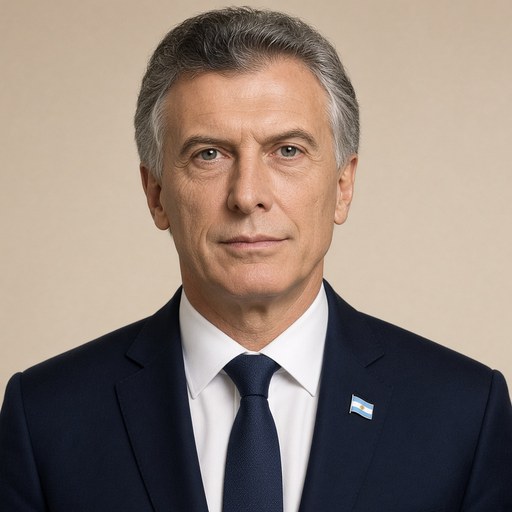
President Mauricio Macri at the presentation of the "Learn Mathematics Plan" at the Galileo Galilei Planetarium in the Autonomous City of Buenos Aires.
 Mauricio Macri · President of Argentina
- Context
- Macri addressed students and educators at Buenos Aires' Galileo Galilei Planetarium on October 18, 2018, to launch the national Learn Mathematics Plan.
- Main themes
- Mathematics education reform, Learn Mathematics Plan, quality public education, technological revolution and future jobs, student assessment and evaluation, teacher training, educational equity, artificial intelligence and robotics, overcoming math anxiety, education and opportunity, educational innovation
- Duration
- ~8 min
- Words
- 949
- Sentences
- 25
- Readability
- 42
- Grade
- 16.8
- Syntax
- 3.69
- Vocabulary
- 1.74
Translated from Spanish
The broad sphere of national life a sentence belongs to. Every sentence has an Arena, so it is the denominator the other indices are read against.
Other25 sentences in 13 paragraphs
Good morning, thank you "Fino"; good morning to everyone.
If there is something that unites us Argentinians, if there is something on which we all agree, it is the importance, the power that education has in terms of generating future, of generating opportunities. And alongside education, we aspire to create jobs, reduce poverty.
And now we have a much greater challenge; we all see the speed at which the world is evolving; the speed that the technological revolution has taken; how artificial intelligence and robotics are advancing. So today we also have to try— as Esteban has said many times— to imagine how to prepare our young people for jobs that perhaps do not even exist today: that is an enormous challenge, and that means a quality Public Education system.
But as happened when we started in the City of Buenos Aires, the first thing we wanted to know was where we stood; we really said, "we need to know if we are doing well, if we are doing poorly." And a fundamental issue: not to be afraid of the truth, because only by clearly understanding what our starting point was, where our shortcomings were, could we enter a process of continuous improvement; because it cannot stop, we have to improve every day, because the world improves.
And there, when we started with the evaluation, unfortunately what we suspected was confirmed, that we had many problems in how we were teaching, in how the kids were learning, and we did very poorly in "language," and we had to get to work. But the good thing is that we did a number of things and it started to improve; in the second evaluation, we saw that it improved.
But in mathematics— which I did not struggle with, I struggled with many of the others, but the truth is I did not struggle when I was in school— mathematics, kids, we are original, because you think you are original in everything; in my time, everyone also said, "this is not for me, I don't understand math," there was an allergy; this comes from your dad, from your grandfather, everyone went through the same thing, it was like a taboo. I won't even tell you when I got to chemistry, physics, there it was directly: "help!" everyone says: "help!" And the truth is that there is a lot of denial, a lot of prejudice in thinking that I won't be able to.
And what we really saw, also losing our fear of opening up to the world and seeing what others have done, as we saw in this video presented to us, from Singapore, France, Portugal, Finland, that you can learn by applying things from everyday life, and not just on a blackboard, which seems incredibly boring, distant, remote: you can learn by playing. And we believe and bet that this will really be a true change in how our kids will approach Mathematics.
And the truth is that Mathematics, far from receding, has been infiltrating all careers, because before there were careers from which you could escape Mathematics, but today Mathematics has infiltrated everything: in art, in culture in general, in everything that has to do with Programming and Design; so we believe that this is key for what is to come. If we really do not make a profound shift based on what we saw as a result, that only 3 out of every 10 students who finish— let’s think that half— unfortunately— do not finish, have a basic necessary knowledge in Mathematics, we will have problems with what we dream of and we are here to build something different.
So, I believe that all this we have done opens up a huge opportunity for us; I believe that today sixth-grade students, more than 700,000 are taking the tests, more and more are doing so. I thank the students, the teachers who are joining in; there is still much to be done. It is really necessary that we all pull together, because this is about the future, about the most valuable thing we have, which is our children, our young people.
I believe that these 600, more than 650 teachers who will be teachers of teachers, aiming for 75,000 across the country will start with a huge responsibility, and I hope with the joy of bringing them new tools, that innovate, that bring them closer to the kids who are so demanding today and need us to tell them everything very quickly, as happens at home; if we don’t talk to our children in the first two minutes, they won’t pay attention anymore, so we have to be agile too, because the challenge is permanent. So it is not just your responsibility as teachers, it is everyone’s.
So I really hope that this opportunity, which is part of this entire program, which truly incorporates technology, brings it to schools, will definitely bring us together so that together we can generate this Argentina of opportunities, which is what we want, and that it be throughout the country, that there is no difference between a child from a province in the North, the South, or one from the Capital, which is also another thing that has existed in Argentina and that has nothing to do— precisely— with something as important as equity.
So thank you all for being committed, thank you to the kids who showed me their experiences, really very interesting. I would have loved to have that opportunity and those tools to start applying Mathematics to real-life things from the very beginning, which really makes it much easier.
So congratulations to everyone and let’s keep going with strength, thank you.
The original Spanish. The tags above are read on the English translation's sentences.
Buenos días, gracias “Fino”; buenos días a todos.
Si hay algo que nos une a los argentinos, si hay algo en lo cual todos coincidimos, es en la importancia, en la potencia que tiene la educación en términos de generar futuro, de generar oportunidades. Y de la mano de la educación aspiramos a generar trabajo, reducir la pobreza.
Y ahora tenemos un desafío mucho mayor, todos vemos a la velocidad que está evolucionando el mundo; la velocidad que tomó la revolución tecnológica; cómo avanza la inteligencia artificial, la robótica. Entonces además hoy tenemos que tratar- como tantas veces también ha dicho Esteban- de imaginarnos cómo preparar a nuestros jóvenes para trabajos que tal vez hoy todavía no existen: ese es un desafío enorme, y eso significa un sistema de educación, Educación Pública de calidad.
Pero como nos pasó cuando empezamos en la Ciudad de Buenos Aires, lo primero que quisimos saber es dónde estábamos parados, realmente dijimos “tenemos que saber si estamos yendo bien, estamos yendo mal”. Y un tema fundamental: no tenerle miedo a la verdad, porque solamente teniendo claro cuál era el punto de partida, dónde estaban nuestras falencias, es que podíamos entrar en un proceso de mejora continua; porque aparte no puede parar, nosotros tenemos que mejorar todos los días, porque el mundo mejora.
Y ahí, cuando empezamos con la evaluación, lamentablemente lo que presentíamos se confirmó, que teníamos muchos problemas en cómo estábamos enseñando, en cómo estaban aprendiendo los chicos, y nos dio muy mal “lengua”, y tuvimos que ponernos a trabajar. Pero lo bueno es que hicimos una cantidad de cosas y empezó a mejorar, en la segunda evaluación vimos que mejoró.
Pero en matemáticas -que a mí no me costó, me costaron muchas de las otras, pero la verdad no me costó cuando estaba en el colegio-, matemáticas, chicos, nos originales, porque ustedes piensan que son originales en todo, en mi época también todo el mundo decía “esto no es para mí, la matemática yo no la entiendo”, había una alergia; esto viene de tu papá, de tu abuelo, a todo el mundo le pasó lo mismo, era como un tabú. Ni te cuento cuando llegué a química, física, ya ahí directamente: “¡socorro!”, dicen todos: “¡socorro!”. Y la verdad es que hay mucho como de negación, mucho como de prejuicio en que no voy a poder.
Y realmente lo que vimos, también perdiendo nosotros el miedo de abrirnos al mundo y ver qué es lo que han hecho otros, como vimos en el video este que nos presentaron, de Singapur, de Francia, de Portugal, de Finlandia, que se puede aprender aplicando cosas de la vida cotidiana, y no tan solo en un pizarrón, que parece aburridísimo, lejano, distante: se puede aprender jugando. Y eso, creemos y apostamos que va a ser realmente un verdadero cambio en cómo nuestros chicos se van a aproximar a la Matemática.
Y la verdad que la Matemática lejos de retroceder se ha ido metiendo en todas las carreras, porque antes había carreras en la cual vos te podías escapar de la Matemática, pero hoy la Matemática se ha metido en todo: en el arte, en la cultura en general, en todo lo que tiene que ver sobre todo y se conecta con la Programación y el Diseño; entonces creemos que esto es clave para lo que viene. Si realmente nosotros no pegamos un giro profundo a lo que vimos como resultado, que solamente 3 de cada 10 alumnos que terminan, pensemos que la mitad – lamentablemente – no termina, conocen y tienen un conocimiento básico necesario, en Matemática, vamos a tener problemas en lo que nosotros soñamos y estamos acá para construir algo distinto.
Entonces, creo que todo esto que hemos hecho nos abre una enorme oportunidad, creo que hoy los chicos de sexto grado, están más de 700.000 haciendo las pruebas, cada vez son más lo que la realizan. Agradezco a los alumnos, a los docentes que se van sumando, todavía falta mucho. Realmente es necesario que todos tiremos del carro junto, porque esto se trata del futuro, de lo más valioso que tenemos, que son nuestros hijos, nuestros jóvenes.
Creo que estos 600, más 650 docentes que van a ser docentes de docentes, apuntando a 75.000 en todo el país van a arrancar con una enorme responsabilidad y espero que con la alegría de llevarles herramientas nuevas, que innoven, que los acerquen a los chicos que hoy son tan exigentes y necesitan que todo se lo digamos muy rápido, como nos pasa en casa, si a nuestros hijos no le hablamos en los primeros dos minutos ya después no te prestan atención, así que hay que estar ágiles también, porque el desafío es permanente. Así que no es solamente de ustedes los docentes, es de todos.
Así que espero realmente que esta oportunidad, que es parte de todo este programa, que realmente incorpora la tecnología, la lleva a las escuelas, todo junto nos acerque definitivamente a que entre todos vayamos generando esta Argentina de oportunidades, que es lo que queremos y que además sean en todo el país, que no haya diferencia entre un chico de una provincia del Norte, del Sur o con uno de la Capital, que también es otra cosa que ha existido en la Argentina y que no tiene que ver – justamente - con algo tan importante como es la equidad.
Así que gracias a todos por estar comprometidos, gracias a los chicos que me mostraron sus experiencias, la verdad que muy interesantes. Me hubiese encantado a mí tener esa oportunidad y esas herramientas para ya, desde el comienzo empezar a aplicar la Matemática a cosas de la vida real, que realmente se facilitan y mucho.
Así que felicitaciones a todos y a seguir con fuerza, gracias. (APLAUSOS)