




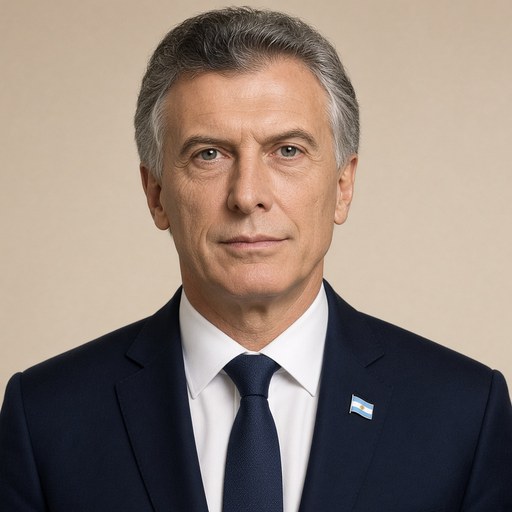
President Mauricio Macri, in the presentation of the results of the Aprender 2017 evaluation.
 Mauricio Macri · President of Argentina
- Context
- Macri addressed educators and officials at the presentation of the Aprender 2017 national education evaluation results in Argentina on March 21, 2018.
- Main themes
- Aprender 2017 evaluation results, education quality, equality of opportunity, student learning outcomes, mathematics and language skills, teacher training, 21st-century skills, technological revolution and employment, vulnerable students, school dropout, Down Syndrome Day, diversity
- Duration
- ~10 min
- Words
- 1,143
- Sentences
- 31
- Readability
- 49
- Grade
- 15.3
- Syntax
- 3.68
- Vocabulary
- 1.79
Translated from Spanish
The broad sphere of national life a sentence belongs to. Every sentence has an Arena, so it is the denominator the other indices are read against.
Other31 sentences in 16 paragraphs
Good morning, good morning everyone.
I see the Governor and the front row looking at my socks, they are very impressed. It's not that I've gone crazy, because I might seem a bit crazy to some, but it's because today is World Down Syndrome Day, and these different socks want to celebrate that diversity has wonderful value. And they are bright, as you can see, just like all those who have been born with Down syndrome, who give us an example of overcoming challenges, of joy in living, and I think it is important that we all understand this more and more every day. And I believe we are understanding it, in Argentina we are understanding it and we are having very important and beautiful debates around these themes.
Thank you “Fino” for your words, thank you to all the Ministers of Education who are here, to the directors, to the teachers, to the students.
This is also a very special moment in this construction of the Argentina we dream of. On March 1st, I invited all of you to raise the torch of education, to truly bring quality education to all the young people in this country, especially to those who are in more vulnerable situations; because we have often said that there is no tool that achieves better equality of opportunities than good education, especially quality Public Education.
And also in this that we seek, that all our young people, our children tomorrow can choose, all of you who are here can choose, and what gives you more capacity to choose is the knowledge you acquire: it is truly fundamental. And especially today that we live in a time in the world in which we are subjected to a technological revolution, so there are jobs that disappear and jobs that are created. We want all of you to be able to access those 21st-century jobs.
But as the Minister said, we had to know where we were starting from, we had to be sure of what we were doing right and what we were doing wrong. And that is where the Evaluación Aprender was born, not without initial resistance - as the Minister stated - but little by little we have been convincing ourselves that we should not be afraid of the truth, that the truth must be on the table, and from there start to build a different reality.
And as many of us knew, and also the parents: the first result was very bad, it was very bad. We found that a significant percentage, almost the majority of the children who graduated, who were already half of those who had started, did not understand texts by the end of their training; and not to mention the gap they had with mathematics. And with that which the parents already knew - because they saw their children who, even passing grades, did not read fluently very well, and they could not finish learning their multiplication tables - with all that information, with all those data we did not stop there, because behind each of those numbers are girls and boys who need something additional. And with that we prepared new tools, new proposals, and we sent to each director strengths, weaknesses, and challenges they had to face.
And fortunately, as the Minister and those who have worked on the issue tell me, nine out of ten directors worked with that information and produced this change in trend in social sciences, natural sciences, and language; still in mathematics we struggle; but this has always been the case, right?: when I was studying, there were only a few who liked mathematics. But it is a great starting point, because it shows that by not being afraid of the truth and putting the information on the table, we can change reality.
And we have to finish understanding that what we should be afraid of is that our children do not learn, and worse: that they do not finish school, which is what happens in half of the cases.
So I believe that this beginning, I am convinced, will be the beginning of a great journey, because all of you are truly committed to the task. And we also did this and achieved it because we made a new commitment, a strong commitment, to teacher training.
And now to this new year of Evaluación Aprender we added value, we sought more information, we wanted to know what the context of the students was, so that in each minority group we also understood the magnitude of their problem: the children of adolescent mothers and fathers; the children who work as well, where we saw that the results of those who work are unfortunately worse than those who do not work. So we also have to have some differential approach there so that everyone, absolutely everyone, can walk this path of education. I am convinced that this is the only way, that it is the only path.
I want to congratulate the teachers for being part of this, of this important first step forward that we have taken, to understand that the 21st century challenges us all. We always heard that doctors had to study one or two hours a day every day of their lives, because medicine evolved: now it happens to all of us, we all have to keep studying, because the world has accelerated in the generation of knowledge, not to mention the technological revolution that reaches the classroom, so we all have to be open.
And the beautiful thing about continuing to learn, the wonderful thing about continuing to learn is that it is the best way to stay young forever, if you keep being able to learn you will be young your whole life; so there is no need to be afraid of having to keep learning, of continuing to train ourselves.
And to the students, I also want to congratulate you, to those who felt they had to be part of this, because that is what we are doing: that every Argentine, from their corner, where they were born and where they are living at this moment, feels that they have something to contribute to that Argentina we dream of.
So I want to truly tell you that I am happy that we are increasingly more who want to work with the truth on the table, work as a team, and always thinking about the children, about their future, about how this Argentina has to be able to embrace them, include them, and that they choose time and again to stay here, in their country, and especially that we achieve that they stay in the place where they were born, because that is where their affections are, if that is what they truly desire.
Thank you all and let’s keep working.
The original Spanish. The tags above are read on the English translation's sentences.
Buenos días, buenos días a todos.
Estoy viendo a la Gobernadora y a la primera fila mirando mis medias, están muy impresionados. No es que me volví loco, porque puedo estar un poco loco para algunos, pero es porque hoy es el Día Mundial de Síndrome de Down, y estas medias diferentes quieren celebrar que la diversidad tiene un valor maravilloso. Y son brillantes, como ven, como pueden ser todos los que han nacido con el Síndrome de Down, que nos dan un ejemplo de superación, de alegría de vivir, y creo que es importante que todos entendamos esto y cada día más. Y yo creo que lo estamos entendiendo, en la Argentina lo estamos entendiendo y estamos dando debates muy importantes y muy lindos alrededor de estas temáticas.
Gracias “Fino” por tus palabras, gracias a todos los Ministros de Educación que están acá, a los directivos, a los docentes, a los alumnos.
Es un momento también muy especial en esta construcción de la Argentina que soñamos. El 1° de marzo yo los invité a todos a levantar la antorcha de la educación, de que realmente llevemos una educación de calidad a todos los jóvenes de este país, especialmente a los que están en una situación más vulnerable; porque tantas veces hemos dicho que no hay ninguna herramienta que logre mejor igualdad de oportunidades que la buena educación, especialmente la Educación Pública de calidad.
Y también en esto que buscamos, que todos nuestros jóvenes, nuestros chicos el día de mañana puedan elegir, todos ustedes que están acá puedan elegir, y lo que te da más capacidad de elegir es el conocimiento que adquirís: es realmente fundamental. Y especialmente hoy que vivimos un tiempo del mundo en el cual estamos sometidos a una revolución tecnológica, entonces hay empleos que desaparecen y empleos que se generan. Nosotros queremos que todos ustedes puedan acceder a esos empleos del siglo XXI.
Pero como decía el Ministro, teníamos que saber desde dónde partíamos, teníamos que estar seguros de qué es lo que estábamos haciendo bien y lo que estábamos haciendo mal. Y ahí nació la Evaluación Aprender, no sin resistencias iniciales -como manifestó el Ministro-, pero poco a poco nos hemos ido convenciendo de que no tenemos que tenerle miedo a la verdad, que la verdad tiene que estar sobre la mesa, y desde ahí empezar a construir una realidad distinta.
Y como ya muchos sabíamos, y también los padres: el primer resultado fue muy malo, fue muy malo. Comprobamos que un porcentaje importante, casi la mayoría de los chicos que se recibían, que ya eran la mitad de los que habían comenzado, no comprendían textos al terminar su formación; y ni que hablar el agujero que tenían con las matemáticas. Y con eso que ya los padres sabían -porque veían a sus hijos que, aun pasando de grado, no leían de corrido muy bien, y las tablas no las lograban terminar de aprender-, con toda esa información, con todos esos datos no nos quedamos ahí, porque detrás de cada uno de esos números hay chicas y chicos que necesitan algo adicional. Y con eso preparamos nuevas herramientas, nuevas propuestas, y le enviamos a cada directora o director fortalezas, debilidades y desafíos que tenían que encarar.
Y por suerte, según me cuenta el Ministro y los que han trabajado en el tema, nueve de cada diez directores trabajaron con esa información y produjeron este cambio de tendencia en ciencias sociales, naturales y lengua; todavía en matemática nos cuesta; pero esto fue de siempre, ¿no?: cuando yo estudiaba eran unos pocos a los les gustaba la matemática. Pero es un gran punto de partida, porque demuestra que no teniéndole miedo a la verdad y poniendo la información sobre la mesa, podemos cambiar la realidad.
Y tenemos que terminar de entender que a lo que le tenemos que tener miedo es a que nuestros chicos no aprendan, y peor: que no terminen el colegio, que es lo que nos pasa en la mitad de los casos.
Entonces creo que este comienzo yo estoy convencido que va a ser el comienzo de un gran camino, porque todos ustedes están realmente consustanciados con la tarea. Y esto también lo hicimos y lo logramos porque hicimos una nueva apuesta, fuerte apuesta, a la capacitación docente.
Y ahora a este nuevo año de Evaluación Aprender le agregamos valor, fuimos por más información, quisimos saber cuál era contexto de los estudiantes, para que en cada grupo minoritario también entendiésemos cuál era la magnitud de su problema: los hijos de madres y padres adolescentes; los chicos que trabajan también, donde vimos que los resultados de los que trabajan lamentablemente son peores que de los que no trabajan. Entonces tenemos que también ahí tener algún abordaje diferencial para que todos, absolutamente todos, puedan recorrer este camino de la formación. Estoy convencido de que esta es la única manera, que es único camino.
Yo quiero felicitarlos a los maestros por haber sido parte de esto, de este primer paso adelante importante que hemos dado, de entender que el siglo XXI nos desafía a todos. Siempre escuchábamos que los médicos tenían estudiar una hora o dos horas por día todos los días de su vida, porque la medicina evolucionaba: ahora a todos nos pasa lo mismo, todos tenemos que seguir estudiando, porque el mundo aceleró en la generación de conocimiento, ni que hablar con la revolución tecnológica que llega al aula, entonces todos tenemos que estar abiertos.
Y lo lindo de seguir aprendiendo, lo maravilloso de seguir aprendiendo es que es lo mejor para mantenerte joven eternamente, si vos seguís pudiendo aprender vas a ser joven toda tu vida; entonces no hay que tenerle miedo a tener que seguir aprendiendo, a seguirnos capacitando.
Y a los estudiantes también quiero felicitarlos, a aquellos que sintieron que tenían que ser parte de esto, porque de eso se trata lo que estamos haciendo: que cada argentino, desde su rincón, donde le haya tocado nacer y donde esté viviendo en este momento, sienta que tiene algo que aportar a esa Argentina que soñamos.
Entonces yo quiero decirles de verdad que estoy feliz de que cada vez seamos más los que queremos trabajar con la verdad sobre la mesa, trabajar en equipo, y pensando siempre en los chicos, en su futuro, en que esta Argentina tiene que poder abrazarlos, incluirlos, y que ellos elijan una y otra vez quedarse acá, en su país, y especialmente que logremos que se queden en su lugar donde hayan nacido, porque ahí es donde están sus afectos, si es lo que realmente desean.
Gracias a todos y a seguir trabajando. (APLAUSOS)