




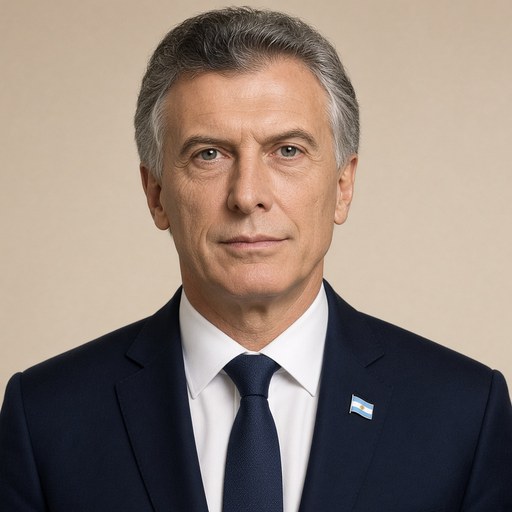
President Mauricio Macri at the presentation of the results of the Learning Test.
 Mauricio Macri · President of Argentina
- Context
- Macri addressed an audience at the presentation of Argentina's largest-ever national learning assessment results, highlighting poor student performance and proposing education reforms.
- Main themes
- Education reform, learning assessment results, public education quality, educational inequality, mathematics and literacy deficiencies, Master Plan for education, early education, extended school day, bilingual education, technology in schools, national commitment to improvement
- Duration
- ~9 min
- Words
- 1,103
- Sentences
- 27
- Readability
- 38
- Grade
- 17.9
- Syntax
- 3.78
- Vocabulary
- 1.84
Translated from Spanish
The broad sphere of national life a sentence belongs to. Every sentence has an Arena, so it is the denominator the other indices are read against.
Other27 sentences in 14 paragraphs
(...) the most important in the history of our country. Fifteen months ago, we took the leadership of Argentina with a clear mandate to produce a profound change in our society, which - of course - should lead us to greater equity, greater inclusion, and greater opportunities. And for that, we committed to work in the long term, thinking of our children, of our children's children, to do the things that had not been done and that truly help a country to grow, that a society can develop.
And we talk a lot about roads, highways, ports, airports, energy, which are important, clearly, but the most fundamental, what drives and enhances the development of a country, is clearly education, and especially, public education.
At that point - as in all others - we decided to face reality, which challenges us, and that is why we conducted the most important evaluation in history: 1,700,000 young people, kids accepted to be evaluated, throughout the country, in primary and secondary education. And there I want to congratulate the families, the teachers, the kids for this result and for having had the courage - because just as the truth connects us with honesty - education also links us with honesty.
We did it, why? For a very simple reason: because we want to improve. The only way to improve is to know where we stand, where we are failing, and unfortunately today, after five months of evaluating all these results, - Esteban will elaborate later - and we will continue, I hope, debating.
The results were very bad, surprisingly bad, to cite: 7 out of 10 kids who finish secondary school do not have basic knowledge of Mathematics and 5 out of 10 do not understand texts. And that remembering something we already knew, which is that half of the kids who today start in public school, somewhere in Argentina, do not finish, meaning that for every two - as Esteban says - who are sitting sharing a desk, one of them will not finish, and of those who do finish - I repeat - 7 out of 10 do not have knowledge of Mathematics and half do not understand texts. This prevents them from making logical reasoning, having content, tools not only to continue studying but perhaps, to work, and 4 out of 10 primary school students, 6th grade who took the evaluation, in public school, do not understand texts, 6th grade; and in private school: 2 out of 10, which also marks another underlying problem, which is the terrible inequity between those who can go to a private school versus those who have to fall back on public school.
And I said on March 1st, that our task, my task, must be that all kids, no matter where they are born, have the same opportunities. But I also want to tell you that this painful situation, that we are sharing today and that we will share in the coming days, because there is a lot of information, by province, by district, has a solution. We are clearly here because we are convinced that it can be improved, and that we will improve.
And that, in addition, we are fortunate to have already seen it in reality, applying concrete policies we managed to improve, which was in the years we governed in the City of Buenos Aires, where we also faced, coincidentally, the very low level of Mathematics. So, we implemented specific policies and today in these poor results one sees that those measures we took in the City of Buenos Aires lead to - in terms of Mathematics - results that are much higher than the average. I say this - I insist - so that we can be optimistic because if we take on this commitment, which we have taken with the truth, the results will change and your children will have a better opportunity.
For that, we want to send to the National Congress what we call the "Master Plan," with specific goals, based on this wonderful agreement, which we made as soon as we took office, in Purmamarca, with all the governors and their Ministers of Education, so that we can set goals that clearly commit us to resolve it and that move us away from speeches, shortcuts, lies; and that in this we are all committed because it is not only the President, the Governors, the mayors, it is the entire educational community, families, businesses, universities, unions.
This has to be a national undertaking, because only then will we be sure that our children will have a better future and these goals start, as we have seen, in the information to accelerate the process so that all kids have early education, that we achieve to extend the school day faster in all schools in the country - which we are currently failing to comply with, with a Law that is already in force - that we can have more and more bilingual teachers; in 10 years we should reach more than half of the teachers, who can also teach in English and access to technology, which is an absolutely central element in 21st-century education, having all schools connected to the internet as soon as possible and that is perhaps what we will achieve the fastest. We also have to dare to change, to revolutionize teacher training and ongoing evaluation.
I said it, too, on March 1st: we need Congress to approve the Institute for the Evaluation of Educational Quality because this has to be a permanent exercise and has to do with this commitment, which we have all taken, to have a society that includes all Argentines.
A few days ago, a journalist or a host asked me: What keeps me awake at night? Without a doubt, the present of Argentina is full of difficulties and I know them and work daily to address them, but what deeply troubles me is this: that we can make a true educational revolution because today, we are failing to build a future for hundreds of thousands of kids across the country.
So I hope that, from this, a permanent commitment arises, especially from the leadership of Argentina, and that we understand that we need - if we want a fairer, more equal society with future opportunities for all - that public education be of quality, in every corner of Argentina.
Thank you all, especially to Minister Bullrich's team for the work, and I hope we meet every day talking about the future of public education in the Republic of Argentina.
Thank you very much.
The original Spanish. The tags above are read on the English translation's sentences.
(…) más importante en la historia de nuestro país. Hace 15 meses asumimos la conducción de la Argentina con un mandato claro de producir un cambio profundo en nuestra sociedad, que - por supuesto - ese cambio nos lleve a mayor equidad, mayor inclusión, mayores oportunidades. Y para eso nos comprometimos a trabajar en el largo plazo, pensando en los hijos, en los hijos de nuestros hijos, en hacer las cosas que no se venían haciendo y que realmente ayudan a que un país pueda crecer, que una sociedad se pueda desarrollar.
Y hablamos mucho de las rutas, las autopistas, los puertos, los aeropuertos, la energía, que son importantes, claramente, pero lo más cardinal, lo que dinamiza y potencia el desarrollo de un país, claramente es la educación, y especialmente, la educación pública.
En ese punto - como en todos los demás- decidimos encarar la realidad, que nos desafía y por eso hicimos la evaluación más importante de la historia: 1.700.000 jóvenes, chicos aceptaron evaluarse, en todo el país, en primaria y secundaria. Y ahí quiero felicitar a las familias, a los docentes, a los chicos por este resultado y por haber tenido el coraje - porque así como la verdad nos conecta con la honestidad - la educación también nos vincula con la honestidad.
La hicimos, ¿por qué? Por algo muy simple: porque queremos mejorar. La única manera de mejorar es saber dónde estamos parados, en qué estamos fallando, y lamentablemente hoy, después de cinco meses de evaluar todos estos resultados, - Esteban después va a profundizar - y seguiremos, espero, debatiendo.
Los resultados fueron muy malos, sorprendentemente malos, para citar: 7 de cada 10 chicos, que terminan el secundario no tienen conocimientos básicos de Matemáticas y 5 de cada 10 no comprenden textos. Y eso recordando algo que ya sabíamos y es que la mitad de los chicos, que hoy comienza en la escuela pública, en algún lugar de la Argentina, no termina, o sea de cada dos – como dice Esteban- que están sentados compartiendo un banco, uno de ellos no va a terminar y de lo que terminan – repito – 7 de cada 10 no tienen conocimientos de Matemática y la mitad no comprende textos. Eso les impide hacer razonamientos lógicos, tener contenidos, herramientas no sólo para seguir estudiando, sino tal vez, para trabajar y 4 de cada 10 alumnos del primario, 6to grado que hizo la evaluación, en escuela pública, no comprende textos, 6to grado; y en la escuela privada: 2 de cada 10, lo cual marca también otro problema de fondo, que es la terrible inequidad entre aquel que puede ir a una escuela privada versus aquel que tiene que caer en la escuela pública.
Y lo dije el 1º de marzo, que nuestra tarea, mi tarea, tiene que ser que todos los chicos, nazcan donde nazcan, tengan las mismas oportunidades. Pero también quiero decirles que esto doloroso, que estamos compartiendo hoy y que compartiremos los próximos días, porque hay muchísima información, por provincia, por distrito, tiene solución. Claramente estamos acá porque estamos convencidos que se puede mejorar, y que vamos a mejorar.
Y que, además, tenemos la suerte de ya haberlo podido ver en la realidad, aplicando políticas concretas logramos mejorar, que fue en los años que nos tocó gobernar en la Ciudad de Buenos Aires, donde enfrentamos, también, hasta coincidía el bajísimo nivel de Matemáticas. Entonces, hicimos políticas específicas y hoy en estos pobres resultados uno ve que esas medidas, que tomamos en la Ciudad de Buenos Aires, hacen que - en términos de Matemáticas - tengan resultados muy superiores a la media. Esto lo digo – insisto- para que seamos optimistas porque si asumimos este compromiso, que hemos asumido con la verdad, los resultados van a cambiar y sus hijos van a tener una mejor oportunidad.
Para eso queremos enviar al Congreso de la Nación lo que llamamos el “Plan Maestro”, con metas específicas, que basadas en este maravilloso acuerdo, que hicimos apenas asumimos, en Purmamarca, con todos los gobernadores y sus ministro de Educación, lo podamos llevar a metas que nos comprometan claramente a resolverlo y que nos alejen de los discursos, los atajos, la mentira; y que en eso estemos comprometidos todos porque no es solamente el Presidente, los Gobernadores, los intendentes, es toda la comunidad educativa, las familias, las empresas, las universidades, los sindicatos.
Esto tiene que ser una gesta nacional, porque sólo así vamos a estar seguros que nuestros hijos van a tener un mejor futuro y estas metas arrancan, como hemos visto, en la información de acelerar el proceso para que todos los chicos tengan educación inicial, que logremos extender más rápido la jornada en todas las escuelas del país -que estamos incumpliendo, actualmente, con una Ley que ya está vigente-, que podamos tener cada vez más profesores bilingües; en 10 años deberíamos llegar a más de la mitad de los docentes, que también puedan enseñar en inglés y el acceso a la tecnología, que es un elemento absolutamente central en la educación del siglo XXI, teniendo todas las escuelas conectadas a internet lo antes posible y eso es tal vez lo que más rápido logremos. También tenemos que animarnos a cambiar, a revolucionar la capacitación docente y la permanente evaluación.
Lo dije, también, el primero de marzo: necesitamos que el Congreso apruebe el Instituto de Evaluación de la Calidad Educativa porque esto tiene que ser un ejercicio permanente y tiene que ver con este compromiso, que hemos asumido todos, de tener una sociedad que incluya a todos los argentinos.
Hace unos días atrás me preguntaba una periodista o una conductora: ¿Qué es lo que me sacaba el sueño? Sin dudas, el presente de la Argentina está lleno de dificultades y las conozco y trabajo diariamente para atenderlas, pero lo que me desvela profundamente es esto: que podamos hacer una verdadera revolución educativa porque estamos, hoy, fallando en construir futuro para cientos de miles de chicos en todo el país.
Así que espero que, a partir de esto, surja un compromiso permanente, especialmente de la dirigencia de la Argentina, y que entendamos que necesitamos - si queremos una sociedad más justa, igualitaria y con oportunidades de futuro para todos - que la educación pública sea de calidad, en cada rincón de la Argentina.
Gracias a todos, especialmente al equipo del ministro Bullrich por la tarea, y espero que nos reencontremos todos los días hablando del futuro de la educación pública en la República Argentina.
Muchas gracias. (APLAUSOS)