




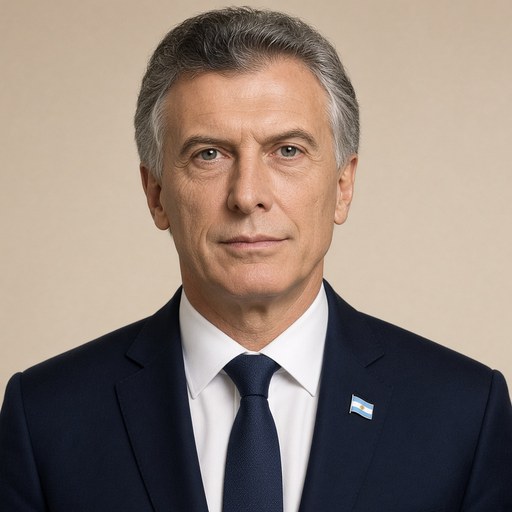
President Mauricio Macri presented the National Plan to Combat Human Trafficking.
 Mauricio Macri · President of Argentina
- Context
- Macri addressed an audience in Argentina on July 31, 2018, to launch the National Biannual Plan to Combat Human Trafficking and Exploitation of Persons.
- Main themes
- Human trafficking, national anti-trafficking plan, victim protection and assistance, sexual exploitation, forced labor, state accountability, civil society collaboration, eradication of modern slavery, rule of law, social justice, dignity and freedom
- Duration
- ~6 min
- Words
- 752
- Sentences
- 19
- Readability
- 44
- Grade
- 17.0
- Syntax
- 3.18
- Vocabulary
- 1.91
Translated from Spanish
The broad sphere of national life a sentence belongs to. Every sentence has an Arena, so it is the denominator the other indices are read against.
Other19 sentences in 6 paragraphs
Good morning everyone, and thank you very much for joining us today.
Yesterday, as you all know, was the World Day Against Human Trafficking, and it is a source of pride to share with you today the National Biannual Plan for the Fight Against Trafficking and Exploitation of Persons and for the Protection and Assistance of Victims. Not only because it is the first time in our history that a plan has been presented to combat these crimes, but also because it addresses a historical debt that the State has with the Argentine people, especially with the victims. Ten years ago, a law was enacted to prevent and punish trafficking and to assist those who fall victim to it, and it was modified six years ago. At that same time, the Federal Council for the Fight Against Trafficking and Exploitation of Persons was created, but it was only this Government that convened it for the first time in 2016. Until that moment, the Argentine State had been failing to fulfill its obligation to take action to protect the rights of all, and we know that the consequences of trafficking and exploitation are even greater when there is a State that, instead of acting, looks the other way, leaving victims and their families alone in this tremendously painful struggle.
As I have always said: to govern is to care, it is to be at the service of the Argentine people, it is to be close, and to listen to their needs in order to provide them with a concrete response. A year ago in Villa María, Córdoba, I met with a group of victims and with the women who work to help them, they told me their stories, what they experienced until they reached this foundation, which for them was more than a foundation; it was a refuge, and I told them that there is a Government here willing to support them. Today I remember our meeting and feel the peace of fulfilling my word, because they are not alone in this fight. When we talk about trafficking, we are not only talking about sexual exploitation but also about the crimes of servitude, child pornography, forced labor, forced marriage, and forced organ extraction. All of these are unacceptable crimes, and our commitment, which is now a State policy, is to eradicate all forms of slavery, because our commitment is to freedom. The future we are building together is only possible if every Argentine lives with dignity, if they are able to lead a full life, choosing what to dedicate themselves to, and where and how to live.
That is why we are working to ensure that the State acts clearly, that it can respond to these crimes, that it can prevent them and put an end to them, and that it can protect and assist the victims, helping them to move forward despite the difficulties and the terrible injustice to which they have been subjected; that is what this plan is about, saying enough to injustice, enough to the practice of taking advantage of the most vulnerable. This plan is about putting an end to what harms us so much as a society, and we are doing it together, because this is the result of teamwork, of a path of dialogue between national and international agencies, and it included the invaluable experience and knowledge of civil society. So I want to especially thank everyone who was part of this exchange and ask for a round of applause for all of you.
As I said on March 1st in Congress, we Argentines want to live in peace, we want to go out into the streets without fear and for our children to live in tranquility. For that, it was necessary to make a change, a change that was born from the heart of the Argentines and that we are building together, doing what has never been done, to achieve what has never been achieved in our country; we are doing it to be able to look to the future with the hope of a more just Argentina, a more just Argentina means one that bets on truth, justice, and peace. That is how a society grows, and we Argentines are growing, we are on the right path making the right effort, which is why we have a huge, huge future ahead of us.
Thank you very much to all of you for this work, and let us continue more committed than ever, thank you.
The original Spanish. The tags above are read on the English translation's sentences.
Muy buenos días a todos y muchas gracias por acompañarnos hoy.
Ayer, como todos ustedes saben, fue el día mundial contra la trata de personas y es un orgullo compartir con ustedes hoy el Plan Nacional Bianual para la Lucha contra la Trata y Explotación de Personas y para la Protección y Asistencia a las Víctimas. No solo porque es la primera vez en nuestra historia que se presenta un plan para luchar contra estos delitos, sino porque viene a saldar una deuda histórica que el Estado tiene con los argentinos, en especial con las víctimas. Hace diez años que existe una Ley para prevenir y sancionar la trata, y para asistir a las personas que caen en ella, y seis años atrás se modificó. En ese mismo momento, se creó el Consejo Federal para la Lucha de Trata y Explotación de Personas, pero recién fue este Gobierno el que lo convocó por primera vez en el año 2016. Hasta ese momento el Estado argentino venía incumpliendo la obligación de ponerse en acción, para proteger los derechos de todos, y sabemos que las consecuencias de trata y de la explotación son todavía mayores cuando hay un Estado que en lugar de actuar, mira para el otro lado, deja a las víctimas y a sus familias solas en esta lucha tremendamente dolorosa.
Como siempre dije: gobernar es cuidar, es estar al servicio de los argentinos, es estar cerca, y escuchar sus necesidades para llevarles una respuesta concreta. Hace un año en Villa María, Córdoba, me reuní con un grupo de víctimas y con las mujeres que trabajan para sacarlas adelante, me contaron sus historias, lo que vivieron hasta llegar a esta fundación, más que una fundación era para ellas un refugio, y les dije que acá hay un Gobierno dispuesto a acompañarlas. Hoy me acuerdo de nuestro encuentro y siento la tranquilidad de estar cumpliendo con mi palabra, porque no están solas en esta lucha. Cuando hablamos de trata, no hablamos solamente de explotación sexual sino también sobre los delitos de servidumbre, pornografía infantil, trabajo matrimonio forzoso y extracción forzada de órganos. Son todos delitos inaceptables y nuestro compromiso, que hoy ya es una política de Estado, es erradicar todo tipo de esclavitud, porque nuestro compromiso es con la libertad. Justamente el futuro que estamos construyendo juntos, solo es posible si cada argentino vive con dignidad, si es capaz de llevar una vida plena de elegir a qué dedicarse, y dónde, y cómo vivir.
Por eso estamos trabajando para que el Estado actúe, claramente, pueda actuar ante estos delitos, para que pueda prevenirlos y terminar con ellos, y para que pueda proteger y asistir a las víctimas, ayudándolas a seguir adelante a pesar de las dificultades y la terrible injusticia a la que fueron sometidas; de eso se trata este plan, de decirle basta a la injusticia, basta de esa práctica de sacar proyecto de los más vulnerables. Este plan se trata de poner punto final a eso que nos hace tanto daño como sociedad, y lo estamos haciendo juntos, porque este es el resultado de un trabajo en equipo, de un camino de diálogo entre organismos nacionales e internacionales, y que incluyó la valiosísima experiencia y conocimiento de la sociedad civil. Así que quiero agradecer muy especialmente a todos los que formaron parte de este intercambio y pido un aplauso para todos ustedes. (APLAUSOS)
Como dije el 1° de marzo en el Congreso, los argentinos queremos vivir en paz, queremos salir a la calle sin miedos y que nuestros hijos vivan tranquilos. Para eso era necesario hacer un cambio, un cambio que nació del corazón de los argentinos y que lo estamos construyendo juntos, haciendo lo que nunca se hizo, para lograr lo que nunca se logró en nuestro país, lo estamos haciendo para poder mirar al futuro con la esperanza de una argentina más justa, más justa significa que apuesta a la verdad, a la Justicia y la paz. Así crece una sociedad y los argentinos estamos creciendo, estamos en el camino correcto haciendo el esfuerzo correcto, por eso tenemos un enorme, enorme futuro por delante.
Muchas gracias a todos ustedes por este trabajo y a seguir más comprometidos que nunca, gracias.