




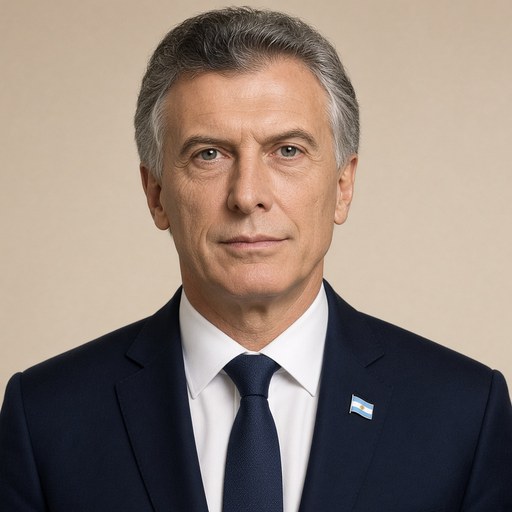
President Mauricio Macri toured the new railway workshop of the Roca line in Tolosa, Buenos Aires Province.
 Mauricio Macri · President of Argentina
- Context
- Macri addressed residents at the reopening of the Roca line railway workshop in Tolosa, Buenos Aires Province, on May 8, 2019, celebrating modernized train safety.
- Main themes
- Railway infrastructure investment, public transportation safety, automatic braking systems, Roca line renovation, state accountability, decades of neglect, Buenos Aires metropolitan transit, passenger growth, long-term planning, transparency and anti-corruption, foundational public works
- Duration
- ~12 min
- Words
- 1,498
- Sentences
- 47
- Readability
- 53
- Grade
- 13.8
- Syntax
- 3.50
- Vocabulary
- 1.83
Translated from Spanish
The broad sphere of national life a sentence belongs to. Every sentence has an Arena, so it is the denominator the other indices are read against.
Other47 sentences in 11 paragraphs
Good morning, good morning, dear people of Buenos Aires, dear people of La Plata, as you said, dear people of Tolosa, dear Argentinians. The truth is that it is moving, it makes us happy, it surprises us to see how these facilities are being restored.
And this happens to us because it is logical, there is a logic behind this emotion and this joy, the logic of seeing that, after so many years in which we have been promised so many things and nothing happened, we had begun to resign ourselves. We had begun to believe, for example, that in the province of Buenos Aires, this is how we traveled, that there was no other way to travel on a train without automatic brakes, without the necessary safety measures. And when today we have the opportunity to see that this workshop is reopening after having been closed in 2001, that starting in June, here, all these trains that run on the Roca lines, which are already electrified, will come, and that maintenance and care will be given to these trains that now have automatic brakes, one begins to feel that we could, that everything we had been told was a lie, that it was absolutely not impossible to have a good quality train, safe, on time. And that the State, a State that truly works, could provide it, could make it happen.
The truth is that when one looks and sees that for 40 years, 40 years, there has been no investment in safety for passenger trains in the metropolitan area, 40 years is roughly the age of this young governor, I won’t say the exact age because they say it’s not gentlemanly to mention age. But she would be, let’s say, in kindergarten, so imagine how small she was the last time there was an investment thinking about the people. Forty years. We, in three and a half years, have put the Roca railway in full operation, electrified, with automatic brakes. And in a few months, we hope that all the trains in the metropolitan area will have the same safety mechanisms.
So, one starts to think, what happened? Why, during these 40 years, did all those who preceded us in the exercise of power not take care of this, not do it? Did they not know? Did they not want to? Is it because it was not visible? Of course, one says: “automatic brakes, who sees them?” One gets on a train and does not know what they are getting on or how they are getting on. And, unfortunately, as the Governor said, following a tragedy, the worst of several we have had in the history of our railways, they rushed to buy a lot of things without having a clear idea of how, for what, how to make them work, how to repair them, how to maintain them. And it was not like that; things need to be planned, they need to be studied, as we are doing now that we have projects that end in four years, others in eight, others in twelve years, because only on the Roca line do 700,000 people travel per day. But since we have been in government, with the improvements we have already made on all lines, the number of passengers has increased by more than 55 percent. In other words, we went from less than 1,000,000 passengers per day to more than 1,500,000, and if we continue to do things right, there will be 3,000,000 Argentinians who feel safe every day to leave their homes and take a train to go to work, to study, to go to a hospital, whatever it may be.
That is why, when we tell you that we are building the foundations, we are talking about this, about those bases, because we want much more than this, we want a country that grows, we want a country full of opportunities for all Argentinians. But if Argentinians cannot move, cannot transport themselves from one place to another, safely, on time, reliably, they will not be able to study, they will not be able to work. That is why it was important to start with this, to start with these foundational things like the transportation of people, like energy, which we did not have. That is why what we have done is much deeper than going from a handbrake to an automatic brake; it is deeper because it is going from neglect to action, it is going from abandonment to doing something every day to build a new reality, it is going from corruption to transparency, because this requires a lot of honest, intelligent people working, studying, carrying it out, and taking care of the resources of all Argentinians, because there is not enough for everything, we do not have excess. It costs us; everything costs us. So, we have to be sure that everything we buy is useful, that everything we put in place will work, and that it will work for many years, not just for a little while. Not to have a nice event and cut a ribbon, as María Eugenia said.
That is why I am very proud; the truth is that I am very proud of what we have done, that we have really started to change this story, definitively. And I want to congratulate Guillermo Dietrich, our Minister of Transport, and all his team: there is Manuela López Menéndez, who is carrying out the works; Marcelo Orfila, who leads all the operations; Guillermo Fiad, who we will also talk about at another time, just like Ezequiel Lemos regarding all that is freight trains; Ballester is also here; Juan Pablo Chaín is here. A very large, very dynamic, very vigorous, very committed team in all this, which is clearly the revolution of the trains.
Since we have been in government, we have launched the revolution of airplanes, the revolution of highways and roads, the revolution of telecommunications to connect from our schools to the roads, to connect the country, because today, as important as physical connectivity is, virtual connectivity is also important. And we have also launched a revolution in our trains, the freight trains to allow the work of Argentinians to reach other places in Argentina and other places in the world, which we will talk about another day, and I will tell you all the things we are doing that are already fundamentally changing the employment possibilities, especially in northern Argentina.
But today, here, what we are witnessing is the revolution of transportation in the metropolitan area. Being already at 1,500,000 passengers and aspiring to 3,000,000 passengers, with safety, with peace of mind, knowing that they have an application on their cell phones that tells them what time their train will arrive, and the train is there, waiting to take them to that place where they are essential, where it is important, because this is the wonderful thing. That there is a task waiting for all of us, there is a task waiting for everyone. Today we see workers who will start working in this workshop starting in June; here we have a woman who will operate the lathe, who has a family that loves everything mechanical and metal, and she is training to operate a state-of-the-art lathe. And this is what we are generating, jobs thinking about more Argentinians who will create more jobs. And with that work, our country will grow, without shortcuts, without lies, without magic solutions, working shoulder to shoulder.
And, as María Luján said when we talked, they have been very much behind all this because they have suffered firsthand what has been the poor exercise of power, the misuse of public resources, because had they done all this before, none of them would have gone through the tragedy and loss that they experienced. And with her, we talked and with all of them that these things take time, but the important thing is to start them and continue them, because along the way we are already different. When we start doing this type of thing, we already transform into someone better, because we are doing something good for everyone, we are not trying to take advantage, we are not trying to paint a couple of things to justify our existence, but doing something foundational, substantive, real, root-level, that will allow every Argentinian to have their place and their opportunity.
So, again, I want to say to everyone, thank you very much. Thank you, Mayor, for receiving us. Thank you, María Eugenia, for always being together in this task, because really seeing that this workshop will have more than 350 people working every day, giving dynamism to the area, and bringing joy to the life of each of them because they will do something very important for all Argentinians: take care of our trains and ensure the safety of all those who travel on the trains.
Congratulations and let’s keep working together.
The original Spanish. The tags above are read on the English translation's sentences.
Buenos días, buenos días, queridos bonaerenses, queridos platenses, como dijiste, tolosanos, queridos argentinos. La verdad es que emociona, nos alegra, nos sorprende ver cómo estas instalaciones se están recuperando.
Y nos pasa esto porque es lógico, tiene una lógica detrás de esta emoción y esta alegría, la lógica de ver que, después de tantos años en que se nos han prometido tantas cosas y que nada pasaba, habíamos empezado a resignarnos. Habíamos empezado a creer, por ejemplo, que en la provincia de Buenos Aires se viajaba así, que no había otra manera que viajar en un tren sin frenos automáticos, sin las seguridades del caso. Y cuando hoy tenemos la oportunidad de ver que este taller se reabre después de haber sido cerrado en el 2001, que a partir de junio, acá, van a venir todos estos trenes que circulan por las líneas del Roca, que ya están electrificadas, y que se les va a hacer el mantenimiento, el cuidado, a estos trenes que ahora tienen freno automático, uno empieza a sentir que podíamos, que era mentira todo lo que nos habían dicho, que en absoluto era un imposible tener un buen tren de calidad, seguro, en hora. Y que el Estado, un Estado que funciona de verdad, lo podía suministrar, lo podía hacer.
La verdad es que cuando uno mira y ve que hace 40 años, 40 años, que no se invertía en seguridad en los trenes de pasajeros del área metropolitana, 40 años es más o menos la edad de esta joven gobernadora, no voy a decir la edad exacta porque dicen que no es de caballero decir la edad. Pero estaría, calcúlenle, en el jardín de infantes, así que imagínense lo chiquitita que era cuando fue la última vez que se invirtió pensando en la gente. Cuarenta años. Nosotros en tres años y medio pusimos el ferrocarril Roca en plenitud, electrificado, con frenos automáticos. Y para dentro de unos pocos meses, esperamos que todos los trenes del área metropolitana tengan los mismos mecanismos de seguridad.
Entonces, uno se pone a pensar, ¿qué paso? ¿Por qué, durante estos 40 años, todos aquellos que nos precedieron en el ejercicio del poder no se ocuparon, no lo hicieron? ¿No supieron? ¿No quisieron? ¿Es porque no se veía? Claro, uno dice: “frenos automáticos, ¿quién los ve?” Uno sube a un ferrocarril y no sabe a qué está subiendo ni cómo está subiendo. Y, lamentablemente, como dijo la Gobernadora, a partir de una tragedia, la peor de varias que hemos tenido en la historia con nuestros ferrocarriles, se lanzaron a comprar un montón de cosas sin tener una idea clara de cómo, para qué, cómo hacerlas funcionar, cómo repararlas, cómo mantenerlas. Y no era así, las cosas hay que planificarlas, hay que estudiarlas, como estamos haciendo ahora que tenemos proyectos que terminan en cuatro años, tenemos otros a ocho, otros a doce años, porque solamente en el Roca viajan 700.000 personas por día. Pero, desde que estamos en el Gobierno, con las mejoras que ya hemos hecho en todas las líneas, aumentó más del 55 por ciento la cantidad de pasajeros. O sea, pasamos de menos de 1.000.000 de pasajeros por día a más de 1.500.000 y, si seguimos haciendo las cosas bien, van a ser 3.000.000 de argentinos los que se sientan todos los días seguros de salir de su casa y tomar un tren para ir a trabajar, para ir a estudiar, para ir a un hospital, lo que sea.
Por eso, cuando les decimos que estamos construyendo los cimientos, hablamos de esto, de esas bases, porque nosotros queremos mucho más que esto, queremos un país que crece, queremos un país lleno de oportunidades para todos los argentinos. Pero, si los argentinos no se pueden trasladar, no pueden transportarse de un lugar al otro, seguros, en tiempo, en hora, en forma confiable, no van a poder estudiar, no van a poder trabajar. Por eso, era importante empezar por esto, empezar por estas cosas de base como es el transporte de la gente, como es la energía, que no teníamos. Por eso, esto que hemos hecho es mucho más profundo que pasar de un freno de mano a un freno automático, es más profundo porque es pasar de la desidia a la acción, es pasar del abandono al hacer todos los días para construir una nueva realidad, es pasar de la corrupción a la transparencia, porque esto requiere de mucha gente honesta, inteligente, trabajando, estudiando y llevándolo a cabo y cuidando el mango de todos los argentinos, porque no sobra para todo, no tenemos de más. Nos cuesta, cada cosa nos cuesta. Entonces, tenemos que estar seguros de que cada cosa que compramos sirve, que cada cosa que ponemos va a funcionar, y que va a funcionar por muchos años, no por un ratito. No para tener un acto lindo y para cortar una cinta, como decía María Eugenia.
Por eso, estoy muy orgulloso, la verdad es que estoy muy orgulloso de lo que hemos hecho, de que hemos empezado realmente a cambiar esta historia, definitivamente. Y quiero felicitarlo a Guillermo Dietrich, nuestro ministro de Transporte, y a todo su equipo: ahí está Manuela López Menéndez, que lleva a cabo las obras; Marcelo Orfila, que conduce todo el funcionamiento de esto; Guillermo Fiad, que también vamos a hablar en otro momento, igual que con Ezequiel Lemos de todo lo que es el tren de cargas; también está Ballester; está Juan Pablo Chaín. Todo un equipo muy grande, muy dinámico, muy pujante, muy comprometido en todo esto que es claramente la revolución de los trenes.
Hemos lanzado, desde que estamos en el Gobierno, la revolución de los aviones, la revolución de las autopistas y las rutas, la revolución de las telecomunicaciones para conectar desde nuestras escuelas hasta las rutas, a conectar el país, porque tan importante hoy, como la conectividad física, es la conectividad virtual. Y también hemos lanzado una revolución en nuestros trenes, los trenes de carga para permitir que el trabajo de argentinos llegue a otros lugares de la Argentina y a otros lugares del mundo, que otro día vamos a hablar y les voy a contar todas las cosas que estamos haciendo y que ya están cambiando de raíz las posibilidades de empleo, especialmente en el norte argentino.
Pero, hoy, acá, lo que estamos comprobando es la revolución del transporte del área metropolitana. Estar ya en 1.500.000 de pasajeros y aspirar a 3.000.000 de pasajeros, con seguridad, con tranquilidad, sabiendo que tienen una aplicación en el celular que les dice a qué hora va a llegar su tren, y el tren está ahí, lo está esperando para llevarlo a ese lugar donde él es fundamental, donde es importante, porque esto es lo maravilloso. Que en todos hay una tarea que nos espera, para todos hay una tarea que nos espera. Hoy vemos trabajadores que van a empezar a trabajar en este taller a partir de junio, acá tenemos una mujer que va a manejan el torno, que tiene una familia que le gusta todo lo mecánico y los fierros, y ella se está capacitando para manejar un torno de última generación. Y esto es lo que estamos generando, trabajo pensando en más argentinos que van a generar más trabajo. Y con ese trabajo es que va a crecer nuestro país, sin atajos, sin mentiras, sin soluciones mágicas, trabajando hombro a hombro.
Y, como decía María Luján cuando hablábamos, que ellos han estado muy detrás de todo esto porque han sufrido en carne propia lo que ha sido el mal ejercicio del poder, el mal uso de los recursos públicos, porque, habiendo hecho todo esto antes, ninguno de ellos hubiese pasado por la tragedia y por la pérdida que pasaron. Y con ella hablábamos y con todos ellos de que estas cosas llevan tiempo, pero lo importante es empezarlas y continuarlas, porque en el camino ya somos distintos. Cuando empezamos a hacer este tipo de cosas ya nos transformamos en alguien mejor, porque estamos haciendo algo bueno para todos, no estamos queriendo sacar ventajas, no estamos queriendo pintar un par de cosas para justificar nuestra existencia, sino haciendo algo de base, de fondo, de verdad, de raíz, que le va a permitir a cada argentino tener su lugar y su oportunidad.
Así que, de vuelta, decirles a todos, que muchas gracias. Gracias, Intendente, por recibirnos. Gracias, María Eugenia, por siempre estar juntos en esta tarea, porque realmente ver que este taller va a tener más de 350 personas trabajando todos los días, dándole dinámica a la zona, y dándole alegría a la vida de cada uno de ellos porque van a hacer algo muy importante para todos los argentinos: cuidar nuestros trenes y cuidar la seguridad de todos aquellos que viajan en los trenes.
Felicitaciones y a seguir trabajando juntos.