




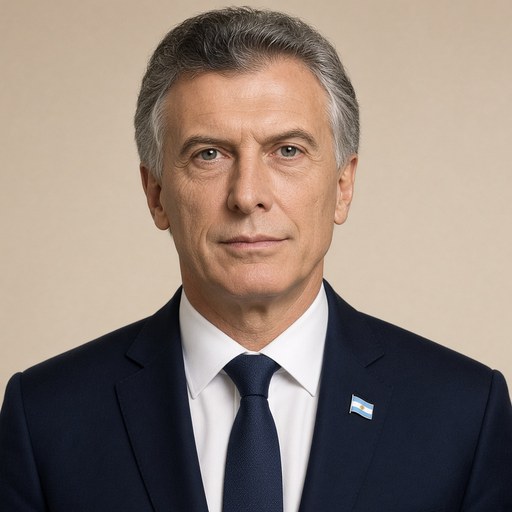
Words of President Mauricio Macri, at the Investment Forum, organized by the World Bank and the Meeting of the Task Force Women Leaders in Business, from the CCK.
 Mauricio Macri · President of Argentina
- Context
- Macri addressed the World Bank Investment Forum and Women Leaders in Business Task Force at the CCK in Buenos Aires on the sidelines of the G20 summit on November 30, 2018.
- Main themes
- Women's financial inclusion, gender gap in labor market, women's empowerment, infrastructure for development, Argentina's economic transformation, G20 presidency, World Bank investment forum, equal opportunities legislation, digital inclusion, macroeconomic stabilization, international support for Argentina
- Duration
- ~13 min
- Words
- 1,558
- Sentences
- 32
- Readability
- 28
- Grade
- 20.6
- Syntax
- 3.87
- Vocabulary
- 2.06
Translated from Spanish
The broad sphere of national life a sentence belongs to. Every sentence has an Arena, so it is the denominator the other indices are read against.
Other32 sentences in 10 paragraphs
Good afternoon, I want to thank the President of the World Bank, Jim Yong Kim, who I see is well accompanied, next to the Governor of Buenos Aires, a great Governor, and especially thank Her Majesty Queen Máxima of the Netherlands, who is very dear to all Argentinians, and above all, thank her for the visibility she has given to such an important issue, as a central theme for the empowerment of women, which is the financial inclusion of women.
The world, not just the region, is really missing out by not generating these very important tools. And I want to tell the Queen that – in these three years – we have made significant progress in Argentina, being aware that we still have much ahead of us, but we have truly managed to pass a Law on Equal Opportunities, which really aims to work on reducing the wage gap that exists between men and women; the issue of licenses has improved, and most importantly, for the first time in our history – Your Majesty – we have been fortunate to include in the Budget, that which everyone knows has had to be significantly reduced, right, Minister? resources for the empowerment of women, in all fields related to training, digital inclusion, and clearly everything that pertains to how to access the tools. And the truth is that achieving this will mean a lot for the region, because if we could close that gender gap that exists in the labor market, the region's Gross Product could grow by 14 percent. And we are talking about something that would give enormous power to the region and truly improve the opportunities for progress for all.
But I also want to mention a couple of numbers – that the World Bank has provided us – which say that 48.69 percent, globally, is the participation of women in the economy and 75.20 percent for men. But the bad news is that, since 2008, this gap has not closed, meaning we have stagnated, and we were making good progress, and there is something that is not working, which is why we have not managed to continue reducing this gap. So, we need to put all available intelligence into this, and that is why, as President of this G20, we have included the agenda transversally, gender equality in all fields so that we can understand how we can accelerate this reduction of the gap again. And we must also clearly understand that this is not just a public issue; this is a matter for both the public and private sectors, which we must tackle.
But well, just as we have advanced in that, I want to tell you what we have done in Argentina in these three years, which we feel we have approached things as we perhaps have not done in our history, and what we decided – above all – was to put the truth upfront and the problems on the table and seek what the solutions are instead of continuing to blame the rest of the world for the things that were happening to us. And we undertook profound, structural transformations that correct bad policies from the last 15 years, if not decades. And the truth is that we feel we have laid solid foundations upon which we will be able to grow for many years, thus generating greater well-being for all Argentinians.
And one of the points I want to highlight is the enormous level of support we have had from the international community; it has truly been impressive, and I will thank each of the presidents as we meet, as I have already done with the President of France and shortly I will do with Justin Trudeau, with whom I will have dinner tonight. It has truly been unanimous support for this transformation agenda, for this return of Argentina, and we believe that the gathering of so many leaders, as never before, in our country, at the same time and in the same place, is a recognition of the role that Argentina is playing on the global stage.
And from this vocation to grow, to develop, to generate employment – clearly as the World Bank has focused on this meeting – infrastructure for development is key; without infrastructure, there is no equity, there is no progress, there is no job creation. And today when we talk about infrastructure, we talk about both physical and virtual infrastructure, because today both are equally important; without access to broadband and quality Internet; without access to mobile communications in any corner of any country, it is as serious as not having a road, not having a port, not having an airport. And that is why, from the first day of our Government, in addition to taking structural measures to stabilize the macroeconomy and provide transparency to institutions, to information, to access to information, to the veracity of information, which are key to being predictable and reliable, we have launched the most important infrastructure plan in our history, which, fortunately, already has significant progress, despite the financial restrictions we have. And we have advanced in the construction of highways, roads, ports, airports; here is the Minister of Transport who leads part of this successful infrastructure plan, and we believe that we have clearly added a credible and reliable regulatory framework so that competition, starting from telecommunications, generates the arrival of 4G to all corners of the country, preparing for 5G, which will be very important for the Internet of Things, and also providing – as I mentioned earlier – access to quality Internet.
All of this is also complemented by what we have achieved in terms of recovering the path in energy production. Argentina has always been a country capable of producing its energy, at least in recent decades, and unfortunately, due to bad policies in the previous government, we became net energy importers again, but today, among renewable energies, to which we have given a strong boost while also fulfilling our commitment to the "Green Agenda," with the commitments we made at the Paris Summit, we have added the development of Vaca Muerta, which everyone knows is the second most important reserve in the world for shale gas and also very important for oil. So, I believe that through the development of Vaca Muerta, we will not only generate more than half a million jobs, which is always the government's obsession, but we will also have access to energy at competitive prices for the development of our country, and we aspire, in five years… I might have greeted Miguel Gutiérrez, who is one of the protagonists with YPF, in five years to be a major exporter of oil to the world and also of gas. And in this way, strengthen the foundations of our economy, but in terms of financing infrastructure, we believe that we need to achieve sustainable financing for the development of infrastructures. This is a challenge and it is also on the agenda of this G20, and I hope we can find mechanisms that bring that financing closer.
Always – as we discussed with the gender agenda – the interaction between the public and private sectors is fundamental, and we believe there is a tool that enhances that participation, which is PPP, public-private partnerships, and from that instrument, we launched with Minister Dietrich, a few months ago, the first tenders to build highways, which has been a success; we have had many offers. We have awarded contracts and they are beginning, despite all the financial problems we have had in recent months, and we will continue to bet on that tool because we believe it not only gives dynamism but also transparency to the way of building infrastructure, which is also another chapter in which we have placed much emphasis as a government: to have truly clear, transparent rules of the game, so that there is healthy competition and that we can really eradicate corruption from our system because, above all, and beyond the moral problems that corruption poses, it generates a huge level of inefficiency, and inefficiency is the greatest partner one can have with poverty. And we are here to truly reduce poverty in this country and provide opportunities for progress to Argentinians.
So, having made these comments, I want to say that we have had to govern in difficult times, with a tumultuous, controversial global scenario, which we will address tomorrow in the G20 agenda; there are tensions between countries due to different visions of how to individually tackle opportunities and challenges, but I believe now more than ever that the way to push the limits of what is possible is to dialogue, dialogue, and dialogue. There is no other way, so I hope tomorrow to face this responsibility we have assumed as the presidency of the G20, with the hope of making a contribution in terms of international cooperation, multilateralism, and global governance. And the presence of all of you truly helps us a lot to believe in the future of our country, to continue betting that what we are doing will really bring prosperity to all Argentinians.
Thank you very much, truly, to everyone for joining us, and I regret, I insist, the logistical problems we had at the CCK. Thank you very much to all.
The original Spanish. The tags above are read on the English translation's sentences.
Buenas tardes, quiero agradecerle al presidente del Banco Mundial Jim Yong Kim, a quien veo bien acompañado, al lado de la Gobernadora, de Buenos Aires, una gran Gobernadora y especialmente agradecerle la presencia a la Reina Máxima, de los Paìses Bajos, muy querida por todos los argentinos, y sobre todo agradecerle la visibilidad que la ha dado a un tema tan importante, como un tema central para el empoderamiento de las mujeres, que es la inclusión financiera de las mujeres.
Realmente el mundo, no sólo la región se está perdiendo mucho por no generar estas herramientas tan importantes. Y quiero decirle a la Reina, que – en estos tres años – hemos avanzado mucho, en la Argentina, teniendo conciencia que todavía tenemos mucho por delante, pero realmente hemos logrado sacar una Ley de Igualdad de Oportunidades, que realmente tienden a trabajar en la reducción de la brecha salarial, que existe entre los hombres y las mujeres; ha mejorado el tema de las licencias y lo más importante es que, por primera vez, en nuestra historia – Reina – hemos tenido la suerte de poder incluir en el Presupuesto, ese que todos saben ha tenido que acotarse mucho, ¿no es cierto, ministro? recursos para el empoderamiento de las mujeres, en todos los campos, que tienen que ver con la capacitación, la inclusión digital y claramente todo lo que hace a cómo llegar a las herramientas. Y la verdad que lograrlo va a significar muchísimo para la región, porque si lográsemos cerrar esa brecha de género, que existe en el mercado laboral podría crecer el Producto Bruto de la región, en un 14 por ciento. Y estamos hablando de algo que le daría una enorme potencia a la región y le mejoraría realmente las oportunidades de progreso para todos.
Pero también quiero mencionar un par de números – que el Banco Mundial nos ha suministrado – que dice que el 48,69 por ciento, a nivel global, es la participación de las mujeres en la economía y el 75,20 la de los hombres. Pero lo malo de todo esto es que, desde el 2008, esta brecha no se cierra, o sea hasta ahí quedamos y veníamos progresando bien y hay algo que no está funcionando, por lo cual no logramos que esta brecha se siga reduciendo. Entonces, tenemos que poner toda la inteligencia disponible, y por eso como presidente de este G20, hemos incluido la agenda en forma transversal, la igualdad de género en todos los campos para que entendamos de qué manera podemos volver a acelerar esta reducción de la brecha. Y también claramente entender que esto no es sólo un tema público, esto es un tema del sector público y del sector privado, que lo tenemos que encarar.
Pero bueno así como avanzamos en eso, yo quiero contarles qué hemos hecho, en la Argentina, en estos tres años, que sentimos que hemos encarado las cosas como no lo habíamos hecho, tal vez, en nuestra historia y lo que decidimos – ante todo – fue poner la verdad por delante y los problemas sobre la mesa y buscar cuáles son las soluciones en vez de seguir echándole la culpa al resto del mundo por las cosas que nos pasaban. Y encaramos transformaciones profundas, estructurales, que corrigen malas políticas, de los últimos 15 años, sino tal vez de décadas. Y la verdad que sentimos que hemos echado bases sólidas sobre las cuales vamos a poder crecer, durante muchos años, y así generar un mayor bienestar a todos los argentinos.
Y uno de los puntos, que quiere destacar es el enorme nivel de apoyo, que hemos tenido de la comunidad internacional, realmente ha sido impresionante y yo se los voy a agradecer a cada uno de los presidentes, en la medida en que nos vayamos encontrando, como lo hice ya con el Presidente de Francia y dentro de un rato lo haré con Justin Trudeau, con el cual comeremos, esta noche. Realmente ha sido un apoyo unánime a esta agenda de transformación, a esta vuelta de la Argentina y creemos que también claramente tomamos, que se reúnan tantos líderes, como nunca antes, en nuestro país, en el mismo momento y en el mismo lugar tienen que ver con un reconocimiento de este rol, que está cumpliendo la Argentina en el escenario global.
Y de esta vocación de crecer, de desarrollarnos, de generar empleo - claramente como ha puesto en el foco el Banco Mundial, a esta reunión - la infraestructura para el desarrollo es algo clave; sin infraestructura no hay equidad, no hay progreso, no hay generación de empleo. Y hoy cuando hablamos de infraestructura hablamos de infraestructura física y virtual, porque claramente hoy son las dos igual de importantes, sin acceso a banda ancha e Internet de buena calidad; sin acceso a comunicaciones de celulares, en cualquier rincón de cualquier país es tan grave como no tener un camino, como no tener un puerto, como no tener un aeropuerto. Y por eso, nosotros desde el primer día de nuestro Gobierno, además de tomar las medidas estructurales para sanear la macroeconomía y darle transparencia a las instituciones, a la información, al acceso a la información, a la veracidad de la información, que son claves para ser predecibles y confiables hemos lanzado el plan de infraestructura más importante de nuestra historia y que, por suerte, ya tiene grandes avances, a pesar de las restricciones financieras que tenemos. Y hemos avanzado en la construcción de autopistas, de rutas, de puertos, de aeropuertos; acá está el ministro de Transporte que es el que lidera una parte de todo ese plan de infraestructura exitosamente y creemos que claramente a eso hemos agregado un marco regulatorio creíble y confiable para que la competencia, a partir de las telecomunicaciones, genere la llegada del 4G a todos los rincones del país, preparándonos para el 5G, que va a ser importantísimo para la Internet de las cosas, y también llevar – como decía antes – acceso a Internet de calidad.
A todo esto también se le suma lo que hemos logrado en términos de recuperar la senda, en la producción de energía. La Argentina siempre ha sido un país con capacidad de producir su energía, al menos en las últimas décadas y, lamentablemente, por malas políticas en el gobierno anterior volvimos a ser importadores netos de energía, pero hoy entre las energías renovables, a las que le hemos dado un fuerte impulso también cumpliendo con nuestro compromiso con la “Agenda Verde”, con los compromisos que asumimos, en la Cumbre de París, le hemos sumado el desarrollo de Vaca Muerta, que todos saben es la segunda reserva más importante del mundo en shale gas y muy importante también en oil. Entonces, creo que por el camino del desarrollo de Vaca muerta no sólo vamos a generar más de medio millón de puesto de trabajo, que es siempre la obsesión del gobierno, sino que además vamos a tener acceso a energía a precios competitivos para el desarrollo de nuestro país y aspiramos, en cinco años… por ahí lo saludé a Miguel Gutiérrez, que es uno de los protagonistas con YPF, en cinco años ser un gran exportador de petróleo al mundo y también de gas. Y también de esa manera fortalecer las bases de nuestra economía, pero en términos de financiar la infraestructura, creemos que hay que lograr financiamientos sustentable para el desarrollo de las infraestructuras. Esto es un desafío y también está en la agenda de este G20 y espero que logremos encontrar mecanismos que acerquen ese financiamiento.
Siempre – como lo hablábamos con la agenda de género – la interacción entre el sector público y el privado son fundamentales y nosotros creemos que hay una herramienta, que potencia esa participación, que son las PPP, las participaciones públicas-privadas y de ese instrumento, hemos lanzado con el ministro Dietrich, hace unos meses las primeras licitaciones para construir autopistas, que ha sido un éxito, hemos tenido muchas ofertas. Hemos adjudicado y están comenzando, a pesar de todos los problemas financieros, que hemos tenido en los últimos meses y vamos a seguir apostando a esa herramienta, porque creemos que no sólo le da dinámica, sino también transparencia a la forma de construir infraestructura, que también es otro de los capítulos en los cuales hemos puesto mucho énfasis como gobierno: el tener realmente reglas del juego claras, transparente, para que haya una competencia sana y que realmente desterremos la corrupción de nuestro sistema porque, ante todo y más allá de los problemas morales, que plantea la corrupción genera una enorme nivel de ineficiencia, y la ineficiencia es la mayor socia que uno puede tener con la pobreza. Y acá estamos para realmente reducir la pobreza, en este país y darles oportunidades de progreso a los argentinos.
Entonces, habiendo hecho estos comentarios, quiero decirles que nos ha tocado gobernar en tiempos difíciles, con un escenario global movido, controvertido, que mañana vamos a abordar en la agenda del G20, hay tensiones entre los países por distintas visiones de cómo encarar individualmente las oportunidades y los desafío, pero creo hoy más que nunca que el camino para correr los límites de lo posible es dialogar, dialogar y dialogar. No hay otra manera, así que espero, mañana, encarar esta responsabilidad que hemos asumido de la presidencia del G20, con la esperanza de hacer un aporte, en términos de la cooperación internacional, el multilateralismo y la gobernanza global. Y la presencia de todos ustedes realmente nos ayuda y mucho a creer en el futuro de nuestro país, a seguir apostando que lo que estamos haciendo le va a traer realmente prosperidad a todos los argentinos.
Muchas gracias, de verdad, a todos por acompañarnos y lamento, insisto, los problemas que tuvimos logísticos en el CCK. Muchas gracias a todos. (APLAUSOS)