




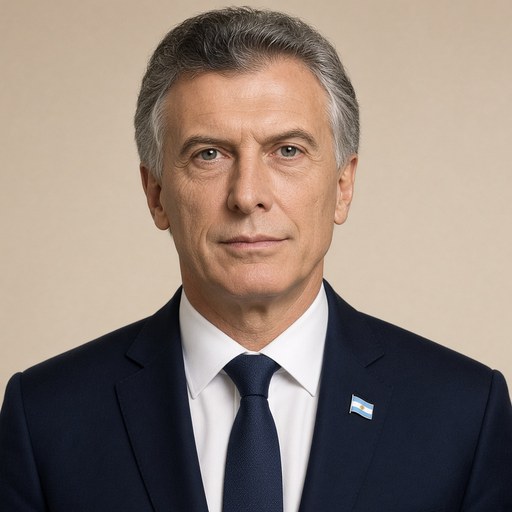
Words of President Macri at the opening of the G20 Summit in Costa Salguero, CABA.
 Mauricio Macri · President of Argentina
- Context
- Macri addressed world leaders at the opening of the first G20 Summit held in South America, in Buenos Aires, Argentina, on November 30, 2018.
- Main themes
- Multilateralism and global dialogue, G20 summit leadership, sustainable development, future of work, international cooperation, technological change and artificial intelligence, climate sustainability, financial stability, international trade, Argentina's global role, consensus-building
- Duration
- ~8 min
- Words
- 974
- Sentences
- 27
- Readability
- 35
- Grade
- 17.3
- Syntax
- 3.53
- Vocabulary
- 2.04
G7 / G20 Summit Communiqués Translated from Spanish
The broad sphere of national life a sentence belongs to. Every sentence has an Arena, so it is the denominator the other indices are read against.
Other27 sentences in 16 paragraphs
I want to thank you for your presence in Buenos Aires. This is the first G20 Summit in South America, and it has been 10 years since heads of government and heads of state of the G20 met for the first time, called together in the United States with a spirit of creating this mechanism, this space for dialogue that at that moment helped to prevent the worsening of the international financial crisis.
In these years, the changes and social, political, and economic circumstances, both globally and in our countries, have generated a questioning of contemporary multilateral mechanisms, including the G20; and tensions have emerged among our countries regarding the vision of how to individually address global opportunities and challenges.
For that reason, while today the agenda that brings us together is different, I want to ask you to act with the same sense of urgency as in 2008, because in a diverse world with a multiplicity of actors with their own history and culture, the essence of the G20 is to promote dialogue that respects differences and drives actions based on shared interests.
I want to tell you that, as you know, this Summit is an unprecedented event in our country; never in our history have so many leaders converged at the same time, and we take it as a gesture of support and recognition of Argentina's presence and performance on the global stage, especially after so many years of isolation.
Here, leaders see each other face to face, speak frankly, and reaffirm agreements while managing disagreements, and this is something that has been happening year after year for a decade. I hope that in this day and a half of work we can lay the foundations for the consensus of the next 10 years: it is a great task that lies ahead of us.
We are all witnesses to the profound changes that our societies are experiencing, changes that are accelerating and deepening, especially in the last ten years and perhaps more in the last five; changes in production processes, in behaviors, in customs, in the ways we communicate. Along with other advances such as in nanotechnology, artificial intelligence, virtual reality, robotics, and 3D printing, which create an opening and a possibility for progress, but which also challenge many of our categories.
Today, a citizen receives more information in thirty days than in their entire life thirty years ago: yes, thirty days versus an entire life thirty years ago. This shows that people have become rich in information and millionaires in expectations, and this marks the level of challenge we face today, and we must rise to the occasion.
Many people look at us with doubts about the purpose of these summits; we have the obligation to show the world that today global challenges require global solutions. Problems like the future of work, climate issues, we cannot solve them alone. That is why I want to invite you to work together to take advantage of the mechanisms we have at our disposal today, and to discuss, discuss what other mechanisms we may need to continue providing coordinated responses.
For me, the solution is - as we just saw in the retreat - to dialogue, dialogue, and dialogue; that is the way to push the limits of what is possible, understanding that each country has its preferences, values, and interests, but we all agree on one thing: that we want to promote sustainable development.
We take on the responsibility of presiding over the G20 with the conviction that we must make a contribution, that we can make a contribution to international cooperation, multilateralism, and global governance. We have already held more than fifty meetings in all regions of the country because we are a federal country and we are proud of each of our regions, for the talent of our people, their opportunities, their drive, their natural resources, and their cultural heritage. And I want to take this opportunity to thank all the Argentines who have participated in order to host you today, organizing such an important event, and also to the citizens of Buenos Aires who have accepted the challenge of moving in response to this call.
Under the slogan of building consensus for sustainable and equitable development, in these days we will address several topics such as the future of work, infrastructure for development, a sustainable food future, financial stability, climate sustainability, and international trade, among others. An agenda centered on people and with a vision for the future.
I am optimistic by nature; I have always been, but much more so after this year that I have worked alongside my team with the support of all of you, and seeing that we have reached important consensuses, reflected both in the ministerial communiqués and in action plans already agreed upon among all of us. But it is clear that consensus is not something that is built overnight; it is a process with advances and setbacks, and it continues after the G20. But it is better when our commitments are reflected in concrete actions that improve the well-being of our people.
That is why at the southernmost G20 that has ever been organized, I invite you to send a clear message to the world that from here, together, we can set a horizon for development, with shared responsibilities, with a strong commitment to gender equality, and united in diversity.
And I also want to, recalling someone I have always admired greatly, Mandela, who invited us - in this year in which he would have turned one hundred years old - to end poverty by 2030, and he was always a champion of dialogue.
So thank you again for your presence here; I appreciate it very much, and we will start the first session in a couple of minutes.
Thank you very much.
The original Spanish. The tags above are read on the English translation's sentences.
Quiero agradecerles su presencia en Buenos Aires. Esta es la primera Cumbre del G20 en Sudamérica, y pasaron 10 años desde que jefes de Gobierno y jefes de Estado del G20 se reunieron por primera vez convocados en Estados Unidos y con un espíritu de crear este mecanismo, este espacio de diálogo que permitió en ese momento evitar el agravamiento de la crisis financiera internacional.
En estos años los cambios y las circunstancias sociales, políticas y económicas, tanto a nivel global como en nuestros países, han generado un cuestionamiento sobre los mecanismos multilaterales contemporáneos, incluido el G20; y han emergido tensiones entre nuestros países acerca de la visión de cómo encarar individualmente las oportunidades y los desafíos globales.
Por esa razón, si bien hoy la agenda que nos convoca es distinta, quiero pedirles que actuemos con el mismo sentido de urgencia que en el 2008, porque en un mundo diverso y con multiplicidad de protagonistas con su propia historia y cultura, la esencia del G20 es promover el diálogo que respete las diferencias e impulse acciones basadas en intereses compartidos.
Quiero decirles que, como ustedes saben, esta Cumbre es un hecho inédito en nuestro país, nunca convergieron en nuestra historia tantos líderes y al mismo tiempo, y lo tomamos como un gesto de apoyo y de reconocimiento a la presencia y al desempeño que está teniendo la Argentina en el escenario global, sobre todo después de tantos años de aislamiento.
Aquí los líderes nos vemos cara a cara, hablamos con franqueza y ratificamos coincidencias a la misma vez que administramos desacuerdos, y es algo que viene sucediendo años tras año hace una década. Yo espero que en este día y medio de trabajo logremos crear las bases para los consensos de los próximos 10 años: es una gran tarea que tenemos por delante.
Todos somos testigos de los cambios profundos que están viviendo nuestras sociedades, cambios que se aceleran y se profundizan, especialmente en los últimos diez años y tal vez más en los últimos cinco; cambios en los procesos productivos, en los comportamientos, en las costumbres, en las formas de comunicarnos. Junto a otros avances como en nanotecnología, en inteligencia artificial, en realidad virtual, la robótica, la impresión 3D, que generan una apertura y una posibilidad de progreso, pero que también a la vez desafían muchas de nuestras categorías.
Hoy un ciudadano recibe en treinta días más de información que en toda su vida treinta años atrás: sí, treinta días versos toda una vida treinta años atrás. Eso demuestra que la gente se volvió rica en información y millonaria en expectativas, y eso marca el nivel de desafío que tenemos hoy en día y tenemos que estar a la altura.
Mucha gente nos mira con dudas acerca de para qué sirven estas cumbres, nosotros tenemos la obligación de mostrarle al mundo que hoy los desafíos globales requieren soluciones globales. Problemas como el futuro del trabajo, problemas del clima, no podemos resolverlos solos. Por eso quiero invitarlos a que trabajemos juntos para aprovechar los mecanismos que hoy tenemos a nuestro alcance, y debatamos, debatamos qué otros mecanismos podemos necesitar para seguir dando respuestas coordinadas.
Par mi las soluciones es -como recién vimos en el retiro- dialogar, dialogar y dialogar, esa es la forma de empujar los límites de lo posible, entendiendo que cada país tiene sus preferencias, valores e intereses, pero todos coincidimos en algo: en que queremos promover el desarrollo sostenible.
Asumimos la responsabilidad de presidir el G20 con la convicción de que tenemos que hacer un aporte, que podemos hacer un aporte a la cooperación internacional, el multilateralismo y la gobernanza global. Ya hicimos más de cincuenta reuniones en todas las regiones del país, porque somos un país federal y estamos orgullosos de cada una de nuestras regiones, por el talento de nuestra gente, sus oportunidades, su empuje, sus recursos naturales y su bagaje cultural. Y quiero aprovechar a agradecerles a todos los argentinos que han participado para poder recibirlos hoy, organizando tan importante evento, y también a los ciudadanos de Buenos Aires que han aceptado el desafío de moverse ante esta convocatoria.
Bajo la consigna de construir el consenso para un desarrollo sostenible y equitativo, estos días abordaremos varios temas como el futuro del trabajo, la infraestructura para el desarrollo, un futuro alimentario sostenible, la estabilidad financiera, la sustentabilidad climática y el comercio internacional, entre otros. Una agenda centrada en las personas y con una visión de futuro.
Soy optimista por naturaleza, siempre lo he sido, pero mucho más después de este año que he trabajado junto a mí equipo con el apoyo de todos ustedes, y viendo que hemos llegado a importantes consensos, plasmados tanto en los comunicados ministeriales como en planes de acción acordados ya entre todos nosotros. Pero queda claro que el consenso no es algo que se construye de la noche a la mañana, es un proceso con avances y retrocesos, y que continúa después del G20. Pero resulta mejor cuando nuestros compromisos se plasman en acciones concretas que mejoran el bienestar de nuestra gente.
Por eso en el G20 más al sur que se haya organizado, los invito a que demos un mensaje claro al mundo de que de aquí, juntos, podemos marcar un horizonte de desarrollo, con responsabilidades compartidas, con un fuerte compromiso con la igualdad de género y unidos en la diversidad.
Y también quiero, recordando a alguien que siempre he admirado mucho, a Mandela, que él nos invitó -en este año en el que él hubiese cumplido cien años- a que de aquí al 2030 terminemos con la pobreza, y además él fue siempre un cultor del diálogo.
Así que gracias nuevamente por su presencia aquí, les agradezco mucho, y vamos a empezar la primera sesión en un par de minutos.
Muchas gracias.