




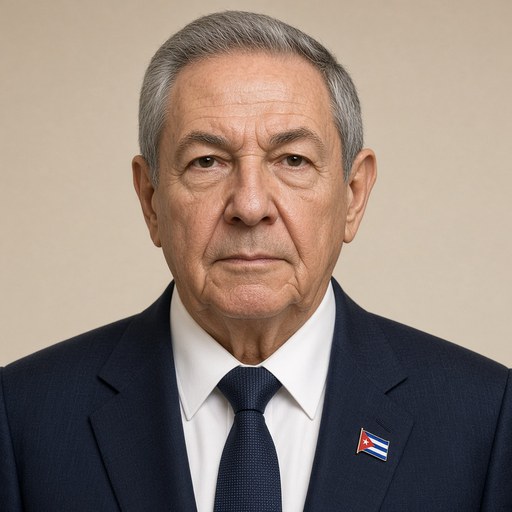
Intervention in the public segment of the VII Extraordinary Summit of ALBA, Cumaná, Venezuela,
 Raúl Castro · President of Cuba
- Context
- Raúl Castro addressed the VII Extraordinary ALBA Summit in Cumaná, Venezuela on April 16, 2009, marking the 48th anniversary of the Bay of Pigs invasion.
- Main themes
- US blockade of Cuba, ALBA solidarity, Bay of Pigs anniversary, US imperialism in Latin America, agrarian reform, OAS criticism, Cuban Revolution history, Guatemalan intervention, state terrorism, socialism proclamation
- Duration
- ~20 min
- Words
- 2,425
- Sentences
- 88
- Readability
- 54
- Grade
- 12.3
- Syntax
- 3.31
- Vocabulary
- 2.13
Translated from Spanish
The broad sphere of national life a sentence belongs to. Every sentence has an Arena, so it is the denominator the other indices are read against.
Other88 sentences in 28 paragraphs
Raúl Castro:...Remember that you have to give me the floor to thank everyone, especially those who have spoken — and I will not exclude Daniel, because he will do so, just as he has done throughout his life as a revolutionary — on behalf of the people of Cuba, for all the expressions of solidarity and support for our Revolution, for our people, and I consider that, therefore, also to the Leader of the Revolution, comrade Fidel Castro, who is listening to us directly.
I will not extend myself; I will speak on the other points. I have to take the floor — as they told me — also at the mass event, right?, in the Plaza. I still don’t know how it will be. Are we going to speak there in the Plaza?
Hugo Chávez: Yes. We ask you to speak on behalf of all.
Raúl Castro: No, that is a very great responsibility. If anything, the main host.
In any case, I believe that what we have heard here this afternoon, which does not surprise us, we know that the whole world, with the exception of the United States, its main ally, Israel, and a few other countries that have occasionally abstained or even voted against in the UN General Assembly, the entire planet condemns the blockade.
I do not want to talk about the OAS; I already spoke in Sauípe, at the Rio Summit meeting, right? And, moreover, friend Zelaya will meet with all the delegates at the end of May and the beginning of June; I do not want to respond to the words that Mr. Insulza said recently, because comrade Fidel already responded to him a few hours ago.
We can say many more things about the OAS. The OAS, it can be said, has oozed blood since its very creation; Cuba is an example, but before Cuba, there are many more. Venezuela, for example, I was imprisoned for the attack on the Moncada barracks in 1954, I heard about the intervention in Guatemala, why? Because an honest president, who had been a colonel in the Guatemalan army, Jacobo Arbenz, once he won the presidency, within the framework of the rules of the game imposed by the North Americans in that country, and the dominant classes in all countries of the world, won the elections, and wanted to give a little bit of land to the aborigines, to the Indians, to the descendants of the great Mayan culture. And what happened? Three characters: Eisenhower; his Secretary of State, Foster Dulles; and his brother Allen Dulles, who was the head of the CIA and, moreover, its founder, decided to launch that mercenary operation, with a certain Castillo Armas at the forefront. That story is known to almost all of us present here. Only seven years had passed when, in 1961, a day like yesterday, the bombings began in the main cities of the country and two air bases.
A day like today — as was pointed out here — in the farewell of mourning for the victims of those bombings, 48 years ago Fidel proclaimed socialism when the aggression was already evident, and a mass of people, among whom there were normal citizens, simple, I mean workers, students, peasants, the Rebel Army that two years earlier had defeated the Batista tyranny, the police, with rifles raised supported that decision, and the next day they went to give their blood to defeat that aggression.
Why were we attacked? That aggression was planned by the same trio that attacked Guatemala seven years earlier, before the word socialism was mentioned in Cuba.
It happened that four and a half months after the triumph, on May 17, 1959, the first Agrarian Reform Law was approved in our country; the most important law after the triumph of the Revolution, up to that moment. I say that this is our Rubicon, that crossing it meant the death penalty for the Cuban Revolution by those who decided seven years earlier the invasion of Guatemala, of which Foster Dulles was a lawyer for the United Fruit Company, the same one that in Cuba instead of Fruit, was United Sugar Company, and part of its lands were affected by that agrarian reform.
Now I speak of recent history in a very summarized way, and in Sauípe, Brazil, I mentioned the more than 5,500 dead, more dead than mutilated, as a consequence of all the state terrorism of the United States against Cuba. The list is endless, from the epidemic of hemorrhagic dengue, which hundreds of thousands of people, simultaneously, saturated our hospitals throughout the country, which international health organizations say is impossible for it to have been an epidemic of the so-called normal type. I will not talk about the plane from Barbados and the 73 victims who died, including the Cuban youth fencing team, which was leaving here from Venezuela, where they had won all the gold medals. I will not talk about those who fell in Girón. On a day like yesterday, comrades began to fall under the bombings, starting from the early morning of tomorrow, 48 years ago, when dozens of comrades began to fall, because we had more casualties than they did.
Fidel ordered us — and rightly so — that before 72 hours we had to eliminate this aggression; the panorama was clear. The North Americans had formed a puppet government at the Opa-Locka military base in Florida, led by a certain Miró Cardona at the head of it, the council of ministers headed by the titled prime minister at that time. The invasion occurs; if that beachhead, which was protected by the largest swamp in the Caribbean, the Zapata Swamp, consolidates, through which they had to advance in single file, because we had just built a road in the middle of that swamp, and the troops could not be deployed, they had to go through that in single file. We had more casualties than they did.
The territorial waters at that time were three miles; today they are 12, and therefore, a little more than three miles away there was an American fleet, with marines, including an aircraft carrier. Twice pairs of American combat planes flew over the place where the combat actions were taking place; they did nothing but passed by. And it was very simple, why didn’t the OAS do in 1961 what it did in January 1962? They condemned us in Chile, they condemned us in Costa Rica; they were creating the conditions, naturally, under the baton of those who have commanded the OAS since its founding in 1948. And that is why they did not expel us earlier, because if they brought in the puppet government and it consolidated in Playa Girón or in the Bay of Pigs — which is its real name, because Playa Girón was a small village, today it is a tourist center — the OAS would recognize that government, the government would ask for help from the OAS, and part of those North American forces, which were just a little more than three miles from our coasts, would have invaded us.
What would have happened if American troops had invaded Cuba in 1961? I only compare how many deaths occurred in the sister republic of Guatemala as a consequence of that 1954 intervention, also organized by the Yankees, also led by the same three characters mentioned earlier, also supported by the OAS? Why didn’t the OAS condemn it?
According to some contemporary historians, as a result of that intervention and the dictatorships that subsequently ravaged that sister republic of Guatemala, between 250,000 and 300,000 Guatemalans have died. Is that so or not? Is that amount, is it more, is it less? There were hundreds of thousands of victims. Who is responsible? Who accused them? Except for the people, honest people, some other government.
How many dead would Cuba have had, with many more inhabitants, with much more armament, even at that time, and with a tradition of struggle, recently revived by the triumph of the Revolution in 1959, and with hundreds of thousands of Cubans already armed at that time? Can anyone calculate it?
Now, would imperialism have accepted that defeat, that involuntary humiliation, of course, caused by a small Caribbean country and our continent? Would they allow it? On January 2, in commemoration of the second anniversary of the triumph of the Revolution, which was January 1 — a holiday — the next day Fidel speaks in the Plaza de la Revolución; January 2, 1961 — Girón was in 1961. Eisenhower, who had 17 days left in power in his administration, broke relations with Cuba on January 3 of that year, 1961. The OAS expelled Cuba on January 31, 1962. And why didn’t they expel it earlier, in 1961, when Girón was coming? Because the puppet government they were going to put there had to ask for help from the OAS; it was a country of the OAS. Why do they expel us then, separate us, or suspend us, which is the same, in this case in 1962? Because this time it was not a mercenary invasion; this time it was an invasion by the North Americans. And that situation — of which not much has been written, or almost nothing — was what caused the presence of Soviet missiles in Cuba and what prevented that invasion.
It has already been demonstrated by the documents declassified by the CIA and the Pentagon and, ultimately, by the North American government — declassified documents, although with many redactions — that the plan was that. They did not do it because the crisis was resolved, in the midst of which we had serious disagreements with Khrushchev, the Soviet Prime Minister, over the way he handled it, ignoring us, and no one can ignore us, neither the largest country in the world nor a group of countries, even if they are the largest in the world, neither the G-7 nor the G-20.
And that is the sad reality. First, they only sanction us, condemn us in several meetings, creating the atmosphere, but they do not separate us from the OAS, for the request for help, and then they do separate us. They accelerated even Playa Girón when they knew the amount of armaments that had already been contracted, the pilots we were training abroad, etc.
And sometimes, what Evo and other comrades were talking about just now, about democracy, freedom, human rights. We have sent word to the North American government privately and publicly that there are the rights whenever they want to discuss them all: human rights, freedom of the press, political prisoners, everything, everything, everything they want to discuss, but on equal terms, without the slightest shadow over our sovereignty and without the slightest violation of the right to self-determination of the Cuban people.
I do not understand that democracy of the United States; I do not understand it; I have even told some North American citizens that in the United States there is one party, one single party; study the history of the two, study the behavior, the way of acting in each event in which they have had to make an important decision. What they have, it is true, is a well-oiled system, their press; it may be that an editor or a group of newspapers, as there are in the United States and in Europe, from a single company, open a wider range and tell the press: You write what you want about this, but about the rest of the problem, only what the owner of the newspaper, or the radio station, or the television station wants is written. That is how it is, and if not, let someone prove me otherwise.
But I said that there is only one party. They say: “How is that?” I say: “Yes. Do you want just one example?” How is it possible that a Republican government, Eisenhower, organizes an expedition against Cuba and three months after taking office a Democrat authorizes the invasion? That is the reality; I could be talking about many more things here.
We can be wrong; we admit it; we are human beings; we are willing to sit down to discuss — as I said — whenever they want, the thing is that now — and to conclude — it is evident that they have to create this atmosphere and anyone who disagrees in anything, immediately they come out saying democracy, freedom, prisoners.
The other day — in Brasília — a insolent and provocative journalist, after a meeting with President Lula, in an interview asked me, “How many dissidents have you executed?” It was not even heard, and he started to tremble when I answered him, in the way I know how to answer. He was trembling! And from there I told him: “Yes, those dissidents, who are on the payroll of the United States, go see the last budget that was approved in Congress, the item of 57 million dollars to finance all those so-called ‘patriot’ dissidents, ‘independent journalists,’ etc. And why don’t they release our five heroes, heroic young men who did no harm to the United States, nor sought information against the United States, but against the terrorists who have attacked and have been attacking with greater or lesser intensity for almost 50 years against my country?”
Then, that proposal arose, and I reaffirm it here today: If they want the freedom of those supposed “political prisoners,” among whom some include confessed terrorists, Guatemalans and Salvadorans, who were tried in Cuba, convicted, even sentenced to death — which is maintained but which we have not applied for a long time — and their sentence was commuted to life imprisonment. Release our prisoners and we will send them over there — with family and all who want — those so-called dissidents and patriots.
In that style, we could say a few things, only that, Evo, if after what you said today they expel you from the OAS for being incompatible with Marxism-Leninism, Bolivia and Cuba will form something that is not called OAS in any way, and then we will give entry to those who accompany us.
Well, Chávez, forgive me for the time and the informality from where I spoke, I was going out there, I came to apologize to Daniel and I have taken the floor from him. This has been an abuse of power; it seems that since I am dressed in uniform.
Thank you very much.
The original Spanish. The tags above are read on the English translation's sentences.
Raúl Castro .- ...Acuérdate que me tienes que dar la palabra para agradecer a todos, muy especialmente a los que han hecho uso de la palabra y no voy a excluir a Daniel, porque lo hará, igualmente, como lo ha hecho durante toda su vida de revolucionario, en nombre del pueblo de Cuba, todas las expresiones de solidaridad y apoyo a nuestra Revolución, a nuestro pueblo, y considero que, por lo tanto, también al Jefe de la Revolución, el compañero Fidel Castro, que nos está escuchando directamente (Aplausos).
No voy a extenderme, hablaré en los otros puntos. Tengo que hacer uso de la palabra según me dijeron también en el acto de masa, ¿no?, en la Plaza. No sé todavía cómo va a ser. ¿Vamos a hablar allá en la Plaza?
Hugo Chávez .- Sí. Te pedimos que hables tú a nombre de todos.
Raúl Castro .- No, eso es una responsabilidad muy grande. Si acaso, el anfitrión principal.
De todas maneras, creo que lo que hemos escuchado en la tarde de hoy aquí, que no nos sorprende, sabemos que el mundo entero, con excepción de Estados Unidos, su aliado principal, Israel, y algún que otro país que ocasionalmente se ha abstenido o hasta ha votado en contra en la Asamblea General de la ONU, el planeta entero condena el bloqueo.
No quiero hablar de la OEA, ya hablé en Sauípe, en la reunión de la Cumbre de Río, ¿eh? Y, además, el amigo Zelaya se reunirá con todos los delegados a fines de mayo y principio de junio próximo; no quiero contestar a las palabras que dijo el señor Insulza recientemente, porque ya le contestó el compañero Fidel hace unas horas.
Podemos decir muchas cosas más de la OEA. La OEA, puede decirse que, rezume sangre desde su propia creación, Cuba es un ejemplo, pero antes que Cuba hay muchos más. Venezuela, por ejemplo, yo estaba guardando prisión por lo del ataque al cuartel Moncada en 1954, escuché lo de la intervención en Guatemala, ¿por qué?, porque un presidente honesto, que había sido coronel del ejército guatemalteco, Jacobo Arbenz , una vez ganada la presidencia, dentro del marco de las reglas del juego que habían impuesto los norteamericanos en ese país, y las clases dominantes en todos los países del mundo, ganó las elecciones, y quiso entregar un poquito de tierra a los aborígenes, a los indios, a los descendientes de la gran cultura maya. ¿Y qué sucedió?, tres personajes: Eisenhower; su Secretario de Estado, Foster Dulles ; y su hermano Allen Dulles , que era el jefe de la CIA y, además, su fundador, decidieron lanzar aquella operación mercenaria, con un tal Castillo Armas al frente. Esa historia la conocemos casi todos los aquí presentes. Habían pasado siete años nada más, cuando en 1961, un día como ayer, se iniciaron los bombardeos en las principales ciudades del país y dos bases aéreas.
Un día como hoy como ya se señaló aquí, en la despedida del duelo de las víctimas de esos bombardeos, hace 48 años Fidel proclama el socialismo cuando ya era evidente la agresión, y una masa de pueblo, entre los que había ciudadanos normales, simples, quiero decir obreros, estudiantes, campesinos, el Ejército Rebelde que dos años antes había derrotado la tiranía batistiana, la policía, con los fusiles en alto apoyaron esa decisión, y al otro día fueron a dar su sangre para derrotar dicha agresión.
¿Por qué nos agredieron? Esa agresión se planificó por el mismo trío que agredió a Guatemala siete años antes, antes de que en Cuba se mencionara la palabra socialismo.
Sucedió que cuatro meses y medio después del triunfo, el 17 de mayo de 1959, se aprobó la primera Ley de Reforma Agraria en nuestro país; la ley más importante después del triunfo de la Revolución, hasta ese momento. Yo digo que ese es nuestro Rubicón, que cruzarlo significó la condena a pena de muerte a la Revolución Cubana por los que decidieron siete años antes la invasión a Guatemala, de los cuales, Foster Dulles era abogado de la United Fruit Company , la misma que en Cuba en vez de Fruit , era United Sugar Company , y parte de sus tierras fueron afectadas por esa reforma agraria.
Ahora hablo de la historia reciente de manera muy resumida, y en Sauípe, Brasil, mencioné los más de 5 500 muertos, más muertos que mutilados, consecuencia de todo el terrorismo de Estado de Estados Unidos contra Cuba. Es interminable la lista, desde la epidemia del dengue hemorrágico, que cientos de miles de personas, simultáneamente, saturaron nuestros hospitales en todo el país, que organismos internacionales de la salud dicen que eso es imposible que fuera una epidemia de las llamadas normales. No voy a hablar del avión del Barbados y las 73 víctimas que murieron, entre ellos el equipo juvenil de esgrima de Cuba, que salía de aquí de Venezuela, donde se había ganado todas las medallas de oro. No voy a hablar de los que cayeron en Girón. En un día como ayer empezaron a caer los compañeros bajo los bombardeos, a partir de la madrugada de mañana hace 48 años que empezaron a caer decenas de compañeros, porque tuvimos más bajas que ellos.
Fidel nos ordenó y con razón que antes de 72 horas había que liquidar esta agresión, estaba claro el panorama. Los norteamericanos habían formado un gobierno títere en la base militar de Opa - Locka en la Florida, por un tal Miró Cardona al frente de la misma, el consejo de ministros encabezado por el titulado primer ministro en esa ocasión. Se produce la invasión, si se consolida esa cabeza de playa que estaba protegida por la ciénaga o el humedal más grande del Caribe insular, que es la Ciénaga de Zapata, por el cual había que avanzar en fila india, porque acabábamos de construir una carretera en medio de esa ciénaga, y no se podían desplegar las tropas, había que ir por eso en fila india. Tuvimos más bajas que ellos.
Las aguas territoriales en aquel momento eran tres millas, hoy son 12, y, por lo tanto, a un poco más de las tres millas había una flota norteamericana, con infantes de marina, entre ellos un portaaviones. Dos veces parejas de aviones de combate norteamericanos pasaron por encima del lugar donde se libraban las acciones combativas, no hicieron nada pero pasaron por ahí. Y era muy sencillo, ¿por qué la OEA no hizo en 1961 lo que hizo en enero de 1962? Nos condenaron en Chile, nos condenaron en Costa Rica; fueron creando las condiciones, naturalmente, bajo la batuta de los que han mandado la OEA desde su fundación, en 1948. Y es ahí por qué no nos expulsan antes, porque si traen el gobierno títere y se consolida en Playa Girón o en la Bahía de Cochinos que es su verdadero nombre, porque Playa Girón era una aldeíta , hoy es un centro turístico, la OEA reconocería ese gobierno, el gobierno pediría ayuda a la OEA, y parte de esas fuerzas norteamericanas, que estaban apenas a un poco más de tres millas de nuestras costas, nos hubieran invadido.
¿Qué hubiera pasado si en Cuba nos invaden con tropas norteamericanas en 1961? Solo comparo ¿cuántas muertes hubo en la hermana república de Guatemala como consecuencia de aquella intervención de 1954, también organizada por los yankis, también dirigida por los tres mismos personajes mencionados anteriormente, también apoyada por la OEA? ¿ Porqué la OEA no la condenó?
Según dicen algunos historiadores contemporáneos, a consecuencia de esas intervención y las dictaduras que posteriormente asolaron esa hermana república de Guatemala, han muerto entre 250 000 y 300 000 guatemaltecos. ¿Es así o no es así? ¿Es esa cantidad, es más, es menos? Fueron cientos de miles de víctimas. ¿Quiénes son los responsables? ¿Quién los acusó? Salvo los pueblos, la gente honesta, algún que otro gobierno.
¿Cuántos muertos hubiera tenido Cuba, con muchos más habitantes, con mucho más armamento, aún en esos momentos, y con una tradición de lucha, recientemente reverdecida por el triunfo de la Revolución, en 1959, y con cientos de miles de cubanos armados ya en esos momentos? ¿Alguien podrá calcularlo?
Ahora bien, ¿se hubiera quedado el imperialismo con esa derrota, con esa humillación involuntaria, por supuesto , ocasionada por un pequeño país del Caribe y de nuestro continente? ¿Iban a permitirlo? El día 2 de enero, en conmemoración del segundo aniversario del triunfo de la Revolución, que era el 1ro de enero día feriado, al otro día habla Fidel en la Plaza de la Revolución; 2 de enero de 1961 Girón fue en 1961. Eisenhower, que le quedan 17 días de poder en su administración, rompe relaciones con Cuba el 3 de enero de ese año, 1961. La OEA expulsa a Cuba el 31 de enero de 1962. ¿Y por qué antes no la expulsó, en 1961, cuando venía Girón? Porque el gobierno títere que iban a poner allí tenía que pedirle ayuda a la OEA, era un país de la OEA. ¿Por qué nos expulsan entonces, nos separan, o nos suspenden, que es lo mismo, en este caso en el año 1962? Porque esta vez no era una invasión mercenaria, esta vez era una invasión de los norteamericanos. Y esa situación que de esto no se ha escrito mucho, o casi nada fue lo que ocasionó la presencia de los cohetes soviéticos en Cuba y lo que impidió esa invasión.
Está demostrado ya por los documentos desclasificados por la CIA y el Pentágono y, en definitiva, por el gobierno norteamericano documentos desclasificados, aunque con muchas tachaduras , que el plan era ese. No lo hicieron porque se llegó a la solución de la crisis, en medio de la cual tuvimos serias discrepancias con Jruschov, primer ministro soviético, por la forma en que la tramitó, ignorándonos a nosotros, y a nosotros no hay quien nos ignore, ni el país más grande del mundo ni un grupo de países aunque sean los más grandes del mundo, ni los G-7, ni los G-20 (Aplausos).
Y esa es la triste realidad. Primero solo nos sancionan, nos condenan en varias reuniones, creando el ambiente, pero no nos separan de la OEA, para la solicitud de ayuda, y después sí nos separan. Ellos aceleraron, incluso Playa Girón, cuando sabían la cantidad de armamentos que ya se habían contratado, los pilotos que estábamos preparando en el extranjero, etcétera.
Y a veces, lo que estuvieron Evo y otros compañeros hablando ahorita, sobre la democracia, la libertad, los derechos humanos. Le hemos mandado a decir al gobierno norteamericano en privado y en público que ahí están los derechos cuando ellos quieran discutirlos todos : derechos humanos, libertad de prensa, presos políticos, todo, todo, todo lo que quieran discutir, pero en igualdad de condiciones, sin la más mínima sombra a nuestra soberanía y sin la más mínima violación al derecho de la autodeterminación del pueblo cubano (Aplausos).
Yo no entiendo esa democracia de Estados Unidos, no la entiendo; yo le he dicho, incluso, a algunos ciudadanos norteamericanos que en Estados Unidos hay un partido, un solo partido; estudien la historia de los dos, estudien el proceder, la forma de actuar ante cada hecho en que han tenido que tomar una decisión importante. Lo que tienen, es cierto, bien engrasado su sistema, su prensa; puede ser que una editora o un grupo de periódicos, como hay en Estados Unidos y en Europa, de una sola empresa, abren un abanico mayor y le dicen a la prensa : Ustedes de esto escriban lo que quieran, pero de este resto del problema se escribe solo lo que quiere el dueño del periódico, o de la estación de radio, o de la estación de televisión. Eso es así, y si no que alguien me demuestre lo contrario a mí.
Pero yo decía que hay un solo partido. Dice : ¿Cómo es eso? Digo: Sí. ¿Quiere un solo ejemplo? Cómo es posible que un gobierno republicano, Eisenhower, organice una expedición contra Cuba y tres meses después de tomar posesión un demócrata autoriza la invasión. Esa es la realidad, podría estar hablando muchas cosas más aquí.
Podemos estar equivocados, lo admitimos, somos seres humanos; estamos dispuestos a sentarnos a discutir como dije cuando quieran, lo que pasa es que ahora y para concluir es evidente que tienen que formar este ambiente y a todo el que discrepe en algo, enseguida le salen diciendo que democracia, que libertad, que prisioneros.
El otro día en Brasilia, un periodista insolente y provocativo, después de una reunión con el presidente Lula, en una entrevista me preguntó, ¿Cuántos disidentes han fusilado? Ni se oyó, y se puso a temblar cuando le contesté, en la forma en que yo sé contestar. ¡Temblaba!, y de ahí le dije: Sí, los disidentes esos, que están a sueldo de Estados Unidos, ve a ver el último presupuesto que se aprobó en el Congreso, la partida de 57 millones de dólares para financiar a todos esos disidentes patriotas, periodistas independientes, etcétera. ¿Y por qué no nos sueltan nuestros cinco héroes, jóvenes heroicos que no le hicieron ningún daño a Estados Unidos, ni buscaron información contra Estados Unidos, sino contra los terroristas que atacaban y han estado atacando en mayor o menor intensidad durante estos casi 50 años a mi país?
Entonces, surgió ese planteamiento y lo ratifico hoy aquí: Si quieren la libertad de esos supuestos presos políticos, entre los cuales algunos cuentan a unos terroristas confesos, guatemaltecos y salvadoreños, que fueron juzgados en Cuba, condenados, incluso, a la pena de muerte que se mantiene pero que no la aplicamos hace rato y les fue conmutada por cadena perpetua. Suelten a nuestros prisioneros y les mandamos para allá con familia y todos los que quieran a esos llamados disidentes y patriotas (Aplausos).
Por el estilo, podríamos decir unas cuantas cosas, solo que, Evo, si después de lo que dijiste hoy te expulsan de la OEA por ser incompatible con el marxismo-leninismo, Bolivia y Cuba formaremos otra cosa que no se llame OEA ni remotamente, y, entonces les daremos ingreso a los que nos acompañen (Aplausos).
Bueno, Chávez, perdona por el tiempo y la informalidad desde donde hablé, que iba allá afuera, vine a pedirle disculpas a Daniel y le he quitado la palabra. Esto ha sido un abuso de poder, parece que como estoy vestido de uniforme (Risas).
Muchas gracias (Aplausos).