




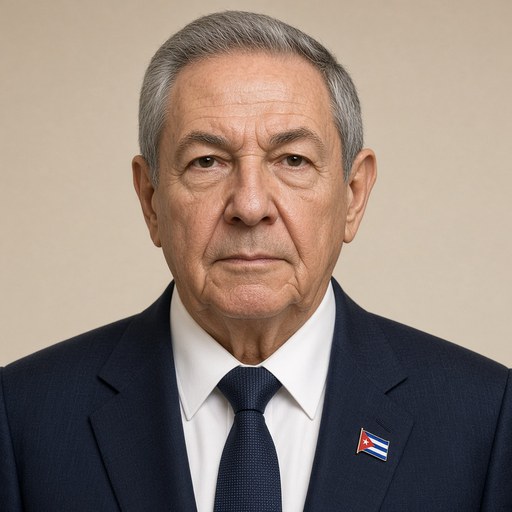
Words spoken at the unveiling ceremony of the Bust of Simón Bolívar. Salvador, Bahia, Brazil.
 Raúl Castro · President of Cuba
- Context
- Raúl Castro spoke at the unveiling of a Simón Bolívar bust in Salvador, Bahia, Brazil, in December 2008, during an official visit that included stops in Caracas and Brasília.
- Main themes
- Cuba-Brazil solidarity, Simón Bolívar commemoration, Cuba-Venezuela relations, Fidel Castro and Hugo Chávez friendship, African cultural roots shared by Cuba and Brazil, Cuban military internationalism in Angola, Amazon rainforest, Latin American unity, Angolan independence struggle, "portuñol" language
- Duration
- ~13 min
- Words
- 1,514
- Sentences
- 51
- Readability
- 50
- Grade
- 13.5
- Syntax
- 3.37
- Vocabulary
- 2.34
Translated from Spanish
The broad sphere of national life a sentence belongs to. Every sentence has an Arena, so it is the denominator the other indices are read against.
Other51 sentences in 27 paragraphs
Good evening, dear friends from Salvador de Bahia!
Starting from the early hours of tomorrow, I will begin an official visit to Brasilia, the capital of Brazil, and when this event concludes, we will move there; therefore, I will speak very little, I do not speak as much as Chávez, because Chávez has more vigor, he is younger.
It is true that I told him, as we were approaching here, that he was imprisoned when the 3rd Ibero-American Summit was held in 1993, with the participation of Fidel and other heads of state.
I approached the podium for one reason only: To tell Chávez that Fidel was watching him live on television, and, as you saw, he did not let me speak to him and put me to speak instead.
How do you greet Fidel when you see him? (President Chávez answers him.) He says: "How are you, Fidel?" He greets him in English from Venezuela, when he is at some event, or in his Aló Presidente, those long programs he organizes every Sunday.
I have a problem with him, I watch him from Cuba, but his conferences last so long that I keep the television low and continue working, and then I ask some assistant to give me a summary of what President Chávez said, because he says very interesting things, and although I am a bit older than him, I always learn something.
He remembered that he calls me uncle and Fidel father, a consideration that embarrasses us, out of modesty, but we feel proud. And one of my granddaughters, a little girl, about 12 years old, told her mother — one of my daughters — the other day: "Well, if uncle Fidel" — she calls Fidel uncle — "is Chávez's dad and grandpa Raúl is the uncle, then I am Chávez's cousin". The little girl is named Mónica, one of the pseudonyms used by her grandmother — now deceased — in the clandestine struggle, in the liberation war.
I just wanted to give you all a hug, through my words, to all of you; through you, to the entire state and to all of Brazil, which already has more than 190 million inhabitants and more than 8 million square kilometers.
When I was coming from Caracas to here, I flew over the Amazon and spent hours and hours looking at the gigantic and magnificent green mass of this important lung of oxygen, not only for Brazil and America, but for the planet.
The people of Brazil and the people of Cuba have the same roots, the ethnic roots. This big black man you see here (He refers to the translator) is not Brazilian, he is Cuban, if I don't say it, you might think he is Brazilian; he doesn't dance samba, although he likes to watch mulatas dance samba. What do you call mulatas here? Ah, you don't know. He dances conga, which is a very similar and very cheerful variety.
We have the same cultural roots — I was telling you — we have an explosive character, that bond of our African trunk, our common trunk, and of our European trunk: in some cases one predominates; in others, the other. The National Poet of Cuba, now deceased, Nicolás Guillén, has a beautiful and long poem dedicated to his two grandparents: to his black grandfather and to his white grandfather.
That is why when I have been able to briefly share with this gathering of Bahianos, I feel like I am in Cuba; I feel like I am in Santiago de Cuba, even more similar: a smaller city, with fewer inhabitants, but the same: some speak Portuguese, others speak Spanish, and in Cuba many speak "portuñol."
"Portuñol" we could say is a dialect that arose from the need to communicate between Angolans and Cubans during 15 years, in which we had the honor to participate, along with the Angolan patriots, of the Popular Movement for the Liberation of Angola, under the leadership of its first President and founder of the State, founded on November 11, 1975, when from four different places, at midnight that day, or that night, the nascent State was besieged by all its enemies: the South African racists from the south, the puppets of UNITA, an organization founded by the Portuguese colonialists and that later served the Americans; from the north, the troops of Mobutu and a so-called National Front for the Liberation of Angola, also puppets first of the Portuguese colonialists and then of the Central Intelligence Agency, the CIA.
A little further north, in an enclave called Cabinda, separated from the rest of Angola by the mouth of the gigantic Congo River — which was the only place at that time where they had oil, which was extracted near its coasts in the sea — was also attacked four days before the proclamation of independence, an aggression that was repelled by Cuban and Angolan troops.
That gigantic internationalist military operation that began in the second half of 1975 lasted 15 years. During that time, 300,000 Cuban soldiers passed through Angola and tens of thousands of officers; depending on the situation, there were always between 35,000 and 55,000 Cuban soldiers, and extremely difficult situations were experienced at different stages of those long years, and from our people, all who participated, military, professionals or reservists, went voluntarily to fulfill that dangerous internationalist mission. More than two thousand gave their lives in such a noble mission, until Angola could stand on its own.
We named that operation Carlota. Who was Carlota? A slave, probably from Angola, although it has not been confirmed in the investigations, who in the 19th century led a slave uprising. She failed, it was an isolated place, it was in a sugar factory — it was not a factory, I don't know what they would call it — it was a small factory, they were not yet steam-powered (Chávez says that Raúl talks much more than he does). And Carlota escaped to the mountains and joined other slaves who had also escaped, who were called maroons. Some time later, she led the uprising of another group of those sugar workers. On that occasion, she was captured. Judged by the Spanish colonialists, she was sentenced to be quartered and cruelly divided into four pieces by four horses. It was the same thing they were going to do with Angola: divide it into four pieces.
When the moment finally came for us to leave, we had managed not only to consolidate the independence of Angola from Cabinda, to the north, to Cunene, to the south, on the border with Namibia, which was also occupied at that time by the South African racists. Angola and its one million and a quarter square kilometers remained intact and remains so to this day.
We also managed to implement United Nations Resolution 435, which forced the South African racists to leave Namibia and for it to obtain its freedom and independence.
As another byproduct of that heroism of the Angolan people and their Cuban brothers, the odious apartheid of South Africa was left seriously affected and staggering. The great South African leader, Nelson Mandela, who had already spent nearly 27 years in prison, obtained his freedom and became the first president of that gigantic and prosperous country, after winning in an election.
That is the effort made by the Cuban people, the results of those efforts, of that sacrifice, of which we are proud.
To the Angolans, we said: "We will only take the remains of our dead with us," and we all brought them back to their municipalities, that is, to their homes of origin. Cuba has 14 provinces and 169 municipalities, and there were casualties in less than two municipalities, in all the others. In a solemn ceremony, at the same time throughout the country, on December 7, we buried all the Cubans who fell in that internationalist mission.
To the Africans, we told them that we did not need them to express any gratitude, on the contrary, we paid a small part of the great debt that our people have with Africa, because the vast majority of the wealth of my country — at that time coffee, sugar, among other activities — was achieved with African slave labor.
We all Cubans feel proud of those missions, and today we continue to collaborate, but in other types of civil activities.
I wanted to share that with you, why we feel so good in a population like this, which is the same as ours.
To all of you, Bahianos, a strong hug from Cuba, from my companions, from President Hugo Chávez, who already spoke — for our luck he spoke little —; from President Zelaya, from Honduras; from President Evo Morales, from Bolivia.
I believe that at least these four heads of state present here, we have had the privilege of closing with a golden touch, in this brief meeting with you, the summits we have held over the last two days in Sauípe de Bahia.
Thank you very much.
The original Spanish. The tags above are read on the English translation's sentences.
¡Buenas noches, queridos amigos y amigas de Salvador de Bahía!
A partir de las primeras horas de mañana, empiezo una visita oficial a Brasilia, la capital de Brasil, y cuando concluya este acto nos trasladaremos para allá; por lo tanto, les voy a hablar muy poco, yo no hablo tanto como Chávez, porque Chávez tiene más vigor, es más joven.
Es cierto que le dije, cuando nos acercábamos aquí, que él estaba preso cuando se celebró la 3ra. Cumbre Iberoamericana, en 1993, con la participación de Fidel y otros jefes de Estado.
Yo me acerqué a la tribuna por una sola razón: Para decirle a Chávez que Fidel lo estaba viendo por televisión en vivo (Aplausos), y, como ustedes vieron, no me dejó hablarle y me puso a hablar a mí.
¿Cómo es que tú le dices a Fidel cuando lo saludas? (El presidente Chávez le contesta.) Le dice: How are you, Fidel? (Risas.) Lo saluda en inglés desde Venezuela, cuando está en alguna actividad, o en su Aló Presidente, larguísimos programas que él organiza todos los domingos.
Con él tengo un problema, yo lo veo desde Cuba, pero sus conferencias duran tanto que tengo el televisor bajito y sigo trabajando, y después le pido a algún ayudante que me haga un resumen de lo que dijo el presidente Chávez, porque dice cosas muy interesantes, y aunque soy un poco mayor que él, siempre aprendo algo.
Él recordaba que me dice a mí tío y a Fidel padre, una consideración que a nosotros nos avergüenza, por modestia, pero nos sentimos orgullosos. Y una de mis nietas, pequeña, de unos 12 años, le decía a su mamá una hija mía el otro día: Bueno, si tío Fidel le dice tío a Fidel es el papá de Chávez y abuelo Raúl es el tío, entonces yo soy prima de Chávez (Risas y aplausos). Se llama Mónica la chiquita, uno de los seudónimos que usó su abuela ya fallecida en la lucha clandestina, en la guerra de liberación.
Solo quería darles un abrazo, a través, de mis palabras, a todos ustedes; a través de ustedes, a todo el estado y a todo Brasil, que tiene ya más de 190 millones de habitantes y más de 8 millones de kilómetros cuadrados.
Cuando venía de Caracas para acá, sobrevolaba por el Amazonas y eran horas y horas y horas viendo la gigantesca y magnífica masa verde de este importante pulmón de oxígeno, ya no solo de Brasil y de América, sino del planeta.
El pueblo de Brasil y el de Cuba tienen las mismas raíces, las raíces étnicas. Este negro grande que ustedes ven aquí (Se refiere al traductor) no es brasileño, es cubano (Risas), si no lo digo podría creer que es brasileño; no baila samba, aunque le gusta ver a las mulatas bailar samba. ¿Cómo se les dice a las mulatas aquí? ¡Ah!, tú no sabes (Risas). Él baila conga, que es una variedad muy parecida y muy alegre.
Tenemos las mismas raíces culturales les decía, tenemos un carácter explosivo, esa liga de nuestro tronco africano, nuestro tronco común, y de nuestro tronco europeo: en unos casos predomina uno; en otros, otro. El Poeta Nacional de Cuba, ya fallecido, Nicolás Guillén, tiene una bellísima y larga poesía dedicada a sus dos abuelos: a su abuelo negro y a su abuelo blanco.
Por eso cuando he podido compartir brevemente con esta concentración de bahianos, pues me siento como en Cuba; me siento como en Santiago de Cuba, más parecido aún: más pequeña la ciudad, con menos habitantes, pero los mismos: unos hablan portugués, otros hablan español, y en Cuba muchos hablan portuñol.
Portuñol pudiéramos decir que es un dialecto surgido de la necesidad de comunicarnos entre angolanos y cubanos durante 15 años, que tuvimos el honor de participar, junto con los patriotas angolanos, del Movimiento Popular para la Liberación de Angola, bajo la dirección de su primer Presidente y fundador del Estado, fundado el 11 de noviembre de 1975, cuando por cuatro lugares distintos, a las 12 de la noche de ese día, o de esa noche, el naciente Estado se vio acosado por todos los enemigos: los racistas sudafricanos por el sur, los fantoches de la UNITA, una organización fundada por los colonialistas portugueses y que posteriormente se puso al servicio de los norteamericanos; por el norte, las tropas de Mobutu y de un llamado Frente Nacional de Liberación de Angola, títeres también primero de los colonialistas portugueses y después de la Agencia Central de Inteligencia, la CIA norteamericana.
Un poco más al norte, en un enclave llamado Cabinda, separado del resto del territorio de Angola por la desembocadura del gigantesco río Congo que era el único lugar en que en aquel momento tenían petróleo, que se extraía próximo a sus costas en el mar, que cuatro días antes de la proclamación de la independencia fue agredida igualmente, agresión que fue rechazada por tropas cubanas y angolanas.
Esa gigantesca operación militar internacionalista iniciada en el segundo semestre de 1975 duró 15 años. Durante ese tiempo, 300 000 militares cubanos pasaron por Angola y decenas de miles de oficiales; según la situación, siempre hubo entre 35 000 y 55 000 soldados cubanos, se vivieron situaciones dificilísimas en diferentes etapas de esos largos años, y de nuestro pueblo, todos los que participaron, militares, profesionales o de la reserva, fueron con carácter voluntario a cumplir esa peligrosa misión internacionalista. Más de dos mil dieron su vida en tan noble misión, hasta que ya Angola pudo andar sola.
Le pusimos Carlota a esa operación. ¿Quién era Carlota? Una esclava, probablemente de Angola, aunque no ha sido confirmado en las investigaciones, que en el siglo XIX dirigió una sublevación de esclavos. Fracasó, era un lugar aislado, era en una fábrica de azúcar no era fábrica, no sé cómo le dirían, era una pequeña fábrica, todavía no eran de vapor (Chávez dice que Raúl habla mucho más que él) (Risas). Y Carlota se fugó a las montañas y se unió a otros esclavos que se habían fugado igualmente, que les llamaban cimarrones. Tiempo después dirigió la sublevación de otro cachimbo de esos azucareros. En esa ocasión fue capturada. Juzgada por los colonialistas españoles fue condenada al descuartizamiento y con cuatro caballos, dividida cruelmente en cuatro pedazos. Era lo mismo que iban a hacer con Angola: dividirla en cuatro pedazos.
Cuando ya por fin llegó el momento de irnos, se había logrado no solo consolidar la independencia de Angola desde Cabinda, por el norte, hasta Cunene, por el sur, en la frontera con Namibia, ocupada en esos momentos también por los racistas sudafricanos. Angola y su millón y cuarto de kilómetros cuadrados se conservó intacta y se conserva hasta hoy.
Logramos, además, que se aplicara la Resolución 435 de las Naciones Unidas, que obligaba a los racistas sudafricanos a abandonar Namibia y a esta obtener su libertad e independencia.
Como otro subproducto de ese heroísmo del pueblo angolano y sus hermanos cubanos, el odioso apartheid de Sudáfrica se quedó seriamente afectado y tambaleándose. El gran dirigente sudafricano, Nelson Mandela, que ya llevaba cerca de 27 años en prisión, obtuvo su libertad y fue el primer presidente también de ese gigantesco y próspero país, después de obtener la victoria en unas elecciones.
Ese es el esfuerzo hecho por el pueblo cubano, los resultados de esos esfuerzos, de ese sacrificio, del que nos sentimos orgullosos.
A los angolanos les dijimos: De aquí solo nos llevaremos los restos de nuestros muertos, y todos juntos los trajimos a los municipios del país, o sea, a sus hogares de origen. Cuba tiene 14 provincias y 169 municipios y hubo bajas, menos de dos municipios, en todos los demás. En una solemne ceremonia, a la misma hora en todo el país, un 7 de diciembre, dimos sepultura a todos los cubanos caídos en esa misión internacionalista.
A los africanos les dijimos que no necesitábamos que nos manifestaran gratitud alguna, todo lo contrario, nosotros pagamos una pequeña parte de la gran deuda que nuestro pueblo tiene con África, porque la inmensa mayoría de la riqueza de mi país en aquella etapa el café, el azúcar, entre otras actividades se logró con mano esclava africana.
Nosotros nos sentimos, todos los cubanos, orgullosos de esas misiones, y hoy seguimos colaborando, pero en otro tipo de actividades civiles.
Quería contarles eso a ustedes, por qué nos sentimos tan bien en una población como esta, que es la misma nuestra.
A todos ustedes, bahianos, un fuerte abrazo de Cuba, de mis acompañantes, del presidente Hugo Chávez, que ya habló para suerte nuestra habló poco; del presidente Zelaya, de Honduras; del presidente Evo Morales, de Bolivia (Aplausos).
Creo que por lo menos estos cuatro jefes de Estado aquí presentes, hemos tenido el privilegio de cerrar con broche de oro, en esta breve reunión con ustedes, las cumbres que hemos celebrado durante estos últimos dos días en Sauípe de Bahía.
Muito obrigado (Aplausos).