




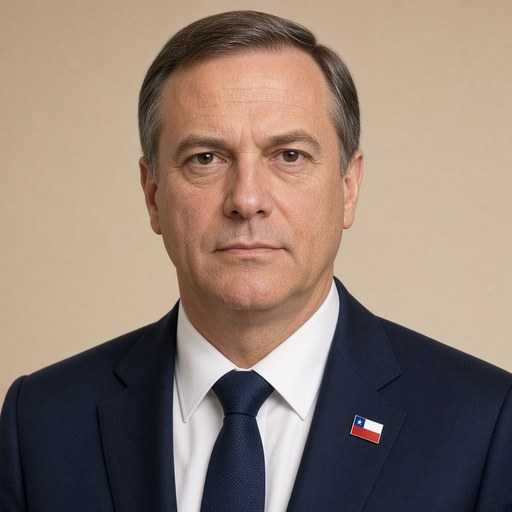
Chile — Statement to the General Debate of the 81st Session of the United Nations General Assembly (2026)
 José Antonio Kast · President
- Context
- Kast addressed the General Debate of the 81st UN General Assembly in New York on September 22, 2026, declaring that Chile is back and proposing United Nations bureaucracy cuts, agenda prioritisation and Security Council reform.
- Main themes
- Chile's economic and security recovery, order as a condition of freedom, fall in homicides and Border Shield Plan, corporate tax cut and investment reforms, permitting reform, lithium, copper and energy transition, Latin American coordination against organized crime, resumed relations with Venezuela, call to end wars, United Nations reform and Security Council reform, Valparaíso bid for BBNJ secretariat, responsible-pace approach to artificial intelligence
- Duration
- ~19 min
- Words
- 2,229
- Sentences
- 140
- Readability
- 50
- Grade
- 10.2
- Syntax
- 2.64
- Vocabulary
- 2.14
UN General Assembly Translated from Spanish Source: gadebate.un.org ↗
The broad sphere of national life a sentence belongs to. Every sentence has an Arena, so it is the denominator the other indices are read against.
Other140 sentences in 32 paragraphs
Mr. Secretary-General, Mr. President of the General Assembly, Heads of State and Government, distinguished Delegates:
Sixty-four years ago, in this very forum, the then President of Chile, Jorge Alessandri, described our country as a long and narrow land, stretched out between the Andes and the Pacific, reaching down to the moving immensity of Antarctica. That land is still there. What has changed is the world around it. And what has changed, above all, is Chile. For a good part of the 1990s and the early 2000s, Chile was a success story and a model for many nations. Our country implemented economic policies that prioritized macroeconomic stability, trade openness and private investment. In the Latin American context, where many nations were facing inflationary and foreign-debt crises, Chile stood out for maintaining responsible fiscal management, high growth rates and a reduction in poverty.
What happened next? Chile stagnated. Chile made bad decisions. Public policies were pushed through that raised taxes, regulations and the obstacles to starting a business.
We also went through a very hard moment, in October 2019. Chile broke apart, and for months an outbreak of violence took hold of our streets, where chaos reigned and disorder prevailed. All of this had consequences. Investment left. Employment stagnated. Homicidal violence escalated to levels Chile had never known in its modern history, because of the advance of organized crime. Until now.
Dear Delegates, I have come to this forum to tell you that Chile is back. And this is not a slogan. It is the observation of a country that is now beginning to walk toward development. Our government started from a conviction: order is not contrary to freedom. Order is one of the conditions of freedom. Freedom to be able to return home safely and not be a victim of organized crime. Freedom to start a business and not be obstructed by the actions of the State. Freedom to invest and not face constant changes to the rules of the game. We have been in office for six months, and we are putting our house in order. Today Chile is a safer country, a more competitive country and a country with less bureaucracy.
A safer country
In Chile, in the first half of this year, the homicide rate fell by 11.5%, and we are approaching the levels we had before the pandemic. Our borders are more controlled. With the Border Shield Plan, we have reduced irregular entry by 86%; 50% more people have been expelled than in the previous year. Along these lines, we have promoted the Santiago Agreement on security, bringing together several South American countries to coordinate effectively in combating transnational organized crime. The task is not finished; it is only just beginning. A safer country is a country with more confidence. Where there is confidence, there is more growth, employment and investment. A more competitive country
Just a few weeks ago, Chile approved the most important economic reform of recent decades. We approved the reduction of the corporate tax from 27% to 23%, a tax that, since 1990, had only been going up. In addition, tax invariability for twenty years was established for large investments, we temporarily exempted home purchases from taxes, and we opened a path for the repatriation of capital.
Chile is a country with less bureaucracy. We are dismantling the so-called "permit-ology", that hidden bureaucracy that prevents projects from moving forward. In six months, investment applications worth more than 44 billion dollars have been submitted for evaluation by the Environmental Assessment System. More than 33 billion dollars have been approved, in projects that had been waiting for years. More than 17 billion dollars have been unblocked in the environmental decision-making bodies.
Deeds, not words
Concrete actions that are changing Chile's course and steering us ever more toward development. And although the economy has not yet taken off and unemployment, which distresses thousands of families, remains high, change is going to come. Results take time, but the reforms that give structure to the future are already under way.
That is the difference between a leadership that knows where it is going and one that merely reacts without any direction. After the storm, the sun always comes out.
After winter, spring always comes. And after years of stagnation, Chile is back. There are many reasons that explain how we got here, but there is only one path for Chile to take off again. Unity. Unity among all those who defend freedom and who want to see the people of Chile prosper. There are many things that separate us between right and left, but we are united by the will for Chile to grow again and to be a safe country.
Dear Delegates, to those listening to us from the world of investment, I say: choose Chile to invest. You will find rules that do not change from one day to the next, courts that work, contracts that are honored and a State willing to facilitate investment. Chile understands that, in a multipolar world, institutional stability is not a luxury; it is a necessity. We are, for example, a key player in the energy transition.
Chile holds about a quarter of the world's lithium reserves and we are the leading copper producer on the planet. Chile has intense sunshine, a long Pacific Ocean coastline, lakes, rivers and volcanoes, which can generate an impressive amount of energy. Chile also has the Strait of Magellan, an indispensable alternative for world trade. Our nation will become the bridge and the port of the bi-oceanic corridors that will link America with Asia. That wealth is not only our fortune: it is our responsibility before you. Chile does not renounce its sovereignty, and at the same time it affirms that the minerals and energy of the future must serve humanity, and not be held hostage by monopolies or by actors who do not abide by the rules. And let no one be mistaken: it is possible and necessary to reconcile growth with sustainability. They are inseparable. Chile understands that environmental protection and economic progress form part of a single development strategy, in which investment and innovation are essential to improving people's quality of life. Sustainable development requires solid institutions, clear rules, timely decisions and effective management capable of turning commitments and diagnoses into concrete results for people and for the environment.
Mr. President, I would now like to speak about our continent, Latin America, because I sincerely believe that the next decade can be ours. For the first time in a long time, Latin American governments are truly coordinating. Not only through communiqués, but by getting to know one another and working together to generate concrete actions against transnational organized crime, on migration control, and by forging opportunities for joint development.
Latin America is the continent of the future, and those of us who lead the continent today are ready to drive that change. Relations with our neighboring countries Peru, Bolivia and Argentina are in a good place. And we are resuming our relationship with Venezuela. Under new leadership, doors have opened that were closed for many years. Some will tell us not to recognize that change. Others will tell us to align ourselves unconditionally with it. Chile does neither one nor the other. We recognize reality as it is, we value change where it exists, and we offer our support. We believe that Venezuela has before it a historic opportunity to reconnect with its best democratic traditions, with its institutions, with its millions of sons and daughters scattered across our continent who dream of returning. That path will be demanding, and Chile expresses its willingness and wants to provide whatever help they require at every step.
After two decades of tensions, Latin America wants this story to end well.
Distinguished delegates: This Assembly cannot remain indifferent to the wars and conflicts taking place in the world. These open conflicts not only threaten the stability of various regions, but harm the entire world. Chile, like several countries represented in this hall, imports practically all the oil it consumes and has been directly affected by the various wars.
This is not abstract geopolitics: it shows up in the cost of bread, of transport and of harvests. It is inflation that does not let up, rates that do not come down, investment that is postponed and jobs that are not created. Entire countries that were taking off have stagnated again because of wars they did not provoke and cannot stop. That is why Chile's call is direct: the wars must stop. War not only bleeds those who fight, but impoverishes the rest of the world. We all lose with wars, and we have already lost too much.
The United Nations has a role to play, and it must do so with the character and energy it has not shown until now.
Dear delegates, and here I come to the most uncomfortable thing I came to say: this Organization has not risen to the challenges of our times. It is not only a problem of leadership, present or future, but also a problem of action.
Over recent decades and for various reasons, the United Nations has not been part of the solution to these problems. It is not possible to keep the world order of 1945 in force in a world of 2026. An architecture has been built that deliberates excessively and executes slowly. A Security Council that reflects the political landscape of 1945 and not the reality of 2026. A bureaucracy that grows inward, as in many countries.
A proliferation of agendas that, however noble they may seem, have ended up displacing what this organization committed to do in its founding Charter: to maintain peace, protect life and defend the freedom of peoples. Chile believes in the United Nations, and believing in it means demanding that it fulfill its mandate.
We propose three things: (1) Reduce bureaucracy and concentrate the budget where lives are at stake; (2) suspend the agendas that are not priorities, in order to restore focus to those that are; (3) reform the Security Council, not as a symbolic gesture, but as a condition for its decisions to be respected once again. Chile signed the Charter in San Francisco and has not been absent from any of its causes.
Proof of this, today, is our commitment to the High Seas Agreement, known as BBNJ, and Valparaíso's bid to host its Executive Secretariat, which, if successful, would make it the first United Nations body of universal membership headquartered in Latin America. And this bid genuinely enjoys a national consensus across the different sectors.
That is exactly the multilateralism we believe in: concrete, ambitious and capable of showing results. An efficient and effective multilateralism. And allow me to say why this reform can no longer wait. While we discuss how to modernize institutions created in 1945, the most powerful technology humanity has ever built is emerging, and no one is governing it. Artificial intelligence is not just a technical matter that we can delegate to the experts. It is an ethical challenge and it is also a geopolitical issue. Chile rejects the false dilemma between innovation and responsibility. We do not believe that going faster is always going better, and neither are we going to give up opportunities out of fear. For our country, artificial intelligence could mean growth of 10% or 20% in our economy. That is why we have chosen a path we call responsible pace: advancing as fast as our capacity to manage what we advance allows. Regulation that enables, not that prohibits. Investment in talent, in computing and in energy. And rigorous evaluation.
Chile wants to lead from knowledge and not from fear. And I say this here, in this hall, for one reason: the United Nations must be able to bring humanity to the table to talk about the technology that will decide this century, before everything is settled by an algorithm.
Mr. President, I return to the beginning. That President of Chile who spoke here 74 years ago said, on behalf of his people and above any ideological difference, that Chile would continue to work with fervor and deep conviction so that the principles that inspire the Charter of the United Nations and the Declaration of Human Rights would be realized. Back then we were seven million inhabitants. Today we are twenty. The world is different, and so are we.
But that word still stands, and I renew it today before you. Chile has restored order, and with order, freedom is returning. Confidence has returned, and with confidence, the drive is beginning to return. Investment has returned, and with investment, work will begin to return.
A country that is rising as quickly as it fell has something to say to the world. And what Chile has come to say is that this can be done: a country can be recovered without destroying it, with votes, with agreements, with laws and with results. But it also has something more to say: a future can be built without being hostage to the decisions of others. Latin America can be the continent of the next decade not because someone allows it, but because we have the capacity and the will to make it happen.
Chile wants to lead the way to achieve it. Chile is back. Thank you very much.
The original Spanish. The tags above are read on the English translation's sentences.
Señor Secretario General, Señor Presidente de la Asamblea General, Señoras y señores Jefes de Estado y de Gobierno, distinguidos Delegados:
Hace sesenta y cuatro años, en este mismo foro, el entonces Presidente de Chile, Jorge Alessandri, describió a nuestro país como una tierra larga y angosta, tendida entre los Andes y el Pacífico, hasta la conmovedora inmensidad antártica. Esa tierra sigue ahí. Lo que ha cambiado es el mundo que la rodea. Y lo que ha cambiado, sobre todo, es Chile. Durante buena parte de los años 90 y principios de los 2000, Chile fue un caso de éxito y un modelo para muchas naciones. Nuestro país implementó políticas económicas que priorizaron la estabilidad macroeconómica, la apertura comercial y la inversión privada. En el contexto latinoamericano, donde muchas naciones enfrentaban crisis inflacionarias y de deuda externa, Chile destacó por mantener una gestión fiscal responsable, altas tasas de crecimiento y reducción de la pobreza.
¿Qué pasó después? Chile se estancó. Chile tomó malas decisiones. Se impulsaron políticas públicas que aumentaron los impuestos, las regulaciones y los obstáculos para emprender.
También pasamos por un momento muy duro, en octubre de 2019. Chile se quebró y se instaló en nuestras calles, por meses, un estallido de violencia, donde reinó el caos y se impuso el desorden. Todo lo anterior, trajo consecuencias. La inversión se marchó. El empleo se estancó. La violencia homicida escaló a niveles que Chile no conocía en su historia moderna, por el avance del crimen organizado. Hasta ahora.
Estimados Delegados, he venido hasta este foro, a contarles, que Chile está de vuelta. Y no es una consigna. Es la constatación de un país que hoy comienza a caminar hacia el desarrollo. Nuestro gobierno partió de una convicción: el orden no es contrario a la libertad. El orden es una de las condiciones de la libertad. Libertad para poder volver tranquilo a casa y no ser víctima del crimen organizado. Libertad para emprender y no ser obstaculizado por la acción del Estado. Libertad para invertir y no enfrentar el continuo cambio de las reglas del juego. Llevamos seis meses, y estamos ordenando la casa. Hoy Chile es un país más seguro, un país más competitivo y un país con menos burocracia.
Un país más seguro
En Chile, en el primer semestre de este año, la tasa de homicidios registró una baja de 11,5%, y nos acercamos a los niveles que teníamos antes de la pandemia. Nuestras fronteras, están más controladas. Con el Plan Escudo Fronterizo, hemos reducido en un 86% el ingreso irregular; se ha expulsado a un 50% más de personas que el año anterior. En esa línea, hemos impulsado el Acuerdo de Santiago, en materia de seguridad, sumando a varios países de Sudamérica para coordinarnos efectivamente a la hora de combatir el crimen organizado transnacional. La tarea no está terminada, recién comienza. Un país más seguro, es un país con más confianza. Donde hay confianza, hay más crecimiento, empleo e inversión. Un país más competitivo
Hace solo algunas semanas, Chile aprobó la reforma económica más importante de las últimas décadas. Aprobamos la rebaja del impuesto a las empresas de 27% a 23%, un impuesto que, desde 1990, solo venía subiendo. Además, se estableció la invariabilidad tributaria por veinte años para las grandes inversiones, liberamos temporalmente de impuestos la compra de viviendas. y abrimos un camino a la repatriación de capitales.
Chile es un país con menos burocracia. Estamos desmontando la llamada permisología esa burocracia oculta que impide que los proyectos puedan avanzar. En seis meses, han ingresado solicitudes de inversión por más de 44 mil millones de dólares para ser evaluados por el Sistema de Evaluación Ambiental. Se han aprobado más de 33 mil millones de dólares, en proyectos que llevaban años esperando. Se ha destrabado más de 17 mil millones de dólares, en las instancias de definición ambiental.
Hechos y no palabras
Acciones concretas, que están cambiando el rumbo de Chile y nos orientan cada vez, más hacia el desarrollo. Y si bien la economía aún no despega y el desempleo, que angustia a miles de familias, se mantiene alto, el cambio va a llegar. Los resultados tardan, pero las reformas que estructuran el futuro ya están en marcha.
Esa es la diferencia entre una dirección que sabe dónde va y una que solo reacciona sin rumbo alguno. Después de la tormenta, siempre sale el sol.
Después del invierno, siempre llega la primavera. Y después de años de estancamiento Chile está de vuelta. Hay muchas razones que explican cómo llegamos hasta acá, pero hay solo un camino para que Chile vuelva a despegar. La unidad. La unidad entre todos aquellos que defienden la libertad y que quieren ver al pueblo de Chile progresar. Hay muchas cosas que nos separa entre derechas e izquierdas, pero nos une la voluntad de que Chile vuelva a crecer y ser un país seguro.
Estimados Delegados, a quienes nos escuchan desde el mundo de la inversión les digo: elijan Chile para invertir. Encontrarán reglas que no cambian de un día para otro, tribunales que funcionan, contratos que se cumplen y un Estado dispuesto a facilitar la inversión. Chile entiende que, en un mundo multipolar, la estabilidad institucional no es un lujo, es una necesidad. Somos, por ejemplo, un actor clave para la transición energética.
Chile posee cerca de un cuarto de las reservas mundiales de litio y somos el primer productor de cobre del planeta. Chile tiene un sol intenso, una larga costa del Océano Pacífico, lagos, ríos y volcanes, que pueden generar una energía impresionante. Chile también tiene el Estrecho de Magallanes, una alternativa indispensable para el comercio mundial. Nuestra nación se convertirá en el puente y el puerto de los corredores bioceánicos que unirán América con Asia. Esa riqueza no es solo nuestra fortuna: es nuestra responsabilidad ante ustedes. Chile no renuncia a su soberanía, y al mismo tiempo afirma que los minerales y la energía del futuro deben servir a la humanidad, y no quedar rehenes de monopolios ni de actores que no se ciñen a las reglas. Y que nadie se confunda: es posible y necesario conciliar crecimiento con sustentabilidad. Son inseparables. Chile entiende que la protección del medio ambiente y el progreso económico forman parte de una misma estrategia de desarrollo, donde la inversión y la innovación son esenciales para mejorar la calidad de vida de las personas. El desarrollo sustentable requiere instituciones sólidas, reglas claras, decisiones oportunas y una gestión eficaz capaz de convertir compromisos y diagnósticos en resultados concretos para las personas y el medio ambiente.
Señor Presidente, quiero hablar ahora de nuestro continente, América Latina, porque creo sinceramente que la próxima década puede ser la nuestra. Por primera vez en mucho tiempo, gobiernos latinoamericanos se están coordinando de verdad. No solo mediante comunicados, sino que conociéndonos y articulándonos para generar acciones concretas contra el crimen organizado transnacional, el control migratorio y forjando oportunidades de desarrollo conjunto.
América Latina es el continente del futuro y quienes lideramos el continente hoy estamos dispuestos a impulsar ese cambio. Las relaciones con nuestros países vecinos Perú, Bolivia y Argentina, están en un buen momento. Y estamos reanudando, nuestro relacionamiento con Venezuela. Bajo un nuevo liderazgo se han abierto puertas que estuvieron cerradas durante muchos años. Algunos nos dirán que no reconozcamos ese cambio. Otros nos dirán que nos alineemos incondicionalmente con él. Chile no hace ni una cosa ni la otra. Reconocemos la realidad como es, valoramos el cambio donde existe, y ofrecemos acompañamiento. Consideramos que, Venezuela tiene por delante una oportunidad histórica de reencontrarse con sus mejores tradiciones democráticas con sus instituciones, con sus millones de hijos dispersos por nuestro continente que sueñan con regresar. Ese camino será exigente, y Chile manifiesta su disposición y quiere brindar la ayuda que ellos requieran en cada paso.
Después de dos décadas de tensiones, América Latina quiere que esta historia termine bien.
Distinguidos delegados: Esta Asamblea no puede mantenerse indiferente frente a las guerras y conflictos que están ocurriendo en el mundo. Estos conflictos abiertos, no solo amenazan la estabilidad de diversas regiones, sino que perjudican al mundo entero. Chile, al igual que varios países representados en esta sala, importa prácticamente todo el petróleo que consume y ha sido impactado directamente por las distintas guerras.
Eso no es geopolítica abstracta: se expresa en el costo del pan, del transporte y de las cosechas. Es inflación que no cede, tasas que no bajan, inversión que se posterga y empleo que no se crea. Países enteros que estaban despegando han vuelto a estancarse por guerras que no provocaron y que no pueden detener. Por eso el llamado de Chile es directo: las guerras deben cesar. La guerra no solo desangra a quien combate, sino que empobrece, al resto del mundo. Todos perdemos con las guerras y ya hemos perdido demasiado.
Naciones Unidas tiene un rol que jugar y lo tiene que hacer con el carácter y la energía que hasta hoy no ha mostrado.
Estimados delegados, y aquí llego a lo más incómodo que vine a manifestar, esta Organización no ha estado a la altura de los desafíos de nuestros tiempos. No es solamente un problema de liderazgo, presente o futuro, sino también un problema de acción.
Naciones Unidas durante las últimas décadas y por distintos motivos no ha sido parte de la solución a estos problemas. No es posible mantener vigente el orden mundial del año 1945 en un mundo del 2026. Se ha construido una arquitectura que delibera en exceso y ejecuta con lentitud. Un Consejo de Seguridad que refleja el escenario político de 1945 y no la realidad de 2026. Una burocracia que crece hacia adentro, al igual que en muchos países.
Una proliferación de agendas que, por muy nobles que parezcan, han terminado por desplazar aquello que ésta organización se comprometió a hacer en su Carta fundacional: mantener la paz, proteger la vida y defender la libertad de los pueblos. Chile cree en Naciones Unidas, y creer en ellas implica exigirles que cumplan con su mandato.
Proponemos tres cosas: (1) Reducir la burocracia y concentrar el presupuesto donde hay vidas en juego; (2) suspender las agendas que no son prioritarias, para devolver el foco a las que sí lo son; (3) reformar el Consejo de Seguridad, no como gesto simbólico, sino como condición para que sus decisiones vuelvan a ser respetadas. Chile firmó la Carta en San Francisco y no se ha ausentado de ninguna de sus causas.
Lo prueba, hoy mismo, nuestro compromiso con el Acuerdo de Alta Mar, conocido como BBNJ y la postulación de Valparaíso para ser sede de su Secretaría Ejecutiva, convirtiéndolo, de lograrlo, en el primer organismo de Naciones Unidas de membresía universal con sede en América Latina. Y esta postulación, concita genuinamente, un acuerdo nacional entre los distintos sectores.
Ese es exactamente el multilateralismo en que creemos: concreto, ambicioso y capaz de mostrar resultados. Un multilateralismo eficaz y efectivo. Y permítanme decir, por qué esta reforma ya no puede seguir esperando. Mientras discutimos cómo modernizar instituciones creadas en 1945, está apareciendo la tecnología más poderosa que la humanidad haya construido, y no la está gobernando nadie. La inteligencia artificial no es solo un asunto técnico que podamos delegar en los expertos. Es un desafío ético y es también una cuestión geopolítica. Chile rechaza el falso dilema entre innovación y responsabilidad. No creemos que ir más rápido sea siempre ir mejor, y tampoco vamos a renunciar a las oportunidades por miedo. Para nuestro país la inteligencia artificial puede significar un crecimiento del 10% o el 20% de nuestra economía. Por eso elegimos un camino que llamamos ritmo responsable: avanzar tan rápido como nuestra capacidad de administrar lo que avanzamos, pueda. Regulación que habilita, no que prohíbe. Inversión en talento, en cómputo y en energía. Y evaluación rigurosa.
Chile quiere liderar desde el conocimiento y no desde el miedo. Y lo digo aquí, en esta sala, por una razón: Naciones Unidas debe ser capaz de sentar a la humanidad a conversar sobre la tecnología que va a decidir este siglo, antes que todo sea resuelto por un algoritmo.
Señor Presidente, vuelvo al comienzo. Aquel Presidente de Chile que habló aquí hace 74 años dijo, en nombre de su pueblo y por encima de cualquier diferencia ideológica, que Chile seguiría trabajando con fervor y con profunda convicción para que se concreten los principios que inspiran la Carta de Naciones Unidas y la Declaración de los Derechos Humanos. Entonces éramos siete millones de habitantes. Hoy somos veinte. El mundo es otro y nosotros también.
Pero esa palabra sigue en pie, y yo la renuevo hoy ante ustedes. Chile volvió a poner orden, y con el orden está regresando la libertad. Volvió la confianza, y con la confianza comienzan a volver las ganas. Volvió la inversión, y con la inversión comenzará a volver el trabajo.
Un país que se está levantando tan rápido como cayó tiene algo que decirle al mundo. Y lo que Chile viene a decir es que esto se puede hacer: se puede recuperar un país sin destruirlo, con votos, con acuerdos, con leyes y con resultados. Pero también tiene algo más que decir: se puede construir un futuro sin ser rehén de las decisiones de otros. América Latina puede ser el continente de la próxima década no porque alguien lo permita, sino porque tenemos la capacidad y la voluntad de hacerlo.
Chile quiere liderar el camino para lograrlo. Chile está de vuelta. Muchas gracias.